Cockroach Life Cycle: How Fast They Reproduce and Why It Matters
Cockroaches are one of those pests most people hope they never deal with. Yet they are surprisingly common, and once they show up, they rarely leave on their own. The reason is simple: their life cycle is fast, efficient, and built for survival. Understanding the cockroach life cycle is not just interesting—it is essential if you want to prevent or stop an infestation in your home.
In this guide, you’ll learn how cockroaches grow, how quickly they reproduce, what affects their development, and why their life cycle makes them such persistent pests. We will also break down their stages, behavior, timeline, and environmental triggers so you can understand exactly how infestations take hold.
Key Takeaways:
Cockroaches develop through egg, nymph, and adult stages.
Warm temperatures speed up growth.
A single female can produce hundreds of offspring.
Early intervention prevents large infestations.
Eliminating food and water sources disrupts the life cycle
Affiliate Disclosure: This page contains affiliate links. If you buy through my links, I may earn a small commission at no extra cost to you.
As an Amazon Associate, I earn from qualifying purchases.
Understanding the Cockroach Life Cycle
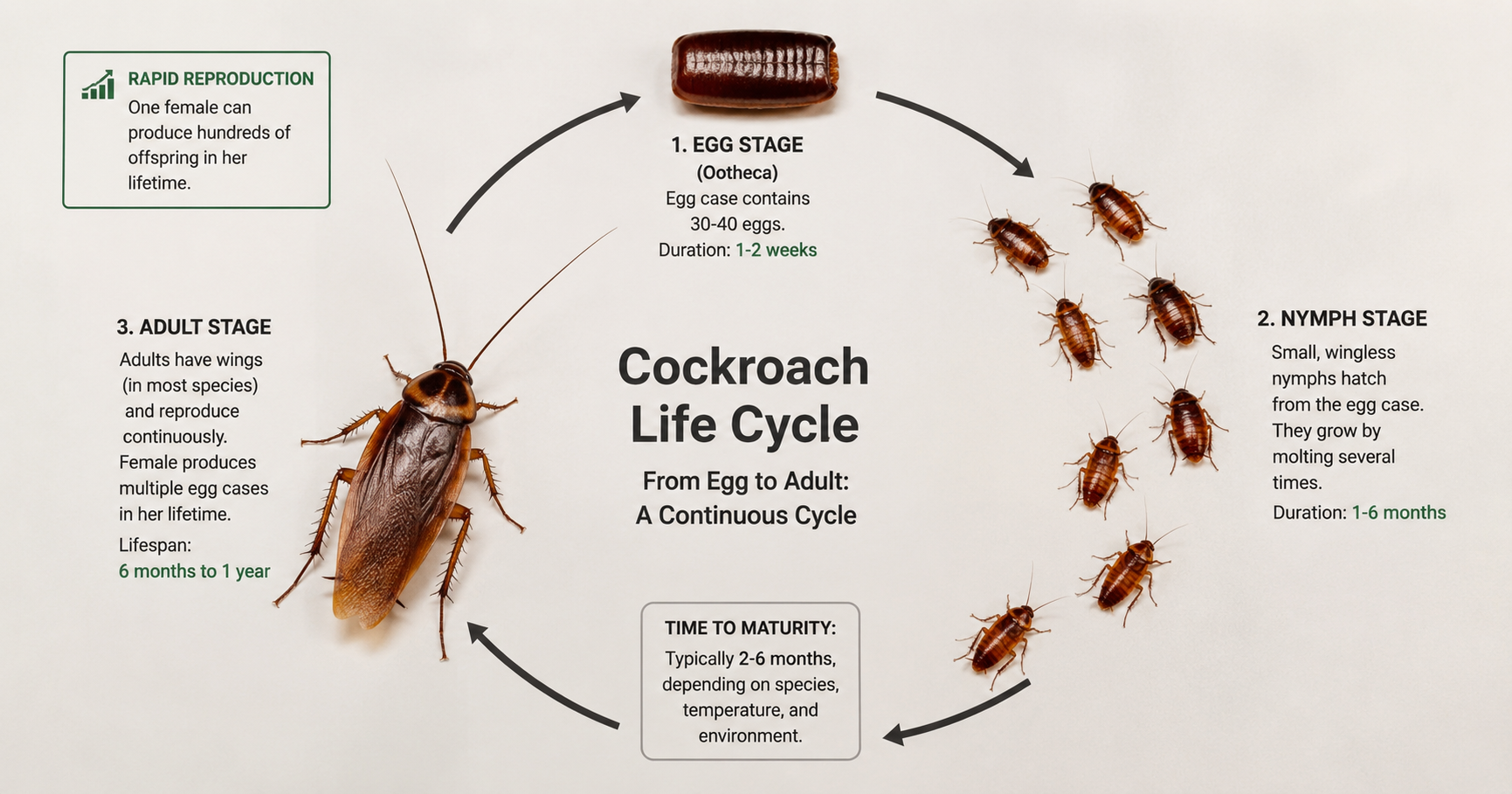
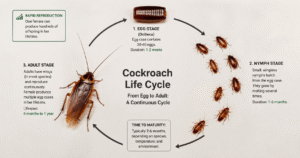
The cockroach life cycle has three main stages:
- Egg stage
- Nymph stage
- Adult stage
Unlike many insects, cockroaches do not have a complicated metamorphosis. Instead, they grow gradually, shedding their skin multiple times until they become adults. This simple but effective system allows them to reproduce quickly and adapt to almost any environment.
What makes them especially difficult to control is that multiple generations can overlap. That means while one group is still growing, another is already reproducing.
Cockroach Life Cycle at a Glance
Understanding the cockroach life cycle is easier when you look at the entire process from start to finish. The table below summarizes the three main life stages, their typical duration, and their primary activities.
| Life Stage | Duration | Main Activity |
|---|---|---|
| Egg (Ootheca) | 2–8 weeks | Development inside egg case |
| Nymph | 6 weeks–6 months | Growth and molting |
| Adult | 6–12 months+ | Reproduction and colony expansion |
Stage 1: Egg Stage (Ootheca Formation)
The life cycle begins with an egg case called an ootheca. This is a small, protective capsule that holds multiple eggs inside.
A single female cockroach can produce several oothecae in her lifetime, and each one may contain dozens of eggs depending on the species.
Key characteristics of the egg stage:
- Eggs are protected inside a tough casing
- Often hidden in dark, warm, and safe spaces
- Incubation usually lasts a few weeks
The female may carry the egg case until it is close to hatching, which increases the survival rate of the young. This is one of the reasons cockroaches spread so quickly indoors.
Stage 2: Nymph Stage (Growing and Shedding)
When the eggs hatch, tiny cockroaches called nymphs emerge. They look like smaller, wingless versions of adults.
This stage is where most of the growth happens.
What happens during the nymph stage:
- Nymphs go through molting (shedding their exoskeleton) multiple times
- Each molt makes them larger and stronger
- They gradually develop wings and adult features
Depending on species and conditions, nymphs may molt 5 to 10 times before reaching adulthood.
Behavior of nymphs:
Nymphs are highly active and constantly searching for:
- Food crumbs
- Water sources
- Dark hiding places
They avoid light and movement, which is why infestations often go unnoticed in early stages.
Stage 3: Adult Stage (Reproduction Begins)
Once fully developed, cockroaches enter the adult stage. This is when reproduction begins, and populations can grow rapidly.
Adult cockroach traits:
- Fully developed body and wings (in many species)
- Strong survival instincts
- Ability to reproduce quickly
Adult females can produce egg cases repeatedly throughout their lives. In ideal conditions, a single female and her offspring can lead to thousands of cockroaches in just one year.
This is where infestations become serious.
Cockroach Reproduction Timeline: How Fast They Multiply
The speed of reproduction is what makes cockroaches such a major pest problem.
Here is a simple breakdown of their timeline:
- Egg incubation: 2–8 weeks
- Nymph development: 6 weeks to 6 months (varies by species)
- Adult lifespan: several months to over a year
What this means in real life:
In warm, food-rich environments, cockroaches can go from egg to reproducing adult in just a few months. This rapid cycle allows populations to grow exponentially.
For example:
- One female produces multiple egg cases
- Each case produces dozens of nymphs
- Those nymphs grow and reproduce again
As a result, infestations can spiral out of control quickly if not addressed early.
Behavior of Cockroaches Throughout Their Life Cycle
Cockroach behavior changes slightly depending on their stage, but some patterns remain consistent.
1. Nocturnal activity
Cockroaches are mostly active at night. They prefer darkness because it offers protection from predators and humans.
2. Constant searching for food and water
They are scavengers. Even small crumbs or grease spots are enough to sustain them.
3. Hiding in tight spaces
Cockroaches love cracks, crevices, and hidden areas such as:
- Behind appliances
- Inside cabinets
- Under sinks
- Inside walls
4. Rapid escape response
They react quickly to vibration, light, and movement, which helps them survive in human environments.
5. Group living behavior
Cockroaches release pheromones that attract others. This is why infestations often appear suddenly in large numbers.
Environmental Triggers That Speed Up the Life Cycle
Cockroach growth is heavily influenced by environmental conditions. When conditions are ideal, their life cycle speeds up significantly.
1. Warm temperatures
Heat accelerates development. Cockroaches thrive in warm homes, especially kitchens and bathrooms.
2. Moisture availability
Water is essential for survival. Leaky pipes, damp areas, and standing water attract them.
3. Food access
Even tiny food particles can support a growing colony. Grease, crumbs, and pet food are major attractants.
4. Shelter and darkness
Cluttered spaces and hidden areas allow them to reproduce undisturbed.
5. Lack of predators
Indoors, cockroaches face fewer natural threats, which allows populations to grow faster.
When all these conditions combine, reproduction speeds up and infestations become harder to control.
Why the Cockroach Life Cycle Matters
Understanding the cockroach life cycle is important for one major reason: timing.
If you know how fast they grow, you can understand why early action is critical.
Here’s why it matters:
- Fast reproduction leads to large infestations quickly
- Egg cases are often resistant to sprays and treatments
- Hidden nymphs delay detection
- Multiple generations overlap inside homes
Because of this, waiting too long can turn a small problem into a serious infestation.
How to Interrupt the Cockroach Life Cycle
Stopping cockroaches requires breaking their cycle at multiple stages.
1. Remove food sources
Clean crumbs, seal food, and avoid leaving dishes overnight.
2. Fix moisture issues
Repair leaks and reduce humidity in kitchens and bathrooms.
3. Seal hiding spots
Close cracks, gaps, and entry points around your home.
4. Use targeted treatments
Baits and gels are often more effective than sprays because they reach hidden colonies.
5. Maintain regular cleaning routines
Consistency is key to preventing reinfestation.
By disrupting their access to food, water, and shelter, you make it harder for the cycle to continue.
Related Cockroach Guides
Cockroach Identification
- How To Identify Cockroach Species In Your Home
- How To Control German Cockroach
- How To Get Rid Of American Cockroaches
- How To Get Rid Of Oriental Cockroaches
- Brown Banded Cockroach Control
Cockroach Behavior
Cockroach Removal
- Best Way To Eliminate Cockroaches Indoors
- How To Control Roaches Indoors Permanently
- DIY Solutions To Kill Cockroaches Fast
- How To Get Rid of Roaches Overnight
Cockroaches in Specific Areas
- How To Get Rid Of Cockroaches In The Kitchen
- Natural Ways To Detect Cockroaches In Your Kitchen
- How To Get Rid Of Roaches In Walls
- How To Get Rid Of Roaches In An Apartment
Recommended Products
- Best Indoor Roach Bait
- Best Roach Killer Kit For Apartments
- Best Indoor Pest Control Solutions That Actually Work for Ants and Roaches
Frequently Asked Questions (FAQs)
1. How long does a cockroach live?
Most cockroaches live between 3 months and 1 year depending on species and environment.
2. How fast do cockroaches reproduce?
In warm conditions, they can go from egg to reproducing adult in about 3 to 6 months.
3. How many eggs does a cockroach lay?
A single female can produce multiple egg cases, each containing 10–50+ eggs depending on species.
4. Do cockroaches reproduce without mating?
Some species can reproduce through a process called parthenogenesis, but most require mating.
5. Why do I see more cockroaches at night?
They are nocturnal and avoid light, so they become active when it is dark.
6. What attracts cockroaches to my home?
Food, water, warmth, and hiding spaces are the main attractants.
7. Can cockroach eggs survive cleaning sprays?
Yes, egg cases are often resistant to many surface sprays, making targeted treatments necessary.
8. How can I stop cockroach eggs from hatching?
You need to remove or properly treat the egg cases using specialized pest control methods.
9. Why do cockroaches suddenly appear in large numbers?
Because multiple generations may already be living and reproducing inside hidden areas.
10. What is the best way to break the cockroach life cycle?
Combining sanitation, sealing entry points, and using baits or gels is the most effective approach.
Conclusion
The cockroach life cycle is built for survival and speed. From egg to adult, each stage is designed to ensure rapid growth and reproduction. Because of this, even a small number of cockroaches can quickly become a large infestation if conditions are right.
However, the good news is that understanding their stages, behavior, timeline, and environmental triggers gives you a clear advantage. Once you know how they grow and what they need, you can interrupt their cycle before it becomes a bigger problem.
Consistency matters most. Clean environments, reduced moisture, and early action are the key steps that keep cockroach populations under control.