How to Get Rid of Cluster Flies (Complete Control Guide)
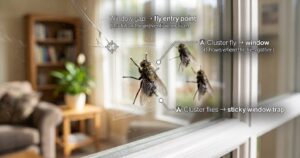
Have you suddenly noticed a group of large, slow-moving flies crawling around your windows as the weather changes? If they are dark gray, unusually sluggish, and seem to gather together rather than chase food, you may be dealing with cluster flies (Pollenia rudis).
Cluster flies can be frustrating because they may appear in surprisingly large numbers inside homes, particularly around sunny windows and upper areas of the house. The good news is that they are usually a seasonal nuisance rather than a pest that establishes a breeding population inside your kitchen or living areas.
The most effective approach is straightforward: identify the flies correctly, close the openings they use to get inside, remove the adults already indoors, and use traps when additional control is needed.
Quick Answer: How Do You Get Rid of Cluster Flies?
The best long-term way to control cluster flies is to prevent them from entering your home. Before seasonal activity begins, inspect and seal cracks around windows, doors, siding, rooflines, utility openings, vents, and other potential entry points. For flies already inside, vacuuming, sticky traps, and suitable indoor flying-insect traps can help remove adults.
If cluster flies keep appearing year after year, don’t focus only on killing the visible flies. Find and seal the places where they are entering or sheltering.
BugOffControl Tip: If you see a few cluster flies one day and many more around the same windows later, inspect the exterior and attic areas around those locations rather than simply treating each fly individually.
Affiliate Disclosure
If you purchase through links on this page, BugOffControl.com may earn a commission at no additional cost to you. This helps support our pest-control guides and product research.
As an Amazon Associate I earn from qualifying purchases.
What Are Cluster Flies?
Cluster flies are medium-sized flies belonging to the blow fly family. The species most commonly associated with homes is Pollenia rudis.
Unlike house flies, cluster flies aren’t normally interested in your kitchen garbage, leftovers, or exposed food. Adults spend much of their active life outdoors. Their larvae develop in association with earthworms in soil, which is one reason a house does not normally become a cluster fly breeding site. Their behavior changes when the seasons change.
As temperatures begin to fall, adult cluster flies may gather on warm exterior surfaces and search for protected places where they can shelter. Buildings can provide exactly what they need: cracks, wall spaces, attics, and other sheltered areas protected from harsh outdoor conditions.
When temperatures rise again, some of these flies may become active and move toward light, making windows a common place to find them.
How to Identify a Cluster Fly
Correct identification is the first step because several types of flies can appear indoors.
Look for these clues:
- Dark gray body
- Slightly larger appearance than a typical house fly
- Golden-yellow hairs around the thorax
- Slow, sluggish movement
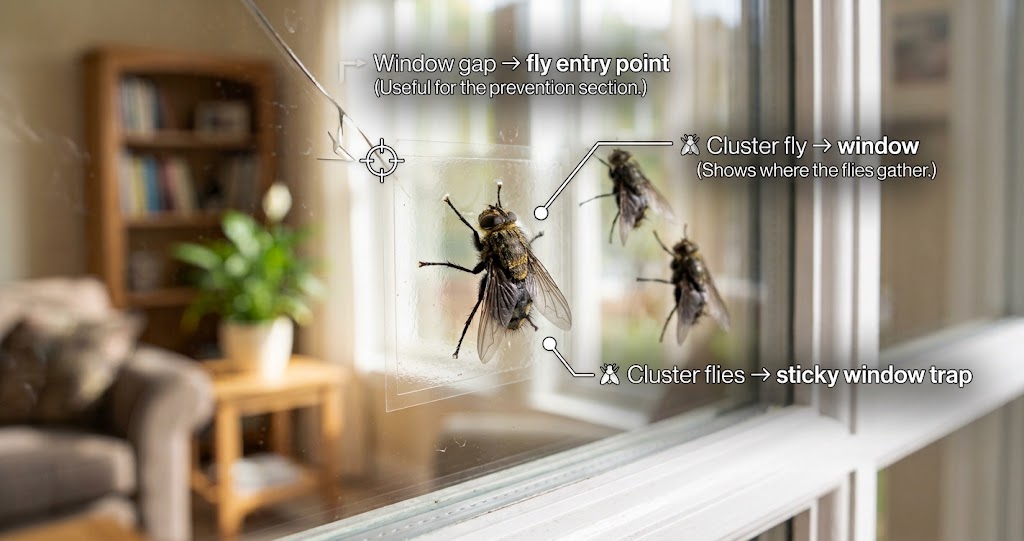
- Frequently found around windows
- Often seen in groups
- Especially noticeable during fall, winter, or early spring
- Often associated with upper areas of buildings
One of the easiest clues is their behavior.
A house fly can be surprisingly difficult to catch because it reacts quickly and takes off when disturbed. Cluster flies tend to be much less energetic. They may crawl slowly across a window or wall instead of immediately flying away.
Is That Really a Cluster Fly?
If you’re trying to identify the fly before buying a control product, ask yourself:
Are the flies unusually slow?
Are they dark gray rather than small and light-colored?
Are they gathering around sunny windows?
Do you notice them primarily when the weather becomes cooler?
Do they appear to be seeking shelter rather than feeding on food or garbage?
If most of those descriptions fit, cluster flies are a reasonable possibility.
If the insects are tiny and concentrated around fruit, fermenting food, or kitchen waste, you may have fruit flies instead. If they’re associated with drains and have a fuzzy, moth-like appearance, check a drain fly identification guide. Large metallic blue-green flies may indicate blow flies or bottle flies.
Correct identification matters because different flies require different control strategies.
Cluster Fly vs. House Fly
Cluster flies and house flies can look similar at first glance, but their behavior and habits provide useful clues.
| Feature | House Fly | Cluster Fly |
|---|---|---|
| Scientific name | Musca domestica | Pollenia rudis |
| General appearance | Gray with darker markings | Dark gray with golden-yellow hairs |
| Movement | Fast and agile | Slow and sluggish |
| Common attraction | Food, waste, organic material | Shelter and warmth |
| Indoor breeding | Can reproduce where suitable food and breeding material are available | Does not normally reproduce indoors |
| Typical seasonal pattern | Common during warm conditions | Often noticed during fall, winter, and spring |
| Common indoor location | Kitchens, garbage areas, food sources | Windows, upper walls, attics, wall spaces |
The distinction is important.
If house flies are repeatedly appearing around garbage or food waste, sanitation and breeding-site management are essential.
If cluster flies are gathering around windows despite having no obvious food source, building exclusion becomes much more important.
Why Are Cluster Flies Coming Into My House?
Cluster flies aren’t necessarily invading your home because they found something to eat. They’re looking for shelter. During late summer and fall, adults may gather on warm exterior walls before moving into protected spaces. A house can provide numerous tiny openings that allow them to get inside.
Potential entry points include:
- Window and door frames
- Cracks around siding
- Roofline gaps
- Fascia and soffit areas
- Attic vents
- Utility penetrations
- Gaps around pipes and cables
- Damaged screens
- Openings around exterior fixtures
Once inside, cluster flies can settle into protected areas such as attics or wall voids. This is why repeatedly killing visible flies may not solve the problem. You may simply be removing the adults that have already made it inside while other flies remain hidden.
Where Do Cluster Flies Hide?
Cluster flies may be difficult to find because they can shelter in parts of the structure that aren’t normally visible.
Outside
Check:
- Sunny exterior walls
- Around windows
- Siding joints
- Roofline areas
- Soffits
- Fascia
- Exterior cracks
Inside
Pay particular attention to:
- Attics
- Upper floors
- Window frames
- Wall voids
- Areas around recessed fixtures
- Sunny windows
- Other warm, lighted locations
If most of the flies appear around one particular window, don’t ignore that clue. The window may be close to an entry or emergence point.
How to Get Rid of Cluster Flies
Effective cluster fly control works best when you combine exclusion and removal.
1. Seal Entry Points
This is the most important long-term step.
Inspect the exterior before cluster fly activity increases and look for openings around:
- Windows
- Doors
- Siding
- Rooflines
- Utility lines
- Pipes
- Vents
- Soffits
- Fascia
- Exterior fixtures
Use appropriate exterior-grade materials to seal cracks and openings. Don’t overlook small gaps simply because they appear insignificant. Small structural openings can become convenient pathways for insects seeking protected shelter.
2. Repair Damaged Screens
A damaged screen can turn an otherwise protected window into an easy access point.
Look for:
- Small tears
- Loose screen edges
- Gaps around frames
- Damaged mesh
- Poorly fitting screens
Repair or replace damaged screens before seasonal fly activity becomes noticeable.
3. Vacuum the Flies You Can See
For a limited indoor infestation, a vacuum cleaner is one of the easiest removal methods. Use the hose attachment to remove flies from:
- Windows
- Walls
- Ceilings
- Window frames
- Attic areas
This avoids smearing individual flies across painted surfaces. Empty the vacuum outdoors afterward, particularly if you’ve collected a large number of insects.
4. Use Sticky Traps Around Problem Windows
Sticky traps can be useful when cluster flies repeatedly gather in the same area. Place appropriate traps where flies are active while keeping them away from children, pets, and areas where people may accidentally touch them. The advantage is simplicity: the trap can capture adults without requiring you to spray the surrounding surface.
Remember, however, that a sticky trap removes flies; it doesn’t close the opening that allowed them inside.
5. Try an Indoor Flying-Insect Trap
Plug-in flying-insect traps can provide another option for capturing adult flying insects indoors. They’re particularly convenient when flies repeatedly appear in a living space and you want a low-maintenance capture method.
Results can vary depending on the insect, placement, room lighting, and product design, so don’t assume every UV trap will work equally well for every species.
Why Do Cluster Flies Keep Coming Back?
This is one of the most frustrating parts of a cluster fly problem.
You vacuum the flies then more appear you trap them then more show up. This often happens because the visible flies aren’t the entire problem.
Cluster flies may already be sheltering in protected structural areas. In addition, additional adults may be entering through exterior openings.
If the problem repeatedly returns, inspect:
- The windows where flies gather.
- The exterior wall around those windows.
- Nearby siding and trim.
- Attic vents and roofline openings.
- Utility penetrations.
- Damaged screens.
- Other cracks or gaps around the building.
The goal is to interrupt the cycle rather than repeatedly remove individual flies.
Best Cluster Fly Control Products
The following products can be useful as supporting tools for adult flying-insect control indoors. They should not all be considered dedicated cluster-fly products. For a recurring Pollenia rudis problem, structural exclusion remains the foundation of control.
Cluster Fly Control Products at a Glance
| Product | Type | Best Use | Main Advantage | Main Limitation |
|---|---|---|---|---|
| LFSYS 50 Window Fly Traps | Sticky trap | Windows | Simple, no spray | Doesn’t stop entry |
| STEM Flying Insect Indoor Trap | UV light trap | Indoor rooms | Plug-in design | Requires electricity |
| Catchmaster Max-Catch Glue Traps 36pk | Glue trap | Monitoring/trapping | Multiple traps | Captured insects remain visible |
| Zevo Flying Insect Trap | Plug-in trap | Indoor flying insects | Convenient design | Requires refills |
| BASF PT Alpine Fly Bait | Fly-control insecticide | Appropriate labeled applications | Chemical control option | Must follow current label |
1. LFSYS 50 Window Fly Traps 4.7  ☆
☆
LFSYS 50 Window Fly Traps provide a simple sticky trapping option for indoor flying insects.
Because cluster flies commonly become noticeable around windows, a window-mounted or nearby sticky trap can be a practical way to capture adults that repeatedly gather in the same area.
Pros

- Simple to use
- No spray required
- Useful around windows
- Can help monitor fly activity
- Multiple traps allow placement in several areas
Cons
- Doesn’t prevent additional flies from entering
- Glue eventually becomes occupied
- Trapped insects remain visible
- Placement affects results
- Not a substitute for exclusion
Best for: Homeowners dealing with flies repeatedly gathering around windows.
Check Latest Price & Availability on Amazon
2. STEM Flying Insect Indoor Trap 3.9
The STEM Flying Insect Indoor Trap uses a UV-light-based approach to attract flying insects toward a capture cartridge.
It can be convenient for homeowners who prefer a plug-in trapping option instead of repeatedly spraying flying insects.
Pros

- Plug-in design
- No aerosol application during normal operation
- Convenient for indoor use
- Replaceable cartridge system
- Useful for ongoing monitoring
Cons
- Requires an electrical outlet
- Replacement cartridges are needed
- Performance can vary by insect species
- Doesn’t address exterior entry points
Best for: Indoor areas where flying insects repeatedly appear.
Check Latest Price & Availability on Amazon
3. Catchmaster Max-Catch Glue Traps 36pk 4.3 ☆
Catchmaster Max-Catch Glue Traps provide a larger supply of sticky traps for ongoing monitoring and capture. Having multiple traps can be useful when you’re trying to determine exactly where flies are most active.
They may be suitable for appropriate locations around windows, attics, garages, or other areas where flying-insect activity occurs.
Pros

- 36-pack provides multiple traps
- No spray required
- Useful for monitoring
- Allows placement in several areas
- Simple trapping method
Cons
- Captured insects remain visible
- Glue surfaces eventually fill
- Placement is important
- Doesn’t prevent new flies from entering
- Must be positioned appropriately around children and pets
Best for: Monitoring and trapping activity in multiple locations.
Check Latest Price & Availability on Amazon
4. Zevo Flying Insect Trap 4.8
The Zevo Flying Insect Trap is a plug-in indoor trapping system designed for flying insects.
Its compact format can make it convenient in rooms where people don’t want to repeatedly use sprays.
Pros

- Easy plug-in operation
- No aerosol spraying
- Designed for indoor flying insects
- Compact format
- Replaceable refill system
Cons
- Requires electricity
- Refills need replacement
- Results vary according to insect and placement
- Doesn’t eliminate structural entry points
- Shouldn’t be treated as a complete solution for recurring infestations
Best for: Convenient indoor capture and monitoring of flying insects.
Check Latest Price & Availability on Amazon
5. BASF PT Alpine Fly Bait 4.3 ☆
BASF PT Alpine Fly Bait is a chemical fly-control product and should be treated differently from passive traps.
Before using any insecticide, read the current product label carefully and confirm that the intended pest, location, application method, and use are permitted.
Don’t assume that a product labeled for certain fly species is automatically appropriate for every fly, including cluster flies.
Pros

- Provides a chemical control option
- Designed for fly-control applications
- Ready-to-use formulation
- Can be considered when trapping alone isn’t sufficient for an appropriate labeled use
Cons
- Requires careful label compliance
- Not necessary for every cluster fly problem
- Doesn’t seal entry points
- Requires responsible handling
- Intended use must be verified against the current label
Best for: Appropriate labeled fly-control situations where a chemical option is warranted.
Check Latest Price & Availability on Amazon
Which Cluster Fly Control Method Should You Use?
The best approach depends on the size and location of the problem.
| Your Situation | Practical Approach |
|---|---|
| A few flies around one window | Vacuum and use a sticky trap |
| Repeated flies around sunny windows | Sticky traps or an indoor flying-insect trap |
| Flies appearing in several rooms | Inspect exterior entry points and attic areas |
| Same problem every autumn | Prioritize exclusion before seasonal activity |
| Flies concentrated in an attic | Inspect entry points and use appropriate traps |
| Large recurring problem | Combine exclusion, removal, monitoring, and appropriately labeled control measures |
The important distinction is this:
Traps manage the flies you can see. Exclusion helps prevent the next flies from getting inside.
Cluster Fly Prevention: Stop the Problem Before Fall
The easiest cluster fly problem to manage is the one you prevent before the flies enter.
Inspect Windows
Check the entire perimeter of window frames for cracks or gaps.
Check Doors
Inspect door frames, thresholds, weather stripping, and surrounding trim.
Examine Siding
Look closely at siding joints, corners, and areas where different materials meet.
Inspect the Roofline
Pay attention to soffits, fascia, vents, and other areas where the exterior envelope may have openings.
Check Utility Openings
Look where cables, pipes, and other services pass through exterior walls.
Repair Screens
Replace torn or poorly fitting screens.
Inspect the Attic
Look for potential openings around vents and other areas where the exterior connects with the attic.
Cluster Fly Prevention Calendar
Late Summer
This is a good time to inspect the exterior.
Look for cracks, damaged screens, gaps around windows, siding openings, roofline gaps, and utility penetrations.
Early Fall
Complete sealing and repairs before seasonal cluster fly activity increases.
Late Fall
Monitor sunny exterior walls and windows for increasing fly activity.
Winter
If flies appear indoors, vacuum or trap adults while investigating where they may be emerging.
Early Spring
Continue monitoring windows and other areas where flies become active. If the same locations produce large numbers of flies each year, use that pattern to guide your exclusion work before the next season.
What Not to Do When You Have Cluster Flies
A cluster fly infestation can be irritating enough to make you reach for the strongest spray available. But more insecticide isn’t necessarily the answer.
Avoid relying entirely on:
- Repeatedly spraying visible flies
- Killing flies without investigating entry points
- Ignoring attic and roofline gaps
- Leaving damaged screens unrepaired
- Using a pesticide for an application that isn’t permitted by its label
- Assuming every gray indoor fly is a cluster fly
A better strategy is to deal with the problem at several levels:
Identify → exclude → remove → monitor.
Are Cluster Flies a Sign of Poor Housekeeping?
Not necessarily. This is an important distinction. Cluster flies aren’t typically entering because your kitchen is dirty or because you’ve left food on the counter. Their behavior is more closely associated with seeking shelter in structures as environmental conditions change. That means cleaning up food won’t necessarily solve a cluster fly problem.
However, ordinary household cleanliness is still worthwhile because it helps distinguish a cluster fly problem from other fly species that are attracted to food, garbage, drains, or decaying organic material.
Can Cluster Flies Damage Your Home?
Cluster flies are primarily considered a nuisance. Their presence can be unpleasant, especially when large numbers gather around windows or emerge indoors. However, the main concern for most homeowners is their presence and recurring seasonal activity, rather than structural damage.
If you’re seeing large numbers every year, focus your attention on the building’s exterior and potential shelter locations.
When Should You Consider Professional Help?
A professional inspection may make sense when:
- Large numbers repeatedly emerge from inaccessible areas
- You cannot locate the entry points
- The infestation occurs throughout multiple parts of the structure
- Flies continue appearing despite exclusion work
- The problem occurs repeatedly every season
- You need help identifying the insect
- Structural repairs are beyond your comfort level
A professional can help determine where flies are entering or emerging and identify areas that may be difficult to inspect from the ground.
10 Frequently Asked Questions About Cluster Flies
1. How do I get rid of cluster flies fast?
Vacuuming visible flies can provide immediate relief, while sticky traps or suitable indoor flying-insect traps can help capture additional adults. For long-term control, seal the openings that allow them to enter.
2. Why are cluster flies suddenly appearing in my house?
They may have entered earlier while seeking protected shelter and become active when indoor temperatures rise. Seasonal changes can make the problem appear to start suddenly even though the flies were already present.
3. Why do cluster flies gather around windows?
When cluster flies become active indoors, they can move toward light and warmer areas. Sunny windows therefore become common gathering locations.
4. Do cluster flies reproduce inside my house?
Cluster flies do not normally reproduce indoors. Their larvae develop outdoors in association with earthworms.
5. Where do cluster flies hide in winter?
They can shelter in protected areas of buildings, including attics, wall spaces, and other inaccessible structural locations.
6. Can cluster flies come through window screens?
Damaged or poorly fitted screens can provide opportunities for insects to enter. Check both the mesh and the edges where the screen meets the frame.
7. Will a UV fly trap catch cluster flies?
A UV flying-insect trap may capture some flying insects, but effectiveness can vary by species, placement, room lighting, and trap design. It should be considered a supporting control method rather than a guarantee.
8. Are cluster flies the same as house flies?
No. They are different flies with different habits. House flies are commonly associated with food and organic waste, while cluster flies are particularly known for seeking sheltered locations and gathering around buildings seasonally.
9. Why do cluster flies keep coming back every year?
Recurring seasonal activity can occur when the building continues to provide suitable entry points and sheltered areas. Sealing cracks and other openings before seasonal activity begins is therefore important.
10. What should I do if I have a large cluster fly infestation?
Start by confirming the identification and locating where the flies are concentrated. Combine exterior exclusion with vacuuming and appropriate traps. If large numbers continue emerging from inaccessible areas, consider a professional inspection.
Final Thoughts: Keep Cluster Flies Outside
Cluster flies can turn a sunny window into an unexpected gathering place, but you don’t have to spend every season chasing them around the house.
The most useful strategy is to look beyond the individual fly.
First, make sure you’re dealing with cluster flies. Then inspect where they’re entering, seal those openings, remove the adults already indoors, and use traps when additional control is needed.
Sticky window traps, glue traps, and indoor flying-insect traps can make cleanup easier, while an appropriately labeled insecticide may have a role in certain situations.
But for recurring seasonal problems, exclusion is the long-term solution worth prioritizing.
If the same windows or areas of your home become covered with cluster flies every fall, let that pattern guide your inspection. Finding and closing those entry points before the next seasonal invasion can save you from repeatedly dealing with the same nuisance.
Identify the fly. Seal the entry points. Remove the adults. Prevent the next invasion.