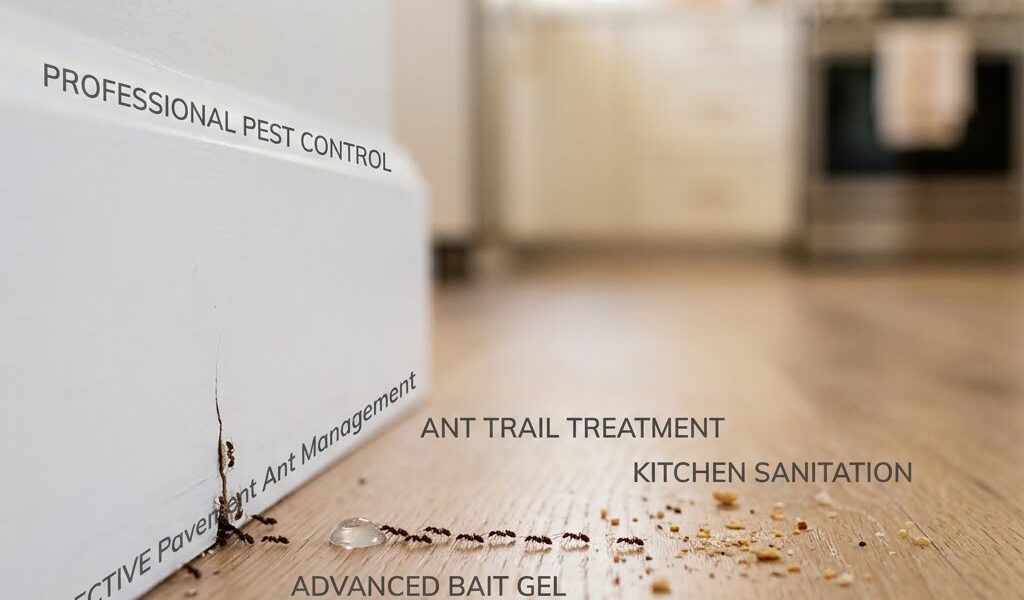
Pavement Ant Bait for Indoor Infestation (Best Control Options)
Pavement ants may be tiny, but they can become a persistent nuisance once they find their way around your home. You may notice them along driveways, patios, sidewalks, foundations, kitchens, or other areas where they can easily find food, moisture, or shelter. Because these ants are so small, it is easy to reach for a spray and kill the ones you see. The problem is that this may only deal with the visible ants while leaving the larger colony and the reason they are entering untouched.
Unfortunately, that often treats the symptom rather than the colony.
A more effective way to tackle the problem is to follow the ants to see where they are coming from, choose a suitable bait for the situation, eliminate easy sources of food and moisture, and close the small gaps they may be using to get inside.
This guide explains how to control pavement ants indoors and outdoors and reviews several products that may fit different situations.
Affiliate Disclosure: If you purchase through links on this page, BugOffControl.com may earn a commission at no additional cost to you. This helps support our pest-control guides and product research.
As an Amazon Associate I earn from qualifying purchases.
Quick Answer: How Do You Get Rid of Pavement Ants?
For most pavement ant problems, baiting is an important part of the control strategy because foraging ants can carry suitable bait back to the colony.
A practical approach is:
- Find the ant trails and likely entry points.
- Use an appropriate ant bait where the current product label permits the intended use.
- Avoid spraying over bait placements, which can interfere with feeding.
- Clean up food and water sources.
- Seal cracks and gaps after identifying how ants are entering.
- Address outdoor nesting areas and recurring activity.
- Monitor the area instead of judging success from the number of ants you see immediately.
The right product depends on whether your problem is primarily indoors, outdoors, or both.
Top Pavement Ant Control Options
| Product or Method | Best Fit | Main Purpose |
|---|---|---|
| Advion Ant Gel | Targeted indoor baiting | Place bait near active ant trails and areas where ants forage |
| Maxforce Quantum | Liquid baiting | Provide a liquid bait option for suitable ant activity |
| BASF Advance 375A | Outdoor activity | Granular baiting around appropriate exterior areas |
| TERRO Outdoor Liquid Ant Bait Stakes | Easy outdoor baiting | Ready-to-use bait stations for outdoor ant activity |
| BASF Termidor Foam | Specialized treatment | Targeted treatment of suitable cracks, voids, or areas specifically permitted by the label |
| Caulk & Sealant | Entry prevention | Close cracks and gaps used for entry |
| Sanitation | Indoor prevention | Remove food sources that attract foraging ants |
| Moisture Control | Long-term prevention | Reduce water sources that encourage pest activity |
Important: Always read and follow the current product label before using any pesticide. Product labels can differ by location and application site.
What Are Pavement Ants?
Pavement ants are small ants commonly associated with areas around pavement, foundations, sidewalks, patios, driveways, and other structures.
They can also enter buildings while searching for:
- Food
- Water
- Shelter
- Suitable nesting locations
Their small size allows them to take advantage of surprisingly narrow cracks and openings.
Once a trail becomes established, you may notice ants repeatedly following the same route along walls, floors, countertops, windows, doors, or other surfaces.
That repeated activity is an important clue.
Instead of concentrating only on the individual ants, look for the route they are using and determine why they are entering.
Why Are Pavement Ants Coming Into My House?
Pavement ants do not necessarily enter a home because it is dirty.
They may simply be responding to an easily available food or water source.
Common attractions include:
- Crumbs
- Sugary foods
- Grease
- Pet food
- Food residue
- Leaking pipes
- Condensation
- Damp areas
- Trash
- Outdoor vegetation touching the building
- Cracks around doors and windows
Weather can also influence ant activity.
During periods of excessive heat, rain, or changing outdoor conditions, ants may search more aggressively for suitable food, water, or shelter.
Look for the reason behind the activity
If ants repeatedly appear in one room, don’t just wipe them away.
Ask: Where are they coming from?
Then ask: What are they looking for?
Those two questions can help you build a much more effective pavement ant control strategy.
Where Do Pavement Ants Nest?
Pavement ants commonly establish nests in protected areas, particularly around structures.
Potential nesting locations include:
- Cracks in pavement
- Sidewalks
- Driveways
- Foundation edges
- Under slabs
- Beneath stones
- Around patios
- Wall voids
- Structural cracks
- Areas near insulation or other protected spaces
Outdoor nests can be difficult to locate because ants may travel considerable distances between the nest and food source.
This is one reason simply killing the ants you see may provide only temporary relief.
How to Identify a Pavement Ant Problem
A few ants appearing occasionally does not necessarily mean you have a major infestation.
Look for patterns.
Signs may include:
- Repeated ant trails
- Ants appearing in the same room
- Activity around doors or windows
- Ants emerging from cracks
- Large numbers of ants around food
- Outdoor trails near foundations
- Ant activity around patios or pavement
- Ants repeatedly returning after being removed
A consistent trail is especially useful because it can reveal the route between the ants’ feeding area and their nesting location.
Can Pavement Ants Contaminate Food?
Pavement ants are primarily considered nuisance pests, but ants moving between outdoor environments, soil, waste areas, and indoor food surfaces can potentially transfer contaminants.
That is why it is sensible to prevent ants from accessing:
- Food preparation surfaces
- Open food
- Pantry items
- Pet food
- Dishes
- Food storage areas
Good sanitation is not a replacement for colony control, but it can make your home less attractive to foraging ants.
Best Products for Pavement Ant Control
1. Syngenta Advion Ant Gel 4.5 ☆
☆

Best For: Indoor pavement ant trails and targeted bait placement.
Advion Ant Gel is a targeted ant bait designed for placement near areas where ants are actively foraging. Its gel formulation allows you to make small, precise bait placements rather than treating an entire room.
For an indoor pavement ant infestation, this can be useful when you can identify where ants are traveling and place the bait appropriately.
Pros
- Targeted gel-bait format
- Easy to place near active ant trails
- Useful for localized indoor ant activity
Cons
- Requires careful placement
- Other food sources can compete with the bait
- Does not replace sanitation and sealing entry points
Bottom Line: A practical option to consider when pavement ants are actively foraging indoors and targeted bait placement is appropriate.
Check Latest Price & Availability on Amazon
2. Maxforce Quantum Ant Bait 4.6☆

Best For: Indoor pavement ant activity where a liquid bait format is preferred.
Maxforce Quantum provides a liquid bait option for ant control. Its liquid formulation can be useful when ants are actively searching for suitable food sources and a liquid bait approach fits the situation.
For homeowners dealing with recurring indoor ant trails, it provides an alternative to gel-based baiting.
Pros
- Liquid bait format
- Convenient for targeted placement
- Provides an alternative to gel bait
Cons
- Competing food sources can affect feeding
- Requires appropriate placement and monitoring
Bottom Line: A useful alternative for homeowners who prefer a liquid ant-bait format for suitable indoor pavement ant activity.
Check Latest Price & Availability on Amazon
3. BASF Advance 375A Granular Ant Bait 4.0

Best For: Recurring pavement ant activity around suitable outdoor areas.
BASF Advance 375A is a granular ant bait designed for appropriate applications indoors or outdoors according to its current product label. Its granular format makes it particularly useful to consider when pavement ants are actively foraging around suitable exterior areas.
Outdoor baiting can be an important part of the strategy when ants are repeatedly approaching the home from outside.
Pros
- Granular bait format
- Useful for suitable outdoor applications
- Designed for ant baiting
Cons
- Outdoor conditions can affect bait placement and performance
- Must be applied according to the current product label
Bottom Line: A useful option to consider when pavement ants are actively foraging in suitable outdoor areas around a home.
Check Latest Price & Availability on Amazon
4. TERRO Outdoor Liquid Ant Bait Stakes 4.5 ☆

Best For: Homeowners who want a simple, ready-to-use outdoor baiting option.
TERRO Outdoor Liquid Ant Bait Stakes offer a simple, ready-to-use way to place liquid ant bait around suitable outdoor areas. Because the stakes come prepared for use, homeowners can avoid the extra steps of mixing or handling loose bait.
For pavement ants that are regularly traveling around patios, foundations, walkways, or other outdoor areas, these stakes can provide a convenient baiting option. Always place and use them according to the product’s current label directions.
Pros
- Ready-to-use format
- Simple outdoor placement
- Liquid bait formulation
Cons
- Intended for outdoor use
- Correct placement is important
- May not address an indoor infestation by itself
Bottom Line: A convenient choice for homeowners looking for a ready-to-use outdoor bait option around recurring pavement ant activity.
Check Latest Price & Availability on Amazon
5. BASF Termidor Foam 4.6 ☆

Best For: Specific structural treatment situations where the current label permits the application.
Termidor Foam is different from the bait products discussed above. Rather than being used simply to attract feeding ants, it is a specialized foam treatment intended for specific labeled applications involving suitable cracks, voids, or other structural areas.
That makes it a more specialized option and not something to automatically use wherever pavement ants are visible.
Pros
- Foam formulation for suitable structural applications
- Can reach appropriate cracks and voids
- Provides a specialized treatment option
Cons
- Not a general-purpose ant spray
- Not appropriate for every pavement ant problem
- Requires careful attention to the current product label
Bottom Line: A specialized option to consider only when the treatment area and intended use are specifically permitted by the current product label.
Check Latest Price & Availability on Amazon
Caulk and Sealant 4.5 ☆

Once you understand where ants are entering, sealing suitable cracks and gaps can help reduce future entry.
Pay particular attention to:
- Door frames
- Window frames
- Foundation cracks
- Utility penetrations
- Wall openings
- Gaps around pipes
- Gaps around cables
Don’t automatically seal every opening before you understand the ant route.
First identify the traffic pattern.
Then address the entry point.
Sanitation: Remove the Food Trail
Even a small amount of food can attract foraging ants.
Regularly clean:
- Countertops
- Floors
- Cabinets
- Pantry shelves
- Around appliances
- Pet feeding areas
- Trash containers
Store sugary and other attractive foods in sealed containers.
If an ant trail suddenly appears around a kitchen counter, look carefully for the food source before assuming you need more pesticide.
Moisture Control
Water can be just as important as food.
Check for:
- Leaking faucets
- Plumbing leaks
- Condensation
- Wet cabinets
- Damp areas beneath sinks
- Standing water
- Poor exterior drainage
Fixing a moisture problem can make an area less attractive to pests while also helping protect the structure.
Pavement Ant Control Based on Activity Level
Not every ant problem requires the same approach.
Occasional activity
Start with:
- Cleaning
- Monitoring
- Identifying the entry point
- Sealing suitable gaps
- Targeted baiting where appropriate
Regular indoor activity
Consider:
- Targeted indoor baiting
- Sanitation
- Moisture control
- Entry-point reduction
- Outdoor monitoring
Heavy or recurring activity
A broader strategy may be needed:
- Indoor baiting where appropriate
- Exterior baiting where appropriate
- Exclusion
- Moisture correction
- Structural inspection
- Professional assistance if the colony location is inaccessible
Pavement Ant Bait vs. Spraying the Ants
This is one of the most important differences to understand.
Spraying visible ants
A contact insecticide may kill ants that are directly contacted.
But killing visible workers does not necessarily eliminate the colony.
Baiting
Baiting takes a different approach.
Foraging ants consume an appropriate bait and may carry it back toward the colony.
That is why baiting can be particularly useful when your goal is to address the colony rather than simply kill the ants you can see.
However, baiting is not magic.
Ants may ignore a bait if it does not match their current food preference, if it is placed incorrectly, or if competing food sources are readily available.
Common Pavement Ant Control Mistakes
1. Killing every ant immediately
If you see a trail, take a moment to investigate it.
The trail may reveal where the ants are entering.
2. Using too many products at once
More products do not automatically mean better control.
Choose products according to the situation.
3. Spraying directly over bait
Some treatments can interfere with baiting.
Follow the product label and avoid practices that discourage ants from feeding on an intended bait.
4. Ignoring outdoor activity
If ants are repeatedly entering from outside, treating only the kitchen may leave the underlying problem untouched.
5. Leaving food available
Even small crumbs, spills, pet food, and sugary residue can compete with bait.
6. Ignoring moisture
A persistent water source can continue attracting pests even after treatment.
7. Sealing too early
If you seal an opening without understanding the route, ants may simply find another way inside.
Do You Need All of These Products?
No you generally do not need to purchase every product listed in this guide.
The better strategy is to match the solution to the problem.
For indoor ant trails
A targeted bait such as Advion Ant Gel or a suitable liquid bait such as Maxforce Quantum may be considered, along with sanitation and exclusion.
For outdoor activity
A suitable granular bait such as Advance 375A or a ready-to-use option such as TERRO Outdoor Liquid Ant Bait Stakes may fit better, depending on the location and label directions.
For structural voids
A specialized product such as Trermido Foam may be appropriate only for situations covered by its current label.
For long-term prevention
Don’t overlook:
Caulk + sanitation + moisture control + monitoring.
These simple steps can make a major difference.
My Recommended Pavement Ant Control Strategy
If I were approaching a pavement ant problem, I would not start by buying every product available.
I would work through the problem in this order:
Step 1: Follow the ants
Find the trail.
Step 2: Find the attraction
Look for food, water, shelter, or another reason they are gathering.
Step 3: Identify the entry point
Check doors, windows, cracks, utility penetrations, and foundation areas.
Step 4: Choose the appropriate bait
Use an indoor or outdoor bait that matches the situation and whose current label permits the intended application.
Step 5: Reduce competing food sources
Clean the area and store food properly.
Step 6: Address moisture
Repair leaks and reduce unnecessary dampness.
Step 7: Seal suitable entry points
Once the route is understood, use an appropriate sealant to reduce future access.
Step 8: Monitor
Keep checking the area rather than assuming the first treatment solved everything.
This approach is usually more sensible than repeatedly spraying every ant you see.
DIY Pavement Ant Control vs. Hiring a Professional
Many minor pavement ant problems can be approached with basic inspection, sanitation, exclusion, and appropriately labeled consumer products.
Professional help becomes more attractive when:
- Ant activity is widespread
- The source cannot be located
- Ants are coming from inaccessible structural areas
- Activity continues despite a reasonable control attempt
- The infestation keeps returning
- You are uncomfortable handling pesticides
- The building has complicated construction or moisture problems
A professional can also help determine whether the ants are actually pavement ants or another species requiring a different strategy.
Pesticide Safety Matters
Always read the current product label before using any pesticide.
Important precautions include:
- Follow application directions exactly.
- Use only where the label permits.
- Keep pesticides away from children and pets as directed.
- Do not use more product than the label recommends.
- Store products securely.
- Do not transfer pesticides into unlabeled containers.
- Wear the protective equipment specified by the label.
- Follow all disposal instructions.
If you are unsure whether a particular product is appropriate for your situation, ask a qualified pest-control professional.
Frequently Asked Questions
How do I get rid of pavement ants in my house?
Start by identifying the ant trail and entry point. Remove food and moisture sources, then consider an appropriately labeled ant bait. Once you understand how ants are entering, seal suitable gaps and continue monitoring.
What is the best bait for pavement ants?
There isn’t one bait that is automatically best for every situation. Advion Ant Gel, Maxforce Quantum, Advance 375A, and TERRO Outdoor Liquid Ant Bait Stakes provide different bait formats and applications. Choose based on where the ants are active and the current product label.
Will spraying pavement ants get rid of them?
Spraying can kill ants you contact, but it may not eliminate the colony. A properly planned baiting strategy can be useful when the goal is to address the colony through foraging behavior.
Why do pavement ants keep coming back?
They may be returning because the colony remains active, another entry point is available, food or moisture remains accessible, or outdoor activity continues near the structure.
Where do pavement ants enter a house?
Common routes include cracks, gaps around doors and windows, utility penetrations, foundation openings, and other small structural openings.
Are pavement ants dangerous?
Pavement ants are generally considered nuisance pests rather than aggressive household pests. However, ants moving through outdoor and unsanitary environments can potentially contaminate food or surfaces.
Should I kill the ants I see?
Not necessarily. If ants are actively feeding on a suitable bait, immediately killing them can interfere with the baiting strategy. Follow the product label and allow an appropriate baiting approach to work.
How long does pavement ant control take?
The timeline can vary considerably depending on colony size, food competition, weather, nesting location, bait acceptance, and the control strategy used. Monitor the trend rather than expecting every ant to disappear immediately.
Can pavement ants live inside walls?
Ants may use protected structural areas, including suitable wall or other void spaces, depending on the building and conditions. If activity appears to originate from an inaccessible void, professional inspection may be worthwhile.
Should I use indoor and outdoor ant bait?
Sometimes. If ants are entering from an exterior source, addressing only indoor activity may leave part of the problem untreated. The correct combination depends on where the ants are active and what each product’s current label permits.
Do I need professional pest control for pavement ants?
Not always. Small, localized problems may be manageable with inspection, sanitation, baiting, exclusion, and monitoring. Persistent or inaccessible infestations may justify professional assistance.
What is the most important part of pavement ant control?
Don’t focus only on the ants you can see.
Find the trail, understand why they are there, use an appropriate control method, and address the conditions allowing them to return.
Final Verdict: The Smart Way to Control Pavement Ants
Pavement ant control is most effective when you treat it as a complete pest-management problem rather than simply an ant-killing exercise.
The goal is to reduce the conditions that attract ants, use an appropriate baiting or treatment strategy, and make it harder for them to return.
For targeted indoor baiting, Advion Ant Gel is an option worth considering.
For liquid baiting, Maxforce Quantum provides another approach.
For suitable outdoor activity, BASF Advance 375A and TERRO Outdoor Liquid Ant Bait Stakes offer convenient baiting options.
For specific structural situations covered by the label, BASF Termidor Foam may have a role.
But products are only part of the solution.
Sanitation, moisture control, exclusion, and monitoring are what help turn short-term ant control into a longer-term solution.
If you can identify where the ants are coming from and why they are there, you are already much closer to solving the problem.
Bug Off Control’s Approach
At Bug Off Control, the goal is simple:
Identify the pest → understand the problem → choose the right control method → prevent it from returning.
That approach can help you spend less money on unnecessary products while building a more practical pest-control strategy for your home.
Always read and follow the current product label before using any pesticide.