Roof Rat Control Kit: Complete DIY Control Guide
Roof rats can be surprisingly difficult to control once they find everything they need around a home or property. Food, water, fruit trees, garbage, dense vegetation, roof spaces, attics, garages, sheds, and small openings can all provide opportunities for these agile rodents.
The good news is that you don’t have to rely on a single trap or simply scatter rat bait around the property.
A much better strategy is to build a roof rat control kit around the actual problem.
For light activity, you may be able to make significant progress with inspection, sanitation, trapping, and exclusion.
For moderate activity, a combination of traps, monitoring, sanitation, exclusion, and properly secured bait stations may be appropriate.
For heavy activity, you’ll generally need a more organized approach that addresses the rats themselves and the food, water, shelter, and entry points keeping the problem going.
This guide walks you through that process step by step and explains how products such as rat traps, tamper-resistant bait stations, rodenticide bait, monitoring tools, and exclusion materials can fit into a practical roof rat control plan.
BugOffControl Recommended: Don’t think of roof rat control as simply finding something that kills rats. Think of it as a system: identify the activity → remove attractions → control the rats → seal entry points → keep monitoring.
Affiliate Disclosure
If you purchase through links on this page, BugOffControl.com may earn a commission at no additional cost to you. This helps support our pest-control guides and product research.
As an Amazon Associate I earn from qualifying purchases.
Quick Answer: How Do You Get Rid of Roof Rats?
A practical roof rat control program usually follows these steps:
1. Confirm roof rat activity
↓
2. Find where the rats are traveling
↓
3. Remove accessible food
↓
4. Reduce water and moisture
↓
5. Remove hiding and nesting opportunities
↓
6. Trap or bait according to the level of activity
↓
7. Seal potential entry points
↓
8. Continue monitoring
The biggest mistake is treating only the rats you can see.
If a roof rat population has access to food, water, shelter, and an easy way into the building, removing a few rats may not solve the underlying problem.
That’s why this guide combines rodent control + sanitation + moisture management + exclusion + monitoring.
Roof Rat Control at a Glance
Choose Your Control Strategy by Activity Level
What Is a Roof Rat?
The roof rat (Rattus rattus) is an agile rodent commonly associated with buildings, trees, roofs, attics, and other elevated areas.
It is also known by names such as the black rat and ship rat.
Roof rats are generally more slender and agile than Norway rats. Common identifying characteristics can include:
- A relatively slender body
Large ears
A pointed or narrow-looking nose
Dark, gray, brown, or mixed coloration
A long tail that is often longer than the head-and-body length
Strong climbing ability
One of the most important differences for homeowners is their climbing behavior.
While Norway rats are commonly associated with ground-level areas and burrows, roof rats are excellent climbers and may use:
- Trees
Rooflines
Attics
Rafters
Utility lines
Fences
Vines
Dense vegetation
Wall and ceiling spaces
That means a roof rat problem can sometimes begin above your head rather than underneath your feet.
Where Do Roof Rats Live?
Roof rats prefer locations that provide protection and easy access to food and water.
Around a property, inspect areas such as:
Outside
- Trees
Palm trees
Dense shrubs
Overgrown vegetation
Rooflines
Garages
Sheds
Attics
Storage areas
Garbage areas
Compost
Fruit trees
Bird-feeding areas
Outdoor kitchens
Pet-feeding areas
Wood or debris piles
Areas beneath decks
Where Do Roof Rats Nest Inside a Home?
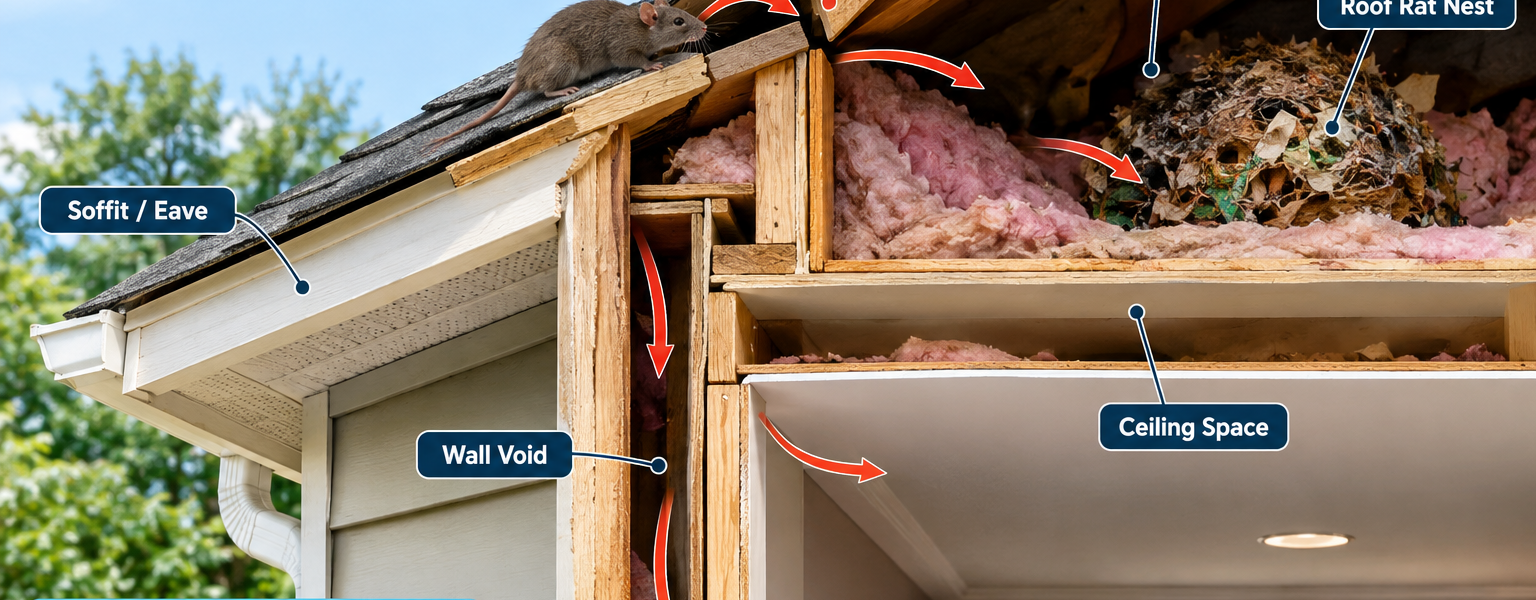
If roof rats make their way into a house, don’t assume they’ll stay at ground level. These agile rodents are comfortable climbing and may take advantage of higher, quieter areas of a building where they can find warmth, shelter, and protection. That makes the upper parts of your home especially important when you’re trying to locate a roof rat problem.
Common Indoor Roof Rat Nesting Areas
Attics and Loft Spaces
Attics are attractive nesting locations because they are often quiet, dark, and rarely disturbed.
Roof rats may use materials such as:
- Insulation
- Cardboard
- Paper
- Cloth
- Fibers
- Other soft materials
If you discover shredded insulation or nesting material in an attic, look nearby for additional signs such as droppings, gnaw marks, urine staining, or well-used travel routes.
Wall Voids and Cavities
Roof rats can move through hollow areas inside walls and other structural cavities. Listen for scratching or scurrying, particularly at night. You may also find droppings or gnawing around areas where pipes, wires, vents, or other openings connect different parts of the structure.
Because these spaces can be difficult to inspect, avoid sealing an opening until you have considered whether rats may still be inside the building.
Soffits and Eaves
The area beneath the roofline can provide an easy transition between the outside and inside of a house.
Inspect:
- Soffits
- Eaves
- Fascia
- Roof vents
- Attic vents
- Roof-to-wall junctions
- Damaged screens
These areas are particularly important because a small structural gap can provide access to a much larger protected space.
Ceiling Voids
Roof rats may also use hollow ceiling spaces, especially where there is little human activity.
If you hear movement above a ceiling, don’t immediately assume the animal is in the attic itself. The noise could be coming from a connected ceiling or wall cavity.
Garages and High Storage Areas
Garages can provide plenty of hiding places, particularly when boxes, stored materials, shelves, and rafters are left undisturbed.
Check:
- High shelves
- Storage rafters
- Cardboard boxes
- Stored furniture
- Wall edges
- Behind appliances
- Around stored pet food or animal feed
Reducing clutter makes these areas easier to inspect and can remove potential nesting material.
What Does a Roof Rat Nest Look Like?
A roof rat nest isn’t necessarily a perfectly shaped ball or obvious pile. It may look like a loose collection of shredded or gathered materials tucked into a protected location.
Common nesting materials can include:
- Shredded insulation
- Paper
- Cardboard
- Cloth
- Dried plant material
- Fibers
- Other soft materials available nearby
You may also find droppings, urine staining, gnaw marks, or a noticeable travel route around the nesting area.
BugOffControl Tip: Don’t focus only on finding the nest. The surrounding evidence can be just as useful for determining where the rats are traveling and how they’re getting into the structure.
Can Roof Rats Have More Than One Nest?
Yes. Finding one nest does not necessarily mean you’ve located every area being used by the rats. A roof rat population may use more than one protected location, particularly when food, water, shelter, and access are available in different parts of a property.
For that reason, finding a nest should be treated as an important clue, not proof that the entire problem has been eliminated. After locating nesting material, inspect the surrounding area and work backward to identify:
Nest → Travel Route → Entry Point → Outdoor Food/Shelter Source
That simple approach can help you understand the bigger picture.
Where Should You Look First?
If you suspect roof rats inside your home, start your inspection in the areas that connect the building to the outdoors.
Check these locations:
☐ Roofline
☐ Soffits and eaves
☐ Attic vents
☐ Attic insulation
☐ Wall penetrations
☐ Utility lines
☐ Pipe openings
☐ Ceiling voids
☐ Garage rafters
☐ High storage areas
☐ Trees touching the roof
☐ Dense vegetation near the structure
Don’t forget to inspect above eye level.
That’s one of the biggest differences between investigating a roof rat problem and investigating a rodent problem that is primarily ground-based.
Finding the Nest Is Only the Beginning
A nest tells you that rats have found a protected location, but removing the nesting material alone doesn’t solve the underlying problem.
A complete roof rat control plan should also determine:
Where are they getting inside?
What are they eating?
Where are they getting water?
What route are they using?
Where are they hiding outside?
What needs to be repaired to prevent another entry?
Once you answer those questions, you can match your control methods to the actual problem instead of simply treating the area where you happened to find evidence.
BugOffControl Recommended: When inspecting for roof rats, think vertically. Check the roof, attic, soffits, eaves, ceiling spaces, wall cavities, and high storage areas—not just the floor and foundation. Finding where the rats travel can be just as important as finding where they nest.
Inside
Roof rats may enter:
- Attics
Ceilings
Wall voids
Garages
Kitchens
Storage rooms
Utility areas
Crawl spaces
Areas around pipes and wiring
Because roof rats climb so well, don’t limit your inspection to the foundation.
Look up
Inspect roof edges, soffits, vents, attic openings, branches touching the roof, and utility penetrations.
How to Tell If You Have Roof Rats
You may never get a clear look at the animal. Instead, look for the evidence it leaves behind.
Droppings
Roof rat droppings are typically smaller and more slender than Norway rat droppings.
Check:
- Attics
Cabinets
Storage areas
Garages
Roof spaces
Along travel routes
Near food sources
Fresh droppings can indicate ongoing activity, but droppings alone do not tell you exactly how many rats are present.
Gnaw Marks
Rats have continuously growing incisors and need to gnaw.
Look for damage to:
- Food packaging
Plastic
Wood
Insulation
Wiring
Stored materials
Doors
Other accessible objects
Electrical-wire damage deserves particular attention because damaged wiring can create a fire hazard.
Rub Marks and Travel Routes
Rats frequently use established routes.
You may notice dark or greasy marks along:
- Walls
Beams
Pipes
Roof spaces
Entry points
Frequently used pathways
Tree and Roof Activity
Look for:
Rats moving through trees after dark
Droppings near roof access points
Damage around roof penetrations
Branches touching the structure
Activity around attic vents
Gnawing around soffits or fascia
Scratching and Movement
Nighttime scratching or scurrying in ceilings and attics can be a warning sign. If you hear repeated activity overhead, inspect the attic and roofline rather than assuming the problem is coming from the ground.
Damaged Fruit
Roof rats can take advantage of accessible fruit.
Inspect fruit trees for:
- Partially eaten fruit
Fallen fruit
Gnaw marks
Droppings
Repeated nighttime activity
Fruit trees can become an important part of the food supply supporting an outdoor population.
Why Roof Rats Are a Health and Property Concern
Rodents can contaminate food and surfaces with urine, feces, saliva, and other biological material. Depending on the circumstances, rodent exposure can be associated with diseases and infections including leptospirosis and salmonellosis. Rats can also cause property damage through gnawing.
Potential problems include:
- Damaged electrical wiring
Contaminated food
Damaged insulation
Chewed storage materials
Contaminated surfaces
Nesting material inside structures
Cleaning Up Roof Rat Droppings
If you discover rodent contamination, take precautions. Avoid sweeping or vacuuming dry droppings because this can disturb contaminated material.
Instead:
- Keep children and pets away from the area.
Wear appropriate protective equipment.
Follow recommended rodent-cleanup procedures.
Clean contaminated surfaces carefully.
Wash hands thoroughly afterward.
Dispose of contaminated material appropriately.
If an attic, crawl space, or other area has extensive contamination, professional cleanup may be appropriate.
Build Your Roof Rat Control Kit
A useful roof rat kit should contain products that perform different jobs. Don’t buy five products that all do the same thing. Instead, build your kit around these categories:
Trapping
- Rat traps
Enclosed or tunnel-style traps where appropriate
Monitoring traps/devices
Secured Baiting
- Appropriate rat bait
Tamper-resistant bait stations
Inspection
- Bright flashlight
Inspection mirror if needed
Gloves
Basic cleaning supplies
Exclusion
- Hardware cloth
Appropriate metal mesh
Door sweeps
Suitable sealants
Metal flashing where needed
Fasteners for durable repairs
Sanitation
- Tight-fitting garbage containers
Sealed food-storage containers
Cleaning supplies
Outdoor Management
- Pruning tools
Vegetation-management supplies
Materials for removing clutter and debris
Each item has a different purpose.
The goal isn’t to own the biggest pile of pest-control products. It’s to have the right tool for each control job.
🟢 LIGHT ROOF RAT ACTIVITY
When Should You Use the Light-Activity Approach?
This approach may be appropriate when:
- You’ve seen one or two rats.
You find occasional droppings.
Activity appears limited.
You have identified an accessible food source.
There is no evidence of widespread indoor activity.
You can identify likely entry points.
Start with the basics.
Step 1: Remove Food
Roof rats are opportunistic feeders.
Secure:
- Pet food
Bird seed
Garbage
Animal feed
Food scraps
Fallen fruit
Outdoor cooking waste
Compostable food waste
Store food in containers that rats cannot easily chew through. If you have fruit trees, remove fallen fruit regularly. Don’t make the yard an easy buffet.
Step 2: Remove Water Sources
Inspect for:
- Leaking outdoor faucets
Irrigation leaks
Leaking pipes
Standing water
Pet water containers
Poor drainage
Condensation
Containers collecting rainwater
Reducing accessible water can make the property less attractive.
Step 3: Trim the Rat Highway
Roof rats can use vegetation as a route to buildings. Pay particular attention to branches or vines that:
* Touch the roof
* Touch gutters
* Reach windows
* Connect with fences
* Create access to attic openings
Keeping vegetation managed can reduce convenient pathways.
Step 4: Start Trapping
When activity is limited, trapping can be an effective part of the control plan. Place traps where roof rat activity has actually been identified rather than randomly distributing them around the property. Potential locations include protected travel routes, attic areas, garages, and other suitable locations. Keep traps away from children, pets, and non-target animals.
Enclosed Rat Traps 4.2 
An enclosed or tunnel-style rat trap can provide a more contained trapping setup than an exposed trap.
Best for:
Light-to-moderate activity where you want a contained trapping option.
Pros

* Enclosed design
* More discreet than some exposed traps
* Can help protect the trap mechanism from accidental contact
* Useful for targeted placement
* Multiple units can be used in separate activity areas
Cons
* Correct placement is important
* Requires regular inspection
* Must be kept away from children and pets
* Trap type and size should be appropriate for rats
Amazon: Check Latest Price & Availability on Amazon
🟡 MODERATE ROOF RAT ACTIVITY
A more organized strategy may be necessary when you notice:
* Repeated nighttime sightings
* Fresh droppings appearing regularly
* Multiple travel routes
* Continued gnawing
* Rats entering garages or other structures
* Activity around several parts of the property
* Trapping alone is not reducing the evidence
This is where a combination of trapping + secured baiting where appropriate + sanitation + exclusion can become useful.
Tamper-Resistant Rat Bait Stations 4.4 ☆
A bait station provides a designated location for presenting compatible rodenticide bait while helping restrict access by children, pets, and non-target animals.
Best for:
Organized rat baiting where rodenticide use is appropriate and permitted.
Pros

* Helps contain bait
* Creates a defined baiting location
* More organized than loose bait placement
* Multiple stations can be used to address separate activity areas
* Can be useful as part of a structured control program
Cons
* Correct placement is essential
* Stations require inspection and maintenance
* Must be compatible with the selected bait
* Rodenticide labels must be followed
* Stations do not eliminate the need for sanitation or exclusion
Amazon: Check Latest Price & Availability on Amazon
Important Safety Reminder: Never assume that placing bait in a station automatically makes it safe. Use the current product label and station instructions.
Keep bait stations inaccessible to children, pets, livestock, and non-target wildlife.
Catchmaster Max-Catch Glue Traps 4.3 ☆
Glue boards can be useful for monitoring or intercepting rodent activity in suitable protected locations.
The Catchmaster Max-Catch 36-pack gives you multiple traps for monitoring different areas.
Best for:
Monitoring and trapping in appropriate protected areas.
Pros:

- Ready to use
- No bait mixing
- Multiple traps in one package
- Useful for monitoring rodent activity
- Can be placed in protected travel routes
Cons:g
- Glue traps must be monitored frequently
- They can be affected by dust and environmental conditions
- They are not appropriate for every situation
- Trapped animals can experience prolonged distress if the traps are not checked properly
- They should be kept away from children, pets, and non-target animals
Amazon: Check Catchmaster Max-Catch Glue Traps on Amazon
Important: Use glue traps responsibly and check them frequently. Where local rules or animal-welfare requirements restrict their use, choose another appropriate control method.
Rat Rodenticide Bait 4.9
Rodenticide can be part of a roof rat control program when the product is legally available, appropriate for the situation, and used according to its label. Depending on the product, active ingredients may include different types of rodenticides. For that reason, don’t choose bait simply because it claims to be “strong.”
Pros

- Can be useful as part of a broader roof rat control program.
- May help address rat activity when trapping alone is not enough.
- Different formulations are available for different rodent-control situations.
- Can work alongside exclusion, sanitation, and monitoring.
- The product label provides specific directions for placement and safe use.
Cons
- Requires careful use and strict adherence to the current product label.
- May require an approved, tamper-resistant bait station depending on the product and label.
- Rodenticide does not prevent rats from entering the building again.
- It can create safety concerns for children, pets, and non-target animals if misused.
- The active ingredient and legal-use requirements vary by product and location.
- It should not replace sealing entry points, removing food sources, and improving sanitation.
Best For: Homeowners looking for a rodenticide option to consider alongside exclusion, sanitation, monitoring, and trapping as part of a roof rat control plan.
Look at:
* Active ingredient
* Target pest
* Approved placement
* Required bait station
* Application directions
* Safety precautions
* Local requirements
The key rule:
Use the product exactly as its current label directs. Never increase bait amounts because you believe you have more rats. Never place rodenticide where the label does not permit it. And never treat rodenticide as a replacement for exclusion and sanitation.
Amazon: Check Latest Price & Availability on Amazon
How Bait and Bait Stations Work Together
Think of the two components as having separate jobs.
Rodenticide bait: Controls the target rodent when consumed according to the label.
Bait station: Provides a controlled location for presenting the bait. The station is therefore not the active control ingredient. It is part of the delivery and access-control system.
This distinction is important because homeowners sometimes focus entirely on finding the strongest bait while overlooking placement, sanitation, and exclusion.
🔴 HEAVY ROOF RAT ACTIVITY
Heavy activity can look very different from a single nighttime sighting.
Warning signs can include:
* Frequent sightings
* Numerous fresh droppings
* Strong attic activity
* Nesting evidence
* Several active travel routes
* Repeated gnawing
* Damaged electrical wiring
* Rats entering occupied rooms
* Continued activity despite trapping
* Multiple entry points
* Heavy outdoor activity around trees and structures
At this point, don’t ask: What’s the strongest rat product? Ask: What parts of the rat’s environment are allowing this infestation to continue?
The Heavy-Activity Roof Rat Control Plan
1. Map the Activity
Inspect the property systematically.
Look for:
* Droppings
* Gnaw marks
* Travel routes
* Nesting material
* Food sources
* Water sources
* Entry points
* Roof access
* Tree-to-roof routes
2. Address Food
Secure all accessible food. Pay particular attention to:
* Garbage
* Pet food
* Bird seed
* Fruit trees
* Outdoor kitchens
* Animal feed
* Food waste
3. Address Water
Repair leaks and eliminate unnecessary standing water.
4. Reduce Shelter
Remove or organize:
* Debris
* Unnecessary clutter
* Dense vegetation
* Unused materials
* Wood piles
* Storage piles
5. Trap Active Routes
Use appropriate rat traps in protected locations where evidence shows rats are traveling.
6. Use Secured Baiting When Appropriate
Where rodenticide is appropriate, use compatible bait stations and follow the product label.
7. Inspect Regularly
Monitor for:
* Fresh droppings
* Gnawing
* Tracks
* Feeding
* New nesting material
* Continued nighttime activity
8. Seal Entry Points
Exclusion is especially important after reducing active rat pressure. Otherwise, another rat may simply use the same opening.
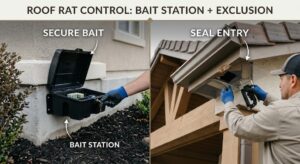
Roof Rat Exclusion: Keeping roof rats from getting back inside is one of the most important parts of a complete roof rat control plan, even though sealing materials may seem less exciting than traps or bait. Traps can remove individual rats, and bait can help control an infestation, but properly sealing roofline, soffit, and other entry points addresses the source of the problem by helping prevent more rats from getting inside.
Inspect:
* Soffits
* Fascia
* Roof vents
* Attic vents
* Eaves
* Gaps around pipes
* Utility penetrations
* Garage doors
* Door gaps
* Wall penetrations
* Damaged screens
* Roof-to-wall junctions
Hardware cloth can be useful for protecting larger openings and vulnerable areas.
Pros
* Durable
* Useful for larger openings
* Can provide a strong physical barrier
* Suitable for many exterior exclusion projects
Cons
* Requires cutting and installation
* Needs secure fastening
* Improper installation can leave gaps
Appropriate metal mesh can be useful around smaller openings and irregular penetrations.
It can be combined with an appropriate sealant or other durable repair material depending on the location.
Pros

* More resistant to chewing than many soft materials
* Useful around irregular openings
* Helpful for smaller repairs
Cons
* Not suitable for every opening
* Must be installed securely
* Large openings need a more substantial repair
A gap beneath an exterior door can provide a simple access route. A properly fitted door sweep can help close that gap.
Check:

* Garage doors
* Exterior doors
* Utility entrances
* Storage areas
Sealants and Structural Repairs
Suitable sealants can help close small gaps around:

* Pipes
* Wires
* Frames
* Utility penetrations
* Other structural openings
For larger openings, combine sealant with a durable physical barrier when appropriate.
Don’t Make This Mistake
Don’t rely on expanding foam alone as a rat-proof barrier rats can chew through many soft materials. For vulnerable openings, use a durable exclusion material appropriate for the location and secure it properly.
Can You Keep Roof Rats Away With Repellents?
Repellent products may be marketed for rats, but they shouldn’t be the foundation of your control program.
If rats have:
* Easy food
* Reliable water
* Shelter
* Fruit
* Garbage
* Convenient roof access
a repellent alone may not address the reason they are staying. A stronger prevention strategy focuses on: Food control + moisture reduction + vegetation management + exclusion + monitoring.**
The BugOffControl Roof Rat Control Kit
Here is the basic system I recommend readers think about when building a roof rat control kit.
Roof Rat Control Methods by Infestation Level
| Control Job | Recommended Product or Method | When to Use It |
|---|---|---|
| 🔎 Inspect for Activity | Flashlight + check rooflines, attic spaces, droppings, gnaw marks, travel routes, nesting areas, and possible entry points | 🟢 All Levels |
| 🍽️ Remove Food Sources | Secure garbage, pet food, bird seed, animal feed, fallen fruit, and other accessible food | 🟢 All Levels |
| 💧 Reduce Water Sources | Repair leaks, improve drainage, remove standing water, and address damp areas around the property | 🟢 All Levels |
| 🌴 Trim Access Routes | Cut back tree branches and vegetation that provide roof rats with easy access to roofs and structures | 🟢 All Levels |
| 🪤 Set Rat Traps | Place appropriate rat traps along confirmed travel routes and areas showing fresh activity | 🟢 Light → 🟡 Moderate |
| 🧰 Use Bait Stations | Use compatible tamper-resistant bait stations when baiting is appropriate and permitted by the product label | 🟡 Moderate → 🔴 Heavy |
| ☠️ Apply Rat Bait | Use a labeled rodenticide exactly according to the manufacturer’s directions and safety requirements | 🟡 Moderate → 🔴 Heavy |
| 🧱 Seal Entry Points | Hardware cloth, metal mesh, suitable sealants, and structural repairs to close gaps and openings | 🟢 All Levels |
| 🚪 Close Door Gaps | Install properly fitted door sweeps and repair damaged doors or frames | 🟢 All Levels |
| 🧹 Improve Sanitation | Remove food waste, clutter, debris, nesting materials, and unnecessary hiding places | 🟢 All Levels |
| 🔍 Monitor Results | Check regularly for fresh droppings, gnaw marks, tracks, nesting evidence, and nighttime activity | 🟢 All Levels |
🟢 Light Activity
Focus on:
Inspection + sanitation + trapping + exclusion + monitoring. The goal is to address the problem while it is still limited.
🟡 Moderate Activity
Consider:
Trapping + appropriate secured baiting + sanitation + exclusion + monitoring. The goal is to reduce active rats while simultaneously removing the conditions supporting them.
🔴 Heavy Activity
Use a coordinated strategy:
Inspection + sanitation + moisture management + trapping + secured baiting where appropriate + exclusion + monitoring.
If activity is extensive, rats are entering occupied areas, or control attempts are not working, professional pest management may be appropriate.
What Should You Use First Against Roof Rats?
🟢 Light Activity
Start with:
Food control + sanitation + moisture reduction + vegetation management + trapping + exclusion. Don’t automatically start with rodenticide if the problem is small and manageable.
🟡 Moderate Activity
A broader strategy may include: Trapping + properly secured baiting where appropriate + sanitation + exclusion + monitoring.
🔴 Heavy Activity
Use a comprehensive program: Inspection + sanitation + moisture control + trapping + secured baiting + exclusion + ongoing monitoring.
If rats have established themselves inside an inaccessible attic, ceiling, wall, or other difficult area, professional assistance may be the safest option.
Common Roof Rat Control Mistakes
Mistake 1: Only Removing the Rats, you may eliminate several rats while leaving behind the conditions attracting more.
Better approach: Control the rats + remove food + reduce shelter + seal entry points.**
Mistake 2: Ignoring Fruit Trees
A property can appear clean while a fruit tree provides a dependable food source.
Better approach: Remove fallen fruit promptly and manage accessible fruit where practical.
Mistake 3: Forgetting the Roof-Roof rats are excellent climbers.
Better approach:
Inspect:
* Trees
* Rooflines
* Eaves
* Attic vents
* Soffits
* Utility lines
* Roof penetrations
Mistake 4: Leaving Bird Feed Accessible. Bird seed can provide an easy food source.
Better approach: Use secure storage and clean up spilled seed.
Mistake 5: Using Too Much Rodenticide more bait doesn’t automatically mean better control.
Better approach: Follow the current product label exactly.
Mistake 6: Depending on Foam Alone Soft materials can be vulnerable to gnawing.
Better approach: Use appropriate durable exclusion materials.
Mistake 7: Forgetting Water, food isn’t the only resource rats need.
Better approach: Fix leaks and remove unnecessary standing water.
Mistake 8: Stopping Too Soon Not seeing a rat for one night doesn’t prove the problem is gone.
Better approach: Continue monitoring for fresh evidence.
Roof Rat Control Checklist
Use this checklist when inspecting your home or property.
Food
☐ Secure garbage
☐ Store pet food properly
☐ Secure bird seed
☐ Store animal feed
☐ Remove fallen fruit
☐ Clean outdoor food areas
☐ Remove food waste
Water
☐ Fix leaking faucets
☐ Repair plumbing leaks
☐ Remove standing water
☐ Check irrigation systems
☐ Improve drainage
☐ Inspect outdoor water containers
Shelter
☐ Remove unnecessary debris
☐ Reduce clutter
☐ Organize storage areas
☐ Manage dense vegetation
☐ Inspect sheds
☐ Inspect garages
☐ Check attic spaces
Roof Access
☐ Inspect trees touching the roof
☐ Check soffits
☐ Check fascia
☐ Inspect roof vents
☐ Check attic vents
☐ Inspect utility penetrations
☐ Check damaged screens
Control
☐ Identify active travel routes
☐ Place appropriate traps
☐ Monitor activity
☐ Use bait stations where appropriate
☐ Follow all rodenticide instructions
Exclusion
☐ Seal small openings
☐ Repair damaged vents
☐ Install durable mesh where appropriate
☐ Repair larger structural openings
☐ Check garage-door gaps
☐ Install door sweeps where needed
How Long Does Roof Rat Control Take?
There isn’t one fixed timeline because every infestation is different. The amount of time required depends on:
* Number of rats
* Access to food
* Availability of water
* Nesting locations
* Number of entry points
* Building construction
* Whether rats are inside or outside
* Effectiveness of trapping
* Whether exclusion has been completed
Instead of relying on a specific number of days, watch the evidence. You want to see a sustained reduction in:
* Fresh droppings
* Gnaw marks
* Food disturbance
* Nighttime activity
* Tracks
* Nesting evidence
When Should You Call a Professional?
DIY control can be useful for manageable situations, but some roof rat problems are better handled by a qualified pest-control professional.
Consider professional help when:
* Rats are repeatedly entering living areas.
* There is extensive attic contamination.
* Electrical wiring has been damaged.
* You cannot identify the entry point.
* The infestation appears extensive.
* Rats continue appearing despite a coordinated control program.
* There are difficult-to-access nesting areas.
* You are uncomfortable handling rodenticides.
* Local rules make certain control methods unavailable.
A professional can also help identify structural entry points and determine whether the problem involves more than one rodent species.
Frequently Asked Questions About Roof Rat Control
1. What is the best way to get rid of roof rats?
There isn’t one product that solves every roof rat problem. A practical strategy combines identifying activity, removing food and water, reducing shelter, trapping or appropriately secured baiting, sealing entry points, and continued monitoring.
2. Why are roof rats getting on my roof?
Roof rats are strong climbers and may use trees, vines, utility lines, fences, and other structures to reach roofs. Overhanging vegetation can provide an especially convenient route.
3. What attracts roof rats to a house?
Accessible food, fruit, garbage, pet food, bird seed, water, vegetation, shelter, and openings into attics or other protected areas can all contribute to roof rat activity.
4. Do roof rats live in attics?
Yes. Attics and roof spaces can provide shelter, nesting opportunities, and protection from weather and predators.
5. How do I stop roof rats from entering my attic?
Inspect and repair potential entry points around soffits, vents, rooflines, utility penetrations, damaged screens, and other openings. Use durable exclusion materials appropriate for each location.
6. Can roof rats chew through expanding foam?
Rats can chew through many soft materials. Expanding foam by itself should therefore not be considered a reliable rat-proof barrier.
7. Should I use traps or rat bait first?
The appropriate method depends on the situation. For limited activity, trapping, sanitation, and exclusion may be sufficient. More established activity may require a broader program that can include properly secured baiting where appropriate.
8. Are roof rat bait stations safer than loose bait?
A properly designed and correctly used bait station can help restrict access to rodenticide and provide a controlled baiting location. However, it does not eliminate the need to follow the product label and keep baiting equipment away from children, pets, and non-target animals.
9. Can fruit trees attract roof rats?
Yes. Accessible fruit and fallen fruit can provide a food source. Regularly removing fallen fruit and managing vegetation can help reduce available food.
10. How do I know if the roof rats are gone?
Continue monitoring for fresh droppings, gnaw marks, tracks, nesting material, food disturbance, and nighttime activity. A sustained absence of fresh evidence is more meaningful than simply not seeing a rat.
11. Can roof rats come back after I remove them?
Yes. If food, shelter, water, or entry points remain available, another rat can potentially move into the same area.
12. What keeps roof rats away permanently?
There is no single product that guarantees permanent prevention. Long-term prevention comes from combining sanitation, food management, moisture control, vegetation management, exclusion, and regular inspection.
Final Thoughts: Build a Roof Rat Control System
Roof rat control becomes much easier when you stop looking for one magic product.
- A trap has a job.
- A bait station has a job.
- Rodenticide has a job.
- Sanitation has a job.
- Vegetation management has a job.
- Exclusion has a job.
- Monitoring has a job.
- The real goal is to make those pieces work together.
Your roof rat control formula is:
Find the activity
↓
Remove food
↓
Reduce water
↓
Manage vegetation and shelter
↓
Trap or bait appropriately
↓
Seal entry points
↓
Keep monitoring
For light activity, you may be able to solve the problem with sanitation, trapping, exclusion, and monitoring.
For moderate activity, a combination of trapping and properly secured baiting may be appropriate.
For heavy activity, a coordinated control program may be necessary, particularly when rats have entered attics, ceilings, walls, or occupied areas.
And remember: the objective isn’t simply to kill the rats you see.
The bigger goal is to make your property less attractive, remove the routes they use, close the openings they exploit, and monitor for signs that the problem has truly been reduced.
BugOffControl Recommended: Instead of asking only, What kills roof rats?, ask three questions: Where are they coming from? What are they finding here? And what can I change so they don’t come back?”
That mindset turns a handful of pest-control products into a complete roof rat management plan.