House Mouse Control Kit: Complete DIY Buyers Guide

A house mouse problem rarely requires just one product. You may catch one mouse with a trap, but if mice are entering through gaps around the building, finding food in the kitchen, nesting in storage areas, or traveling through wall voids, another mouse can eventually take its place.
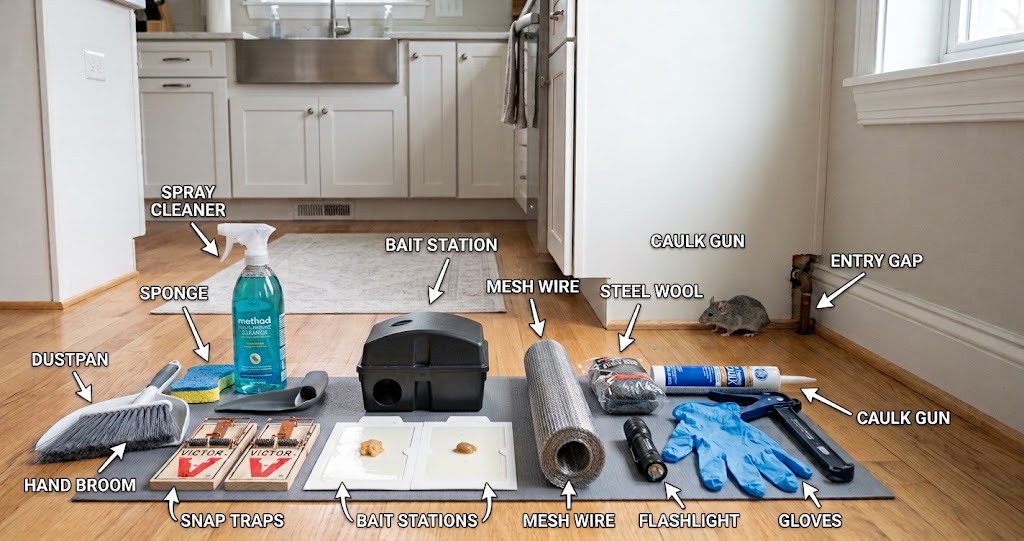
That is why a house mouse control kit can make more sense than buying a single mouse trap and hoping for the best. A complete DIY mouse-control kit should cover several different jobs:
Detect the activity → trap or control the mice → remove food and shelter → seal entry points → monitor for new activity.
For a small problem, a few well-placed snap traps and exclusion materials may be all you need. A more established problem may require multiple traps, monitoring devices, properly secured mouse bait, and more extensive exclusion.
This guide compares the products in a practical house mouse control kit and explains what each product does, when you may need it, where it fits in the control process, and what else you should buy to complete the job.
BugOffControl Recommended
Don’t think of this as a shopping list where every homeowner automatically needs every product.Instead, think of the kit as a group of control tools with different jobs. A homeowner with one mouse in the garage may need only traps and exclusion. A homeowner finding fresh droppings throughout the kitchen, garage, and storage room may need a much more organized approach.
Affiliate Disclosure: This page contains affiliate links. If you buy through my links, I may earn a small commission at no extra cost to you.
As an Amazon Associate, I earn from qualifying purchases.
Quick Answer: What Should Be in a House Mouse Control Kit?
A practical house mouse kit can include:
- Snap traps for direct mechanical control
- Monitoring traps or glue boards where appropriate
- Contained mouse stations for controlled placement of compatible products
- Mouse bait stations where rodenticide is appropriate
- Stainless steel mesh or other durable exclusion material
- Steel wool for suitable small gaps
- Sealant and repair materials
- Food-storage containers
- Garbage containers with secure lids
- Cleaning and sanitation supplies
- A flashlight and inspection tools
- Optional deterrent equipment such as a plug-in rodent deterrent
You don’t necessarily need all of these. The right combination depends on how much mouse activity you have and where the mice are entering.
House Mouse Control Kit at a Glance
| Control Job | Product / Method | Best Use |
|---|---|---|
| Catch mice | Victor Metal Pedal Mouse Traps | Direct mechanical control |
| Monitor / intercept | Catchmaster Max-Catch Glue Traps | Monitoring and trapping where appropriate |
| Contain equipment | Keyed Mouse Stations | Controlled access to compatible equipment |
| Mouse bait | Tomcat Mouse Killer Disposable Stations | Rodenticide control where appropriate |
| Additional deterrence | MouseBlocker 1000x | Additional deterrent layer |
| Block entry | Stainless Steel Mesh | Durable exclusion around suitable openings |
| Fill suitable small gaps | Steel Wool | Small exclusion repairs |
| Remove attractions | Sanitation + sealed food storage | Prevention |
| Find activity | Flashlight + inspection | Locate travel routes and entry points |
| Monitor results | Regular inspections | Determine whether activity is declining |
Which House Mouse Control Product Should You Buy?
This is one of the most important questions for a commercial-intent guide. Instead of simply listing products, match the product to the problem.
| If Your Main Problem Is… | Consider… | Why |
|---|---|---|
| One or two mice | Victor snap traps | Direct mechanical control |
| Multiple mouse travel routes | Multiple snap traps | Allows broader coverage |
| You need monitoring | Catchmaster glue traps where appropriate | Helps identify activity |
| You want contained equipment | Keyed mouse stations | Provides controlled access |
| Established mouse activity | Tomcat Mouse Killer stations where appropriate | Provides a contained baiting option |
| Mice entering through gaps | Stainless steel mesh | Helps create a durable barrier |
| Small suitable openings | Steel wool + appropriate sealant | Helps close potential entry routes |
| Garage or building deterrence | MouseBlocker 1000x | Adds another prevention layer |
| Mice keep returning | Exclusion + sanitation | Addresses the conditions supporting continued activity |
House Mouse Control Kit: Product Comparsion
| Product | Primary Control Role | Best For | Key Advantage | Important Limitation |
|---|---|---|---|---|
| Victor Metal Pedal Mouse Traps, 12-Pack | Mechanical trapping | Light to moderate mouse activity | Reusable snap traps provide direct mouse control | Placement and setup must be done carefully |
| Mouse Stations With Keys, 12-Pack | Bait containment | Safer, controlled bait placement | Lockable stations help restrict access to bait | The station contains bait but does not control mice by itself |
| Catchmaster Max-Catch Glue Traps, 72-Pack | Monitoring and trapping | Monitoring multiple rooms and activity areas | Large pack provides broad coverage for multiple locations | Requires frequent inspection and proper disposal |
| Tomcat Mouse Killer, 2 Stations | Rodenticide control | Moderate to heavy mouse activity when appropriate | Ready-to-use bait stations simplify placement | Must be used strictly according to the product label and safety directions |
| MouseBlocker 1000x | Supplemental deterrence | Added prevention around potential activity areas | Plug-in design is simple to use | Should not replace trapping, baiting, sanitation, or exclusion |
| Stainless Steel Mesh Rodent Barrier Kit | Entry-point exclusion | Sealing gaps and potential mouse entry points | Durable mesh helps block openings when properly installed | Effective exclusion depends on finding and sealing entry points correctly |
Victor Metal Pedal Mouse Traps, 12-Pack 4.0 
Best for: Direct mechanical control of house mice

If you want a traditional trap-based approach, the Victor Metal Pedal Mouse Traps give you multiple reusable traps to work with. The biggest advantage of a 12-pack is coverage. Instead of putting one trap in the kitchen and waiting, you can target several confirmed mouse travel routes.
Why Consider It?
- 12 traps
- Reusable design
- Mechanical control
- No rodenticide required
- Useful for multiple activity areas
- Can be part of a light or moderate mouse-control program
Pros
- Multiple traps allow broader coverage
- Reusable
- Straightforward mechanical control
- No bait poison required
- Useful for targeted placement
Cons
- Requires correct positioning
- Requires regular inspection
- Exposed traps may not be appropriate where children or pets can access them
- One trap may not be enough for several activity areas
- Doesn’t address entry points
Best For
Light to moderate indoor mouse activity where trapping is practical.
Not a Complete Solution Because…
A trap catches a mouse. It doesn’t seal the hole that allowed the mouse inside. That’s why snap traps work best as one part of a larger control system.
Check Latest Price & Availability on Amazon
Mouse Stations With Keys — 12 Pack 4.2
Best for: Containing compatible mouse-control equipment A keyed mouse station can be useful when you want control equipment kept inside a more contained housing. The 12-pack also makes sense when activity has been identified in multiple locations.
Pros

- Keyed access
- Multiple stations
- Helps contain equipment
- Useful around areas requiring controlled access
Cons
- Requires correct placement
- Requires regular inspection
- Keys must be managed
- Must be used with compatible equipment
Best For
Homeowners who want a more controlled station setup, particularly in areas where children or pets may be present.
Important: Always verify compatibility between the station and the trap or bait product being used.
Check Latest Price & Availability on Amazon
Catchmaster Max-Catch Glue Traps — 72 Pack 4.4 ☆
Best for: Monitoring and trapping in suitable protected areas

A 72-pack gives you substantial coverage. That can be useful when you aren’t sure exactly where mice are traveling. You can place appropriate monitoring devices in several suspected areas and use the results to identify where activity is concentrated.
Pros
- 72-pack
- Ready to use
- Multiple monitoring locations
- No bait mixing
- Useful for identifying activity
Cons
- Requires frequent inspection
- Can collect dust and debris
- Not appropriate for every location
- Must be kept away from children and pets
- Animal-welfare considerations apply
Best For
Monitoring and interception in suitable protected locations.
Important
Glue traps should not simply be placed randomly around a home and forgotten. Check them frequently and use them responsibly and in accordance with applicable requirements.
Check Latest Price & Availability on Amazon
Tomcat Mouse Killer — Child & Dog Resistant Disposable Stations 4.3 ☆
Best for: Contained mouse baiting where rodenticide is appropriate

This product takes a different approach from snap traps. Instead of physically trapping the mouse, the station contains rodenticide intended to control mice that consume the bait. Because it is a pesticide, the product needs to be treated differently from a simple mechanical trap.
Pros
- Ready-to-use station
- Disposable format
- Contained baiting design
- Designed for mouse control
- Useful as part of a broader program
Cons
- Requires strict label compliance
- Must be kept inaccessible to children and pets
- Does not seal entry points
- Dead rodents may need to be located
- Rodenticide should not be treated as the only control method
Best For
Moderate to heavy activity where a labeled rodenticide product is appropriate.
Important Safety Point
“Child and dog resistant” does not mean “safe to leave anywhere.” Always follow the current product label regarding:
- Placement
- Use
- Handling
- Inspection
- Disposal
- Safety precautions
Check Latest Price & Availability on Amazon
MouseBlocker 1000x Plug-In Rodent Deterrent 4.1
Best for: Adding a deterrent layer

A plug-in deterrent can be attractive to homeowners who want a non-pesticide component in their mouse-control plan. However, it should be treated as an additional layer, not the foundation of the program.
Pros
- Plug-in design
- No bait placement
- Convenient
- Can complement other control methods
- Useful for garages and buildings where appropriate
Cons
- Doesn’t physically block entry
- Doesn’t remove established mice
- Shouldn’t replace traps
- Shouldn’t replace sanitation
- Results may vary by situation
Best For
Supplementing a broader mouse-control and prevention plan.
Check Latest Price & Availability on Amazon
Stainless Steel Mesh Rodent Barrier Kit 4.5 ☆
Best for: Preventing mice from getting back inside

This may be one of the most important purchases in the entire kit. Why? Because killing mice doesn’t prevent another mouse from entering through the same opening. Stainless steel mesh can be useful for suitable gaps around:
- Pipes
- Utility lines
- Vents
- Foundations
- Walls
- Garage areas
- Structural penetrations
Pros
- Durable
- Resistant to chewing compared with many soft materials
- Useful for small openings
- Supports long-term exclusion
Cons
- Larger openings may need another repair method
- Must be secured properly
- May require sealant or fasteners
Check Latest Price & Availability on Amazon
What About Steel Wool?
Steel wool can be useful for certain small gaps, particularly when combined with an appropriate sealing or repair method. But don’t make the mistake of treating steel wool as the complete exclusion system. For vulnerable openings, the goal is to create a secure, durable barrier.
For larger openings, hardware cloth, metal flashing, structural repair, or another suitable material may be more appropriate.
What Else Should You Buy?
This is another important commercial-intent section missing from many mouse articles. The products above handle the major control jobs, but a complete DIY kit may also need:
Essential Supporting Supplies
- Sealed food-storage containers
- Heavy-duty garbage containers
- Appropriate sealant
- Fasteners for exclusion materials
- Flashlight
- Cleaning supplies
- Protective equipment appropriate for cleanup
- Door sweeps where needed
- Hardware cloth for larger openings
- Replacement storage containers for damaged food packaging
These aren’t glamorous purchases. But they can be just as important as the trap itself.
🟢 Best House Mouse Kit for Light Activity
If you’ve seen one mouse or found a small amount of evidence, don’t automatically buy every product in this guide. A practical light-activity kit can focus on:
Recommended Jobs
2. Stainless steel mesh / suitable exclusion material
3. Steel wool for appropriate small gaps
5. Cleaning supplies
6. Monitoring
Main Goal
Catch the mouse and close the door behind it.
🟡 Best House Mouse Kit for Moderate Activity
If you are finding fresh droppings regularly or seeing mice in several locations, increase your coverage. A moderate-activity kit can include:
- Multiple Victor snap traps
- Catchmaster monitoring/trapping products where appropriate
- Keyed stations where compatible and useful
- Tomcat Mouse Killer stations where rodenticide is appropriate
- Stainless steel mesh
- Steel wool
- Sealant
- Food-storage containers
- Sanitation supplies
Main Goal
Control the current activity while removing the conditions supporting it.
🔴 Best House Mouse Kit for Heavy Activity
Heavy activity requires a more organized strategy.
Consider:
- Multiple snap traps
- Appropriate monitoring
- Secure baiting where appropriate
- Exclusion materials
- Sanitation
- Moisture reduction
- Food control
- Continued monitoring
If mice are widespread, entering occupied rooms, damaging electrical wiring, or continuing despite reasonable DIY control efforts, professional pest management may be appropriate.
How Many Mouse Traps Do You Need?
There is no universal number that works for every house. The number depends on:
- Size of the affected area
- Number of activity zones
- Number of travel routes
- Severity of activity
- Whether activity is limited to one room or spread throughout the building
The key principle is:
Don’t put one trap in a large house and expect it to cover every mouse travel route.
Use your inspection to determine where additional traps or monitoring devices make sense.
Where Should Mouse Traps Go?
Placement is often more important than simply buying more traps.
Look for:
- Along walls
- Behind appliances
- Near droppings
- Near gnaw marks
- Near suspected entry points
- Along known travel routes
- Near food-storage areas
Mice often travel along protected edges rather than crossing large open spaces. Always position traps safely and according to the manufacturer’s instructions.
Where Should Mouse Bait Stations Go?
Don’t place bait stations randomly. First identify areas showing mouse activity. Then follow the product label for approved placement and use. Never assume that placing bait closer to a food source automatically makes it more effective. The objective is to use the product exactly as labeled and in a controlled location.
How Do Traps, Bait and Exclusion Work Together?
Think of the house mouse kit as three major layers.
Layer 1: Control
Traps and appropriately used bait
↓
Reduce the mice already present.
Layer 2: Remove Attractions
Food + garbage + clutter + moisture
↓
Make the building less attractive.
Layer 3: Exclusion
Mesh + suitable sealant + structural repairs
↓
Reduce the opportunity for new mice to enter. This is why buying a $10 trap without fixing a hole can turn into an endless cycle.
The House Mouse Control Funnel
Use this simple process:
🔎 FIND
Identify droppings, nesting areas, travel routes and entry points.
↓
🪤 CONTROL
Use appropriate traps or properly secured bait.
↓
🧹 CLEAN
Remove food, garbage, clutter and nesting opportunities.
↓
🧱 BLOCK
Seal potential entry points.
↓
👀 MONITOR
Continue looking for fresh signs.
↓
🏠 PREVENT
Maintain sanitation and exclusion.
Common Products You Shouldn’t Rely On Alone
A commercial buyer’s guide should also explain what not to expect from a product.
Don’t Rely on One Snap Trap
A trap may catch a mouse, but it doesn’t seal the building.
Don’t Rely on Bait Alone
Bait doesn’t remove the conditions attracting mice or close entry points.
Don’t Rely on a Plug-In Deterrent Alone
A deterrent doesn’t replace exclusion and sanitation.
Don’t Rely on Steel Wool Alone
Some openings require a more durable or properly secured repair.
Don’t Buy Products Without Knowing the Problem
More products don’t automatically equal better control.
Correct placement and matching the product to the problem are more important than simply buying more.
House Mouse Control Mistakes That Cost Homeowners Money
Mistake #1: Buying Too Many Products
A homeowner may buy traps, bait, repellents and gadgets without identifying where the mice are entering.
Better approach: Inspect first.
Mistake #2: Buying Only One Trap
One trap may provide insufficient coverage.
Better approach: Target multiple confirmed travel routes when necessary.
Mistake #3: Ignoring Exclusion
This is one of the most expensive mistakes because the same problem can return.
Better approach: Budget for exclusion materials as part of the kit.
Mistake #4: Treating Bait as a Magic Solution
Rodenticide is one component of control, not a substitute for sanitation and exclusion.
Mistake #5: Ignoring Food Storage
An accessible food supply can keep mice interested in the property.
Mistake #6: Ignoring the Garage or Attic
Mice don’t necessarily live where you first notice them.
Mistake #7: Stopping Monitoring Too Soon
A few quiet days don’t necessarily prove that the problem is finished.
House Mouse Control Checklist
Inspect
☐ Find droppings
☐ Find gnaw marks
☐ Identify travel routes
☐ Look for nesting material
☐ Inspect behind appliances
☐ Check garage and attic
☐ Find entry points
Control
☐ Place appropriate snap traps
☐ Monitor suspected activity areas
☐ Use glue traps only where appropriate
☐ Consider properly secured bait where appropriate
☐ Inspect control devices regularly
Exclusion
☐ Inspect doors
☐ Check garage doors
☐ Check pipe penetrations
☐ Check utility lines
☐ Inspect vents
☐ Check foundation openings
☐ Install durable mesh where appropriate
☐ Seal suitable gaps
Sanitation
☐ Secure food
☐ Secure pet food
☐ Secure garbage
☐ Clean spills
☐ Remove clutter
☐ Reduce nesting material
Prevention
☐ Continue monitoring
☐ Reinspect entry points
☐ Maintain food storage
☐ Keep garbage secured
☐ Repair new openings promptly
House Mouse Kit: What I Would Buy for Different Situations
| Mouse Control Situation | Recommended DIY Kit Approach | Main Goal |
|---|---|---|
| 🟢 One or Two Mice | Victor snap traps + exclusion materials + thorough sanitation | Remove active mice and prevent additional entry |
| 🟢 Mouse Seen in the Garage | Victor snap traps + stainless-steel mesh + steel wool + sanitation supplies | Control the mouse while sealing potential garage entry points |
| 🟡 Repeated Kitchen Activity | Multiple Victor traps + monitoring traps + exclusion materials + appropriate baiting when needed | Reduce activity and identify how mice are entering or moving through the home |
| 🟡 Mice in Several Rooms | Multiple traps + monitoring + contained baiting where appropriate + comprehensive exclusion | Control mice across active areas while addressing access points |
| 🔴 Heavy Mouse Activity | Multiple control methods + extensive exclusion + sanitation + ongoing monitoring | Reduce an established infestation and prevent continued access |
| 🏠 After Treatment | Exclusion materials + sanitation supplies + monitoring traps | Keep mice from returning and detect renewed activity early |
Frequently Asked Questions About House Mouse Control Kits
1. What is the best house mouse control kit?
The right kit depends on the level of activity. A small problem may need traps and exclusion, while an established infestation may require multiple control methods plus sanitation and exclusion.
2. Should I buy mouse traps or mouse bait?
For light activity, traps can be a practical starting point. For more established activity, appropriately secured bait may become part of a broader control program. Always follow the current product label.
3. Do I need both traps and bait?
Not necessarily. It depends on the situation. Some homeowners may successfully address limited activity with trapping and exclusion, while others may need multiple control methods.
4. Are 12 mouse traps enough?
They may provide useful coverage for many situations, but the appropriate number depends on the size of the affected area and the number of active travel routes.
5. Are 72 glue traps too many?
A large pack can be useful for monitoring multiple areas, but you should only deploy traps where they are appropriate and check them frequently.
6. Do mouse bait stations prevent mice from entering?
No. Bait stations are designed for control of mice that consume the bait. Entry-point repairs are needed to address how mice get inside.
7. Will stainless steel mesh keep mice out?
When properly selected, installed, and secured, durable metal mesh can help block suitable entry points. Larger openings may require different exclusion methods.
8. Should I use steel wool or stainless steel mesh?
Steel wool can be useful for certain small gaps. Stainless steel mesh may be preferable where a more durable barrier is needed. The right material depends on the opening.
9. Will a plug-in mouse deterrent replace traps?
It should not be treated as a replacement for trapping, sanitation, or exclusion.
10. How long should I monitor after catching mice?
Continue checking for fresh droppings, gnawing, nesting material and other signs rather than assuming the problem is finished immediately after catching a mouse.
11. Why do mice keep coming back?
Common contributing conditions can include accessible food, shelter, clutter, moisture and unresolved entry points.
12. When should I call a professional?
Consider professional assistance when activity is extensive, difficult to locate or access, involves significant contamination or electrical damage, or continues despite a well-organized DIY control effort.
Final Thoughts: Buy the Right Mouse-Control Tools, Not Just More Products
A complete house mouse control kit isn’t about filling a shopping cart with every mouse product available. It’s about giving each product a specific job.
Victor traps can provide direct mechanical control.
Catchmaster traps can provide monitoring or trapping in appropriate locations.
Keyed stations can provide controlled access to compatible equipment.
Tomcat Mouse Killer stations can provide a contained rodenticide option where appropriate.
MouseBlocker can add a deterrent layer.
Stainless steel mesh and steel wool can help close suitable entry points.
And perhaps most importantly, sanitation and exclusion help address why mice are there in the first place.
The complete strategy is:
Inspect
↓
Identify
↓
Control
↓
Clean
↓
Seal
↓
Monitor
↓
Prevent
That is the difference between simply buying a mouse trap and building a complete house mouse control kit.
BugOffControl Recommended
Before buying everything on the list, identify your mouse problem first.
Light activity? Start with traps and exclusion.
Moderate activity? Expand your coverage and consider additional control methods.
Heavy activity? Use a coordinated approach and consider professional help when DIY control isn’t enough.
The best mouse-control purchase isn’t necessarily the product with the biggest package or the most aggressive claim.
It’s the product that performs the right job for the problem you actually have.