Best Products for Brown-Banded Cockroaches (Indoor Control)
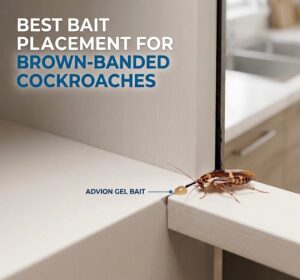
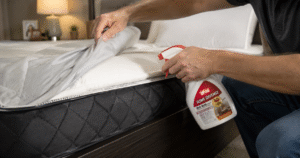
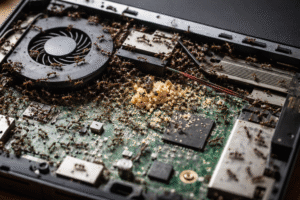
Brown-banded cockroaches can be surprisingly difficult to control because they often hide in places you may not think to look. Instead of staying close to sinks and other damp areas, they can settle inside cabinets, furniture, appliances, electronics, wall spaces, and other warm, protected locations.
The good news is that you do not need to spray every room to get started. A better approach is to combine targeted baiting, insect growth regulators, monitoring traps, appropriate residual insecticides, sanitation, and careful treatment of hiding places.
The products below were researched and selected by BugOffControl.com based on their intended pest-control use, product type, manufacturer information, and the role each product can play in a broader brown-banded cockroach control strategy.
BugOffControl Recommended
The products featured in this guide were researched and selected by BugOffControl.com based on product information, intended use, active ingredients, and their potential role in a complete brown-banded cockroach management program.
We do not claim to have personally tested these products. Instead, we focus on the available product information and explain where each type of control may fit.
Affiliate Disclosure: If you purchase through links on this page, BugOffControl.com may earn a commission at no additional cost to you. This helps support the site and allows us to continue publishing pest-control guides and product reviews.
As an Amazon Associate I earn from qualifying purchases.
Quick Answer: What Is the Best Product for Brown-Banded Cockroaches?
Choose the Right Control Approach for Brown-Banded Cockroaches
The best way to control brown-banded cockroaches depends on how often you see them and where they are hiding. Because these roaches often hide in dry, elevated areas such as cabinets, furniture, closets, appliances, and electronics, targeted baiting and monitoring can be more useful than simply spraying visible areas.
Use the guide below to match your situation with an appropriate control strategy.
| Brown-Banded Cockroach Situation | Recommended Control Approach | Primary Goal |
|---|---|---|
| Occasional sightings | Advion Cockroach Gel Bait + monitoring traps + sanitation | Find where roaches are active and target feeding roaches before the problem grows. |
| Regular indoor activity | Advion or Maxforce FC Magnum + an IGR + monitoring traps | Reduce active roaches while disrupting the development of immature roaches. |
| Roaches around cabinets, furniture, or electronics | Gel bait + IGR + targeted monitoring | Target hidden activity without relying on widespread indoor spraying. |
| Heavy or recurring infestation | Gel bait + IGR + appropriate residual treatment + monitoring | Attack the infestation from multiple directions and reduce the chance of continued activity. |
| Roaches appearing in multiple elevated areas | Bait + IGR + targeted treatment of cracks and harborages | Reach hidden populations and help reduce reproduction and future activity. |
A Simple Rule for Brown-Banded Roach Control
If you are seeing only an occasional brown-banded cockroach, start with monitoring, sanitation, and targeted bait placement.
When sightings become regular or you find evidence of an established infestation, a more comprehensive approach using gel bait, an insect growth regulator (IGR), monitoring traps, and appropriately labeled treatments may be necessary.
Always follow the product label for application sites, amounts, safety precautions, and restrictions. Avoid placing insecticide products where they could contaminate food, food-contact surfaces, or areas accessible to children or pets.
Why This Approach Works
Brown-banded cockroach control is usually more effective when different methods have different jobs.
Gel bait targets cockroaches that are feeding.
An IGR works on cockroach development.
Monitoring traps help reveal where activity is occurring.
Residual insecticides and dusts can provide additional control where their labels permit the intended application.
Sanitation and exclusion help remove conditions that allow cockroaches to survive and spread.
You may not need every product listed in this guide. The right combination depends on how much activity you are seeing and where the cockroaches are hiding.
Always read and follow the current product label before using any pesticide.
Where Do Brown-Banded Cockroaches Hide?
One of the biggest challenges with brown-banded cockroaches is that they can establish themselves in areas that are easy to overlook.
They may hide in:
- Kitchen cabinets
- Upper cabinets
- Furniture
- Closets
- Behind pictures and wall decorations
- Electronics
- Appliances
- Wall voids
- Ceiling areas
- Cracks and crevices
- Storage boxes
- Sheltered areas behind or underneath furniture
- Areas around electrical equipment
- Other warm, protected locations
This behavior is important when choosing a control product.
If you only treat the floor and lower baseboards, you may miss a significant portion of the population.
Why Brown-Banded Cockroaches Can Be Difficult to Control
Brown-banded cockroaches are small and secretive.
They can hide during the day and become active when the home is quiet.
Their ability to use elevated hiding places also means you may find evidence of activity in locations that seem unrelated to food or water.
For example, you might notice cockroaches or droppings around:
- Upper cabinets
- Furniture
- Electronics
- Shelves
- Closets
- Wall areas
- Ceilings
- Storage spaces
That is why finding the harborages is just as important as choosing the insecticide.
How We Chose These Brown-Banded Cockroach Products
We researched these products according to their intended pest-control purpose, product type, active ingredients, manufacturer information, and potential role in cockroach management.
We also looked at how each product performs a different job.
You are not simply buying several products that do the same thing.
Instead:
Gel bait = feeding-based control
IGR = development and population management
Glue traps = monitoring
Residual insecticide = additional targeted control
Dust = treatment of suitable cracks and voids where labeled
That makes it easier to build a control program around the actual problem.
1. Advion Cockroach Gel Bait — Best Overall for Targeted Baiting 4.6 ☆
☆

Best for: Targeted brown-banded cockroach baiting
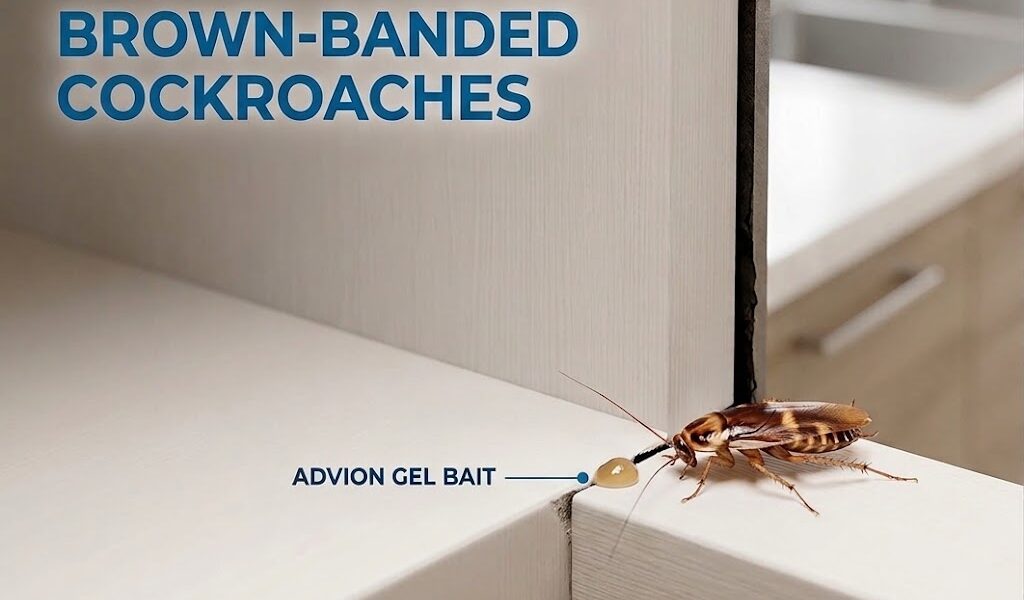
Advion Cockroach Gel Bait is one of the products worth considering when brown-banded cockroaches are actively feeding in areas where bait can be placed appropriately.
Instead of covering a room with spray, gel bait allows you to place small amounts in selected areas where cockroaches are likely to encounter it.
For brown-banded cockroaches, that can be particularly useful around appropriate hiding and activity areas such as cabinets, furniture, cracks, and other locations permitted by the product label.
Why Consider Advion?
Brown-banded cockroaches can spend much of their time hidden.
That makes targeted baiting an appealing part of an integrated control strategy.
The important point is placement.
Do not simply put bait in the middle of an open room and expect it to solve the problem. Look for signs of activity and place the product only where the current label permits.
Pros
- Designed for cockroach control
- Targeted application
- Useful as part of an integrated pest-management program
- Can complement monitoring and sanitation
- Less dependent on treating large surface areas
Cons
- Placement matters
- Does not correct the underlying infestation source
- Should not be treated as the only control method for a serious infestation
- Must be used according to the current label
Best use: Targeted baiting where brown-banded cockroach activity has been identified.
Check Latest Price & Availability on Amazon
2. Maxforce FC Magnum — Best Alternative Gel Bait 4.4 ☆

Best for: Targeted cockroach baiting
Maxforce FC Magnum is another professional-style cockroach gel bait that can be considered for targeted cockroach control.
Like other gel baits, its main advantage is that you can concentrate the treatment in areas where cockroach activity has been found rather than automatically spraying large portions of the home.
For brown-banded cockroaches, the ability to place bait near suitable harborages can be especially useful because these roaches may hide in cabinets, furniture, wall areas, and other protected locations.
Pros
- Gel-bait format
- Designed for cockroach control
- Useful for targeted applications
- Can complement an integrated pest-control program
Cons
- Correct placement is important
- Does not eliminate hiding places
- Does not correct sanitation or structural problems
- Must be used according to the current label
Best use: An alternative gel-bait option when targeted baiting is appropriate.
Check Latest Price & Availability on Amazon
3. Gentrol IGR — Best for Supporting Long-Term Population Management 4.6 ☆

Best for: Interfering with cockroach development
Gentrol is an insect growth regulator (IGR), giving it a different job from cockroach bait or conventional insecticides.
Instead of functioning primarily as a bait, an IGR is intended to interfere with insect development.
That can make an IGR a useful addition when brown-banded cockroach activity has become established.
Why Consider an IGR?
Killing the adult cockroaches you see is only part of the problem.
If immature cockroaches continue developing, the population can remain active.
An IGR provides another tool for population management when its labeled use is appropriate.
It should not, however, be viewed as a replacement for baiting, sanitation, monitoring, or finding hiding places.
Pros
- Different control function from gel bait
- Can complement other cockroach-control methods
- Designed to interfere with insect development
- Useful as part of a broader management program
Cons
- Does not immediately eliminate all visible cockroaches
- Does not remove food or hiding places
- Does not seal entry points
- Works best as part of a broader strategy
- Must be used according to the current label
Best use: Established brown-banded cockroach activity where an IGR is appropriate according to the current label.
Check Latest Price & Availability on Amazon
4. Catchmaster Glue Traps — Best for Monitoring 4.3 ☆

Best for: Finding hidden cockroach activity
Glue traps are not a substitute for an insecticide, but they can be extremely useful when you are trying to figure out where brown-banded cockroaches are hiding.
Because these roaches can use unusual harborages, monitoring helps you avoid guessing.
Place traps in appropriate areas where activity is suspected.
Consider locations such as:
- Inside or near cabinets
- Near furniture
- Along walls
- Near suspected hiding areas
- Around appliances
- Near storage areas
- In closets
- Near other areas where droppings or roaches have been found
Pros
- Helps locate activity
- Useful for monitoring progress
- Does not require pesticide
- Can reveal hidden hotspots
Cons
- Does not eliminate an established infestation by itself
- Traps need to be checked
- A trap catches the roach but does not remove the reason the infestation developed
Best use: Monitoring light, moderate, and heavy brown-banded cockroach activity.
Check Latest Price & Availability on Amazon
5. PT Phantom II — Best for Targeted Residual Treatment 4.4 ☆

Best for: Appropriate crack-and-crevice or other labeled residual treatment
PT Phantom II is a residual insecticide that can provide another control option when a labeled application is appropriate.
This type of product can be useful when cockroaches are using cracks, crevices, and protected areas that cannot be effectively addressed with bait alone.
However, residual insecticide should be used strategically.
The goal is not to spray every surface in the home.
Pros
- Provides a control method different from bait
- Useful for targeted residual applications where labeled
- Can complement a broader cockroach-control program
Cons
- Application must follow the current label
- Does not eliminate food or hiding places
- Does not replace monitoring
- Requires attention to safety and application requirements
Best use: Targeted residual treatment where permitted by the current label.
Check Latest Price & Availability on Amazon
6. Talstar P — Best for Appropriate Residual Insecticide Treatment
Best for: Labeled residual cockroach treatment
Talstar P is another insecticide that may have a place in a broader pest-control program when the current label permits the intended application.
Its role is different from a gel bait or IGR.
A residual insecticide can provide another treatment method for appropriate areas rather than relying entirely on feeding-based control.
Pros
- Provides residual insecticide control
- Can complement baiting
- Useful for appropriate labeled applications
- Can be part of an integrated pest-management program
Cons
- Correct mixing and application are important
- Label restrictions must be followed
- Does not eliminate food or hiding places
- More pesticide is not automatically better
Best use: Appropriate residual treatment where permitted by the current label.
Check Latest Price & Availability on Amazon
7. Boric Acid Dust — Best for Suitable Hidden Cracks and Voids 3.9 ☆

Best for: Appropriate cracks, crevices, and protected areas
Boric acid dust can provide another method of cockroach control when used appropriately.
A light application in a suitable crack or protected area can be more useful than creating piles of powder.
The key word is light.
Brown-banded cockroaches may use cracks and protected spaces that are difficult to reach with liquid products, so dust can have a place in an overall control strategy where the product label permits the application.
Pros
- Useful in suitable cracks and crevices
- Provides a different control method
- Can reach some protected areas
- Generally inexpensive compared with some professional pest-control products
Cons
- Must be applied correctly
- Heavy applications are not better
- Should not be left where people or pets can contact it
- Follow the current product label
Best use: Suitable hidden areas where labeled dust application is appropriate.
8. Diatomaceous Earth — Best for Appropriate Dry Areas 4.5 ☆

Best for: Certain dry cracks and protected areas
Diatomaceous earth is another dust-based option sometimes used for insect control.
It works differently from a conventional residual spray and is most useful when kept dry and applied in an appropriate location.
It is not something you need to spread throughout the home.
Pros
- Different control method from liquid insecticides
- Can be useful in appropriate dry areas
- Can complement other control methods
Cons
- Moisture can reduce its usefulness
- Must be used according to the product label
- Fine dust should not be unnecessarily airborne
- Does not replace baiting or sanitation
Best use: Appropriate dry cracks and protected areas where the product label permits use.
Brown-Banded Cockroach Control: Which Products and Methods Fit the Infestation?
| Product / Method | Primary Purpose | Light Activity | Moderate Activity | Heavy / Recurring Activity |
|---|---|---|---|---|
| Advion Cockroach Gel Bait | Target cockroaches where they feed and hide | ✓ | ✓ | ✓ |
| Maxforce FC Magnum | Alternative professional-style gel bait | ✓ | ✓ | ✓ |
| Gentrol IGR | Helps disrupt cockroach development and population growth | — | ✓ | ✓ |
| Catchmaster Glue Traps | Monitor activity and identify problem areas | ✓ | ✓ | ✓ |
| PT Phantom II | Residual treatment for labeled indoor areas | — | ✓ | ✓ |
| Talstar P | Residual insecticide treatment where permitted by the label | — | ✓ | ✓ |
| Boric Acid Dust | Treat suitable cracks, crevices, and protected areas | — | ✓ | ✓ |
| Diatomaceous Earth | Dry-area treatment for suitable cracks and hiding areas | — | ✓ | ✓ |
| Sanitation & Cleaning | Remove food, grease, moisture, and other attractants | ✓ | ✓ | ✓ |
| Decluttering & Exclusion | Reduce hiding places and seal potential entry points | ✓ | ✓ | ✓ |
Important: You do not need to use every product in this table. Product availability, permitted uses, application sites, and rates can vary. Always read and follow the current product label before using any pesticide.
How to Choose the Right Brown-Banded Cockroach Control
Light Activity
If you have seen one or two brown-banded cockroaches, do not immediately assume the entire home is infested.
Start by looking for where the activity is occurring.
A practical starting point is:
Monitoring traps + sanitation + targeted baiting
Use monitoring traps to determine whether the activity is isolated or occurring in several areas.
If you find a hotspot, targeted gel bait may be appropriate.
Moderate Activity
Moderate activity may include:
- Repeated sightings
- Droppings in several locations
- Cockroaches appearing in cabinets or furniture
- Activity around electronics
- Roaches appearing at night
- Evidence of immature cockroaches
- Activity continuing after cleaning
A broader approach may include:
Targeted gel bait + Gentrol IGR + monitoring + appropriate residual treatment
Each product has a specific job.
Gel bait: targets feeding cockroaches.
IGR: interferes with development.
Monitoring traps: show where activity remains.
Residual insecticide: provides another control method where the label permits it.
Heavy or Recurring Activity
A more serious infestation may involve:
- Frequent sightings
- Numerous cockroaches
- Immature cockroaches
- Droppings in multiple rooms
- Activity throughout cabinets and furniture
- Cockroaches appearing during the daytime
- Repeated activity after treatment
- Cockroaches hiding in multiple elevated locations
At this point, a broader strategy may include:
Gel bait + IGR + monitoring + appropriate residual treatment + sanitation + removal of hiding places
The objective is not to use the most products possible.
The objective is to attack the infestation from several directions.
Where Should You Look for Brown-Banded Cockroaches?
Because brown-banded cockroaches can hide above the floor, inspect areas that are often overlooked.
Look around:
- Upper cabinets
- Behind furniture
- Inside drawers
- Closets
- Shelves
- Wall decorations
- Electronics
- Appliances
- Storage boxes
- Cracks and crevices
- Ceiling areas
- Behind or underneath furniture
Monitoring traps can help narrow down the most active areas.
Once you know where the cockroaches are concentrating, you can make your control efforts more targeted.
Sanitation Still Matters
Brown-banded cockroaches may not be as strongly associated with damp areas as some other cockroach species, but sanitation is still important.
Clean up:
- Food crumbs
- Grease
- Spilled drinks
- Pet food
- Food residue
- Garbage
- Cardboard and unnecessary clutter
- Other materials that provide shelter
Store food in sealed containers and keep food-preparation surfaces clean.
You are not trying to make the house sterile.
You are simply making it harder for cockroaches to find food and shelter.
Reduce Clutter and Hiding Places
This step can be especially important for brown-banded cockroaches.
Stacks of paper, cardboard boxes, cluttered shelves, and unused storage items can create protected spaces where cockroaches can hide.
When practical:
- Remove unnecessary cardboard
- Reduce clutter
- Organize storage areas
- Keep cabinets easier to inspect
- Clean behind furniture
- Avoid creating unnecessary piles of stored materials
The easier it is to inspect an area, the easier it becomes to find and treat cockroach activity.
Why You Should Not Spray Everywhere
More pesticide does not automatically mean better control.
Widespread spraying can also make it harder to use bait effectively if the treatment contaminates areas where cockroaches would otherwise feed.
Instead, think about targeted control.
Find the activity.
Identify the harborage.
Choose the appropriate control method.
Follow the label.
Then monitor the results.
What Germs Can Brown-Banded Cockroaches Spread?
Cockroaches can move through unsanitary environments and may mechanically transfer microorganisms onto surfaces as they travel.
They may encounter garbage, contaminated materials, food waste, and other areas containing microorganisms.
Their droppings, shed skins, and body parts can also contribute to indoor allergens.
This is one reason a persistent cockroach infestation should not simply be ignored.
If cockroaches have been moving across food-preparation surfaces, clean and disinfect appropriate surfaces while working to control the infestation.
How Fast Can Brown-Banded Cockroaches Multiply?
Brown-banded cockroaches can reproduce when they have suitable food, shelter, and environmental conditions.
Females produce egg cases called oothecae, which contain multiple eggs.
The problem is that a small number of cockroaches can become a much larger problem if conditions allow reproduction to continue.
That is why repeated sightings should not automatically be dismissed as isolated visitors.
If you start finding multiple cockroaches, immature roaches, droppings, or activity in several hiding places, investigate the problem before it becomes harder to manage.
Common Brown-Banded Cockroach Control Mistakes
Treating Only the Floor
Brown-banded cockroaches can use elevated hiding places, so treating only lower baseboards may miss important activity.
Ignoring Cabinets and Furniture
Inspect shelves, drawers, furniture, and other protected areas where cockroaches may hide.
Forgetting Electronics
Warm electronics and appliances can provide protected hiding areas.
Using Too Much Bait
More bait is not necessarily better. Follow the product label and place bait strategically.
Spraying Over Bait
Using incompatible treatments around bait can interfere with a baiting strategy.
Ignoring Clutter
Boxes, paper, and stored materials can provide additional hiding places.
Expecting One Product to Do Everything
Bait, IGRs, traps, dusts, residual insecticides, and sanitation all have different jobs.
Skipping Monitoring
If you do not monitor the infestation, you may not know where the real hotspots are or whether activity is declining.
Pesticide Safety and PPE
Pesticide safety should always come before convenience.
Before using an insecticide, read the current product label and use all personal protective equipment required by the manufacturer.
Depending on the product, PPE may include:
- Chemical-resistant gloves
- Protective eyewear
- Long sleeves
- Long pants
- Closed-toe footwear
- Respiratory protection when specifically required
Do not assume that the safety requirements for one product apply to another.
Keep children and pets away from treated areas whenever required by the product label, and follow all ventilation and re-entry instructions.
Always Follow the Manufacturer’s Label
This is one of the most important rules when using any pesticide.
Before mixing, applying, storing, or disposing of a product, read the current label.
Pay particular attention to:
- Approved application sites
- Mixing instructions
- Application rates
- PPE requirements
- Re-entry instructions
- Ventilation requirements
- Storage
- Disposal
- Restrictions around food, children, and pets
Never increase the application rate simply because you have a serious infestation.
Frequently Asked Questions
What is the best product for brown-banded cockroaches?
There is not one product that is best for every infestation.
For many indoor situations, a combination of targeted gel bait, monitoring, sanitation, and an IGR can provide a practical starting point. More serious infestations may require additional treatment methods.
What is the best brown-banded cockroach bait?
Advion Cockroach Gel Bait and Maxforce FC Magnum are two gel-bait options worth considering for targeted cockroach control.
Always confirm the current label and use the product only as directed.
Do brown-banded cockroaches live in kitchens?
Yes. They can be found in kitchens, but they are not limited to the areas immediately around sinks and plumbing.
They may also hide in cabinets, furniture, appliances, electronics, walls, and other protected locations.
Why do brown-banded cockroaches hide so high up?
Brown-banded cockroaches can use warm, protected areas above the floor, including cabinets, furniture, wall spaces, and other sheltered locations.
That behavior makes inspection important.
Should I use an IGR for brown-banded cockroaches?
An IGR can be useful as part of a broader control program when the product label permits its use.
It is designed to interfere with insect development, but it does not replace baiting, sanitation, monitoring, or other appropriate control methods.
Are glue traps good for brown-banded cockroaches?
Yes, primarily as a monitoring tool.
Glue traps can help reveal where cockroaches are traveling and whether activity is decreasing.
They should not be expected to eliminate an established infestation by themselves.
Can I use boric acid for brown-banded cockroaches?
Boric acid products can be useful in suitable areas when the product is labeled for cockroach control and the application is performed according to the label.
A light, properly placed application is preferable to creating piles of dust.
Can diatomaceous earth kill brown-banded cockroaches?
Certain labeled diatomaceous-earth products can be used for insect control. Their effectiveness depends on appropriate use and keeping the dust dry.
Always follow the specific product label.
Should I use residual spray with cockroach bait?
A residual insecticide may have a place in a broader control program, but treatment should be strategic.
Always follow the current labels for both products and avoid applications that conflict with the baiting strategy.
Why do brown-banded cockroaches keep coming back?
Possible reasons include:
- Hidden harborages
- Egg cases
- Food sources
- Clutter
- Untreated cracks and crevices
- Activity inside furniture or appliances
- Untreated rooms or storage areas
- Incomplete control of the existing population
Finding the hiding places is often just as important as killing the cockroaches you see.
How do I know if my treatment is working?
Look for:
- Fewer sightings
- Fewer droppings
- Fewer cockroaches caught in monitoring traps
- Less activity in previously active areas
- Fewer immature cockroaches
- Reduced activity around known harborages
Monitoring is important because seeing one cockroach after treatment does not necessarily tell you whether the overall population is increasing or declining.
When should I call a professional?
Consider professional pest-control assistance if the infestation is widespread, persistent, repeatedly returns, involves difficult-to-access areas, or does not improve despite appropriate control measures.
Final Verdict
Brown-banded cockroaches require a slightly different approach from the typical spray around the kitchen and hope for the beststrategy.
These roaches can hide in cabinets, furniture, electronics, wall areas, storage spaces, and other warm, protected locations, making inspection and monitoring especially important.
For BugOffControl.com, the simplest way to think about the control program is:
1. Find where they are hiding.
2. Remove food and clutter that support the infestation.
3. Use monitoring traps to identify active areas.
4. Use targeted gel bait where appropriate.
5. Consider an IGR for established activity.
6. Use an appropriate residual insecticide or dust where the label permits it.
7. Continue monitoring to see whether activity is declining.
You do not necessarily need every product listed in this guide.
For light activity, monitoring, sanitation, and targeted baiting may be enough.
For moderate activity, adding an IGR and appropriate additional treatment may make sense.
For heavy or recurring activity, a broader integrated approach may be needed.
The most important point is simple:
Don’t just kill the brown-banded cockroaches you see. Find where they are hiding and address the conditions allowing the infestation to continue.