Best Products for Little Black Ants (Control Guide)
Little black ants may be tiny, but when you start seeing a steady trail crossing your kitchen counter, along a baseboard, around a window, or near the sink, they can become a frustrating household pest.
The good news is that you do not necessarily need to spray every ant you see.
A better approach is to follow the trail, find what is attracting the ants, choose the right control method, monitor activity, remove food and moisture sources, and seal suitable entry points.
This guide brings those steps together with practical little black ant control products for indoor baiting, monitoring, outdoor activity, insecticide treatment, and prevention.
Quick strategy: Identify the trail → remove competing food → use an appropriate bait → monitor activity → investigate outside → correct moisture problems → seal suitable entry points.
You do not need every product in this guide. Choose the products that match the problem you actually have.
Affiliate Disclosure: If you purchase through links on this page, BugOffControl.com may earn a commission at no additional cost to you. This helps support our pest-control guides and product research.
As an Amazon Associate I earn from qualifying purchases.
Quick Answer: What Is the Best Little Black Ant Control Kit?
There is no single product that is guaranteed to solve every little black ant problem. For many household situations, the most practical approach is a combination of:
Indoor bait + monitoring + sanitation + moisture control + exclusion
If ants are repeatedly entering from outdoors, exterior inspection and an appropriate outdoor treatment may also become part of the plan when the product label permits the intended application.
Top Little Black Ant Products at a Glance
Best Little Black Ant Products for Kitchen: Quick Comparison
| Product / Solution | Best Use | Main Role in Ant Control |
|---|---|---|
| Syngenta Advion Ant Gel | Active indoor ant trails | Targeted bait placement near areas where ants are actively foraging |
| TERRO T300B Liquid Ant Bait Stations | Simple indoor baiting | Ready-to-use liquid bait for convenient placement |
| TERRO T3206SR Traps | Monitoring indoor activity | Helps monitor where little black ants are traveling and whether activity is changing |
| Spectracide Ant Shield Granules | Outdoor ant activity | Outdoor insect-control option for areas permitted by the product label |
| Alpine WSG | Broader insect-control needs | Water-soluble insecticide option when an appropriate labeled application is needed |
| Caulk or Sealant | Ant entry points | Helps close suitable cracks, gaps, and potential entry routes |
| Sanitation | Food-attracted ants | Removes crumbs, spills, grease, and other competing food sources |
| Moisture Control | Damp areas | Helps address moisture conditions that may contribute to recurring ant activity |
If You Only Want the Essentials
For a typical indoor little black ant problem, you can start with:
1. One appropriate bait
2. Monitoring
3. Thorough sanitation
4. Entry-point inspection
Add outdoor treatment or another insecticide only when the situation calls for it and the product label permits the intended use.
Which Little Black Ant Product Should You Buy?
The easiest way to choose is to start with the problem, not the product.
Active ants on kitchen counters or cabinets?
Consider Advion Ant Gel or TERRO T300B for appropriate indoor baiting.
You want a contained bait station?
Consider TERRO T300B.
You cannot figure out where the ants are traveling?
Consider TERRO T3206SR as a monitoring tool.
Ant activity is clearly coming from outside?
Investigate the exterior and consider an appropriate outdoor treatment such as Spectracide Ant Shield Granules, where the current label permits the intended application.
You need an insecticide treatment?
Alpine WSG may be considered for appropriate treatment situations when the current label permits its use.
Ants are entering through cracks and gaps?
Use a suitable caulk or sealant after identifying the important entry route.
Ants keep returning?
Do not automatically buy more pesticide. Check:
- Food sources
- Moisture
- Outdoor activity
- Entry points
- Areas that have not been inspected
- Whether the bait is being accepted
1. Syngenta Advion Ant Gel 4.5  ☆
☆
Best Fit: Targeted Indoor Little Black Ant Baiting
Product: Syngenta Advion Ant Gel
If you have an active little black ant trail indoors and prefer a targeted gel-bait format, Advion Ant Gel is one product to consider when the current label permits the intended application.
The advantage of a gel format is the ability to make small, targeted placements near appropriate areas of ant activity. Instead of randomly treating an entire room, first locate the trail and identify places where actively foraging ants are traveling.
Why Consider Advion?

Little black ants can use narrow routes along:
- Baseboards
- Counter edges
- Cabinets
- Window areas
- Door frames
- Utility openings
- Other cracks and gaps
Finding the trail gives you a much better idea of where targeted bait placement may make sense.
Pros
- Targeted gel-bait format
- Allows precise placement
- Useful for localized indoor ant activity
- Convenient for active trails
Cons
- Placement matters
- Competing food can reduce bait interest
- Requires monitoring
- Does not replace sanitation or exclusion
Best For
Homeowners dealing with active indoor ant trails who prefer a targeted gel-bait format.
Not Ideal as a Standalone Solution
Advion should not be viewed as a complete answer when ants continue to have easy access to food, moisture, or an unresolved entry route.
Bottom Line
Advion Ant Gel is a practical option to consider for targeted indoor little black ant baiting when the current product label permits the intended application.
Check Latest Price & Availability on Amazon
2. TERRO Liquid Ant Killer Bait Stations T300B 4.6 ☆
Best Fit: Easy Indoor Baiting
Product: TERRO Liquid Ant Killer Bait Stations, 12-Pack, T300B
If you would rather use a contained bait station than apply gel directly, TERRO T300B offers a convenient ready-to-use format. This can be especially appealing if you want a straightforward way to place bait near suitable ant activity without handling loose bait.
Why Consider TERRO T300B?

When ants are actively foraging indoors, a properly positioned bait station gives them access to the bait while keeping the bait contained within the station.
As with any ant bait, placement and acceptance matter.
If ants ignore the bait, look for competing food sources or consider whether the bait is positioned correctly for the activity you are seeing.
Pros
- Ready-to-use format
- Convenient indoor placement
- Contained liquid bait
- Simple approach for homeowners
Cons
- Placement matters
- Competing food may reduce interest
- Requires monitoring
- Does not address outdoor activity or structural entry by itself
Best For
Homeowners who want a simple, contained indoor baiting option.
Bottom Line
TERRO T300B is a convenient choice for homeowners who prefer ready-to-use liquid ant bait stations for indoor activity.
Check Latest Price & Availability on Amazon
Another Option
Raid Ant Killer Baits 4.0
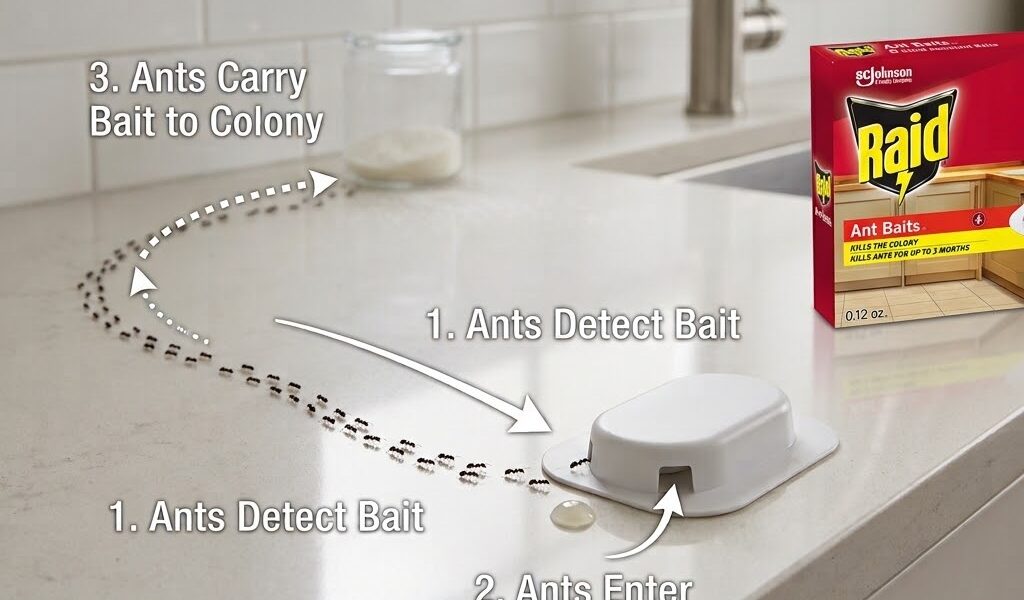
If you prefer a ready-to-use bait station for indoor ant activity, Raid Ant Killer Baits, Indoor Ant Control, 4 Count is another option to consider. The child-resistant bait stations are designed for indoor home use and are marketed to keep killing ants for up to three months. For little black ants traveling through kitchens, along baseboards, or around other indoor areas, placing the bait where ants are actively foraging can provide a convenient approach without spraying the entire area. As with any ant bait, follow the current product label carefully and keep the stations away from children and pets as directed.
Best For: Homeowners looking for a simple, ready-to-use indoor ant bait station.
Check Latest Price & Availability on Amazon
3. TERRO T3206SR Indoor Insect Traps 4.2
Best Fit: Monitoring and Locating Activity
Product: TERRO T3206SR — 12 indoor insect trap not every product in a pest-control kit needs to kill the pest. Sometimes the first job is figuring out where the activity is concentrated. That is where a monitoring product can be useful. Place monitoring traps strategically in areas where you have noticed activity and observe what happens over time.
Areas to Monitor
Consider areas such as:
- Kitchen
- Pantry
- Cabinets
- Baseboards
- Garage
- Utility areas
- Windows
- Doors
- Other locations where activity has been observed
Why Monitoring Matters

Seeing ants in the kitchen does not necessarily mean the kitchen is where the activity begins. A monitoring approach can help you investigate whether activity is concentrated in one location or occurring in several areas.
Pros
- Useful for monitoring activity
- Helps identify problem areas
- Convenient indoor format
- Supports a broader control strategy
Cons
- Monitoring alone does not eliminate an infestation
- Placement matters
- Should be used as part of a larger strategy
Best For
Homeowners who need help locating or tracking recurring indoor insect activity.
Bottom Line
Think of T3206SR as a monitoring tool, not your primary little black ant colony-control product.
Check Latest Price & Availability on Amazon
4. Spectracide Ant Shield Insect Killer Granules 4.3 ☆
Best Fit: Outdoor Little Black Ant Activity
Product: Spectracide Ant Shield Insect Killer Granules — 3 lb shaker bag, 4-pack
If little black ants repeatedly appear indoors, do not forget to investigate the outside of the home. Exterior trails around foundations, doors, windows, patios, walkways, or landscaping may provide useful clues about where ants are traveling.
Spectracide Ant Shield Granules provide a granular outdoor insect-control format for appropriate applications according to the current product label.
Where to Look Outside

Inspect:
- Foundations
- Exterior walls
- Doorways
- Windows
- Patios
- Walkways
- Landscaping
- Utility openings
- Areas with visible ant trails
Pros
- Outdoor granular format
- Convenient shaker-bag application
- Can complement an overall control strategy
- Useful for appropriate exterior applications
Cons
- Not an indoor bait
- Must be used according to the current label
- Exterior conditions can affect treatment
- Does not replace indoor baiting when indoor activity requires it
Best For
Homeowners dealing with recurring outdoor ant activity in areas where the product is labeled for use.
Bottom Line
Spectracide Ant Shield Granules can be considered as part of an outdoor control strategy when the intended application is permitted by the current product label.
Check Latest Price & Availability on Amazon
5. Alpine WSG Insecticide 4.7 ☆
Best Fit: Appropriate Insecticide Treatment
Product: Alpine WSG Insecticide — 5 × 10g packets, with protective gloves and pest identification card
Alpine WSG has a different role from the bait products in this guide. It is an insecticide treatment option that may be considered when the situation calls for insecticide treatment and the current product label permits the intended application.
Why Include Alpine WSG?

Some pest-control situations require more than baiting. An appropriate insecticide treatment can form part of a broader integrated pest-management approach when used correctly. However, it should not automatically be applied around active bait placements simply because ants are present.
Consider:
- Where ants are traveling
- Where they are entering
- Whether baiting is being used
- The intended treatment area
- The current product label
Pros
- Water-soluble formulation
- Broad insect-control product
- Can be used in appropriate treatment situations
- Can complement an integrated pest-control strategy
Cons
- Requires label-directed preparation and application
- Does not replace sanitation
- Does not replace exclusion
- Should not be casually combined with active bait placements
Best For
Homeowners who need an appropriate insecticide treatment option and are prepared to follow the current label carefully.
Bottom Line
Alpine WSG can be considered as part of a little black ant control strategy when the specific treatment situation and current label permit its use.
Check Latest Price & Availability on Amazon
6. Caulk and Sealant 4.8
Best Fit: Closing Suitable Entry Points
Sometimes the most useful pest-control product is not a pesticide. If ants can repeatedly enter through a crack or gap, that opening may continue to provide access even after visible activity has been reduced.
Inspect:

- Door frames
- Window frames
- Foundation cracks
- Utility openings
- Pipe penetrations
- Cable openings
- Baseboards
- Wall gaps
- Other structural openings
Use the Right Sequence
Do not blindly seal every opening where you see an ant.
Instead:
Follow the trail → identify the route → address the activity → seal the suitable opening.
Pros
- Helps reduce future entry
- Supports long-term prevention
- Inexpensive compared with repeated pesticide applications
- Useful around suitable structural gaps
Cons
- Does not kill ants
- Cannot eliminate a colony by itself
- Requires identifying useful entry points
Bottom Line
Caulk and sealant are simple but important tools for reducing repeated ant entry.
Check Latest Price & Availability on Amazon
7. Sanitation
Best Fit: Removing Competing Food Sources
Ant bait has to compete with whatever food is already available. A small amount of sugar, syrup, crumbs, grease, pet food, or sticky residue can make an area more attractive to foraging ants.
Regularly clean:
- Kitchen counters
- Floors
- Cabinets
- Pantry shelves
- Areas around appliances
- Pet-feeding areas
- Dining areas
- Trash containers
Pay particular attention to:
- Sugar
- Syrup
- Juice
- Crumbs
- Grease
- Sticky spills
- Food residue
- Pet food
Store attractive foods in sealed containers whenever practical.
Bottom Line
Sanitation does not replace baiting, but reducing competing food sources can make the environment less attractive to foraging ants and may help your baiting strategy.
8. Moisture Control
Best Fit: Correcting Water and Damp Conditions
Food is not the only thing worth investigating.
Moisture can also make an area more attractive to pests.
Check around:
- Kitchen sinks
- Bathroom plumbing
- Refrigerators
- Air-conditioning equipment
- Cabinets
- Windows
- Exterior walls
- Landscaping
- Drainage areas
Look for:
- Leaking faucets
- Plumbing leaks
- Condensation
- Damp cabinets
- Standing water
- Persistently wet areas
Correcting an underlying moisture problem can help make the environment less favorable to recurring pest activity.
Bottom Line
Moisture control is an easy-to-overlook part of long-term little black ant prevention.
Little Black Ant Control Kit: What Each Product Does
The easiest way to understand this kit is to give every item a specific job.
Little Black Ant Control Products: Match the Product to the Job
| Control Job | Product / Action | What It Does |
|---|---|---|
| 🐜 Bait | Syngenta Advion Ant Gel | Targeted bait placement for active indoor little black ant trails |
| 🧴 Bait Station | TERRO T300B Liquid Ant Bait Stations | Ready-to-use liquid bait for convenient indoor placement |
| 🔎 Monitor | TERRO T3206SR Traps | Helps monitor ant activity and identify areas where ants are traveling |
| 🌿 Outdoor Treatment | Spectracide Ant Shield Granules | Outdoor insect-control option for appropriate labeled applications |
| 🧪 Insecticide | Alpine WSG | Water-soluble insecticide option for suitable labeled applications |
| 🏠 Exclusion | Caulk / Sealant | Helps close suitable cracks, gaps, and potential ant entry points |
| 🧹 Food Control | Sanitation | Removes crumbs, spills, grease, and other food sources that may attract ants |
| 💧 Moisture Control | Repairs / Drying | Helps correct damp conditions that may contribute to recurring ant activity |
Little Black Ant Control by Situation
If You Have a Few Ants Indoors
Start with investigation rather than immediately treating everything.
Start here:
- Follow the trail.
- Look for food and moisture.
- Clean competing food sources.
- Consider an appropriate bait.
- Inspect possible entry points.
Products to Consider
If You Have a Regular Indoor Trail
When ants are appearing repeatedly, take a more organized approach.
Start here:
- Follow the trail.
- Remove competing food.
- Use an appropriate bait.
- Monitor activity.
- Check moisture.
- Inspect entry points.
Products to Consider
Advion or TERRO T300B + T3206SR
If Ants Are Coming From Outside
Look beyond the kitchen.
Inspect:
- Foundation
- Doors
- Windows
- Patios
- Walkways
- Landscaping
- Exterior walls
- Utility openings
Then consider an appropriate outdoor treatment where permitted by the product label.
Product to Consider
Spectracide Ant Shield Granules
If You Cannot Find the Source
Do not keep applying products randomly. Start by gathering information.
Focus On
Monitoring + trail observation + food inspection + moisture inspection
Product to Consider
If Little Black Ants Keep Returning
Recurring activity is a reason to investigate the conditions behind the problem.
Check:
- Exterior trails
- Food sources
- Moisture
- Doors and windows
- Plumbing penetrations
- Foundation gaps
- Wall openings
- Areas you have not previously inspected
A larger control strategy may include:
Baiting + monitoring + sanitation + moisture control + exclusion
An appropriate insecticide treatment may also have a role when the current product label permits its use.
Indoor vs. Outdoor Little Black Ant Control
Little Black Ant Control Products: Match the Product to the Job
| Control Job | Product / Action | What It Does |
|---|---|---|
| 🐜 Bait | Syngenta Advion Ant Gel | Targeted bait placement for active indoor little black ant trails |
| 🧴 Bait Station | TERRO T300B Liquid Ant Bait Stations | Ready-to-use liquid bait for convenient indoor placement |
| 🔎 Monitor | TERRO T3206SR Traps | Helps monitor ant activity and identify areas where ants are traveling |
| 🌿 Outdoor Treatment | Spectracide Ant Shield Granules | Outdoor insect-control option for appropriate labeled applications |
| 🧪 Insecticide | Alpine WSG | Water-soluble insecticide option for suitable labeled applications |
| 🏠 Exclusion | Caulk / Sealant | Helps close suitable cracks, gaps, and potential ant entry points |
| 🧹 Food Control | Sanitation | Removes crumbs, spills, grease, and other food sources that may attract ants |
| 💧 Moisture Control | Repairs / Drying | Helps correct damp conditions that may contribute to recurring ant activity |
How to Get Rid of Little Black Ants: Step-by-Step
If you want a simple process to follow, use this sequence.
Step 1: Follow the Trail
Do not immediately wipe out every visible ant. Watch where the ants are traveling.
Look for:
- Entry points
- Food
- Water
- Shelter
- Cracks
- Gaps
- Outdoor connections
Step 2: Remove Competing Food
Clean:
- Crumbs
- Sugary spills
- Grease
- Pet food
- Food residue
- Sticky surfaces
Keep food stored properly.
Step 3: Check Moisture
Look for:
- Leaks
- Condensation
- Damp cabinets
- Standing water
- Wet areas around appliances
- Plumbing problems
Correct problems you can safely address.
Step 4: Choose the Appropriate Bait
For suitable indoor baiting situations, consider:
or
Use the product according to its current label.
Step 5: Monitor Activity
Use observation or an appropriate monitoring product such as TERRO T3206SR to keep track of where activity is occurring.
Step 6: Investigate Outside
If ants repeatedly appear indoors, inspect the exterior.
Look for trails around:
- Foundations
- Doors
- Windows
- Patios
- Walkways
- Landscaping
Step 7: Address Appropriate Entry Points
Once you understand the route, seal suitable cracks or gaps where practical.
Step 8: Keep Monitoring
Do not judge the entire strategy by what happens immediately. Look at the overall trend in activity.
Little Black Ant Bait vs. Spraying
This is an important distinction.
Spraying Visible Ants
An insecticide can kill ants that directly contact the treatment. The limitation is that killing visible workers does not necessarily address the larger source of activity If food, moisture, outdoor activity, or an entry route remains, ants may appear again.
Baiting
Baiting uses a different approach.
Foraging ants encounter an appropriate bait and may carry it toward other ants.
This makes baiting useful when the goal is to take advantage of ant feeding behavior rather than simply kill individual workers on contact.
The Practical Difference
Spraying focuses on ants contacted by the treatment. Baiting is designed to take advantage of feeding behavior.
Neither approach is guaranteed to solve every situation.
The appropriate method depends on the location, ant activity, bait acceptance, product label, and overall control strategy.
Common Little Black Ant Control Mistakes
1. Killing Every Ant Immediately
Before reaching for a spray, take a moment to follow the trail. The trail can provide useful information about where the ants are traveling.
2. Using Too Many Products
More products do not automatically mean better control. Give every product a specific job.
3. Spraying Around Active Bait
Some insecticide applications can interfere with ants feeding on bait. Follow the current labels and avoid practices that undermine your baiting strategy.
4. Ignoring Outdoor Activity
If ants repeatedly enter from outside, treating only the kitchen may not address the entire problem. Investigate the exterior.
5. Leaving Food Available
Crumbs, sugary residue, pet food, grease, and spills can compete with bait.
6. Ignoring Moisture
A leaking faucet, damp cabinet, condensation, or another moisture problem can continue making an area attractive.
7. Sealing the Wrong Opening
If you seal an opening without understanding the route, ants may simply use another path.
Follow the trail first.
8. Expecting Instant Results
Do not judge the entire strategy by what happens immediately after treatment. Monitor the overall activity over time.
Do You Need the Complete Little Black Ant Control Kit?
Not necessarily.
This is a buyer’s guide, not a recommendation to purchase every product listed.
Mainly Indoor Ants
Start with:
One appropriate bait + sanitation + monitoring + entry-point inspection
Mainly Outdoor Activity
Focus on:
Exterior inspection + appropriate outdoor treatment + exclusion + sanitation
Cannot Find the Source
Start with:
Monitoring + trail observation + food inspection + moisture inspection
Persistent Activity
Consider:
Baiting + monitoring + sanitation + moisture control + exclusion
An appropriate insecticide treatment may also have a role when permitted by the current product label.
Are Little Black Ants Dangerous?
For most homeowners, little black ants are primarily a household nuisance and food-contamination concern rather than a pest generally associated with a serious direct threat to people.
Because ants can travel across floors, garbage areas, outdoor surfaces, pet-feeding areas, and other locations, recurring activity around food-preparation or food-storage areas is worth addressing.
Can Little Black Ants Contaminate Food?
Ants can potentially transfer microorganisms mechanically as they move between different surfaces.
They may travel through:
- Floors
- Garbage areas
- Outdoor soil
- Pet-feeding areas
- Damp locations
- Other contaminated surfaces
They can then travel across counters, food-storage areas, utensils, or exposed food.
Keep exposed food covered and clean food-preparation surfaces regularly.
Do Little Black Ants Bite?
Little black ants are not generally associated with the painful stinging behavior of some other ant species.
Individual species and circumstances can vary, however, so avoid handling ants unnecessarily.
Why Do Little Black Ants Keep Coming Back?
Recurring ants usually mean there is still something worth investigating.
Possible reasons include:
- Food remains available
- Moisture remains available
- Outdoor activity continues
- An entry route remains open
- The bait is not being accepted
- Competing food is more attractive
- The source has not been located
- The ants have established another route
Instead of automatically applying more pesticide, ask:
Where are they coming from?
What are they finding?
What route are they using?
What condition is allowing the activity to continue?
Those questions can lead you toward a more complete solution.
Little Black Ant Control Safety
Always read the current product label before using any pesticide.
Important precautions include:
- Follow the label directions exactly.
- Use pesticides only at labeled sites and for labeled purposes.
- Keep pesticides away from children and pets as directed.
- Never use more product than the label recommends.
- Wear the protective equipment specified by the label.
- Store pesticides securely.
- Never transfer pesticides into unlabeled containers.
- Follow disposal instructions.
- Pay close attention to indoor versus outdoor application directions.
The Alpine WSG kit listed in this guide includes protective gloves, but gloves are only one part of safe pesticide handling.
The current product label remains the final authority for application, protective equipment, use sites, and safety instructions.
Frequently Asked Questions About Little Black Ants
What is the best way to get rid of little black ants?
Start by following the trail and identifying what is attracting the ants. Then address food and moisture sources, use an appropriate bait or treatment, monitor activity, and investigate possible entry points.
What is the best bait for little black ants?
There is no single bait guaranteed to work best in every situation. Advion Ant Gel and TERRO T300B are two indoor baiting options to consider, but placement and bait acceptance are important.
Are little black ants dangerous?
For most households, little black ants are primarily a nuisance and food-contamination concern rather than a serious direct threat.
Can little black ants contaminate food?
They can potentially transfer microorganisms mechanically as they move between different surfaces. Keep exposed food covered and clean food-preparation areas regularly.
Do little black ants bite?
They are not generally associated with painful stinging like some other ant species.
Will spraying little black ants get rid of them?
Spraying can kill ants directly contacted by the treatment, but it may not address the larger source of activity. If food, moisture, outdoor activity, or an entry route remains, ants may return.
Is Advion Ant Gel good for little black ants?
Advion Ant Gel can be considered for appropriate targeted indoor baiting when the current product label permits the intended application.
Placement and bait acceptance remain important.
Should I use Advion or TERRO T300B?
Both are indoor baiting options, but the formats differ. Advion is a gel-bait format designed for targeted placement, while TERRO T300B provides a contained liquid bait-station format. The choice can come down to the type of placement you prefer and the activity you are trying to address.
What are TERRO T3206SR traps used for?
They can be used as monitoring tools to help locate and track indoor insect activity. They should not be viewed as a complete colony-control treatment.
Should I treat outside if I see little black ants inside?
If ants repeatedly appear to be entering from outside, investigating exterior activity can be an important part of the control strategy. Any pesticide treatment should be used only where the current product label permits it.
Why do little black ants keep coming back?
Possible reasons include continued access to food or moisture, outdoor activity, unresolved entry points, or an active source that has not been addressed.
Should I seal cracks before treating little black ants?
First try to understand the ant route. Once you identify an important entry point, sealing a suitable opening can help reduce future access.
Does keeping my kitchen clean help?
Yes cleaning crumbs, spills, grease, pet food, and other attractive food sources can reduce competition with bait and make the area less attractive to foraging ants.
Does moisture attract little black ants?
Moisture can encourage ants to investigate an area. Check for leaking plumbing, condensation, damp cabinets, standing water, and other moisture problems.
How long does little black ant control take?
There is no universal timeline.
Results can depend on:
- Ant activity
- Bait acceptance
- Competing food
- Environmental conditions
- Entry routes
- The source of the infestation
Monitor the overall trend instead of expecting every ant to disappear immediately.
When should I call a professional?
Professional help may be worthwhile when the infestation is widespread, the source cannot be located, ants are coming from inaccessible areas, the problem repeatedly returns, or you are uncomfortable applying pesticides.
Little Black Ant Control Checklist
Before you finish treating the problem, ask yourself:
☐ Did I follow the ant trail?
☐ Did I identify possible food sources?
☐ Did I check for moisture?
☐ Did I choose a control product appropriate for the situation?
☐ Did I follow the current product label?
☐ Did I monitor the activity?
☐ Did I inspect outside?
☐ Did I identify suitable entry points?
☐ Did I seal appropriate cracks or gaps?
☐ Did I avoid unnecessary pesticide applications?
☐ Did I continue monitoring after treatment?
If you can answer yes to these questions, you are approaching the problem as a complete pest-control project rather than simply killing the ants you can see.
Final Thoughts: Choosing the Right Little Black Ant Control Products
Little black ants are small, but controlling them successfully often requires looking beyond the individual ants you see.
Instead of asking only:
“What can I spray on these ants?”
Ask:
“Why are they here?”
“Where are they coming from?”
“What are they finding?”
“How are they getting inside?”
For targeted indoor baiting, Syngenta Advion Ant Gel can be considered when the current label permits the intended application.
If you prefer a ready-to-use bait station, TERRO T300B provides a convenient indoor format.
For monitoring and locating activity, TERRO T3206SR can help you track problem areas.
For appropriate outdoor insect-control situations, Spectracide Ant Shield Granules may complement an overall strategy when the current label permits the intended use.
When an appropriate insecticide treatment is needed and permitted by the current label, Alpine WSG can be considered as another component of an integrated approach.
But the strongest part of a little black ant control plan is not any single product.
It is the combination of:
Baiting + Monitoring + Sanitation + Moisture Control + Exclusion
You do not necessarily need every product listed here.
You need the right product for the right problem, used as part of a sensible control plan.
The Simple Little Black Ant Control Formula
Identify the ants → Follow the trail → Find the attraction → Choose the appropriate control method → Monitor activity → Remove food and moisture sources → Investigate entry points → Seal suitable openings → Continue monitoring
That approach moves you beyond simply killing visible ants and toward understanding the conditions that allow them to keep returning.
Bug Off Control’s Approach
Identify the pest → Understand the problem → Choose the right control method → Prevent it from returning.
That is the approach behind this little black ant control guide.
Always read and follow the current product label before using any pesticide.