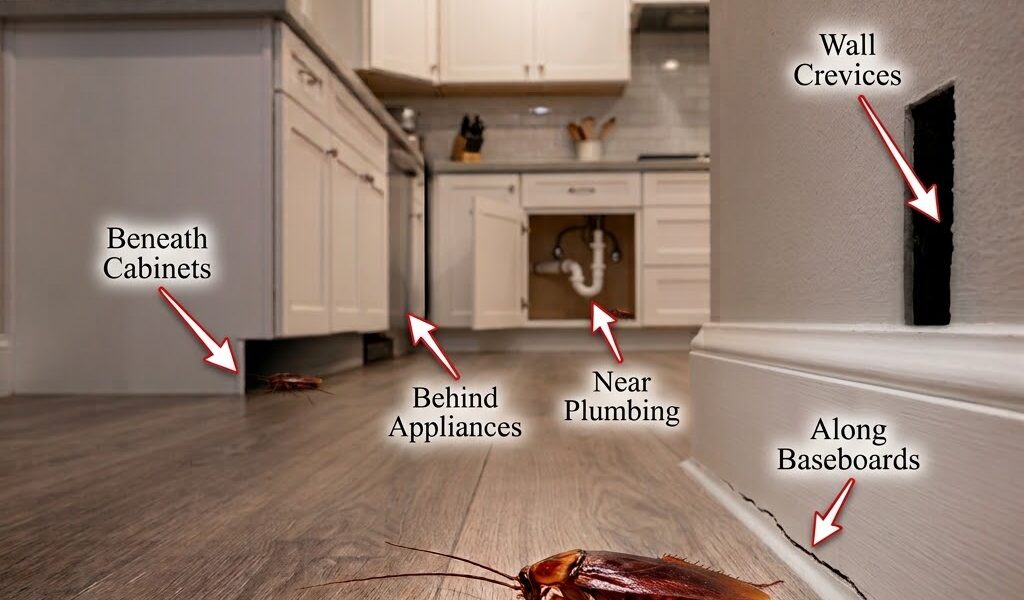
Best Products for American Cockroaches (Indoor & Outdoor Control)
American cockroaches can be a frustrating pest because they do not always begin inside the home.
They are often associated with sewers, drains, damp areas, crawl spaces, basements, garages, utility areas, and outdoor environments, where they can find moisture, food, and shelter. From there, they may enter buildings through gaps, plumbing openings, doors, vents, and other entry points.
Once inside, American cockroaches can move into kitchens, bathrooms, laundry rooms, storage areas, basements, and other warm or humid parts of a building.
The good news is that you do not necessarily need every type of cockroach-control product.
The better approach is to give each method a specific job.
Sanitation removes food and moisture sources, exclusion helps prevent entry, bait targets feeding cockroaches, a residual insecticide can provide another treatment method where the label permits it, an insect growth regulator (IGR) can support longer-term population management, and monitoring traps help locate activity.
In this guide, we look at products that can fit into an American cockroach control program and explain when you may need more than one approach.
BugOffControl Recommended
The products featured in this American cockroach guide were researched and selected by BugOffControl.com based on their intended use, product type, manufacturer information, and the specific role they can play in a complete cockroach-control strategy. We’ve grouped them by purpose and infestation level to help you choose the products and control methods that best fit your situation.
Affiliate Disclosure: If you purchase through links on this page, BugOffControl.com may earn a commission at no additional cost to you. This helps support the site and allows us to continue publishing pest-control guides and product reviews.
As an Amazon Associate I earn from qualifying purchases.
These are general control strategies, not mandatory product combinations.
You may not need every product listed.
The correct approach depends on where the American cockroaches are coming from, how frequently they are appearing, and whether the problem is primarily indoors, outdoors, or both.
Always follow the current product label before using any pesticide.
Where Do American Cockroaches Live?
One of the biggest differences between American cockroaches and German cockroaches is where you are likely to find them.
American cockroaches can live both outdoors and indoors.
They prefer warm, humid environments where food, water, and shelter are available.
Common Outdoor Habitats
Outside, American cockroaches may be found around:
- Sewer systems
- Drainage areas
- Storm drains
- Manholes
- Damp mulch
- Leaf litter
- Compost areas
- Wood piles
- Decaying organic material
- Garbage areas
- Outdoor storage areas
- Landscaping with heavy moisture
- Building foundations
- Irrigation areas
- Crawl-space entrances
- Areas around plumbing and drainage
This outdoor behavior is important because simply treating the inside of a home may not solve a recurring problem if cockroaches continue entering from outside.
Common Indoor Habitats
After entering a building, American cockroaches may move into:
- Basements
- Crawl spaces
- Utility rooms
- Boiler or mechanical rooms
- Garages
- Kitchens
- Bathrooms
- Laundry rooms
- Storage rooms
- Areas around pipes
- Drains
- Plumbing chases
- Dark cabinets
- Wall voids
- Areas around water heaters
- Other warm, damp locations
They may also move through buildings using pipes, utility openings, cracks, and other protected pathways.
Why American Cockroaches Enter Homes
American cockroaches are usually looking for the same basic things many pests need:
Food + water + shelter + suitable temperatures.
A building can provide all four.
Leaks, standing water, overflowing garbage, food debris, clutter, damp crawl spaces, and gaps around plumbing can make a property more attractive to cockroaches.
That is why American cockroach control should not be viewed as a pesticide-only problem.
You want to control the cockroaches you already have while making the property less attractive and harder to enter.
How We Chose These Products
We researched these products based on their intended pest-control use, product type, active ingredients, application purpose, manufacturer information, and suitability for cockroach control.
We also considered how each product fits into an overall pest-management strategy rather than treating every product as though it performs the same job.
That distinction matters.
You are not buying several products that all do the same thing.
Each method has a different purpose.
The American Cockroach Control Products at a Glance
1. Advion Evolution — Best for Targeted Cockroach Baiting 4.5  ☆
☆
Best for: Targeted baiting where cockroach activity is present
Advion Evolution is a gel bait designed for cockroach control.
Rather than spraying an entire room, gel bait can be placed in appropriate locations where cockroaches are likely to encounter it.
For American cockroaches, bait can be particularly useful in areas where activity is concentrated.
Why Consider Advion Evolution?
American cockroaches are scavengers and can search for food around buildings.
A properly placed bait provides a targeted feeding-based control method.
However, bait should not be expected to solve every American cockroach problem by itself.
If the cockroaches are repeatedly entering from outside, through plumbing openings, or from damp utility areas, those conditions need attention too.
Pros

- Designed for cockroach control
- Targeted application
- Useful as part of an integrated pest-management approach
- Can complement sanitation and exclusion
Cons
- Placement matters
- Does not correct the source of an infestation
- Must be used according to the current product label
- May not be enough by itself for recurring or heavy activity
Best use: Indoor American cockroach activity where targeted baiting is appropriate.
Amazon: Check Latest Price & Availability on Amazon
2. BASF Alpine WSG — Best for Appropriate Residual Treatment 4.7 ☆

Best for: Appropriate residual insecticide treatment
BASF Alpine WSG is a water-soluble granule insecticide that is mixed and applied according to its current product label.
It provides a different control method from gel bait.
For American cockroaches, a residual treatment may be particularly useful when cockroaches are moving through areas where a labeled application is permitted.
Why Consider Alpine WSG?
American cockroaches can travel through larger areas than the typical German cockroach hiding primarily inside kitchen cabinets and appliances.
They may move from exterior areas, garages, crawl spaces, utility areas, bathrooms, or other locations into the home.
Where the label permits the intended application, Alpine WSG can provide another component of a broader control program.
Pros
- Provides a treatment method different from gel bait
- Can be part of an integrated cockroach-control program
- Water-soluble formulation
- Useful when an appropriate residual treatment is needed
Cons
- Requires correct mixing and application
- PPE and application requirements must be followed
- Approved uses and application rates depend on the current label
- Should not replace sanitation or exclusion
Best use: Indoor or other labeled areas where residual treatment is appropriate.
Amazon: Check Latest Price & Availability on Amazon
3. Gentrol IGR — Best for Supporting Long-Term Population Management 4.6☆
Best for: Supporting control of cockroach development
Gentrol is an insect growth regulator (IGR).
An IGR works differently from a bait or conventional residual insecticide.
Instead of simply providing another way to kill active cockroaches, an IGR is intended to interfere with insect development.
Why Consider Gentrol?
If American cockroach activity is established, an IGR can provide a different control function as part of a broader program when its labeled use is appropriate.
However, an IGR should not be viewed as a replacement for eliminating food, moisture, harborages, and entry points.
Pros

- Different mode of action from bait
- Can complement other control methods
- Can support longer-term population management
Cons
- Not a replacement for sanitation
- Does not seal entry points
- Does not eliminate moisture problems
- Must be used according to the current label
- Works best as part of a broader strategy
Best use: Established cockroach activity where an IGR is appropriate according to the current label.
Amazon: Check Latest Price & Availability on Amazon
4. Catchmaster Glue Traps — Best for Monitoring 4.3 ☆

Best for: Finding cockroach activity and tracking progress
Catchmaster Glue Traps have a different job from bait, residual insecticide, and IGR products.
They are primarily a monitoring tool.
Place monitoring traps in appropriate areas where cockroach activity is suspected.
They can help answer an important question:
Where are the cockroaches actually coming from?
For American cockroaches, this can be especially useful because they may enter from different parts of a building.
Areas to Monitor
Depending on the property, monitoring locations may include:
- Near plumbing
- Around utility rooms
- Near doors
- Near garages
- Around crawl-space entrances
- Near suspected entry points
- Behind or beside appliances
- In dark storage areas
- Near basement walls
- Other areas showing signs of activity
Pros
- Helps locate activity
- Useful for monitoring progress
- No pesticide required
- Can help identify hotspots
Cons
- Does not eliminate an established infestation by itself
- Traps need to be checked regularly
- A trap catches the cockroach but does not correct the reason it entered
Best use: Light, moderate, and heavy activity as a monitoring tool.
Amazon: Check Latest Price & Availability on Amazon
Sanitation Is Part of American Cockroach Control
Sanitation is sometimes treated as an afterthought.
It should not be.
American cockroaches can take advantage of food debris, garbage, organic material, moisture, and other conditions that make a property easier to inhabit.
The goal is not to make your home perfectly sterile.
The goal is to remove the resources cockroaches are using to survive.
Improve Food Sanitation
- Clean food spills promptly.
- Wipe crumbs from counters and floors.
- Store food in sealed containers.
- Keep garbage containers closed.
- Empty garbage regularly.
- Clean areas beneath appliances.
- Avoid leaving pet food available overnight when practical.
- Clean grease and food residue from kitchen surfaces.
Reduce Moisture
Moisture can be especially important with American cockroaches.
Look for:
- Leaking faucets
- Leaking pipes
- Plumbing leaks
- Standing water
- Damp crawl spaces
- Condensation
- Poor drainage
- Wet garbage areas
- Leaking air-conditioning equipment
Fixing the source is much better than repeatedly treating the symptom.
Exclusion: Stop American Cockroaches From Getting Inside
This is one area where American cockroach control can differ significantly from a German cockroach strategy.
If American cockroaches are coming from outside, you need to make the building harder to enter.
Think of exclusion as creating a barrier between the outdoor habitat and your home.
Check These Areas
Inspect around:
- Exterior doors
- Door sweeps
- Window gaps
- Foundation cracks
- Pipe penetrations
- Utility lines
- Plumbing openings
- Vents
- Garage doors
- Crawl-space openings
- Damaged screens
- Gaps around air-conditioning lines
Seal suitable openings where practical.
A small opening around a pipe or utility line may provide a convenient pathway into the building.
Pay Special Attention to Doors
Exterior doors can provide an easy entry point.
Check that:
- Door sweeps fit properly.
- Weather stripping is intact.
- There are no obvious gaps underneath doors.
- Garage doors close properly.
- Screens are not damaged.
The best pesticide treatment in the world cannot prevent an outdoor cockroach from entering through an open gap.
Should You Use the Same Products for American Cockroaches?
Some of the same products can be useful, but the strategy should be different.
This is an important distinction.
The products in this review—such as bait, an appropriate residual insecticide, an IGR, and monitoring traps—can each have a place in American cockroach management when their current labels permit the intended use.
But American cockroaches often require more attention to:
Outdoor sources + sanitation + moisture + exclusion.
For German cockroaches, the main battle may be inside the kitchen, cabinets, appliances, and other protected areas.
For American cockroaches, you may also need to ask:
Where are these cockroaches coming from?
If they are entering through a garage, crawl space, plumbing opening, foundation gap, drain area, or exterior door, simply adding more indoor pesticide may not solve the underlying problem.
Should You Use Other Products for American Cockroaches?
Sometimes, yes, the right product depends on the source of the activity.
Bait
Useful when cockroaches are actively feeding and the bait can be placed in an appropriate location.
Residual Insecticide
Useful when a labeled residual application is appropriate.
IGR
Can provide another method for longer-term population management when appropriate.
Monitoring Traps
Useful for determining where activity is occurring and whether it is declining.
Exclusion Materials
Caulk, sealants, door sweeps, screens, and other appropriate exclusion materials can be just as important as pesticide because they address the entry route.
Drain and Plumbing Corrections
If activity is associated with drains, plumbing areas, leaks, or sewer-related conditions, correcting the underlying plumbing or drainage problem should be part of the solution.
Light American Cockroach Activity
A light problem may involve:
- An occasional roach sighting
- One or two sightings around a bathroom or garage
- Activity near an exterior door
- Occasional activity around plumbing
- Little evidence of an established indoor population
A Practical Starting Point
Sanitation + exclusion + Catchmaster monitoring
If indoor activity continues, appropriately placed bait may be added where the label permits.
At this stage, the goal is to determine whether you are dealing with an established indoor infestation or occasional invaders.
Moderate American Cockroach Activity
A moderate problem may involve:
- Regular sightings
- Cockroaches appearing in several areas
- Droppings
- Activity around bathrooms or kitchens
- Activity near plumbing
- Repeated sightings around garages or utility rooms
- Cockroaches continuing to appear despite cleaning
A Practical Starting Point
Sanitation + exclusion + Advion Evolution + appropriate residual treatment + Catchmaster monitoring
Each component has a different job.
- Sanitation: removes food and moisture opportunities
- Exclusion: reduces entry
- Advion: targeted baiting
- Alpine WSG: appropriate residual treatment
- Catchmaster: monitoring
Always confirm that the intended pesticide application is permitted by the current label.
Heavy or Recurring American Cockroach Activity
A heavy problem may include:
- Frequent sightings
- Numerous cockroaches
- Daytime activity
- Activity throughout several parts of the building
- Large numbers around drains or utility areas
- Repeated sightings after treatment
- Evidence of an established population
- Cockroaches repeatedly entering from outside
A Broader Approach May Include
Sanitation + moisture reduction + exclusion + Advion Evolution + appropriate residual treatment + Gentrol + Catchmaster monitoring
Again, the objective is not to use the most products possible.
The objective is to attack the problem from several directions.
If the source is not corrected, cockroaches can continue returning even after pesticide treatment.
What Germs Can American Cockroaches Spread?
American cockroaches can move through environments that may contain microorganisms, including garbage, drains, sewage-associated areas, and other contaminated locations.
As they move from these areas to other surfaces, they can mechanically transfer microorganisms.
Cockroaches have been associated with bacteria and other microorganisms that can contaminate food and surfaces.
Their droppings, shed skins, and body parts can also contribute to indoor allergens.
This is one reason cockroach infestations should be taken seriously, particularly in kitchens and other food-preparation areas.
If cockroaches have been moving across food-preparation surfaces, clean and disinfect appropriate surfaces while addressing the infestation.
How Fast Can American Cockroaches Multiply?
American cockroaches can reproduce when conditions provide suitable food, moisture, shelter, and temperatures.
Females produce egg cases called oothecae, which contain multiple eggs.
Warm, humid environments with readily available food and shelter can support continued reproduction.
That means an occasional sighting should not automatically be ignored.
If sightings become frequent, particularly when you begin finding multiple cockroaches or evidence of reproduction, it is time to investigate where they are hiding and how they are entering the property.
American Cockroach Control Products Compared
Choosing the right American cockroach control method depends on how much activity you are seeing. The table below shows the role each approach can play for light, moderate, and heavy or recurring cockroach activity.
| Control Method / Product | Primary Purpose | Light Activity | Moderate Activity | Heavy / Recurring Activity |
|---|---|---|---|---|
| Sanitation & Moisture Control | Remove food, water, and conditions that attract roaches | ✓ | ✓ | ✓ |
| Exclusion & Sealing Entry Points | Reduce cockroach entry through cracks, gaps, doors, and other openings | ✓ | ✓ | ✓ |
| Advion Evolution Bait | Target American cockroaches with a food-based bait | ✓ | ✓ | ✓ |
| BASF Alpine WSG | Provide appropriate residual insecticide control where permitted | — | ✓ | ✓ |
| Gentrol IGR | Help interrupt cockroach development and support population management | — | — | ✓ |
| Catchmaster Glue Traps | Monitor activity and identify areas where roaches are traveling | ✓ | ✓ | ✓ |
How to use this table: For occasional American cockroach sightings, start with sanitation, exclusion, baiting, and monitoring. If activity is more frequent or keeps returning, additional control methods may be appropriate.
Important: Product availability, permitted uses, application sites, and rates can vary. Always read and follow the current product label before using any pesticide.
The Simple Version
Sanitation = remove food and moisture
Exclusion = keep cockroaches out
Advion = bait
Alpine WSG = appropriate residual treatment
Gentrol = IGR
Catchmaster = monitoring
That is the easiest way to understand how the different parts of the program work together.
Why Sanitation and Exclusion Matter So Much
A common mistake is to think:
“I sprayed the cockroaches, so the problem should be gone.”
Unfortunately, American cockroach control is not always that simple.
If food remains available, moisture remains abundant, and entry points remain open, the property can continue to support cockroach activity.
Imagine treating a building today but leaving a gap under the garage door tomorrow.
You may have killed some cockroaches, but another one can simply walk inside.
That is why a better strategy combines:
Control + sanitation + moisture reduction + exclusion + monitoring.
Common American Cockroach Control Mistakes
Treating Only the Inside
If cockroaches are coming from outdoors, the source may continue producing new intruders.
Ignoring Plumbing
Moisture and openings around plumbing can create favorable conditions and pathways.
Forgetting the Garage
Garages can provide an easy transition between outdoor areas and the home.
Ignoring Crawl Spaces
Dark, damp crawl spaces can provide shelter and may connect directly with the structure.
Leaving Food and Garbage Available
Food waste can make a property more attractive to scavenging cockroaches.
Using Too Much Pesticide
A serious infestation does not mean you should automatically increase the application rate.
Always follow the current label.
Spraying Everywhere
More pesticide is not automatically better.
Use products only in locations and at rates permitted by the current label.
Expecting One Product to Do Everything
Bait, residual insecticide, IGR, monitoring traps, sanitation, and exclusion all have different jobs.
Pesticide Safety and PPE
Pesticide safety should always come before convenience.
Before using an insecticide, read the current product label and use all personal protective equipment required by the manufacturer.
Depending on the product and application method, PPE may include:
- Chemical-resistant gloves
- Protective eyewear
- Long-sleeved clothing
- Long pants
- Closed-toe footwear
- Respiratory protection when specifically required
Do not assume the PPE requirements for one product apply to another.
Keep children and pets away from treated areas whenever required by the product label, and follow all ventilation and re-entry instructions.
Always Follow the Manufacturer’s Label
This is one of the most important rules of pesticide use.
Read and follow the current manufacturer’s directions before:
- Mixing
- Applying
- Storing
- Re-treating
- Cleaning application equipment
- Disposing of the product
Pay attention to:
- Approved application sites
- Mixing directions
- Application rates
- PPE requirements
- Re-entry instructions
- Ventilation requirements
- Storage
- Disposal
- Restrictions around food, children, and pets
Never use more pesticide simply because the infestation is severe.
A higher application rate does not automatically mean better control.
Frequently Asked Questions
What is the best product for American cockroaches?
There is no single product that is best for every American cockroach problem.
Because American cockroaches may enter from outdoors, through plumbing areas, or from damp structural spaces, the best strategy often combines sanitation, exclusion, monitoring, and appropriate control products.
What is the best product for a light American cockroach problem?
Start by identifying the entry point or source.
Sanitation, exclusion, and monitoring traps can be a good starting point. Targeted bait can be added when appropriate.
Should I use the same products for American and German cockroaches?
Some of the same products may be useful, but the strategy should not be identical.
American cockroaches often require more attention to outdoor habitats, moisture, plumbing, drainage, and exclusion.
Always verify the current product label for the specific cockroach species and application.
Should I use bait for American cockroaches?
Bait can be useful when American cockroaches are actively feeding and the product is labeled for the intended use.
Placement is important.
Should I use Alpine WSG for American cockroaches?
Alpine WSG can be part of a cockroach-control program where the current label permits the intended application.
Always follow the current label for mixing, application sites, rates, PPE, and other requirements.
Do I need an IGR for American cockroaches?
Not necessarily.
An IGR is an additional tool that may be useful for established activity, but it does not replace sanitation, exclusion, baiting, monitoring, or appropriate residual treatment.
Why do American cockroaches keep coming back?
Possible reasons include:
- Outdoor populations
- Open entry points
- Plumbing openings
- Moisture problems
- Food sources
- Damp crawl spaces
- Garage access
- Drainage problems
- Untreated areas
Finding the source is often just as important as treating the cockroach.
Can American cockroaches live outside?
Yes.
They can inhabit warm, damp outdoor environments and may be found around drainage areas, sewers, mulch, organic debris, garbage areas, and other protected locations.
Where do American cockroaches hide inside?
They may hide in dark, protected, warm, or damp locations such as basements, crawl spaces, utility rooms, garages, bathrooms, kitchens, plumbing areas, and wall or pipe openings.
How do I know if my treatment is working?
Look for:
- Fewer sightings
- Fewer droppings
- Less activity around monitoring traps
- Fewer cockroaches appearing at entry points
- Reduced activity around plumbing and utility areas
Monitoring helps you determine whether activity is actually declining.
Should I use more pesticide if I have a heavy infestation?
No, never increase the application rate simply because the infestation is severe. Follow the current product label.
When should I call a professional?
Consider professional pest-control assistance when the infestation is widespread, persistent, repeatedly returns, involves difficult-to-access areas, or does not improve despite appropriate control measures.
Final Verdict
American cockroach control is different from simply treating a few roaches inside the kitchen.
These large cockroaches can live outdoors as well as indoors, and recurring activity may be connected to moisture, drains, plumbing, crawl spaces, garages, landscaping, sewer-related areas, or openings around the building.
That is why BugOffControl.com’s recommended strategy should be:
1. Find the source.
2. Improve sanitation.
3. Reduce moisture.
4. Seal practical entry points.
5. Use bait where appropriate.
6. Use an appropriate residual treatment when the label permits it.
7. Consider an IGR for established activity when appropriate.
8. Use monitoring traps to track results.
The products do not all have to be used together.
For a light problem, sanitation, exclusion, monitoring, and targeted baiting may be enough.
For a moderate problem, an appropriate residual treatment may be added.
For heavy or recurring activity, a broader program may include bait, residual treatment, IGR, monitoring, sanitation, moisture reduction, and exclusion.
The most important point is this:
Do not just kill the American cockroaches you see. Find out why they are there and how they are getting inside.
That approach gives you a much better chance of reducing the problem instead of repeatedly treating the same symptoms.