How to Get Rid of Blow Flies & Bottle Flies (Complete Control Guide)
Seeing a shiny blue, green, or black fly buzzing around your home can be unsettling—but when several appear at once, you may be wondering where they came from and how to get rid of them for good.
Blow flies and bottle flies belong to the Calliphoridae family and are often recognized by their metallic-looking bodies. Although a few flies may simply enter from outdoors, repeated indoor activity can sometimes point to something more important: a nearby source of decaying organic material.
That could be a dead rodent, bird, garbage, animal waste, decaying food, or another organic source.
The good news is that you don’t have to rely on spraying every fly you see.
This complete guide explains how to identify blow flies, find the source, get rid of adult flies, choose effective traps and control products, clean affected areas, and prevent them from coming back.
Quick Answer: How Do You Get Rid of Blow Flies?
The most effective way to control blow flies is to find and eliminate the source attracting or producing them.
Follow these steps:
- Identify the fly to make sure it is a blow fly or bottle fly.
- Watch where the adults gather, especially around windows and light sources.
- Inspect nearby areas for dead animals, garbage, pet waste, food, or other decaying organic material.
- Remove the source safely when it can be reached.
- Clean and disinfect contaminated surfaces according to the product label.
- Use sticky traps or baited fly traps to reduce remaining adults.
- Use labeled fly-control products when appropriate.
- Repair screens and seal wildlife entry points to prevent another problem.
Affiliate Disclosure
If you purchase through links on this page, BugOffControl.com may earn a commission at no additional cost to you. This helps support our pest-control guides and product research.
As an Amazon Associate I earn from qualifying purchases.
The most important point:
Killing the adult flies is only part of the solution. Finding the source is what can make the biggest difference.
What Are Blow Flies and Bottle Flies?
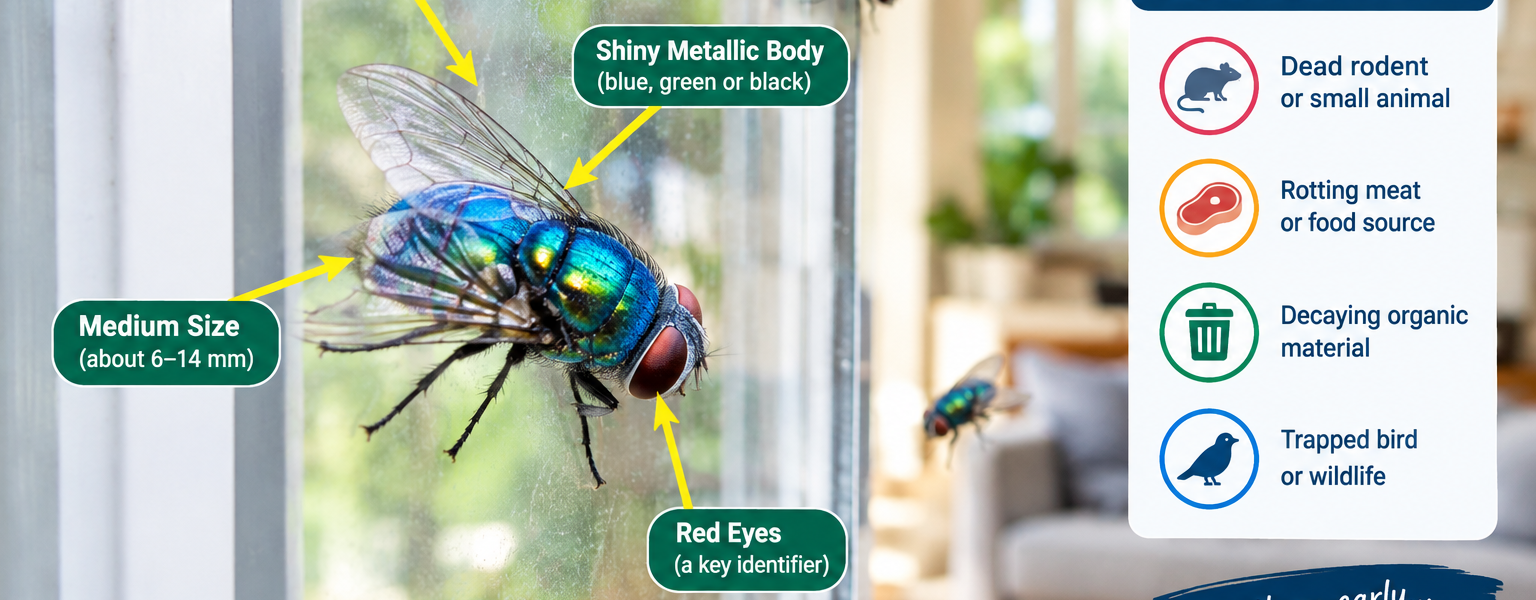
Blow flies are flies in the Calliphoridae family. Bottle flies are commonly used as a name for several metallic-colored blow fly species.
Many have a distinctive shiny appearance that can range from:
- Metallic blue
- Blue-green
- Emerald green
- Bronze
- Copper
- Shiny black
They are generally larger and more robust-looking than tiny fruit flies or fungus gnats.
Their attraction to decomposing organic material is one reason they can become an important clue when they suddenly appear around a home.
How to Identify a Blow Fly
Before choosing a control method, make sure you are dealing with the right type of fly.
Blow Fly Identification
Look for:
| Feature | What to Look For |
|---|---|
| Size | Medium-sized fly |
| Body | Shiny or metallic appearance |
| Color | Blue, green, bronze, copper, or dark metallic shades |
| Body shape | Relatively robust compared with small kitchen flies |
| Behavior | Often attracted to light when indoors |
| Typical association | Decaying organic material and animal remains |
Blow Fly vs. Common Household Flies
Not every fly in your kitchen is a blow fly.
Fruit flies are much smaller and are commonly associated with fermenting fruit, beverages, drains, and other food residues.
Drain flies are tiny, fuzzy, moth-like flies commonly associated with organic buildup inside drains.
Fungus gnats are small, delicate flies often associated with damp soil and houseplants.
House flies are generally gray rather than strongly metallic.
If your fly has a noticeable blue-green or shiny metallic body, a blow fly or bottle fly becomes much more likely.
Why Are Blow Flies in My House?
This is the question most homeowners really want answered.
A single blow fly does not prove that there is a dead animal inside your house.
However, repeated activity deserves investigation.
Possible sources include:
Dead Rodents
A mouse or rat can sometimes die in an attic, crawlspace, wall void, or another inaccessible location.
Dead Birds or Wildlife
Birds and other small animals can become trapped around roofs, vents, chimneys, attics, and other openings.
Garbage
Food waste containing meat or animal products can attract blow flies.
Pet Waste
Animal waste can contribute to fly activity when it is left exposed.
Decaying Food
Forgotten food, spilled meat juices, or improperly cleaned garbage areas can provide an attractive organic source.
Outdoor Sources
The source may not be inside your house at all. Animal remains, garbage, or other organic material near the building can attract flies that later enter through doors, windows, or damaged screens.
How to Find Where Blow Flies Are Coming From
Don’t immediately start spraying. Instead, become a detective.
Step 1: Follow the Flies
Watch where they gather. Windows are particularly useful because adult flies that emerge indoors may move toward light. If you repeatedly see flies collecting at one particular window, inspect the room and surrounding areas.
Important: the window is a clue—not proof that the source is directly behind it.
Step 2: Check for an Unusual Odor
A localized unpleasant smell can sometimes point toward decomposing organic material.
Walk slowly around the room and compare areas rather than relying on one quick inspection.
Pay particular attention to:
- Baseboards
- Wall penetrations
- Electrical openings
- Ceiling areas
- Attic access points
- HVAC openings
- Plumbing penetrations
Step 3: Inspect the Attic or Crawlspace
If flies are concentrated near an upper room, inspect the accessible attic or crawlspace if it is safe to enter.
Look for:
- Animal remains
- Feathers
- Nesting material
- Droppings
- Fly larvae
- Pupae
- Strong odors
- Wildlife entry points
If the area is unsafe or the source cannot be reached safely, consider professional assistance rather than opening walls or disturbing wildlife remains yourself.
What Do Blow Fly Maggots Look Like?
Blow fly larvae are commonly called maggots. They are generally pale or cream-colored, legless, and worm-like. Finding maggots indoors can be a strong indication that a suitable organic source is nearby. But there is an important detail many basic articles overlook:
Maggots can move away from the feeding source.
When larvae mature, they may leave the original material and move into a protected location before pupating. Therefore, finding maggots beneath a baseboard does not necessarily mean the source is directly underneath that baseboard. Search the surrounding area as well.
How Long Do Blow Flies Stay in a House?
There is no single number of days that applies to every blow fly problem. Development depends on factors such as:
- Species
- Temperature
- Humidity
- Food availability
- Location of the breeding material
- Environmental conditions
If the source is removed, the number of flies should eventually decline, but adults that have already developed may continue to appear temporarily.
When should you investigate again?
If new flies continue appearing after the suspected source has been removed, consider whether:
- Another source was overlooked
- Part of the original source remains
- Flies are entering from outside
- Wildlife is still getting inside
- The insects were misidentified
How to Get Rid of Blow Flies Step by Step
1. Remove the Source
This is the most important step. Look for and remove accessible sources such as:
- Animal remains
- Garbage
- Food waste
- Pet waste
- Decaying organic material
If the source is inside an inaccessible wall, ceiling, HVAC system, or other difficult location, professional assistance may be safer.
2. Clean the Area
After the source is removed, clean the affected area thoroughly. Use an appropriate household disinfectant according to its label.
Safety reminder
Never mix cleaning chemicals together. In particular, do not mix bleach with ammonia, acids, or other cleaning products.
3. Trap Remaining Adult Flies
Traps can reduce the number of adult flies while the problem is being resolved. Useful options include:
- Sticky fly traps
- Window traps
- Outdoor baited fly traps
- Commercial fly-bait products where appropriate
4. Seal Entry Points
Inspect:
- Window screens
- Door gaps
- Attic vents
- Roof vents
- Chimney openings
- Utility penetrations
- Exterior wall gaps
Repair damaged screens and seal suitable openings.
Best Blow Fly Traps
Traps are particularly useful when you want to capture adult flies rather than repeatedly spray them. However, remember: A trap catches flies; it doesn’t remove a hidden breeding source.
1. TERRO Fly Magnet Trap 4.2 
The TERRO Fly Magnet Trap is a reusable baited fly trap designed to attract and capture flies.
Best for:
Outdoor fly trapping
Pros

- Reusable design
- Poison-free trapping approach
- Simple setup
- Useful for reducing adult flies outdoors
Cons
- Requires replacement bait
- Captured flies remain in the trap
- Placement matters
- Won’t eliminate a hidden indoor source
Best use
Use it as part of an outdoor fly-reduction strategy rather than as the only treatment for an indoor infestation.
Check Listed Price For TERRO Fly Magnet Trap On Amazon
2. RESCUE! Outdoor Fly Trap 4.5 ☆
The RESCUE! Outdoor Fly Trap is designed to attract and capture flies outdoors using bait.
Best for:
Outdoor fly reduction
Pros

- Easy to deploy
- Designed specifically for flies
- Useful around outdoor fly activity
- Doesn’t require indoor insecticide spraying
Cons
- Intended for appropriate outdoor placement
- Requires replacement/service
- Can attract flies to the trap area
- Doesn’t eliminate a hidden breeding source
Best use
A useful supporting tool when outdoor flies are contributing to the problem.
Check Listed Price For RESCUE! Outdoor Fly Trap On Amazon
3. Catchmaster Bag Fly Trap 3.8
The Catchmaster Bag Fly Trap provides another baited capture option for outdoor fly activity.
Pros

- Simple design
- Easy to monitor
- Useful for capturing adult flies
- Can help reduce outdoor fly pressure
Cons
- Requires replacement or disposal
- Best suited to appropriate outdoor locations
- Does not address the original source
Best use
Use it where outdoor fly activity is substantial and you want a simple capture method.
Check Listed Price For Catchmaster Bag Fly Trap On Amazon
4. Goldstick Fly Traps 3.7 ☆
Goldstick Fly Traps use an adhesive surface to capture adult flies.
Best for:

Indoor monitoring and adult fly capture
Pros
- No spray required
- Simple to use
- Useful near windows
- Helps monitor fly activity
Cons
- Captured flies are visible
- Limited capacity
- Must be replaced
- Does not eliminate the breeding source
Best use
These are particularly useful when you want to determine whether adult fly activity is declining after source removal.
Check Listed Price For Goldstick Fly Traps On Amazon
5. Bayer Maxforce Granular Fly Bait 4.2
Bayer Maxforce Granular Fly Bait is a fly-bait product intended for targeted fly control.
Pros

- Designed for fly control
- Granular formulation
- Can complement sanitation and trapping
- Useful as part of an integrated control strategy
Cons
- Requires careful placement
- Not appropriate for every application site
- Must be kept away from children and pets as directed
- Current label directions must be followed
Best use
Targeted baiting where the product label specifically permits the intended application.
Check Listed Price For Bayer Maxforce Granular Fly Bait On Amazon
6. BASF PT Alpine Fly Bait 4.3 ☆
BASF PT Alpine Fly Bait is another fly-control option designed for targeted adult fly management.
Pros

- Designed specifically for fly control
- Can help reduce persistent adult activity
- Can complement source removal and trapping
- Useful as part of integrated pest management
Cons
- Label restrictions apply
- Requires careful application
- Does not remove a hidden breeding source
- Must be used according to current directions
Best use
For targeted adult fly control after the underlying attraction has been addressed.
Check Listed Price For BASF PT Alpine Fly Bait On Amazon
Blow Fly Control Products Compared
Choosing the right blow fly or bottle fly control product depends on where the flies are coming from and how much activity you’re dealing with. Some products are designed to attract and trap adult flies outdoors, while others are better suited for indoor monitoring or targeted fly control.
Use the comparison below to quickly see what each option is designed to do, where it fits best, and what limitation to keep in mind.
| Product | Best For | Control Method | Key Advantage | Important Limitation |
|---|---|---|---|---|
| TERRO Fly Magnet Trap | Outdoor fly activity | Baited trap | Reusable design for ongoing trapping | Does not eliminate the source attracting the flies |
| RESCUE! Outdoor Fly Trap | Heavy outdoor fly pressure | Baited trap | Simple, ready-to-use trapping approach | Requires suitable outdoor placement |
| Catchmaster Bag Fly Trap | Outdoor fly trapping | Baited trap | Easy to set up and monitor | Requires replacement or disposal |
| Goldstick Fly Traps | Indoor fly monitoring | Adhesive trap | No spray or bait application required | Limited capture capacity |
| Maxforce Granular Fly Bait | Targeted fly control | Fly bait | Designed specifically for fly control | Application sites and use are label-dependent |
| BASF PT Alpine Fly Bait | Persistent adult fly activity | Fly bait | Provides a targeted adult-fly control option | Does not remove the underlying breeding or attraction source |
How to Read This Comparison
For outdoor flies: Baited traps such as the TERRO Fly Magnet, RESCUE! Outdoor Fly Trap, and Catchmaster Bag Fly Trap can help capture adult flies before they continue entering the home.
For indoor monitoring: Goldstick Fly Traps provide a simple way to capture adult flies and monitor whether activity is decreasing.
For targeted control: Maxforce Granular Fly Bait and BASF PT Alpine Fly Bait can be considered when their current labels permit the intended application.
⚠️ One Thing Every Product Has in Common– No trap or fly bait should be expected to solve a hidden source by itself.
If bottle flies continue appearing indoors, investigate for dead animals, garbage, decaying organic material, pet waste, wildlife activity, or other potential sources. Removing the attraction is an important part of achieving longer-lasting control.
Always read and follow the current product label before using any pesticide or fly-control product.
Which Blow Fly Control Method Should You Choose?
Instead of asking which product is universally “best,” match the method to the problem.
If flies are mostly outside:
Consider:
TERRO Fly Magnet, RESCUE!, or Catchmaster bag traps.
If a few flies are gathering around windows:
Consider:
Goldstick adhesive traps for monitoring and capture.
If adult fly activity continues after sanitation:
Consider:
An appropriately labeled fly-bait product such as Maxforce or BASF PT Alpine Fly Bait.
If flies keep appearing from inside:
Don’t rely on traps alone.
Investigate for:
- Dead rodents
- Birds
- Wildlife
- Garbage
- Decaying organic material
- Hidden breeding sites
A Simple Blow Fly Control Plan
LIGHT ACTIVITY
Start with:
- Identify the fly
- Clean food and garbage areas
- Repair screens
- Use sticky traps
- Monitor windows
- Inspect outdoor sources
MODERATE ACTIVITY
Add:
- Outdoor baited traps
- Additional monitoring
- Attic inspection
- Crawlspace inspection
- Wildlife-entry inspection
- Targeted fly-control products where appropriate
HEAVY OR REPEATED ACTIVITY
Look for:
- Animal remains
- Persistent odors
- Wall void activity
- Attic sources
- Crawlspace sources
- Roof or chimney wildlife access
When the source is inaccessible, contaminated, or unsafe to handle, professional pest-control or wildlife-removal assistance may be appropriate.
How to Prevent Blow Flies From Coming Back
Once the immediate problem is under control, prevention becomes the next priority.
Repair Screens
Check screens on:
- Windows
- Doors
- Attic vents
- Other screened openings
Even a small damaged section can provide an easy entry route.
Secure Garbage
Keep outdoor garbage containers closed and clean.
Don’t allow meat scraps or other attractive food waste to remain exposed.
Keep Pet Areas Clean
Remove pet waste regularly and keep outdoor feeding areas clean.
Prevent Wildlife Entry
Inspect the exterior for openings around:
- Rooflines
- Vents
- Chimneys
- Eaves
- Utility lines
- Pipes
Seal appropriate openings only after making sure no wildlife is trapped inside.
When Should You Call a Professional?
A professional may be the better option when:
- Flies continue appearing for an extended period
- You smell decomposition but cannot locate the source
- You suspect a carcass inside a wall
- Wildlife may be trapped inside the structure
- The source is inside an inaccessible attic or crawlspace
- You discover extensive contamination
- You are uncomfortable handling animal remains
Trying to open walls or disturb wildlife remains without knowing what is involved can create a larger problem.
10 Blow Fly & Bottle Fly FAQs
1. What attracts blow flies?
Blow flies are strongly associated with decomposing organic material. Possible attractions include animal remains, garbage, animal waste, and decaying food.
2. Why are metallic blue flies in my house?
They may have entered from outdoors, but repeated indoor activity can sometimes indicate an organic source nearby. Check for garbage, animal remains, wildlife activity, and other potential sources.
3. Does one blow fly mean I have an infestation?
Not necessarily. A single fly may simply have entered from outside. Repeated or increasing activity is more reason to investigate.
4. How do I know if flies are coming from inside a wall?
There is no single visual test that proves a wall is the source. Repeated fly emergence, localized odor, and larvae activity near a particular wall can provide clues.
5. Will fly spray solve blow flies?
Spray can kill exposed adult flies, but it won’t necessarily eliminate the material producing them.
6. Are blow flies the same as house flies?
No. Blow flies belong to the Calliphoridae family and commonly have metallic coloring. House flies are a different group and are generally gray.
7. Can blow flies come from outside?
Yes. Blow flies can enter through open doors, windows, damaged screens, and other openings. Outdoor organic material can also attract them near a home.
8. What kills blow fly maggots?
Removing the material supporting the larvae is an important part of control. Clean affected surfaces appropriately and follow the label of any pesticide used.
9. How do I stop blow flies from coming back?
Remove attractive organic material, secure garbage, clean affected areas, repair screens, and prevent rodents or other wildlife from entering the structure.
10. What is the best way to get rid of blow flies?
The most important step is to identify and remove the source. Traps and appropriately labeled fly-control products can then help reduce remaining adults.
Blow Fly Control Checklist
Before considering the problem solved, work through this list:
☐ Confirm the fly’s identity
☐ Watch where adults gather
☐ Check windows and nearby rooms
☐ Inspect accessible attic and crawlspace areas
☐ Check garbage and food waste
☐ Look for wildlife activity
☐ Investigate unusual odors
☐ Look for larvae or pupae
☐ Remove accessible sources safely
☐ Clean affected surfaces
☐ Use traps to capture remaining adults
☐ Consider labeled fly-control products when appropriate
☐ Repair damaged screens
☐ Seal appropriate exterior entry points
☐ Continue monitoring
Final Thoughts
Blow flies and bottle flies may look impressive with their metallic blue, green, or dark bodies, but you don’t want a growing population inside your home.
The most important thing to remember is that the flies you see may only be the symptom. If you simply spray every adult you find, more may appear if the underlying attraction remains.
Instead, take a complete-control approach:
Identify → Investigate → Remove → Clean → Trap → Prevent.
Start by identifying the fly and watching where it gathers. Then investigate possible sources such as animal remains, garbage, food waste, pet waste, or outdoor organic material.
Once the source has been addressed, products such as TERRO Fly Magnet,RESCUE! Outdoor Fly Trap, Catchmaster Bag Fly Trap, Goldstick Fly Traps, Maxforce Granular Fly Bait, and BASF PT Alpine Fly Bait can help manage remaining adult flies when used according to their current labels.
That combination gives you a much better chance of solving the reason for the fly problem, rather than simply killing the flies you happen to see.
The goal isn’t just fewer flies today. It’s preventing the next wave from appearing tomorrow.