How to Get Rid of Drain Flies (Complete Control Guide)
Tiny fuzzy flies sitting around your bathroom sink or shower can be surprisingly frustrating. If they look like miniature moths and seem to appear from nowhere, you may be dealing with drain flies.
The important thing to know is that the flies you see are usually not the whole problem. Drain flies can develop in the moist organic buildup inside drains, where hair, soap residue, bacteria, and other debris create a suitable breeding environment.
That means repeatedly killing the adult flies may give you temporary relief without solving the source.
The most effective approach is to find the breeding site, remove the organic buildup, treat the drain when appropriate, and prevent the problem from returning.
This guide explains how to identify drain flies, find where they are coming from, get rid of them, choose drain fly control products, and troubleshoot hidden breeding sites.
Quick Answer: How Do You Get Rid of Drain Flies?
To get rid of drain flies, concentrate on the breeding source rather than only the adult flies.
- Identify the insects as drain flies.
Use an overnight tape test to identify the active drain.
Physically remove organic buildup from the drain.
Use an appropriate drain treatment according to its label.
Control remaining adult flies while the breeding site is being eliminated.
Check other drains and hidden damp areas if the flies continue appearing.
Keep drains clean and address leaks or slow drainage.
The key is simple: find and eliminate the place where drain flies are developing.
Affiliate Disclosure
If you purchase through links on this page, BugOffControl.com may earn a commission at no additional cost to you. This helps support our pest-control guides and product research.
As an Amazon Associate I earn from qualifying purchases.
What Do Drain Flies Look Like?
Drain flies belong to the Psychodidae family and are commonly called moth flies, filter flies, or sewer flies. Knowing what you’re dealing with is the first step toward choosing the right control method.
Drain flies are usually:
Very small
Gray, tan, or brownish
Covered with fine hairs
Moth-like in appearance
Broad-winged compared with their tiny bodies
Weak fliers
Commonly found near damp areas
They may appear as tiny gray or brown specks on bathroom walls, ceilings, shower surfaces, or around sinks.
The easiest clue: their behavior
Drain flies are not particularly strong fliers. Instead of quickly zipping around the room, they tend to make short, jerky flights or hops and often settle back onto a nearby surface.
If you disturb one and it moves only a short distance before stopping again, that behavior can help distinguish it from more active flying pests.
Drain Flies vs. Fruit Flies vs. Fungus Gnats
Not every tiny fly around your home is a drain fly.
Pest Typical Clue Common Location
Common Small Fly Identification
Not sure which type of small fly you’re dealing with? Their appearance and the places where you find them can provide helpful clues.
Drain Flies: These tiny flies have a fuzzy, moth-like appearance and are commonly found around drains, sinks, and other damp plumbing areas where organic buildup can collect.
Fruit Flies: Small and smooth-bodied, fruit flies are often attracted to ripening or rotting fruit, food scraps, garbage, and other fermented materials.
Fungus Gnats: These tiny, delicate flies have a mosquito-like appearance and are most often noticed around moist potting soil, houseplants, and other areas with consistently damp soil.
Correct identification matters because the control strategy depends on where the pest is developing. If the flies are concentrated around a sink, shower, or floor drain and have a fuzzy, moth-like appearance, drain flies are a strong possibility.
Where Do Drain Flies Come From?
This is the question most homeowners want answers to.
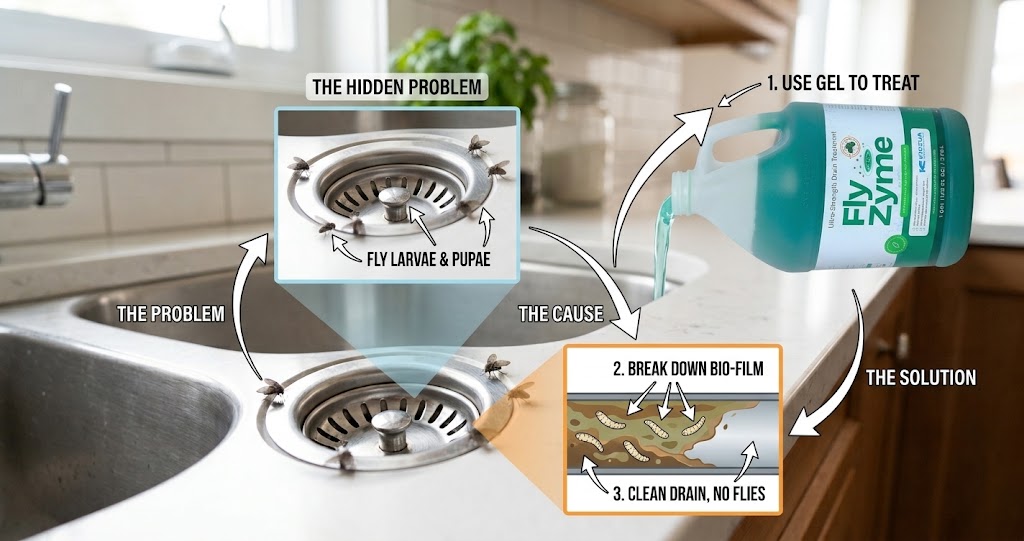
Drain flies can develop in moist organic material and biofilm associated with drains and other damp environments.
That buildup can contain things such as:
- Hair
Soap residue
Skin cells
Bacteria
Fungi
Other organic debris
A drain may look reasonably clean from the top while buildup remains farther inside the plumbing. That is one reason simply wiping the sink or spraying the adult flies may not solve the problem.
Common Drain Fly Breeding Sites
Start your investigation with the places most likely to remain damp and collect organic material.
Bathroom sink drains
Hair, soap residue, toothpaste, and other material can accumulate around and inside the drain.
Shower drains
Showers are particularly important to inspect because hair, soap, and moisture regularly enter the drain.
Floor drains
Floor drains in bathrooms, laundry rooms, garages, basements, and utility areas can be overlooked.
Slow drains
A slow-running drain deserves attention because trapped organic material and moisture can create favorable conditions.
Infrequently used drains
Drains that rarely receive water may be overlooked during routine cleaning.
How to Find the Drain Causing the Problem
Before treating every drain in the house, try to identify the actual source.
The Overnight Tape Test
The tape test is a simple way to investigate suspected drains.
1. Choose a suspected drain
Start with the sink, shower, or floor drain closest to where you see the flies.
2. Dry the surrounding area
Remove excess moisture around the drain opening.
3. Place clear tape over the opening
Use clear adhesive tape positioned over the drain opening. Avoid creating an unsafe or completely sealed plumbing situation.
4. Leave it overnight
Check the tape the following morning.
5. Look for trapped insects
If you find small flies on the tape, that provides useful evidence that the drain may be an active source. If nothing appears, test another drain.
Don’t stop after testing the most obvious drain. If the problem continues, investigate other plumbing and damp areas.
How to Get Rid of Drain Flies
Now that you’ve identified a likely source, it’s time to deal with the actual breeding environment.
Step 1: Remove the Organic
Buildup this is the part many DIY treatments overlook. The objective isn’t simply to kill adult drain flies. You need to remove the material supporting their development.
Use an appropriate drain brush or plumbing brush to physically loosen buildup from accessible portions of the drain. Pay particular attention to areas where hair, slime, soap residue, and other debris collect.
After cleaning, flush the drain according to your plumbing setup and the instructions for any product you use. Why mechanical cleaning matters
A chemical or enzyme treatment may be useful, but a heavily contaminated drain can still contain substantial organic material. Physically removing the buildup gives you a much better starting point for ongoing control.
Step 2: Use a Drain Fly Treatment
After cleaning, you can consider a product specifically intended for drains. Products vary considerably, so always follow the current label instructions.
Some treatments are designed to target insects, while enzyme-based products are intended to help break down organic material in plumbing.
Important safety rule
Never mix drain products, bleach, ammonia, or other household chemicals unless the product label specifically says they can be used together. More chemicals do not automatically mean better control.
Step 3: Control the Remaining Adult Flies
You may still see adult drain flies after cleaning the breeding site. That’s normal. Removing the breeding source does not instantly remove every adult that is already present.
During this period, you can use appropriate sticky traps or other labeled methods to reduce the remaining adult population. The important point is that adult control should support the main treatment—not replace it.
Best Drain Fly Control Products
If you’re looking for a product specifically for drain fly control, the following options can fit different situations.
1. Green Gobbler Fruit Fly Killer+4.1 
Best for: Targeted drain treatment

Green Gobbler Fruit Fly Killer+ is marketed for fruit flies, drain flies, and sewer flies and is designed for use in sinks and pipes.
It can be a practical option for homeowners looking for a dedicated drain treatment.
- Pros
Designed for use in sinks and pipes
Marketed for drain flies and related pests
Convenient liquid treatment
Useful for homeowners looking for a product specifically associated with drain pests
Cons
Does not eliminate the need to remove heavy organic buildup
Won’t correct a leaking or damaged plumbing system
Results depend on treating the actual source
Always follow the current product label
Best for: Homeowners who want a dedicated drain treatment for an identified problem area.
Check Listed Price For Green Gobbler Fruit Fly Killer+ On Amazon
2. Fruit Fly Drain Treatment – 64 Fl Oz 3.8
Best for: Treating multiple drains

This type of drain treatment is designed for household drains and is marketed for fruit flies, drain flies, sewer flies, and similar pests.
The larger container may be useful when more than one drain requires treatment.
- Pros
64-ounce size
Designed for drain applications
Useful when treating multiple drains
Convenient for ongoing drain maintenance when appropriate
Cons
May be more product than necessary for one small drain
Does not fix plumbing leaks or drainage problems
Physical removal of heavy buildup may still be necessary
Check the current label for exact application instructions
Best for: Homeowners dealing with several potentially affected drains.
Check Listed Price For Fruit Fly Drain Treatment On Amazon
3. TERRO Drain Insect Killer 4.9
Best for: Targeted indoor drain treatment

TERRO Drain Insect Killer is marketed as a foam treatment for indoor drain insect infestations. A drain-focused foam treatment can be convenient when the problem has been traced to a specific indoor drain.
- Pros
Specifically marketed for drain insects
Foam formulation
Designed for indoor drain applications
Convenient for targeted treatment
Cons
Does not replace cleaning the breeding site
Won’t correct underlying plumbing problems
May not be appropriate for every plumbing situation
Always follow the current label
Best for: Homeowners who have identified a drain-related infestation and want a targeted treatment.
Check Listed Price For TERRO Drain Insect Killer On Amazon
4. Fly-Zyme Enzyme Drain Cleaner Gel 4.0
Best for: Organic buildup and recurring drain problems

Fly-Zyme is an enzyme-based drain cleaner gel marketed for pipes, organic material, odors, and pests associated with drains. An enzyme-based approach can complement physical drain cleaning when organic residue is part of the problem.
- Pros
Enzyme-based formula
Designed for drain and pipe applications
Targets organic material
Useful for ongoing drain maintenance
1-gallon size
Cons
Large container may be unnecessary for a minor infestation
Does not replace mechanical cleaning of heavy buildup
Won’t solve structural plumbing problems
Application should follow the current product directions
Best for: Homeowners who want an enzyme-based product as part of a broader drain-cleaning strategy.
Check Listed Price For Fly-Zyme Enzyme Drain Cleaner Gel On Amazon
What About Boiling Water, Vinegar, or Bleach?
This is where many DIY drain fly treatments go off track. You may see advice recommending boiling water, vinegar, or bleach as a complete drain fly solution. The bigger issue is not simply whether a substance can kill an individual insect.
The question is:
Did you remove the material where the insects are developing? If organic buildup remains inside the plumbing, adult flies may continue to appear.
For that reason, don’t make a single household liquid your entire control strategy. And besides bleach should never be boiled that can led to health related issues. Never ever take that route of boiling bleach never!!!
Instead:
Identify → Clean → Treat → Monitor → Prevent and always follow the safety directions for any chemical or drain product.
What If Drain Flies Keep Coming Back?
Recurring drain flies usually mean one of two things: The original breeding source has not been completely addressed. or there is another breeding source somewhere else. Go back through your home systematically.
Check:
- Bathroom sink drains
Shower drains
Floor drains
Laundry drains
Utility-room drains
Slow-running plumbing
Sump areas
Damp crawl-space areas
Condensate drainage
Refrigerator drain pans
Areas around leaking plumbing
Areas around toilets showing signs of moisture
Don’t keep treating the same drain repeatedly if the evidence suggests the flies are coming from somewhere else.
Hidden Drain Fly Hotspots
Under the Refrigerator– Check the drain pan and surrounding area for standing water, residue, or organic debris.
Around the Toilet
A damaged or loose seal can create moisture problems around the toilet base. If you notice persistent dampness, leaking, odor, or movement, the plumbing issue should be addressed.
Floor Drains
These are easy to forget because they may not be used every day.
Sump Areas
Inspect damp areas around sump pits and pumps when appropriate.
Condensate Lines
Air conditioners and other condensate systems can sometimes leave behind damp areas where drain flies may breed. If you keep seeing drain flies in places away from your usual household drains, it’s worth checking these systems and nearby areas for hidden moisture or organic buildup.
How to Prevent Drain Flies
Once you eliminate the breeding source, prevention becomes your next priority.
Clean drains regularly
Remove hair and other debris before it becomes a thick buildup.
Don’t ignore slow drainage
A slow drain deserves investigation instead of being treated as a minor inconvenience.
Clean sink overflows
Organic material can accumulate in areas that aren’t immediately visible.
Maintain rarely used drains
Periodically use infrequently used drains to help maintain their water seals and prevent stagnant conditions.
Fix plumbing leaks
Persistent moisture is an invitation for problems.
Keep utility areas clean
Laundry rooms, garages, bathrooms, and other damp areas deserve occasional inspection.
How Long Does It Take to Get Rid of Drain Flies?
There is no single timetable that applies to every infestation.
A small problem associated with one accessible drain may improve relatively quickly after the source is cleaned.
A recurring infestation can take longer if:
- Multiple drains are involved
Organic buildup is extensive
Another breeding source has been overlooked
A plumbing leak is present
The original source was treated but not thoroughly cleaned
If you continue seeing flies, don’t automatically assume the treatment failed. Recheck the source.
Are Drain Flies Dangerous?
Drain flies are primarily a nuisance pest and are not known for biting or stinging people. Their presence is nevertheless worth investigating because a persistent population can indicate a moisture or organic-buildup problem.
The practical concern for most homeowners is therefore not the occasional adult fly itself, but why the flies are able to keep reproducing inside or around the plumbing.
Frequently Asked Questions About Drain Flies
1. What is the fastest way to get rid of drain flies?
The fastest practical approach is to identify the breeding source and remove the organic buildup supporting it. Killing adult flies alone generally does not address the underlying problem.
2. Why do I have drain flies in a clean bathroom?
A bathroom can look perfectly clean while organic buildup remains inside a drain or plumbing area. Check the drains themselves rather than judging the problem only by visible cleanliness.
3. How do I know if drain flies are coming from my sink?
Use an overnight tape test on the sink drain. If flies are captured there, the result can help identify the sink as a potential source.
4. Can drain flies live in shower drains?
Yes. Shower drains can provide moisture and organic material suitable for drain fly development.
5. Will cleaning the drain get rid of drain flies?
Thorough cleaning can remove an important part of the breeding environment. If flies continue appearing, investigate other drains or hidden damp areas.
6. Why are drain flies still appearing after I treated the drain?
Adults that were already present may remain for a while, or another breeding site may have been missed. Recheck the original drain and investigate other possible sources.
7. Are drain flies the same as fruit flies?
No. Drain flies are associated with the Psychodidae family and have a distinctive fuzzy, moth-like appearance. Fruit flies are different insects and are commonly associated with ripe or fermenting food material.
8. Can I use a drain fly killer and skip cleaning?
It’s better not to rely solely on an insect-control product. If organic buildup is supporting the infestation, removing that material is an important part of source control.
9. Why do drain flies keep coming back every day?
Repeated sightings can indicate an active breeding site. Check whether the original drain was thoroughly cleaned and look for additional damp locations if the problem continues.
10. When should I call a plumber?
Consider professional plumbing help if you find persistent leaks, damaged plumbing, recurring drainage problems, sewage-related issues, or a suspected hidden plumbing problem that you cannot safely locate or repair.
Drain Fly Control Checklist
Use this quick checklist if you are dealing with drain flies right now:
☐ Confirm that the insects look like drain flies
☐ Test suspected drains
☐ Identify the most likely breeding source
☐ Remove accessible organic buildup
☐ Clean the drain thoroughly
☐ Use an appropriate drain treatment if needed
☐ Control remaining adult flies
☐ Check other drains
☐ Inspect hidden damp areas
☐ Repair leaks and drainage problems
☐ Keep drains clean to prevent another infestation
Final Thoughts
Drain flies can seem mysterious because the insects appear in places that look clean and then seem to come back no matter how many adults you kill.
The trick is to stop thinking of the adult flies as the entire problem. The real target is the breeding environment. Start by identifying the flies and finding the drain or damp area supporting them. Then physically remove organic buildup, use an appropriate drain treatment when needed, and monitor the area for continued activity.
If the flies return, don’t simply reach for another spray. Test other drains and investigate hidden moisture around floor drains, plumbing, appliances, toilets, and utility areas.
Once the breeding source has been removed and the conditions that support it are corrected, drain fly control becomes much easier.
Related Pest Control Guides
If you’re dealing with small flying insects but aren’t completely sure which pest you have, these guides can help:
Best Fruit Fly Control Products (Complete Guide)
Best House Fly Control Products (Complete Guide)
How to Get Rid of Fruit Flies in the Kitchen
Best Fly Control Products for Your Home
DIY Pest Control Kits for Home & Garden
Quick tip: If you’re seeing tiny flies around food, fruit, or trash rather than drains, start with a fruit fly identification and control guide. If they’re fuzzy and concentrated around sinks, showers, or floor drains, investigate for drain flies first.