BASF Alpine WSG Water Soluble Granule Insecticide Review
If you’re dealing with stubborn ants, cockroaches, flies, or other difficult household pests, choosing the right insecticide can make a big difference. BASF Alpine WSG Water Soluble Granule Insecticide is a professional-strength pest control product designed for people who want an effective treatment without the strong odor commonly associated with some traditional insecticides.
Unlike a ready-to-use spray, Alpine WSG comes as water-soluble granules that are mixed with water before application. That makes it a particularly interesting option for homeowners, pest-control professionals, and anyone looking for a concentrated product that can be used according to the directions on its label.
But is BASF Alpine WSG actually worth buying? Let’s take a closer look at what it offers, where it stands out, and what you should know before purchasing it.
BASF Alpine WSG at a Glance 4.7  ☆
☆
| Product Feature | BASF Alpine WSG |
|---|---|
| Brand | BASF |
| Product name | Alpine WSG Water Soluble Granule Insecticide |
| Product type | Water-soluble granule insecticide |
| Active ingredient | Dinotefuran |
| Formulation | Concentrated granules |
| Formula | Non-repellent |
| Odor profile | Low odor |
| Application | Mixed with water according to the label |
| Use | Labeled indoor and outdoor applications |
| Pest control | Multiple labeled household and structural pests |
| Best for | Persistent pest-control problems |
| Intended users | Homeowners and professional pest-control users |
Affiliate Disclosure: If you purchase through links on this page, BugOffControl.com may earn a commission at no additional cost to you. This helps support the site and allows us to continue publishing pest-control guides and product reviews.
As an Amazon Associate I earn from qualifying purchases
What Is BASF Alpine WSG?
BASF Alpine WSG Water Soluble Granule Insecticide is a concentrated insecticide containing dinotefuran as its active ingredient. The product is formulated as water-soluble granules, allowing users to prepare a spray solution for labeled pest-control applications.
One of the biggest attractions of Alpine WSG is its non-repellent formulation. Rather than relying on a strong repellent effect to keep insects away from treated areas, the product is designed to allow pests to contact treated surfaces without necessarily detecting the insecticide in the same way they might detect a repellent product.
That can be especially useful when dealing with pests that are difficult to control with simple surface repellents.
Key Benefits & Features
BASF Alpine WSG has several features that make it stand out from ordinary household insecticides. Here are some of the main reasons pest-control users consider this product:
Non-Repellent Formulation
One of Alpine WSG’s biggest advantages is its non-repellent formulation. Rather than being designed simply to drive insects away from treated areas, it allows pests to come into contact with treated surfaces without the obvious repellent effect associated with some insecticides.
This can be particularly useful when dealing with pests that are difficult to control through simple barrier treatments.
Low-Odor, Clean-Drying Formula
Alpine WSG is also appealing for indoor pest-control situations because of its low-odor characteristics. When used according to the label, the treatment is designed to dry without the heavy chemical odor that some people associate with traditional insecticides.
That makes it an attractive option when you want a professional-oriented treatment without leaving your home smelling strongly of pesticide.
Versatile Pest-Control Applications
Another benefit is its range of labeled pest-control applications. Depending on the specific pest and application site, Alpine WSG can be used against several common household and structural pests.
The current label should always be checked for the exact pests, locations, and application methods permitted in your area.
Broad Pest-Control Use
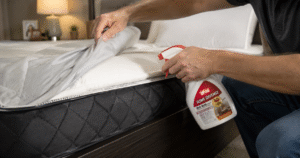
Alpine WSG is designed for use against multiple pest types rather than being limited to a single insect. Its labeled applications include pests such as certain ants, cockroaches, flies, fleas, and bed bugs, among others.
This versatility can make it a useful option for homeowners or pest-control professionals who regularly deal with different types of infestations.
Concentrated Water-Soluble Granules
Instead of buying a ready-to-use spray, you’re getting a concentrated water-soluble granule formulation that is prepared with water according to the product label.
That makes Alpine WSG better suited to targeted pest-management applications where having a concentrated product is useful, although it does require more preparation than a ready-to-use insecticide.
Why the Non-Repellent Formula Matters
This is probably one of the most interesting features of Alpine WSG.
With a conventional repellent insecticide, insects may detect the treated area and avoid it. That can be useful when your main objective is to create a barrier, but it isn’t always ideal when you’re trying to eliminate pests that are already established in an area.
A non-repellent approach works differently. Because pests may not recognize the treated surface as an obvious danger, they can continue moving through treated areas and coming into contact with the active ingredient.
For certain pest problems, that makes Alpine WSG an appealing alternative to products that simply push insects away from one location to another.
How Effective Is BASF Alpine WSG?

The effectiveness of any pesticide depends on several factors, including the pest species, infestation level, application method, sanitation, environmental conditions, and whether the product is being used at the correct labeled rate.
That said, Alpine WSG has a strong reputation as a professional-oriented insecticide because it combines a concentrated formulation with a non-repellent mode of action.
It can be particularly attractive for difficult pest problems where simply spraying visible insects isn’t enough.
For example, if ants are repeatedly appearing around your kitchen, treating only the ants you can see may not solve the underlying problem. Similarly, with cockroaches, eliminating visible insects doesn’t necessarily mean you’ve eliminated the population hiding in cracks, voids, appliances, or other protected areas.
A properly planned treatment using a labeled insecticide can address the problem more systematically.
What Pests Does Alpine WSG Control?
The exact pests and application sites permitted for Alpine WSG depend on the current product label and local regulations.
The product is commonly associated with control of several important household and structural pests, including certain:
- Ant species
- Cockroaches
- Flies
- Fleas
- Bed bugs
- Other pests listed on the product label
Because pesticide labels can differ by formulation, market, and use site, always check the label for the specific Alpine WSG product you purchase.
How to Mix & Apply BASF Alpine WSG
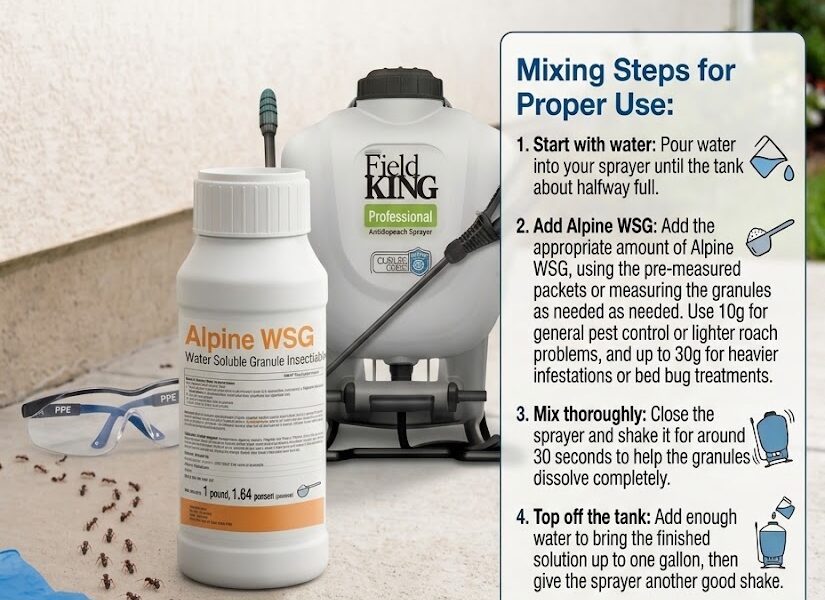
One of the things that makes BASF Alpine WSG different from a ready-to-use insecticide is its concentrated, water-soluble granule formulation. The granules are mixed with water before application, allowing users to prepare a treatment solution according to the requirements of the pest and application site.
Mixing BASF Alpine WSG
The most important thing to remember is that there isn’t one universal mixing rate for every pest.
The correct amount of Alpine WSG depends on the target pest, application site, and use specified on the current product label. For that reason, don’t rely on a generic dilution chart when preparing your treatment.
Always check the current BASF Alpine WSG label for the exact amount of product and water required for your particular application.
This is especially important when treating different pests. A rate permitted for one pest shouldn’t automatically be assumed to be appropriate for another.
Step-by-Step Instructions
Once you’ve identified the target pest and confirmed the appropriate application on the current BASF Alpine WSG label, preparing the solution is relatively straightforward.
1. Fill the Sprayer
Start with a clean spray tank and add approximately half of the required water volume, following the equipment and mixing directions on the product label.
2. Add the Alpine WSG
Measure the amount of Alpine WSG specified for your particular pest and application, then add it to the water as directed by the label.
3. Mix Thoroughly
Agitate the solution according to the product and sprayer instructions to ensure the granules are properly dissolved and the mixture is uniform.
4. Add the Remaining Water
Add the rest of the required water to reach the desired volume, following the label’s mixing procedure.
5. Apply According to the Label
Apply the finished solution only to the permitted treatment areas and at the labeled rate. Depending on the specific use, this may include certain spot, crack-and-crevice, or exterior applications.
Important: Do not assume that the same mixing rate or application method applies to every pest. Always follow the current BASF Alpine WSG label for the specific pest, treatment area, application rate, equipment, and safety requirements.
Alternative Sprayer: FIELD KING 190328 Backpack Sprayer
If you prefer a manual backpack sprayer for applying Alpine WSG, the FIELD KING 190328 Backpack Sprayer is another option to consider. It has a 4-gallon capacity, an internal no-leak pump design, and can deliver pressure up to 150 PSI, making it suitable for homeowners who need a larger-capacity sprayer for outdoor pest-control applications.
The backpack design can also be helpful when treating larger areas because the sprayer is carried on your back rather than having to move a handheld tank around the property.
Why consider the FIELD KING 190328?

- 4-gallon tank capacity
- Internal no-leak pump design
- Up to 150 PSI
- Backpack design for easier mobility
- Useful for larger spraying jobs
Check the current price on Amazon: [FIELD KING 190328 Backpack Sprayer – Amazon]
Important: Before using any sprayer with Alpine WSG, confirm that the equipment is appropriate for the intended application and follow the current BASF Alpine WSG label along with the FIELD KING manufacturer’s instructions.
Alpine WSG Application Guide
| Application Factor | What to Check |
|---|---|
| Target pest | Identify the pest before treatment |
| Mixing rate | Follow the current BASF label |
| Water volume | Use the amount specified on the label |
| Treatment area | Follow the labeled application rate |
| Application equipment | Use equipment permitted by the label |
| Indoor treatment | Apply only to labeled sites |
| Outdoor treatment | Follow all outdoor use restrictions |
| Safety | Follow required protective and re-entry instructions |
How to Apply Alpine WSG
Once the solution has been prepared according to the label, focus treatment on areas where the target pest is likely to travel, hide, or enter.
Depending on the specific labeled application, these areas may include:
- Cracks and crevices
- Gaps around doors and windows
- Pest harborage areas
- Structural entry points
- Areas around plumbing penetrations
- Other locations specifically permitted by the label
Avoid treating areas simply because they are convenient. The product should only be applied to locations permitted by the current label.
Why Correct Mixing Matters
It can be tempting to assume that using more insecticide will produce faster or better results. That’s not how pesticide applications should be approached.
Using too little may reduce effectiveness, while using more than the labeled amount can create unnecessary exposure and may violate pesticide-use requirements.
The goal is to use the correct labeled rate for the specific pest and application, not simply the strongest possible mixture.
Does Alpine WSG Dissolve Easily?
The water-soluble granule formulation is designed to be mixed with water before application. When preparing the solution, follow the product label’s directions for mixing and handling rather than relying on assumptions about how much product should be added.
If you’re using professional spray equipment or a hand-pump sprayer, make sure the equipment and application method are permitted for the intended use and follow the manufacturer’s and pesticide label instructions.
Pro Tip: Don’t Guess the Mixing Rate
If you’re buying Alpine WSG because you’re dealing with German cockroaches, ants, flies, fleas, bed bugs, or another pest, look up that specific pest on the current label before mixing the product.
This small step can make your treatment more accurate and helps prevent one of the most common mistakes people make with concentrated pesticides: assuming that one dilution rate works for everything.
Does Alpine WSG Have a Strong Odor?
One reason people consider Alpine WSG for indoor pest management is its low-odor profile.
Nobody wants their home smelling strongly of pesticide after treatment. Alpine WSG is designed to provide insect control without the heavy chemical smell associated with some older insecticide formulations.
Of course, low odor doesn’t mean harmless. It is still a pesticide, so users should follow all label directions regarding protective equipment, ventilation, treated surfaces, re-entry, food handling, and other safety precautions.
Is BASF Alpine WSG Safe to Use Indoors?
Alpine WSG is labeled for certain indoor applications, but “safe indoors” should never be interpreted as “safe to use anywhere without precautions.”
Pesticides need to be applied exactly as directed.
Before treating an indoor area:
- Read the entire product label.
- Remove or protect food and food-contact items as directed.
- Keep children and pets away from treatment areas as required by the label.
- Avoid applying the product to surfaces or locations that aren’t permitted.
- Follow all ventilation and re-entry instructions.
- Store unused product securely and according to the label.
The label is the final authority for proper use.
What I Like About BASF Alpine WSG
Professional-Strength Formulation
Alpine WSG is aimed at serious pest-control applications rather than being just another general-purpose household spray.
Non-Repellent Technology
The non-repellent formulation is one of its biggest advantages, particularly for pest problems where you don’t simply want insects pushed into another area.
Convenient Water-Soluble Granules
The concentrated granule format can be convenient for preparing spray solutions when you need them rather than storing large quantities of ready-to-use liquid.
Low-Odor Approach
For indoor pest-control situations, the low-odor nature of the product is a major plus.
Useful for Multiple Pest Problems
Depending on the label and application, Alpine WSG can be used against several common structural pests, giving it more versatility than a product designed for only one insect.
BASF Alpine WSG Pros & Cons
Pros
- Professional-oriented insecticide formulation
- Uses dinotefuran as the active ingredient
- Non-repellent formulation
- Low-odor profile
- Water-soluble granules are convenient to mix
- Can be used for multiple labeled pest-control applications
- Suitable for certain indoor and outdoor applications
- Useful for homeowners dealing with persistent pest problems
Cons
- Requires mixing before application
- Not as simple as a ready-to-use household spray
- Users must carefully follow the product label
- Application rates vary depending on the pest and use
- Not a complete solution for every infestation
- May be more product than casual users need for occasional insects
Is BASF Alpine WSG Worth Buying?
For the right pest-control situation, yes, BASF Alpine WSG is worth considering.
The biggest reason is that this isn’t simply another generic insect spray. Alpine WSG combines a concentrated formulation with a non-repellent approach, giving it characteristics that can make sense for persistent pest problems.
It’s especially appealing if you’re looking for a product that can be incorporated into a more structured pest-management program rather than something designed solely for killing an insect you happen to see.
The trade-off is convenience. You have to mix the product and understand the label before using it. If you want something that requires almost no preparation, a ready-to-use product may be easier.
But if you’re comfortable preparing a treatment correctly and want a professional-oriented insecticide, Alpine WSG offers a compelling combination of versatility, low odor, and non-repellent technology.
Who Should Buy BASF Alpine WSG?
I’d consider Alpine WSG a good option for someone who:
- Has a persistent pest problem
- Wants a concentrated insecticide
- Prefers a non-repellent formulation
- Wants a low-odor treatment option
- Is comfortable mixing and applying a pesticide according to its label
- Wants a product with multiple labeled pest-control applications
It may not be the best choice for someone who simply wants a quick, ready-to-use spray for an occasional insect.
Who May Want to Skip It?
Alpine WSG may not be the right fit if you’re looking for:
- A ready-to-use spray
- A product requiring no mixing
- A simple solution for an occasional bug
- A pesticide you can use without reading detailed directions
For those situations, a simpler consumer product may be more convenient.
Alpine WSG vs. a Typical Ready-to-Use Insecticide
One of the easiest ways to understand Alpine WSG is to consider how it differs from a typical household spray.
Feature BASF Alpine WSG Typical Ready-to-Use Spray Concentrated Yes Usually no Requires mixing Yes No Non-repellent formulation Yes Depends on product Professional-oriented Yes Usually consumer-oriented Multiple labeled applications Yes Depends on product Ease of use Moderate High Best suited for Targeted pest management Quick household applications
This doesn’t mean one category is automatically better. The right choice depends on your pest problem and how much control you’re looking for.
How to Get Better Results From Alpine WSG
Even a strong insecticide can disappoint when the underlying pest problem isn’t addressed.
For the best overall results, consider combining treatment with basic integrated pest-management practices:
1. Identify the pest.
Knowing whether you’re dealing with German cockroaches, ants, flies, fleas, or another pest helps determine the appropriate treatment approach.
2. Remove food sources.
Keep counters clean, seal food containers, and empty garbage regularly.
3. Address moisture.
Fix leaks and eliminate unnecessary sources of standing water whenever possible.
4. Seal entry points.
Caulk gaps and cracks where insects may be entering your home.
5. Reduce hiding places.
Decluttering areas around appliances, cabinets, and storage spaces can make pest harborage less attractive.
6. Follow the Alpine WSG label.
Use only the labeled rate, application method, and treatment location for the pest you’re targeting.
Important Safety Reminder
BASF Alpine WSG is a pesticide, so it should be treated with the same respect as any other professional insecticide.
Don’t increase the concentration because you think a stronger solution will work faster. Don’t apply it to areas that aren’t permitted on the label. And don’t improvise application methods.
Before using the product, read the current BASF Alpine WSG label and Safety Data Sheet and follow all applicable federal, state, and local requirements.
Where to Find the BASF Alpine WSG Label and SDS
For the most reliable information, use BASF’s official documentation rather than relying on a retailer’s product description.
The current label and SDS are the best sources for:
- Approved pests
- Mixing instructions
- Application rates
- Approved treatment locations
- Safety requirements
- Storage instructions
- Disposal information
- Restrictions and regulatory information
This is particularly important because pesticide regulations and approved uses can change.
Internal Links for BugOffControl Readers
For readers who want to learn more about controlling specific pests, this review can naturally connect to related BugOffControl guides.
Suggested internal links:
- German Cockroach Control Guide
- Best Ant Baits
- How to Get Rid of Cockroaches
- Best Fly Traps
- How to Get Rid of Fleas
- Best Mosquito Control Options
- How to Prevent Pests From Entering Your Home
Frequently Asked Questions
Is BASF Alpine WSG a repellent?
No. Alpine WSG is formulated as a non-repellent insecticide, which is one of its distinguishing features.
What is the active ingredient in Alpine WSG?
The active ingredient is dinotefuran. Check the product label for the exact concentration and approved uses of the formulation you purchase.
Does Alpine WSG have an odor?
It is known for having a low-odor profile compared with many traditional insecticide products, but users should still follow all label directions.
Can Alpine WSG be used inside a house?
Certain indoor applications are permitted by the product label. Always check the current label for approved indoor sites and application directions.
Does Alpine WSG kill cockroaches?
Alpine WSG is labeled for certain cockroach-control applications. The specific pest species and permitted application methods should be confirmed on the current label.
Can Alpine WSG be used for ants?
Yes, certain ant-control applications are included on the product label. Correct identification of the ant species and following the labeled application directions are important.
Is Alpine WSG a ready-to-use spray?
No. It is a water-soluble granule concentrate that is mixed with water according to the label before application.
Can I use Alpine WSG more heavily to get faster results?
No. More pesticide isn’t necessarily better. Always use the rate and application method specified on the current label.
Is Alpine WSG suitable for professional pest control?
It is a professional-oriented insecticide and is used in structural pest-management applications. Applicators should comply with all applicable pesticide laws and label requirements.
Where can I find the correct mixing instructions?
The current BASF Alpine WSG product label should be your primary source for mixing rates, application directions, permitted sites, target pests, and safety information.
Final Verdict
BASF Alpine WSG is a strong choice for buyers looking for a concentrated, non-repellent insecticide rather than a basic consumer bug spray.
Its professional-oriented formulation, low-odor characteristics, and broad range of labeled applications make it worth considering for serious pest-control jobs.
Just remember that better results don’t come from using more pesticide. They come from identifying the pest correctly, following the current label, applying the product to the right locations, and combining treatment with good pest-prevention practices.
If you’re comfortable with that approach, BASF Alpine WSG is one product worth having on your pest-control shortlist