Best Fruit Fly Control Products (Complete Guide)

Fruit flies can seem to appear out of nowhere. One day your kitchen looks perfectly clean. The next, tiny flies are hovering around the fruit bowl, sink, recycling bin, garbage can, wine bottle or a spilled drink.
These tiny flies are usually about 1/8 inch long, with yellowish-brown to tan bodies and noticeable eyes. They are commonly associated with ripe or fermenting fruit, sugary liquids, food residue, recycling, garbage and other moist organic material.
The frustrating part is that killing the adult flies you can see does not always solve the problem. If food, moisture or another suitable breeding source remains nearby, new adults can continue appearing. That is why successful fruit fly control is not simply about finding something that kills the flies.
It is about finding what is attracting them, removing the source, catching the adults and preventing the problem from returning. Fruit Fly Control Formula: Identify the fly → Find the source → Remove the attraction → Clean the area → Trap adult flies → Monitor → Prevent the problem from returning.
This guide explains the best fruit fly control products, what each type is designed to do, where it fits, and how to choose the right option without buying products you do not actually need.
Affiliate Disclosure: If you purchase through links on this page, BugOffControl.com may earn a commission at no additional cost to you. This helps support our pest-control guides and product research.
As an Amazon Associate I earn from qualifying purchases.
Quick Answer: What Is the Best Fruit Fly Control Product?
There is no single product that is right for every fruit fly problem.
For most visible kitchen activity, a dedicated fruit fly trap is the logical starting point because it is designed specifically to capture adult fruit flies.
If you prefer a plug-in option for broader indoor flying-insect activity, a light-and-sticky trap can be another useful choice.
If flies continue appearing around a sink, garbage disposal or drain after obvious food sources have been removed, investigate the area for organic buildup or another hidden source before simply buying more traps.
Best Fruit Fly Control Products at a Glance
| Product | Best For | Control Type | Why Consider It | Main Limitation |
|---|---|---|---|---|
| TERRO Fruit Fly Trap | Dedicated kitchen fruit-fly control | Liquid attractant trap | Designed specifically for fruit flies and easy to place near activity | Does not remove the breeding source |
| Zevo Flying Insect Trap | Continuous indoor capture | Light + sticky capture | Convenient plug-in format for ongoing flying-insect activity | Requires electricity and does not address the source |
| Safer Home Indoor Fly Trap | Indoor flying-insect capture | Light + sticky capture | Passive indoor capture with replaceable adhesive surface | Does not eliminate breeding material |
| Sticky Fruit Fly Traps | Budget capture and monitoring | Adhesive capture | Simple and inexpensive | Usually best as a supplementary method |
| Fruit Fly Drain Treatment | Suspected drain-related activity | Drain/source treatment | Can complement cleaning when organic buildup is suspected | Not necessary for every fruit fly problem |
| Covered Garbage Container | Prevention | Source reduction | Helps limit access to food waste | Does not kill existing adult flies |
Which One Should You Buy?
For typical kitchen fruit flies:
Start with a dedicated fruit fly trap such as the TERRO Fruit Fly Trap while removing the food and organic material attracting them.
For ongoing indoor flying-insect activity:
Consider a Zevo Flying Insect Trap or Safer Home Indoor Fly Trap.
For a low-cost monitoring option:
Sticky traps can help capture adults and show where activity is concentrated.
For flies repeatedly appearing around a sink or drain:
Investigate the drain and organic buildup rather than simply adding another trap.
For prevention:
Focus on food storage, garbage management, recycling cleanup and keeping food residue from accumulating
Before Buying: Make Sure They Are Actually Fruit Flies
This is one of the easiest steps to overlook. Not every tiny fly found in a kitchen is a fruit fly. Choosing the wrong product can waste money while the actual source continues producing more insects.
Fruit Fly Identification Guide
| Fly Type | Appearance | Common Location | Typical Clue |
|---|---|---|---|
| Fruit Fly | Tiny tan, yellowish-brown or brown fly with noticeable eyes | Kitchens, fruit bowls, recycling and fermentation sources | Often associated with ripe or fermenting food |
| Drain Fly | Tiny, fuzzy or moth-like fly | Sink and floor drains | Often rests around damp drain areas |
| Fungus Gnat | Very small, dark, mosquito-like fly | Houseplants and moist potting soil | Frequently seen around plants |
| House Fly | Much larger gray fly | Garbage, kitchens and outdoors | Noticeably larger than a fruit fly |
Quick Tip
If the insects are tiny and concentrated around ripe fruit, spilled juice, wine, beer, vinegar, recycling or fermenting material, fruit flies are a strong possibility.
If the insects are concentrated around a drain and have a fuzzy, moth-like appearance, drain flies may be a better match.
Correct identification should come before product selection.
What Are Fruit Flies?
Fruit flies are tiny flies commonly associated with ripe, fermenting or decaying fruit and other sugary or organic materials.
Despite their name, they are not limited to fruit.
They may also be attracted to:
- Fruit juice
- Wine
- Beer
- Vinegar
- Sugary drinks
- Fermenting food
- Food scraps
- Garbage
- Recycling residue
- Spilled liquids
- Overripe produce
- Moist organic material
This explains why a kitchen can look clean while fruit flies continue to appear. A small amount of residue inside a bottle, beneath a garbage-can liner or around a drain can be enough to keep the problem going.
Why Do Fruit Flies Keep Coming Back?
If you kill several adult flies and more appear later, there may still be an attractive food or breeding source nearby. Here are some of the most common places to investigate.
1. Overripe Fruit
Fruit left on a counter for too long can become increasingly attractive. Check fruit bowls, countertops, cabinets and other produce-storage areas.
2. Fermenting Liquids
Wine, beer, juice, vinegar and sugary beverages can attract fruit flies. Check bottles, cans and areas where drinks have been spilled.
3. Food Residue
Small spills and sticky food residue can be easy to overlook. Pay particular attention to countertops, under appliances and around food-preparation areas.
4. Recycling
Bottles and cans can retain beverage residue even after most of the contents have been emptied.
5. Garbage
Food scraps and damp organic waste can create an attractive environment.
6. Sink Drains
Organic buildup inside drains can sometimes contribute to small-fly activity.
7. Garbage Disposals
Food residue can remain inside areas of a garbage disposal that are not immediately visible.
8. Hidden Moisture
If the obvious sources have been removed but flies continue appearing, inspect other damp areas where organic material may be present. The important question is not simply:
What kills fruit flies
A better question is:
What is allowing the fruit flies to keep feeding and reproducing?”
Where Do Fruit Flies Come From?
Fruit flies can enter a home through open doors and windows, but they may also arrive with produce and other food items. Once inside, they can locate suitable food or breeding material.
Common areas to inspect include:
- Fruit bowls
- Vegetable storage
- Countertops
- Kitchen sinks
- Garbage disposals
- Recycling bins
- Garbage cans
- Bottles
- Cans
- Wine bottles
- Beer bottles
- Juice containers
- Compost containers
- Damp food residue
- Cleaning areas
If fruit flies keep returning, look beyond the insects themselves.
The goal is to find what is supporting the activity.
The Fruit Fly Life Cycle
Understanding the life cycle helps explain why traps alone may not completely solve an infestation. Fruit flies develop through several stages: Egg → Larva → Pupa → Adult. The adults are the tiny flies you notice flying around the kitchen. The immature stages can develop where suitable moist organic material is available. That creates an important control principle:
Killing Adult Fruit Flies Is Only Part of the Solution
A trap can reduce the number of adult flies you see. But if a suitable source remains available, additional adults may continue appearing. A stronger approach combines:
Source removal + cleaning + adult trapping + monitoring + prevention
How to Choose the Right Fruit Fly Control Product
Before buying anything, ask three simple questions:
1. Where are the flies concentrated?
Are they around:
- Fruit?
- A kitchen counter?
- Recycling?
- Garbage?
- A sink?
- A drain?
- Houseplants?
- Windows?
2. Do you need targeted fruit-fly control or broader indoor capture?
A dedicated fruit fly trap and a plug-in flying-insect trap serve different purposes.
3. Is there an obvious source?
If you have not removed the attraction, adding more traps may simply mean catching adult flies while the underlying problem continues.
If fruit flies continue appearing after obvious food and garbage sources have been removed, inspect sink and drain areas.
Organic material can accumulate inside plumbing, a suitable drain-cleaning product may help address buildup that could be contributing to small-fly activity. However, not every fruit fly infestation is a drain problem. Always check the product directions and make sure the product is appropriate for the intended plumbing system.
Best Fruit Fly Control Products Reviewed
1. TERRO Fruit Fly Trap 3.9 
Best For: Dedicated Kitchen Fruit Fly Control

The TERRO Fruit Fly Trap is designed specifically for fruit flies, making it a natural option for homeowners looking for targeted adult-fly capture around the kitchen. Unlike a general flying-insect trap, a dedicated fruit fly trap is intended around the attraction behavior of fruit flies.
Why Consider TERRO?
If tiny flies are concentrated around fruit, beverages or other kitchen attractions, a dedicated bait trap can provide targeted adult-fly capture while you work on removing the source.
Where to Place It
Place the trap near the area where fruit fly activity is concentrated while keeping it away from locations where it could be knocked over or contaminate food. Always follow the manufacturer’s current directions.
Pros
- Designed specifically for fruit flies
- Convenient kitchen format
- Simple to deploy
- Useful for adult-fly capture
- Can complement source removal
Cons
- Does not eliminate the breeding source
- Requires replacement when used up
- Captured flies may be visible
- Placement matters
Best For
Homeowners dealing with visible fruit fly activity around kitchens, fruit bowls, food areas or other attraction points.
Not Ideal For
Large or persistent infestations where the underlying source has not been identified.
Bottom Line
TERRO Fruit Fly Trap is a practical targeted option when you want to capture adult fruit flies while addressing the sources attracting them.
Check Latest Price & Availability on Amazon
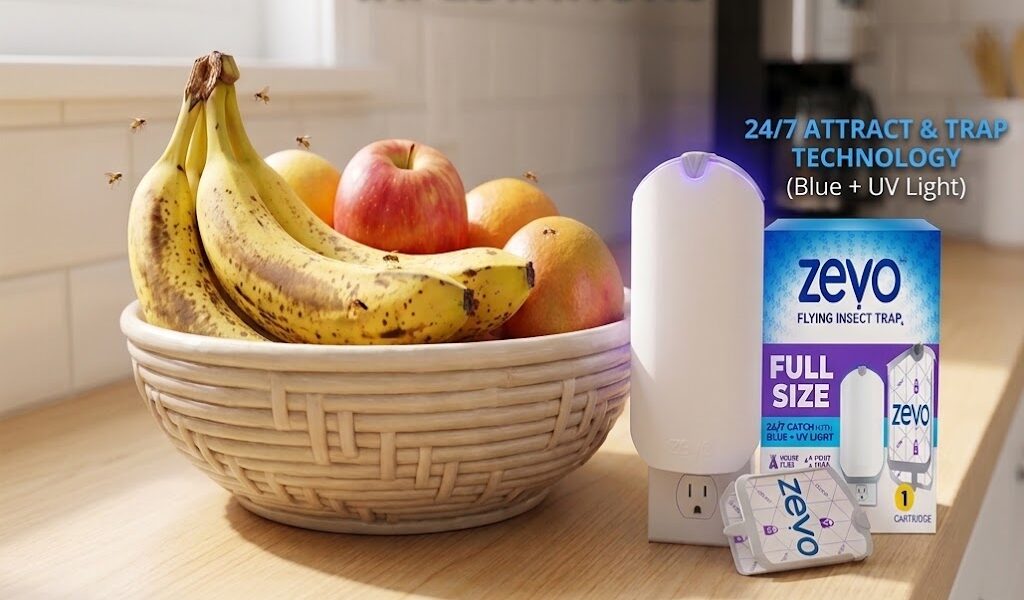
2. Zevo Flying Insect Trap 4.8
Best For: Discreet Indoor Flying-Insect Capture

The Zevo Flying Insect Trap uses light attraction and a sticky capture surface to catch flying insects indoors. This makes it different from a dedicated liquid-bait fruit fly trap.
Why Consider Zevo?
If you prefer a plug-in trap rather than liquid bait sitting on a countertop, a light-and-sticky system can provide another way to capture adult flying insects indoors.
Potential Locations
Depending on the product’s current directions, suitable locations may include:
- Kitchens
- Entryways
- Near windows
- Other indoor areas with flying-insect activity
Pros
- Discreet indoor format
- Plug-in operation
- Light-attraction approach
- Sticky capture method
- No routine aerosol spraying
Cons
- Requires replacement sticky cartridges
- Not a source-control product
- Does not eliminate breeding material
- Placement affects performance
Best For
Homeowners who prefer a convenient plug-in indoor flying-insect trap.
Bottom Line
Zevo can be a useful indoor capture tool when combined with sanitation and source removal.
Check Latest Price & Availability on Amazon
3. Safer Home Indoor Fly Trap 4.2
Best For: Indoor Flying-Insect Capture

The Safer Home Indoor Fly Trap provides another light-and-sticky approach to indoor flying-insect control. It is useful for readers who want passive capture rather than repeatedly spraying visible insects.
Pros
- Indoor-focused design
- Light attraction
- Sticky capture surface
- Convenient placement
- No repeated aerosol application
Cons
- Replacement cards are required
- Does not eliminate breeding sources
- Placement matters
- Not a substitute for sanitation
Best For
Homeowners looking for a simple indoor trap for recurring flying-insect activity.
Bottom Line
Safer Home provides another convenient indoor trapping option when adult flying insects are already inside the home.
Check Latest Price & Availability on Amazon
4. Sticky Fruit Fly Traps 4.2
Best For: Budget Capture and Monitoring
Simple sticky traps can be useful when you want to monitor activity or capture adult insects around specific areas. They can also help you determine where activity is concentrated.
Pros

- Simple design
- Easy to deploy
- Useful for monitoring
- No liquid bait
- Can supplement other control methods
Cons
- Captured insects remain visible
- Does not eliminate breeding material
- Placement matters
- May not be sufficient for an active kitchen infestation by itself
Best For
Light activity, monitoring and supplementary adult-fly capture.
Check Latest Price & Availability on Amazon
5. Fruit Fly Drain Treatment 3.8
Best For: Suspected Drain-Related Activity
If fruit flies continue appearing after you remove ripe produce, clean counters and manage garbage, inspect your sink and drain areas. A suitable drain treatment or cleaner may help address organic buildup inside plumbing.
Before Buying
Look for a product specifically appropriate for the intended drain and follow its directions carefully. Do not assume that every drain cleaner is designed for pest control.
Pros

- Addresses a potential hidden source
- Useful when activity is concentrated around drains
- Can complement trapping
- May help with organic buildup when appropriately formulated
Cons
- Not necessary for every fruit fly problem
- Does not replace sanitation
- Product directions vary
- Correct identification of the problem is important
Best For
Fruit fly activity associated with sinks, drains or garbage disposals where organic buildup is suspected.
Check Latest Price & Availability on Amazon
Fruit Fly Control by Infestation Level
You do not need the same products for every fruit fly problem.
🟢 Light Fruit Fly Activity
Typical Situation
You see a few tiny flies around a fruit bowl or kitchen counter.
Start With
- Remove overripe fruit.
- Clean food and beverage spills.
- Empty food waste.
- Wash suitable recycling containers.
- Clean counters.
- Place one dedicated fruit fly trap.
- Monitor activity.
Simple Setup
Source removal + cleaning + fruit fly trap
🟡 Moderate Fruit Fly Activity
Typical Situation
Fruit flies appear every day and you cannot immediately identify the source.
Focus On
- Remove ripe and damaged produce.
- Clean garbage containers.
- Rinse suitable bottles and cans.
- Check recycling.
- Clean the sink.
- Inspect the garbage disposal.
- Check drains.
- Place a dedicated fruit fly trap.
- Monitor where activity continues.
Simple Setup
Source removal + deep cleaning + targeted trap + monitoring
🔴 Heavy or Persistent Fruit Fly Activity
Typical Situation
Large numbers continue appearing despite normal cleaning.
Investigate
- Drains
- Garbage disposals
- Recycling containers
- Garbage cans
- Bottles and cans
- Produce storage
- Compost containers
- Spilled beverages
- Hidden food residue
- Damp organic material
Then combine:
Source elimination + cleaning + targeted trapping + drain inspection + monitoring
If activity continues despite thorough source removal, or you cannot identify the source, professional pest assistance may be appropriate.
How to Get Rid of Fruit Flies in the Kitchen
The kitchen is usually the first place to investigate.
Step 1: Remove Overripe Produce
Check fruit bowls, counters, cabinets and food-storage areas.
Discard or refrigerate suitable produce that is becoming overripe.
Step 2: Clean Beverage Residue
Pay attention to:
- Juice
- Wine
- Beer
- Soda
- Syrups
- Vinegar
- Sweet drinks
Even small amounts of residue can remain attractive.
Step 3: Clean the Garbage Container
Do not only replace the bag. Inspect the inside and bottom of the container for food residue or sticky material.
Step 4: Rinse Recycling
Bottles and cans can retain beverage residue. Rinse appropriate recyclable containers before storing them in the recycling bin.
Step 5: Inspect the Sink
Clean food debris from the sink and check around the drain.
Step 6: Check the Garbage Disposal
If you have a garbage disposal, inspect and clean it according to the manufacturer’s instructions.
Step 7: Add a Fruit Fly Trap
Once the major attraction sources have been addressed, a dedicated trap can help capture adult flies that remain.
Fruit Fly Traps vs. Light-and-Sticky Traps
These products have different strengths.
Dedicated Fruit Fly Traps
These are designed specifically around fruit fly attraction.
Best fit:
- Fruit bowls
- Kitchen counters
- Fermenting food
- Beverage areas
- Visible fruit fly activity
Light-and-Sticky Traps
These use light attraction and adhesive capture.
Best fit:
- Indoor flying-insect activity
- Kitchens
- Entry areas
- General monitoring and capture
The Main Difference
A dedicated fruit fly trap is designed specifically for fruit flies, while a light-and-sticky trap provides broader indoor flying-insect capture.
Neither approach eliminates a hidden breeding source by itself.
How to Stop Fruit Flies From Coming Back
Once you have reduced the current population, prevention becomes important.
Store Produce Properly
Refrigerate suitable produce when practical and remove damaged or overripe items.
Keep Food Areas Clean
Clean spills promptly.
Do not allow sticky liquids or food residue to remain on counters.
Manage Garbage
Empty food waste regularly.
Clean the inside of the garbage container when necessary.
Clean Recycling
Rinse appropriate beverage containers and keep the recycling area clean.
Maintain Drains
Keep sinks and drains clean and address organic buildup when necessary.
Keep Fermenting Liquids Covered
Do not leave wine, beer, juice, vinegar or other attractive liquids exposed.
Common Fruit Fly Control Mistakes
Buying a Trap but Leaving the Source
A trap can capture adults while new flies continue developing elsewhere.
Leaving Overripe Fruit on the Counter
One overripe piece of fruit can continue attracting flies.
Ignoring Recycling
Sticky beverage residue is easy to overlook.
Forgetting the Garbage Disposal
Food residue can remain in areas that are not immediately visible.
Ignoring the Drain
If activity is concentrated around a sink, investigate the drain instead of simply adding another trap.
Using a General Fly Product for a Fruit Fly Problem
Different fly species behave differently. A product designed specifically for fruit flies may be more appropriate when the pest has been correctly identified.
Using Too Many Products
More products do not automatically mean better control. Each product should have a specific job.
Expecting a Trap to Solve Everything
A trap catches adult flies. It does not necessarily remove the reason they are there.
Do You Need a Complete Fruit Fly Control Kit?
Usually, no. You do not need every product mentioned in this guide. Instead, match your purchase to the problem.
A Few Fruit Flies
Cleaning + source removal + one dedicated fruit fly trap
Regular Fruit Fly Activity
Source removal + deep cleaning + fruit fly trap + monitoring
Fruit Flies Around the Sink
Source removal + drain inspection/cleaning + fruit fly trap
Fruit Flies Around Recycling
Rinse containers + clean recycling area + fruit fly trap
Fruit Flies Keep Returning
Find the hidden source before buying more traps.
This is an important money-saving point: do not keep adding traps when the actual problem may be a food or breeding source that has not been removed.
Which Fruit Fly Control Product Should You Buy?
The right choice depends on what you are trying to control.
Dedicated Fruit Fly Control
A targeted option for visible fruit fly activity around kitchen and food areas.
Best for: Readers who want a fruit-fly-specific trap.
Check Latest Price & Availability on Amazon
Discreet Indoor Flying-Insect Capture
Useful when you prefer a plug-in light-and-sticky trapping system.
Best for: Ongoing indoor flying-insect activity.
Check Latest Price & Availability on Amazon
Another Indoor Trap Option
A light-and-sticky indoor capture option.
Best for: Readers looking for another plug-in indoor trap.
Check Latest Price & Availability on Amazon
Budget Monitoring and Capture
Useful for monitoring activity and catching adult flies around specific locations.
Best for: Light activity and supplementary capture.
Check Latest Price & Availability on Amazon
Suspected Drain Activity
Useful when organic buildup inside plumbing may be contributing to small-fly activity.
Best for: Fruit fly activity associated with drains after other obvious sources have been addressed.
Check Latest Price & Availability on Amazon
Fruit Fly Control Safety
Always read the current product label and manufacturer directions before using any pesticide, drain treatment or other pest-control product.
Important precautions include:
- Follow the product directions exactly.
- Use products only for their labeled purpose.
- Keep products away from children and pets as directed.
- Keep pest-control products away from food and food-contact surfaces unless the label specifically permits the application.
- Do not mix cleaning or pest-control products unless the manufacturer specifically says it is safe.
- Use appropriate protective equipment when required.
- Follow disposal instructions.
- Store products securely.
- Never transfer pesticides into unlabeled containers.
The current product label is the final authority for product use, application sites and safety requirements.
Frequently Asked Questions About Fruit Fly Control
What is the best way to get rid of fruit flies?
Start by removing the food and organic material attracting them. Clean potential source areas and then use a dedicated fruit fly trap to capture remaining adults.
What attracts fruit flies?
Fruit flies are commonly associated with ripe or fermenting fruit, sugary liquids, wine, beer, vinegar, food residue, garbage, recycling and other suitable organic material.
Why do fruit flies keep coming back?
A hidden food or potential breeding source may still be present. Check drains, garbage disposals, recycling containers, garbage cans, produce and beverage residue.
How long does it take to get rid of fruit flies?
The time can vary depending on the size of the infestation and whether the source has been removed. A trap may begin catching adults relatively quickly, but recurring activity can continue while a suitable source remains.
Do fruit fly traps really work?
A dedicated fruit fly trap can capture adult flies, but trapping alone may not eliminate an infestation if food, moisture or suitable breeding material remains available.
Where should I put a fruit fly trap?
Place it near the area where fruit fly activity is concentrated and follow the manufacturer’s placement directions. Keep it away from food and locations where it could easily be knocked over.
Are fruit flies the same as drain flies?
No. Fruit flies and drain flies are different types of small flies. Fruit flies are commonly associated with fermenting food and beverages, while drain flies are often associated with damp organic buildup around drains.
Can fruit flies come from the drain?
Fruit fly activity can sometimes be associated with drains or garbage disposals when suitable organic material is present. If flies are concentrated around the sink, inspect and clean the drain area.
Will vinegar get rid of fruit flies?
Vinegar can attract fruit flies, which is why vinegar-based attractants are used in some traps. However, attracting adult flies does not eliminate the underlying source.
Why are fruit flies around my garbage?
Food scraps, beverage residue and damp organic waste can attract fruit flies. Keep garbage covered, remove food waste regularly and clean residue from the container.
Why are fruit flies around my recycling bin?
Bottles and cans can retain traces of sugary drinks, beer, wine or other liquids. Rinsing appropriate containers and cleaning the recycling area can help reduce the attraction.
Can fruit flies breed in the kitchen?
Yes, when suitable food, moisture and organic material are available. Potential areas include produce, garbage, recycling, drains, garbage disposals and hidden food residue.
What is the difference between a fruit fly trap and a Zevo trap?
A dedicated fruit fly trap is designed specifically around fruit fly attraction, while a Zevo light-and-sticky trap provides broader indoor capture of flying insects using light and adhesive capture.
Should I use a spray or a trap for fruit flies?
A trap can provide targeted adult-fly capture, while a spray may provide direct control when appropriately labeled. Neither approach replaces source removal and sanitation.
When should I call a professional?
Consider professional assistance if fruit fly activity remains heavy despite thorough cleaning and source removal, if you cannot locate the source, or if you are uncomfortable handling pest-control products.
Final Thoughts: Choose the Right Fruit Fly Control Product
Getting rid of fruit flies is not simply about finding something that kills the tiny flies flying around your kitchen. Start with the source.
Check the fruit bowl. Inspect the garbage. Rinse appropriate recycling. Clean spills. Examine the sink and garbage disposal. Look for damp organic material that could be contributing to continued activity. Then choose your control product based on what you actually find. For visible kitchen activity, a dedicated fruit fly trap can provide targeted adult-fly capture. For broader indoor flying-insect activity, a light-and-sticky trap can provide another capture option. If activity continues around a sink or garbage disposal, investigate the drain and organic buildup rather than simply buying more traps. The key is to match the product to the problem. A trap catches adult flies. Source removal helps stop the cycle.
The practical approach is:
Find the source → remove the attraction → clean the area → trap adult flies → monitor activity → prevent the problem from returning.
You do not need every product in this guide.
You need the right product for the right fruit fly problem.
Fruit Fly Control Formula
Identify the fly
↓
Find what is attracting it
↓
Remove ripe, fermenting or contaminated food
↓
Clean garbage, recycling and food areas
↓
Inspect drains and garbage disposals
↓
Trap adult fruit flies
↓
Monitor where activity continues
↓
Prevent the attraction from returning
Bug Off Control’s Approach
Identify the pest → understand why it is there → choose the right control method → prevent it from coming back.
That turns fruit fly control from simply chasing tiny flies around the kitchen into a practical, repeatable pest-management strategy.
Always read and follow the current product directions before using any pest-control product.
Research & Product-Selection Note
This guide focuses on practical fruit fly control using source removal, sanitation, trapping, monitoring and appropriate pest-control products.
Product descriptions, formulations, package sizes, ingredients, permitted uses and manufacturer instructions can change. Check the current manufacturer information and product label before publication and before using any pesticide or pest-control product.
Product recommendations on BugOffControl.com are based on intended use, product specifications, available manufacturer information and practical pest-control considerations. They do not represent a claim of personal hands-on testing unless specifically stated.
Related BugOffControl Guides
Continue learning with these related guides:
- How to Get Rid of Fruit Flies in the House
- How to Kill Drain Flies
- Common Pest Identification
- Best House Fly Control Products
- Indoor Pest Prevention
- Best Outdoor Pest Control Devices
Conclusion: Build a Fruit Fly Control Plan That Makes Sense
Fruit flies are small, but you do not need to fill your kitchen with different pest-control products to deal with them.
Start with the source.
Remove overripe produce. Clean food and beverage residue. Manage garbage and recycling. Inspect the sink and garbage disposal. Look for hidden organic material if the flies keep returning.
Then choose the product that fits the situation.
A dedicated fruit fly trap can help capture adult flies. A light-and-sticky indoor trap can provide another capture option. A suitable drain-cleaning product may be useful when organic buildup is contributing to activity.
But remember the most important principle:
The best fruit fly control plan combines source removal with targeted adult-fly capture.
Find the source → remove the attraction → clean the area → trap adult flies → monitor the results → prevent them from returning.
You do not need every product in this guide.
You need the right control plan for your particular fruit fly problem.
Bug Off Control’s simple approach: Identify the pest → understand the problem → choose the right control method → prevent it from coming back.