Pharaoh Ant Bait Stations for Kitchen (Control Guide)
Pharaoh ants are tiny, persistent household ants that can be surprisingly difficult to control. You may first notice a few around the kitchen sink, countertop, cabinets, appliances, bathroom, or along a baseboard. Before long, those small trails can become a regular part of your daily routine.
The frustrating part is that killing the ants you can see does not necessarily solve the reason they keep appearing.
Pharaoh ants can travel through very small cracks and protected areas while searching for food, moisture, and shelter. That means successful control is usually about more than reaching for a spray bottle.
A better approach is: Find the trail → identify the attraction → reduce competing food → choose an appropriate bait → monitor activity → address moisture and entry points → continue monitoring.
This guide focuses on Pharaoh ant bait stations for kitchens, along with gel bait, granular bait, an IGR option, and supporting control methods that can fit different situations.
Important: The goal is not to use every product at once. Choose products according to where the ants are active, what you are trying to accomplish, and what the current product label permits.
Affiliate Disclosure
If you purchase through links on this page, BugOffControl.com may earn a commission at no additional cost to you. This helps support our pest-control guides and product research.
As an Amazon Associate I earn from qualifying purchases.
Quick Answer: What Is the Best Pharaoh Ant Control Strategy?
There is no single product that is guaranteed to solve every Pharaoh ant infestation.
For a kitchen infestation, a practical approach usually starts with identifying the trail, removing competing food, using an appropriate bait, and monitoring the activity.
Depending on the situation, the five products reviewed here provide different control formats:
Pharaoh Ant Control Products at a Glance
| Product | Best Fit | Main Role |
|---|---|---|
| Advion Ant Gel Bait | Active indoor ant trails | Targeted gel baiting in cracks, crevices, and other suitable areas |
| Advance 375A Select Granular Ant Bait | Exterior or other label-approved areas | Granular baiting to target ants around suitable outdoor areas |
| MGK NyGuard IGR Concentrate | Specific label-approved applications | Insect growth regulation as part of an integrated control strategy |
| BASF Advance 360A Dual Choice Ant Bait Stations | Convenient contained baiting | Ready-to-use bait stations for targeted ant control |
| Combat Ant Killing Gel | Targeted indoor or outdoor areas where labeled | Gel baiting along active ant trails and suitable harborage areas |
Indoor kitchen trail: Start with an appropriately labeled indoor bait.
Want a contained bait format: Consider a bait station.
Need targeted placement: A gel bait may be more convenient.
Ant activity is also outside: Investigate exterior activity and consider an appropriately labeled granular bait.
Considering an IGR: Verify that the current NyGuard label specifically covers the pest and intended application before using it.
What Do Pharaoh Ants Look Like?
Pharaoh ants are extremely small ants, commonly measuring around 1/16 inch, although size can vary.
Their tiny size is one reason homeowners sometimes mistake them for other small household ants.
They may appear yellowish, light brown, reddish, or darker toward the abdomen depending on the individual and viewing conditions.
Because identification can be difficult, avoid assuming that every tiny indoor ant is a Pharaoh ant.
If the identification is uncertain, especially when treatment has repeatedly failed, consider having the ants identified by a qualified pest professional.
Where Do Pharaoh Ants Usually Appear?
Pharaoh ants can show up in many parts of a building, but kitchens are particularly attractive because they can provide food, water, warmth, and numerous protected cracks.
Look carefully around:
- Kitchen sinks
- Countertops
- Cabinet corners
- Pantry shelves
- Backsplashes
- Plumbing openings
- Dishwashers
- Refrigerators
- Stoves
- Baseboards
- Windows
- Door frames
- Bathrooms
- Utility areas
- Wall openings
- Cracks and gaps
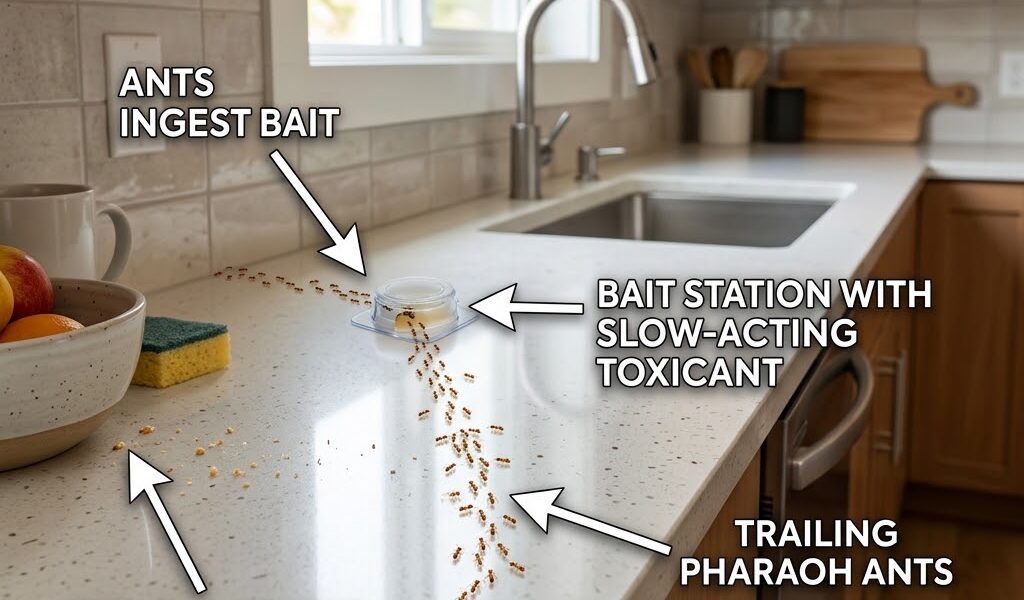
If you see a steady line of ants, don’t immediately destroy the trail. Take a few minutes to observe it. The trail may tell you considerably more about the infestation than the individual ants do.
Why Pharaoh Ants Can Be Difficult to Control
One of the biggest mistakes homeowners make is thinking: I see ants, so I need something that kills ants immediately that can provide temporary relief without addressing the larger problem. Visible workers may be traveling between a food or water source and a protected area.
If you eliminate only the ants you see while leaving food, moisture, access routes, and other favorable conditions untouched, new activity can continue.
This is why baiting can be useful.
Instead of focusing exclusively on killing individual workers, an appropriate ant bait gives actively foraging ants an opportunity to encounter the bait.
However, baiting is not automatic.
Ants may ignore bait when:
- Another food source is more attractive
- The bait is poorly positioned
- The ants are not accepting that bait
- Food competition remains high
- The trail changes
- The bait is disturbed
- Environmental conditions affect activity
That’s why baiting + sanitation + observation + exclusion is a more useful way to think about Pharaoh ant control.
Best Pharaoh Ant Products Reviewed
1. Advion Ant Gel Bait 4.5  ☆
☆
Best Fit: Targeted Indoor Pharaoh Ant Trails
Product: Syngenta Advion Ant Gel
If Pharaoh ants are actively traveling through your kitchen, a gel bait can provide a convenient way to make targeted bait placements near appropriate areas of activity. The advantage of a gel format is precision.
Rather than treating an entire room, you can focus attention on locations where ants are actually traveling, provided the current product label permits the intended use.
Why Consider Advion Ant Gel?

Kitchen ant trails often follow predictable routes.
You may find ants traveling along:
- Counter edges
- Cabinet corners
- Backsplashes
- Baseboards
- Plumbing openings
- Appliance edges
- Wall cracks
Once you identify an active trail, targeted bait placement can be more practical than randomly treating areas where you haven’t observed activity.
Pros
- Targeted gel-bait format
- Allows precise placement
- Useful around localized ant activity
- Convenient for active trails
- Can be incorporated into a broader bait-focused strategy
Cons
- Placement matters
- Competing food can reduce bait interest
- Requires monitoring
- Does not correct moisture or entry problems
- Must be used according to the current label
Best For
Homeowners dealing with active indoor ant trails who prefer a targeted gel-bait format.
Not a Complete Solution
Advion does not replace cleaning, moisture correction, inspection, or exclusion.
If ants continue entering through an unresolved route, you may need to address that part of the problem as well.
Bottom Line
Advion Ant Gel is a practical option to consider for targeted indoor ant baiting when the current label permits the intended application.
Check Latest Price & Availability on Amazon
2. Advance 375A Select Granular Ant Best Bait 4.0

Fit: Appropriate Outdoor or Labeled Granular Baiting
Advance 375A provides a granular bait format that can be useful when ant activity extends beyond the kitchen and into suitable exterior areas or other locations covered by the current label.
This is important because an indoor ant trail does not always mean the source is inside the kitchen.
The ants may be entering from:
- Foundation areas
- Walkways
- Landscaping
- Cracks around doors
- Exterior wall openings
- Utility penetrations
- Other outdoor areas
Why Consider Advance 375A?
The granular format provides a different way to approach ant activity compared with a small gel placement or contained bait station.
If you are seeing recurring ant activity outside the home, investigating that activity can help you determine whether the kitchen trail is connected to an exterior route.
Pros
- Granular bait format
- Useful for suitable exterior applications
- Provides another baiting format
- Can complement an indoor control strategy
- Useful when ants are actively foraging in appropriate areas
Cons
- Weather and environmental conditions can affect placement
- Not every application is permitted
- Requires careful label compliance
- Does not replace indoor sanitation or exclusion
Best For
Homeowners who are seeing recurring ant activity in suitable outdoor areas and want a granular bait option where the current label permits its use.
Bottom Line
Advance 375A can be a useful part of a broader strategy when Pharaoh ant activity extends outdoors and the current label permits the intended application.
Check Latest Price & Availability on Amazon
3. MGK NyGuard IGR Concentrate 4.5 ☆
Best Fit: Only for Label-Permitted Applications

NyGuard is different from the bait products in this guide.
It is an insect growth regulator, or IGR.
An IGR is designed to interfere with insect development rather than functioning simply as an immediate knockdown treatment.
That makes it important to understand what an IGR can—and cannot—do.
Important Pharaoh Ant Warning
Do not assume that NyGuard is automatically appropriate for Pharaoh ants simply because it is an IGR.
Before using it, check the current NyGuard product label to verify that:
- Pharaoh ants are a listed pest, if applicable.
- Your intended application site is permitted.
- The application method is permitted.
- The mixing and application rate are followed exactly.
If the current label does not specifically permit your intended Pharaoh-ant application, don’t use it for that purpose.
Why Consider an IGR?
An IGR works differently from bait.
Rather than serving as the primary food-based control method, it is intended to affect insect development.
That makes it a specialized tool rather than something every homeowner needs for a basic kitchen ant trail.
Pros
- Different control approach from bait
- Designed to affect insect development
- Can be incorporated into an integrated pest-management program when appropriately labeled
- Useful for homeowners who understand the role of an IGR
Cons
- Not an instant-kill solution
- Requires careful preparation and application
- Not appropriate for every pest or application
- Does not remove food or moisture
- Does not seal entry points
- Must be used exactly according to the current label
Best For
Only homeowners whose specific pest, application site, and treatment method are covered by the current NyGuard label.
Bottom Line
NyGuard IGR should be viewed as a specialized tool—not the automatic answer to a Pharaoh ant problem.
For a typical kitchen trail, start with identification, sanitation, appropriate baiting, and monitoring.
Check Latest Price & Availability on Amazon
4. BASF Advance 360A Dual Choice Ant Bait Stations 5.0
Best Fit: Convenient Contained Baiting
If you prefer a contained bait format rather than applying gel directly, Advance 360A Dual Choice Ant Bait Stations provide another approach to ant baiting.
The station format can be appealing for homeowners who want a ready-to-use bait delivery method.
Instead of applying loose bait around an area, the bait is contained within the station.
Why Consider Advance 360A?

Some homeowners simply prefer the convenience of a station.
A contained format can make placement easier in suitable locations, provided the current label allows the intended application.
For kitchen ant activity, think about where the ants are actually traveling rather than placing stations randomly throughout the room.
Potential areas to investigate include:
- Under-sink areas
- Cabinet corners
- Near active trails
- Around suitable entry points
- Behind or beside appliances where permitted
- Other locations specified by the product label
Pros
- Contained bait format
- Convenient to place
- Less messy than loose bait
- Useful for homeowners who prefer stations
- Can fit into a broader baiting strategy
Cons
- Placement still matters
- Ants may ignore bait
- Competing food can reduce interest
- Does not correct moisture or entry problems
- Must be used according to the current label
Best For
Homeowners who prefer a contained bait-station format for appropriate ant activity.
Bottom Line
Advance 360A can be a convenient option when you prefer a bait station and the product label permits the intended application.
Check Latest Price & Availability on Amazon
5. Combat Ant Killing Gel 4.3 ☆
Best Fit: Targeted Gel Baiting Where Labeled
Combat Ant Killing Gel provides another gel-bait option for homeowners who prefer targeted application.
Like other gel baits, its usefulness depends heavily on where the ants are active, whether they accept the bait, and whether the current label permits the intended application.
Why Consider Combat Ant Killing Gel?

A gel format can be useful when ants are traveling through small cracks, corners, edges, or other suitable locations where targeted placement is possible.
The important thing is not to spread bait everywhere.
Instead, concentrate on areas where you’ve actually identified ant activity and follow the manufacturer’s application directions.
Pros
- Targeted gel format
- Convenient for localized activity
- Useful where precise bait placement is appropriate
- Easy to incorporate into a targeted approach
Cons
- Placement matters
- Competing food can interfere with bait acceptance
- Requires monitoring
- Does not solve moisture or entry problems
- Must be used according to the current label
Best For
Homeowners who want a targeted gel-bait option for appropriate ant activity.
Bottom Line
Combat Ant Killing Gel is another option for targeted baiting where the current product label permits the intended application.
Check Latest Price & Availability on Amazon
Advion Gel vs. Advance 360A Bait Stations vs. Combat Gel
These products can look similar because they all involve baiting, but the delivery formats are different.
| Option | Format | Main Advantage | Consider When |
|---|---|---|---|
| Advion Ant Gel | Gel | Precise placement | You have a defined active trail |
| Advance 360A | Bait station | Contained format | You prefer ready-to-use stations |
| Combat Ant Killing Gel | Gel | Targeted application | You want another gel-bait option |
| Advance 375A | Granular bait | Larger-area/exterior format | Suitable outdoor activity is present |
| NyGuard IGR | Concentrate/IGR | Different control approach | Only when the label specifically permits the intended use |
The important point is that you do not need all five products.
Choose the format that matches the problem.
If You Only Have Pharaoh Ants in the Kitchen
You probably don’t need to turn your kitchen into a pesticide warehouse.Start with the basics.
Step 1: Follow the trail
Watch where the ants are traveling.
Don’t immediately destroy every ant you see.
Step 2: Find what is attracting them
Look for:
- Sugar
- Syrup
- Crumbs
- Food residue
- Pet food
- Grease
- Open food containers
- Water
- Leaking plumbing
- Condensation
Step 3: Clean the area
Remove competing food sources.
Wipe counters and other food-preparation surfaces and store food securely.
Step 4: Choose one appropriate bait
Depending on the situation and label directions, this could mean considering:
Advion Ant Gel
or
Advance 360A Dual Choice Ant Bait Stations
or another appropriately labeled bait option reviewed above.
Step 5: Avoid unnecessary disturbance
Don’t automatically spray over or around an active baiting area.
The objective is to allow the bait to be encountered as intended.
Step 6: Monitor
Watch the trail over time.
The important question is not:
“Did I kill every ant today?”
Instead ask:
“Is overall activity decreasing?”
Where Should Pharaoh Ant Bait Be Placed in a Kitchen?
Placement is one of the most important parts of baiting.
Look for locations where you have actually observed ant activity.
Possible areas to investigate include:
- Along countertop edges
- Near backsplashes
- Around cabinet corners
- Beneath sinks
- Near plumbing openings
- Around appliance edges
- Along baseboards
- Near cracks
- Near windows
- Around doors
- Near established ant trails
However, always follow the individual product label.
Do not place pesticide products on food-contact surfaces or in locations prohibited by the label.
Don’t Forget the Sink
The kitchen sink deserves special attention.
Even when there is no obvious leak, check for:
- Damp cabinet interiors
- Dripping supply lines
- Condensation
- Moisture beneath the sink
- Wet sponges
- Standing water
- Plumbing penetrations
A small moisture problem can make an otherwise clean area more attractive to pests. Fixing the moisture problem doesn’t replace baiting, but it can remove one factor supporting continued activity.
Food Sanitation Matters
Ant bait has to compete with whatever else the ants can find. That means a few simple habits can make your baiting strategy more sensible.
Clean up:
- Sugar spills
- Juice spills
- Food crumbs
- Grease
- Sticky residue
- Pet-food debris
- Food beneath appliances
Store:
- Sugar
- Honey
- Syrups
- Snacks
- Pet food
- Other attractive foods
in appropriate sealed containers. You don’t need a perfect laboratory-clean kitchen. The goal is simply to reduce unnecessary food competition.
Should You Spray Pharaoh Ants?
Spraying visible ants can provide immediate knockdown of ants that are directly contacted, but that does not necessarily address the larger source of activity.
If your strategy depends on ants encountering bait, indiscriminate insecticide applications around active baiting areas may also interfere with the baiting approach.
That’s why it’s better to pause and investigate before reaching for a spray.
Ask:
Where are these ants coming from?
What are they feeding on?
Where are they entering?
What control method matches that situation?
A targeted approach is usually more informative than simply spraying every ant you see.
A Simple Pharaoh Ant Control Plan
Here’s a straightforward sequence to follow.
Step 1 — Identify the ant
Make sure you’re reasonably confident that you’re dealing with Pharaoh ants.
Step 2 — Follow the trail
Find where the ants are traveling.
Step 3 — Find the attraction
Look for food, moisture, warmth, shelter, or an entry point.
Step 4 — Reduce competing food
Clean spills, crumbs, grease, and other attractive food sources.
Step 5 — Select an appropriate bait
Choose the product format that fits the location and current label.
Step 6 — Place bait correctly
Use only the amount and locations permitted by the product label.
Step 7 — Avoid unnecessary disruption
Don’t immediately spray over an active baiting area.
Step 8 — Inspect around the kitchen
Check sinks, cabinets, appliances, plumbing openings, windows, doors, and baseboards.
Step 9 — Investigate outdoors
If ants appear to be entering from outside, inspect the exterior route.
Step 10 — Address moisture
Repair leaks and reduce unnecessary damp conditions.
Step 11 — Seal suitable entry points
Once you understand the route, address appropriate cracks and gaps.
Step 12 — Keep monitoring
Continue watching the overall level of activity.
Indoor vs. Outdoor Pharaoh Ant Activity
Indoor Activity
Focus on:
- Food sources
- Moisture
- Ant trails
- Kitchen and bathroom areas
- Plumbing openings
- Cracks and gaps
- Appropriate indoor baiting
Outdoor Activity
Look around:
- Foundation areas
- Doors
- Windows
- Walkways
- Landscaping
- Utility penetrations
- Exterior cracks
- Areas where ants repeatedly travel toward the home
If you use an outdoor pesticide or granular bait, make sure the current product label specifically permits the pest and intended application.
Common Pharaoh Ant Control Mistakes
1. Killing Every Ant You See
The visible ants may only be foragers.
Take time to investigate the trail.
2. Using Too Many Products
More products do not automatically mean better control.
Give every product a specific job.
3. Spraying Directly Over Bait
Unnecessary spraying can interfere with a bait-focused approach.
Follow the product label.
4. Leaving Food Available
Even small food residues can compete with bait.
5. Ignoring Moisture
A dripping pipe or damp cabinet should not be overlooked.
6. Ignoring Exterior Activity
The kitchen may only be where you notice the problem.
7. Sealing Cracks Too Early
First understand the route.
Once you know where ants are entering, exclusion becomes more useful.
8. Expecting Overnight Results
Ant control does not always happen instantly. Look for the overall trend in activity.
9. Assuming Every Tiny Ant Is a Pharaoh Ant
Correct identification matters. Different ant species can require different control strategies.
Do You Need All Five Products?
No.
This is one of the most important points in this guide.
You don’t need to purchase everything simply because it appears in a product comparison.
Occasional indoor trail
Start with:
Inspection + sanitation + appropriate bait + monitoring
Regular kitchen activity
Consider:
Indoor bait + sanitation + moisture control + exclusion
Indoor activity plus exterior trails
Consider:
Indoor bait + appropriate outdoor baiting + sanitation + moisture control + exclusion
Persistent or difficult infestation
Consider:
A broader integrated approach and professional inspection if necessary.
The correct combination depends on where the ants are active and what is sustaining the infestation.
Pharaoh Ant Control Kit by Situation
| Problem | Main Focus | Product/Action to Consider |
|---|---|---|
| Active kitchen trail | Targeted indoor baiting | Advion Ant Gel |
| Prefer contained bait | Ready-to-use bait format | Advance 360A |
| Want another gel option | Targeted baiting | Combat Ant Killing Gel |
| Outdoor ant activity | Granular baiting | Advance 375A |
| Specialized IGR approach | Development regulation | NyGuard only if label permits |
| Food attraction | Sanitation | Clean and store food properly |
| Damp kitchen | Moisture control | Repair leaks and condensation |
| Entry route identified | Exclusion | Seal suitable gaps |
| Persistent infestation | Integrated control | Consider professional help |
Pharaoh Ant Baiting vs. Spraying
| Baiting | Spraying |
|---|---|
| Focuses on feeding ants | Primarily affects contacted ants, depending on product |
| Can be targeted | Often provides faster visible knockdown |
| Requires patience and monitoring | May provide temporary relief |
| Can be disrupted by competing food or inappropriate treatments | Can interfere with a bait-focused strategy in some situations |
| Works best when placed where activity is present | Does not necessarily address the source |
This doesn’t mean that insecticides never have a place in pest management.
It means that the treatment method should match the problem.
How Long Does Pharaoh Ant Control Take?
There is no reliable one-size-fits-all timeline.
The speed of control can depend on:
- Size of the infestation
- Bait acceptance
- Food competition
- Moisture conditions
- Environmental conditions
- Where the ants are nesting or traveling
- Entry routes
- Product placement
- Whether the correct ant species was identified
Don’t judge the entire treatment by what happens during the first few hours. Instead, monitor the overall trend in ant activity.
What If the Ants Ignore the Bait?
Don’t immediately assume the product is useless.
First investigate the basics.
Check the food competition
Are the ants finding something more attractive?
Check placement
Is the bait actually near active ant traffic?
Check identification
Are you sure you’re dealing with Pharaoh ants?
Check the product label
Is the product approved for the pest and location?
Check the environment
Has the trail moved?
Is moisture attracting the ants somewhere else?
Avoid randomly adding more products
A more complicated treatment is not automatically a better treatment.
What If Ant Activity Gets Worse After Baiting?
Seeing continued activity after placing bait does not automatically mean the treatment has failed.
Ant activity can fluctuate.
Continue observing the trail and make sure:
- Competing food has been reduced
- Bait is positioned appropriately
- The product is being used according to its label
- The bait has not been disturbed
- Other treatments are not interfering with the baiting strategy
If activity remains persistent, reassess the source and consider professional assistance.
Pharaoh Ant Safety
Pesticide safety should always come before convenience.
Before using any product in this guide:
- Read the current product label.
- Use it only for labeled pests and sites.
- Follow the application rate exactly.
- Follow indoor/outdoor restrictions.
- Follow PPE requirements.
- Keep children and pets away as directed.
- Follow food-area restrictions.
- Store pesticides securely.
- Never transfer pesticides into unlabeled containers.
- Follow disposal instructions.
The current manufacturer’s label is the final authority.
Do not assume that directions for Advion, Advance, NyGuard, or Combat automatically apply to another product.
Frequently Asked Questions
How do I get rid of Pharaoh ants in my kitchen?
Start by identifying the trail and determining what is attracting the ants. Reduce food and moisture sources, then consider an appropriately labeled bait. Continue monitoring and investigate possible entry points.
What are the best Pharaoh ant bait stations for a kitchen?
A contained bait station such as BASF Advance 360A Dual Choice Ant Bait Stations may be worth considering when the current label permits the intended indoor application. Placement and bait acceptance are important.
Is Advion Ant Gel good for Pharaoh ants?
Advion Ant Gel can be considered for appropriate targeted baiting when the current product label permits the intended pest and application. Follow the label carefully.
Should I use gel bait or bait stations?
It depends on your preference and the situation. Gel provides targeted placement, while a bait station provides a contained format. Choose the product whose label covers your intended use.
Can I use Advance 375A inside my kitchen?
Do not assume that a granular product is appropriate for every indoor kitchen application. Check the current Advance 375A label for the specific pest, site, and application you intend to make.
Is NyGuard IGR a Pharaoh ant treatment?
Do not assume that it is. NyGuard is an insect growth regulator, and its suitability depends on the current label. Verify that Pharaoh ants and your intended application are specifically covered before using it.
Will spraying Pharaoh ants get rid of them?
Spraying can kill ants that are directly contacted, but it may not address the larger source of activity. A bait-focused approach may be more appropriate in some situations.
Why do Pharaoh ants keep coming back?
Possible reasons include continued food or moisture, an unresolved entry route, outdoor activity, bait rejection, or an infestation source that has not been adequately addressed.
Does keeping the kitchen clean help?
Yes. Cleaning crumbs, spills, grease, food residue, and pet-food debris can reduce competing food sources and make baiting more practical.
Does moisture attract Pharaoh ants?
Moisture can contribute to pest activity. Check under sinks, around plumbing, behind appliances, and anywhere condensation or leaks may occur.
Where should I look for Pharaoh ant trails?
Check countertops, sinks, cabinets, backsplashes, baseboards, windows, doors, plumbing openings, appliances, and other protected cracks or gaps.
Should I seal cracks before baiting?
First understand the route whenever possible. Once you identify an important entry point, sealing a suitable gap can help reduce future access.
How long does Pharaoh ant control take?
There is no universal timeline. Bait acceptance, food competition, environmental conditions, infestation size, and the source of activity can all affect results.
Do I need every product in this guide?
No. Choose products according to your particular problem. A small indoor trail may require considerably less than a persistent infestation involving both indoor and outdoor activity.
When should I call a professional?
Consider professional help if the infestation is widespread, the source cannot be located, ants are coming from inaccessible areas, activity repeatedly returns, or you are uncomfortable applying pesticides.
Pharaoh Ant Kitchen Control Checklist
Before you finish, work through this list:
☐ Confirm the ants are reasonably identified
☐ Follow the active trail
☐ Look for food sources
☐ Check under and around the kitchen sink
☐ Inspect plumbing openings
☐ Check behind and around appliances
☐ Clean crumbs and spills
☐ Store attractive foods securely
☐ Reduce unnecessary moisture
☐ Choose an appropriate bait
☐ Follow the current product label
☐ Avoid unnecessary spraying around active bait
☐ Monitor ant activity
☐ Inspect exterior routes if appropriate
☐ Identify important entry points
☐ Seal suitable cracks and gaps
☐ Continue monitoring
☐ Consider professional help if the infestation persists
Final Thoughts: Choosing the Right Pharaoh Ant Control Products
Pharaoh ant control becomes easier to understand when you stop asking only:
“What can I spray on these ants?”
Instead, ask:
Where are they coming from?
What are they finding?
Where are they traveling?
Which control method fits that situation?
For an active indoor kitchen trail, Advion Ant Gel provides a targeted gel-bait option when its current label permits the intended use.
If you prefer a contained bait format, BASF Advance 360A Dual Choice Ant Bait Stations provide another approach.
Combat Ant Killing Gel offers another targeted gel format where appropriately labeled.
When ant activity extends into suitable exterior areas, Advance 375A Select Granular Ant Bait provides a granular option where its current label permits the application.
MGK NyGuard IGR is different because it is an insect growth regulator. It should only be considered for Pharaoh ants if the current product label specifically permits the pest and intended application.
But products are only one part of the equation.
The bigger strategy is:
Identify → follow the trail → remove competing food → address moisture → use appropriate bait → avoid unnecessary disruption → monitor → investigate entry points → seal suitable gaps.
That’s the approach I recommend readers understand before buying a collection of pest-control products.
A small kitchen ant trail doesn’t always require a complicated treatment program.
Start with the problem in front of you, choose the appropriate tool, and build from there.
BugOffControl Recommended: Focus on the right product for the right job rather than using every product at once.
Quick Buyer Summary
Active indoor trail:
→ Advion Ant Gel
Prefer a contained bait station:
→ Advance 360A Dual Choice Ant Bait Stations
Want another gel option:
→ Combat Ant Killing Gel
Recurring suitable outdoor activity:
→ Advance 375A Select Granular Ant Bait
Considering an IGR:
→ NyGuard IGR — only when the current label specifically permits the intended Pharaoh-ant application
For lasting control:
→ Bait + sanitation + moisture control + monitoring + exclusion
The goal isn’t simply to kill the ants you can see. It’s to understand why they’re there and address the conditions allowing the activity to continue.