Best House Fly Control Products (Complete Guide)
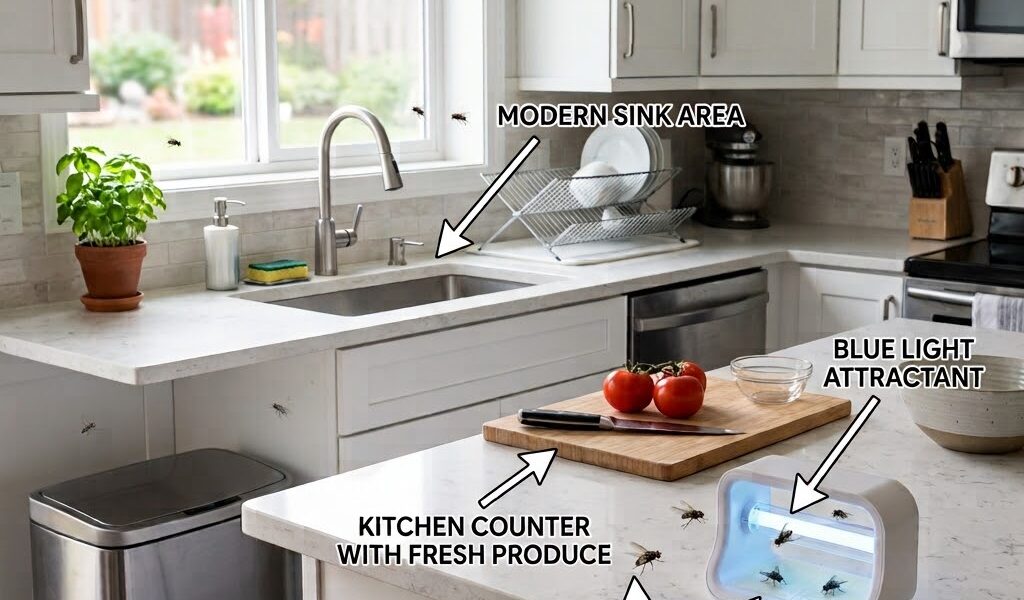
House flies can seem almost impossible to control when they suddenly appear around the kitchen, garbage cans, patio, garage, or back door.
You swat a few, spray another, and think the problem is over.
Then more flies appear the next morning.
The reason is simple: killing the adult flies you see does not necessarily remove the food, breeding material, or entry points attracting new flies.
The common house fly, Musca domestica, is a dull gray fly with four dark stripes running down the thorax and prominent reddish-brown compound eyes. Adults are generally about 1/8 to 1/4 inch (3–6 mm) long.
House flies also have an unusual feeding method. They do not have chewing mouthparts. Instead, they use sponging mouthparts and digestive fluids to liquefy suitable food before sucking it up.
That can include garbage, animal waste, decaying organic material, and human food.
This is why effective house fly control requires more than finding a good spray.
A practical approach is:
Identify the fly → find the attraction → remove breeding sources → keep flies outside → trap adult flies → use targeted treatment when appropriate → monitor the results.
This guide compares house fly control products for indoor and outdoor use and explains how to match each product to the problem you are actually dealing with.
Affiliate Disclosure: If you purchase through links on this page, BugOffControl.com may earn a commission at no additional cost to you. This helps support our pest-control guides and product research.
As an Amazon Associate I earn from qualifying purchases.
Quick Answer: What Are the Best House Fly Control Products?
There is no single product that solves every house fly problem.
The right choice depends on where the flies are active, what is attracting them, and whether they are coming from inside or outside the home.
For most homes, the most useful approach combines sanitation, exclusion, trapping, outdoor control, and targeted treatment when appropriate.
Quick Comparison: Best House Fly Control Products for Kitchen & Home
| Product | Best For | Main Role | Where It Fits |
|---|---|---|---|
| Zevo Flying Insect Trap | Indoor kitchens | Light-and-sticky trapping | Near kitchens, food-preparation areas, and other indoor fly activity |
| Safer Home Indoor Fly Trap | Indoor fly control | Light-and-glue trapping | Kitchens and other indoor areas where flies gather |
| Catchmaster Window Fly Traps | Windows and bright areas | Sticky fly capture | Windows, glass doors, and other fly entry/activity points |
| Musca-Stik Gold | Indoor fly activity | Sticky fly trapping | Areas where adult flies are active |
| TERRO Fly Magnet | Outdoor fly activity | Water-activated trapping | Outdoor areas near doors, patios, garbage, and kitchens |
| RESCUE! Outdoor Fly Trap | Outdoor fly reduction | Attracts and traps flies | Outdoor areas that may be contributing to indoor fly problems |
| Handheld Electric Fly Swatter | Individual flies | Immediate adult-fly control | Quick removal of visible flies indoors |
| PT Alpine Pressurized Fly Bait | Targeted fly treatment | Fly-bait treatment | Use only in locations and situations permitted by the product label |
| Maxforce Fly Spot Bait | Targeted fly activity | Fly-bait treatment | Targeted areas where permitted by the product label |
| Screens, Weatherstripping & Sealants | Fly prevention | Blocks entry points | Windows, doors, gaps, and other potential entry areas |
How to choose: For a kitchen with a few visible flies, an indoor trap can help capture adult flies. If fly activity keeps returning, combine trapping with sanitation, source removal, and entry-point prevention rather than relying on a trap alone. For pesticide products, always follow the current product label for permitted locations and use.
You do not need everything on this list.
The goal is to choose the products that match your specific fly problem.
Before Buying Anything: Make Sure It Is a House Fly
This is an important step that is often skipped. Not every small flying insect in a kitchen is a house fly. Using the wrong product because the insect was misidentified can waste both time and money.
If the fly you are seeing is dull gray with four dark stripes on the thorax and roughly 1/8 to 1/4 inch long, you may be dealing with the common house fly, Musca domestica.
If the insects are tiny, fuzzy, metallic, or concentrated around drains or fermenting fruit, stop and identify them before buying a house fly product.
Correct identification is the first step in effective fly control.
What Are House Flies?
The common house fly is scientifically known as Musca domestica. House flies are closely associated with people because human environments can provide food, waste, moisture, shelter, and suitable breeding material.
A typical house fly is:
- Dull gray
- About 1/8 to 1/4 inch long
- Marked with four narrow dark stripes on the thorax
- Equipped with prominent reddish-brown compound eyes
- Capable of walking across many surfaces
- Attracted to suitable food and organic material
You may see house flies around homes, garbage areas, animal facilities, food areas, patios, garages, and other places where suitable food or breeding material is available.
How Do House Flies Feed?
House flies have an unusual feeding system. They do not chew solid food. Instead, they use sponging mouthparts. When suitable food is too solid to consume, the fly can release saliva and digestive fluids onto the material. This helps liquefy the food so it can be sucked up.
Possible feeding materials include:
- Garbage
- Food waste
- Animal feces
- Pet waste
- Decaying organic material
- Spilled food
- Other suitable moist organic material
This feeding behavior helps explain why sanitation is such an important part of house fly control.
The flies you see flying around the room may only be the visible part of a much larger problem.
House Fly Natural Habitat
House flies are strongly associated with human activity, garbage, animals, and organic waste. They can thrive wherever suitable food, moisture, shelter, and breeding material are available.
Common House Fly Habitats
House flies may be found around:
- Garbage cans
- Dumpsters
- Compost areas
- Animal manure
- Pet waste
- Farms
- Kennels
- Barns
- Stables
- Food-processing areas
- Outdoor eating areas
- Decaying organic material
- Waste areas
- Warm, sheltered areas around buildings
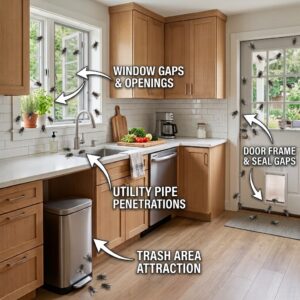
They may also enter homes through doors, windows, damaged screens, and other openings.
Where Do House Flies Breed?
A persistent house fly problem often means there is suitable breeding material somewhere nearby.
Potential sources include:
- Accumulated garbage
- Animal manure
- Pet feces
- Decaying food
- Wet organic waste
- Suitable compost material
- Dead animals
- Other decomposing organic material
The important question is therefore not simply:
“What kills house flies?”
It is:
“What is allowing these flies to feed and reproduce?”
Finding that source can make control much more effective.
The House Fly Life Cycle
Understanding the basic house fly life cycle explains why adult fly control alone may not solve an infestation. House flies develop through four main stages:
Egg → Larva → Pupa → Adult
The immature stages develop in suitable organic material. The adult is the stage you normally notice flying around the home. This creates an important control principle:
Killing Adult Flies Is Only One Part of the Solution
A trap or fly-control product can reduce the adult population you see. But if suitable breeding material remains available, additional flies may continue developing. That is why the strongest approach combines:
Adult-fly control + source reduction + exclusion + monitoring.
Why Do House Flies Keep Coming Back?
If you kill several flies today and see more tomorrow, there may be a continuing source nearby.
1. Food and Garbage
Open garbage, food scraps, spills, and waste can attract flies.
2. Pet Waste
Animal waste can provide suitable material for fly activity.
3. Outdoor Breeding Sources
The source may be outside rather than inside the home.
4. Open Doors
Frequently used doors can become easy entry routes.
5. Damaged Screens
A hole or gap in a screen can provide access.
6. Gaps Around Doors and Windows
Poorly sealed openings can allow flies inside.
7. Indoor Food Residue
Food spills, dirty dishes, garbage, and other organic material can encourage flies to remain indoors.
How to Choose the Right House Fly Control Product
Before buying a product, answer four questions.
1. Are the flies indoors or outdoors?
Indoor problems generally call for indoor traps, exclusion, sanitation, and appropriate indoor treatments. Outdoor problems may call for source reduction, outdoor traps, and appropriately labeled outdoor treatments.
2. Are you dealing with a few flies or a recurring infestation?
A single fly does not require the same strategy as constant fly activity.
3. Where are the flies concentrating?
Look at:
- Windows
- Doors
- Garbage
- Kitchens
- Patios
- Garages
- Animal areas
- Waste areas
4. Is there an obvious breeding source?
If the answer is yes, deal with the source. If the answer is no, investigate before simply adding more products.
Best House Fly Control Products Reviewed
1. RESCUE! Outdoor Fly Trap 4.5  ☆
☆
Best Fit: Outdoor Fly Control

The RESCUE! Outdoor Fly Trap is designed for outdoor fly activity and can be useful when flies are concentrated around garbage, patios, garages, animal areas, or other exterior locations. Its purpose is different from an indoor fly trap. Rather than placing a strong attractant inside the home, you can use an outdoor trap to intercept fly activity away from occupied areas.
Why Consider It?
Outdoor flies can become a continuing source of indoor problems. If flies are concentrated around a garbage area or patio, an outdoor trap may help reduce adult fly activity in that zone.
Placement Matters
Strong-smelling outdoor fly traps should be positioned away from doors, windows, patios, and outdoor seating areas. Always follow the current product directions for placement.
Pros
- Designed for outdoor fly activity
- Useful around fly-prone exterior areas
- Can capture adult flies
- Can complement sanitation and source reduction
Cons
- Attractant can have an unpleasant odor
- Not designed as a discreet indoor solution
- Placement matters
- Does not remove the breeding source
Who Is It For?
Best suited to homeowners dealing with substantial outdoor fly activity around garbage, patios, garages, or other exterior areas.
Who Is It Not For?
It is not the first choice when the problem is only an occasional fly inside the kitchen.
Bottom Line
RESCUE! Outdoor Fly Trap can be a useful outdoor component of an integrated house fly control plan when positioned appropriately.
Check Latest Price & Availability on Amazon
2. TERRO Fly Magnet 4.2
Best Fit: Outdoor Fly Trapping

TERRO Fly Magnet is another outdoor trapping option designed to attract flies into a trap. The water-activated bait format makes setup straightforward. Like other outdoor attractant traps, placement is important.
Why Consider It?
If flies are concentrated around an outdoor garbage area, shed, garage, animal area, or another suitable location, an outdoor trap can help reduce adult fly activity.
Pros
- Outdoor fly-trap format
- Straightforward setup
- Uses an attractant
- Useful around exterior fly activity
Cons
- Attractant can smell unpleasant
- Placement matters
- Does not eliminate breeding material
- Not a replacement for sanitation
Who Is It For?
Best for homeowners who want an outdoor fly trap for recurring exterior fly activity.
Bottom Line
TERRO Fly Magnet can be a useful outdoor component when positioned away from occupied areas and used according to its directions.
Check Latest Price & Availability on Amazon
3. Zevo Flying Insect Trap 4.8
Best Fit: Discreet Indoor Fly Control

Indoor fly control requires a different approach. You probably do not want a strong-smelling outdoor bait trap sitting beside your kitchen. The Zevo Flying Insect Trap uses light attraction and a sticky capture surface to catch flying insects indoors.
Why Consider Zevo?
It provides a relatively discreet way to capture adult flying insects that have already entered the home.
Potential locations include appropriate areas near:
- Entryways
- Kitchens
- Garbage areas
- Windows
- Other areas of indoor fly activity
Pros
- Discreet indoor design
- Plug-in operation
- Light-attraction approach
- Sticky capture method
- Does not require routine aerosol spraying
Cons
- Requires replacement sticky cartridges
- Placement affects performance
- Does not remove an outdoor breeding source
- Intended for adult flying insects rather than source elimination
Who Is It For?
Best for homeowners who want a tidy indoor trapping option.
Bottom Line
Zevo can be a convenient indoor trapping tool when combined with sanitation and exclusion.
Check Latest Price & Availability on Amazon
4. Safer Home Indoor Fly Trap 4.2
Best Fit: Indoor Fly Trapping

The Safer Home Indoor Fly Trap uses light attraction and a sticky capture surface to catch flying insects indoors. It is intended to deal with adult insects that have already made it inside.
Why Consider It?
An indoor trap can be useful when you have recurring flies but do not want to repeatedly spray an occupied room.
Pros
- Designed for indoor use
- Discreet trapping format
- Uses light attraction
- Captures insects on a sticky card
Cons
- Requires replacement cards
- Placement matters
- Does not stop flies entering
- Does not eliminate outdoor breeding sources
Who Is It For?
Best for homeowners who want a simple indoor trapping option.
Bottom Line
Safer Home provides another tidy indoor trapping option for recurring flying-insect activity.
Check Latest Price & Availability on Amazon
5. Catchmaster Window Fly Traps 4.7 ☆
Best Fit: Windows and Bright Areas

House flies may be noticed around windows and other bright areas. Catchmaster Window Traps provide a sticky capture surface that can be positioned on windows.
Why Consider Window Traps?
If you repeatedly find flies around particular windows, a window trap can provide both capture and useful information about where activity is concentrated.
Pros
- Simple sticky-trap design
- Useful around windows
- No spraying required
- Can help monitor fly activity
Cons
- Requires replacement
- Captured insects remain visible
- Does not address the source
- Not appropriate for every location
Who Is It For?
Best for homeowners who consistently find flies around windows or bright areas.
Bottom Line
Window traps can be a simple way to capture adult flies where they are already concentrating.
Check Latest Price & Availability on Amazon
6. Musca-Stik Gold 3.7 ☆
Best Fit: Indoor Sticky Fly Control
Musca-Stik Gold provides another sticky-trap approach for fly control. The concept is simple: provide a capture surface rather than relying on repeated aerosol spraying.
Pros

- Sticky capture format
- Designed around fly control
- Useful for indoor fly activity
- Simple to deploy
Cons
- Captured flies remain visible
- Placement matters
- Does not eliminate breeding sources
- Requires replacement when used up
Who Is It For?
Best for homeowners who prefer passive sticky trapping.
Bottom Line
Musca-Stik Gold can complement sanitation and exclusion when recurring adult fly activity needs additional control.
Check Latest Price & Availability on Amazon
7. Handheld Electric Fly Swatter 4.2
Best Fit: Individual Flies
Sometimes you do not need a complicated product. You have one fly buzzing around the kitchen and simply want it gone. A rechargeable electric fly swatter can provide direct control of individual adult flies when used appropriately.
Pros

- Immediate action
- Reusable
- Useful for individual flies
- No insecticide spray required
Cons
- Requires manual use
- Does not control an infestation
- Does not address breeding sources
- Less practical when many flies are present
Who Is It For?
Best for occasional individual flies.
Bottom Line
An electric fly swatter is a useful backup tool, but it is not a complete house fly control program.
Check Latest Price & Availability on Amazon
8. PT Alpine Pressurized Fly Bait 4.3 ☆
Best Fit: Targeted Fly Treatment

When sanitation, exclusion, and trapping are not enough, a targeted fly-control product may have a role. PT Alpine Pressurized Fly Bait is a professional-style fly-control product that should only be used for applications permitted by its current label. The important point is that pesticide products are not interchangeable. Application sites, directions, restrictions, and safety requirements matter.
Why Consider a Fly Bait?
A targeted bait can provide another method of controlling adult flies without simply spraying every surface in an area.
Pros
- Targeted fly-control approach
- Professional-style product
- Can complement trapping and sanitation
- Useful where a labeled application is appropriate
Cons
- Requires careful label compliance
- Application location matters
- Does not replace sanitation
- Does not remove breeding material
Who Is It For?
Best for homeowners who understand pesticide-label requirements and have a situation where a labeled fly-bait application is appropriate.
Bottom Line
PT Alpine can have a role in targeted house fly control when its current label permits the intended use.
Check Latest Price & Availability on Amazon
9. Maxforce Fly Spot Bait 4.4 ☆
Best Fit: Targeted Fly Activity
Maxforce Fly Spot Bait is another product designed around fly feeding behavior. Rather than treating every possible surface, fly bait can provide a targeted control option where the current label permits the intended application.
Why Consider It?
If flies repeatedly land in particular exterior areas, appropriately labeled fly bait may provide another control tool.
Pros

- Designed specifically for fly control
- Targeted approach
- Can complement outdoor trapping
- Useful for recurring activity where labeled
Cons
- Must be used according to the current label
- Does not replace sanitation
- Does not eliminate breeding material
- Application site matters
Who Is It For?
Best for recurring exterior fly activity where a labeled fly-bait application is appropriate.
Bottom Line
Maxforce Fly Spot Bait can complement an outdoor fly-control plan when used strictly according to its current label.
Check Latest Price & Availability on Amazon
10. Screens, Weatherstripping and Sealants
Best Fit: Preventing House Flies From Entering
Sometimes the most important house fly control product is not a pesticide. It is something that helps keep the flies outside.
Inspect:

- Window screens
- Door screens
- Screen doors
- Door sweeps
- Weatherstripping
- Gaps around windows
- Gaps around doors
- Utility openings
- Other potential entry points
A damaged screen can undermine an otherwise good control plan.
Pros

- Helps prevent entry
- Supports long-term control
- Does not involve pesticides
- Useful throughout the home
Cons
- Does not kill adult flies
- Requires inspection
- Damaged screens may require repair or replacement
Bottom Line

Exclusion is one of the simplest ways to reduce the number of new flies entering your home.
House Fly Control by Infestation Level
You do not need the same house fly control products for every situation.
Light Fly Activity
Typical situation: A few flies indoors.
Start with:
- Remove food and waste.
- Inspect doors and screens.
- Clean food residue.
- Use one indoor trap if needed.
- Remove individual flies.
Simple setup:
Sanitation + exclusion + indoor trap
Moderate Fly Activity
Typical situation: Flies appear regularly indoors and outdoor activity is noticeable.
Focus on:
- Indoor sanitation.
- Garbage management.
- Pet-waste management.
- Screen and door inspection.
- Indoor trapping.
- Outdoor source inspection.
- Outdoor trapping where appropriate.
Simple setup:
Sanitation + exclusion + indoor trap + outdoor control
Heavy or Persistent Fly Activity
Typical situation: Large numbers of flies continue appearing despite normal cleaning.
Focus on:
- Finding the breeding source.
- Inspecting garbage and organic waste.
- Checking pet and animal areas.
- Inspecting compost.
- Checking for decaying organic material.
- Improving exclusion.
- Using appropriate traps.
- Considering a labeled fly-control treatment where appropriate.
- Seeking professional assistance when the source cannot be found or controlled.
Simple setup:
Source elimination + exclusion + outdoor control + indoor trapping + appropriate treatment + monitoring
Outdoor House Fly Control
Outdoor control is important when flies are gathering around garbage, patios, garages, animal areas, or other exterior locations.The goal is not simply to kill flies. The goal is to reduce the number of flies reaching the house.
Start With the Source
Inspect:
- Garbage cans
- Dumpsters
- Pet waste
- Animal manure
- Compost
- Food waste
- Decaying organic material
- Other areas where flies are concentrated
Then remove or manage the source whenever possible.
Add an Outdoor Fly Trap
Products such as:
can provide another layer of outdoor control.
Where Should an Outdoor Fly Trap Go?
Do not place a strong attractant immediately beside the door or patio. Position outdoor attractant traps away from occupied areas and follow the product’s specific placement directions. The goal is to intercept flies before they reach the home, not encourage them directly beside the entrance.
Indoor House Fly Control
Indoor control should focus on removing the reason flies are inside while catching the adults that remain.
Start With:
- Garbage
- Food residue
- Dirty dishes
- Spills
- Pet food
- Open doors
- Damaged screens
- Gaps around windows and doors
Then consider an indoor trap.
Useful Indoor Options
Light-and-sticky traps
Useful for discreet continuous capture.
Window traps
Useful where flies gather around windows.
Sticky fly traps
Useful for targeted capture.
Electric fly swatters
Useful for individual flies.
Appropriately labeled indoor treatments
Useful when additional control is necessary.
House Fly Control: Sanitation Comes First
You can buy an excellent fly trap and still have a fly problem if the property continues providing food and breeding material.
Pay particular attention to:
- Indoor garbage cans
- Outdoor garbage cans
- Food scraps
- Pet waste
- Dirty dishes
- Food spills
- Compost
- Animal manure
- Decaying organic material
Manage Garbage
Use suitable containers with secure lids empty them regularly clean residue from the bottom and sides of garbage containers. Do not allow food waste to accumulate unnecessarily.
Manage Pet Waste
Remove pet waste from yards regularly. This is especially important if flies are concentrated outdoors.
Keep Food Areas Clean
Clean spills and food residue.
Remove dirty dishes.
Store food appropriately.
Do not leave organic waste sitting around unnecessarily.
House Fly Exclusion
If flies are breeding outside, exclusion becomes particularly valuable.
Inspect:
- Window screens
- Door screens
- Screen doors
- Door sweeps
- Weatherstripping
- Window frames
- Door frames
- Utility openings
- Other gaps
A Simple Rule
If you find a route flies are using to enter, fix it.
Traps remove adult flies.
Exclusion helps reduce the number of new flies entering.
House Fly Bait vs. Fly Traps
These products perform different jobs.
Outdoor Bait Traps
Outdoor bait traps attract flies and capture them.
Examples include:
These are useful for exterior fly activity.
Indoor Light-and-Sticky Traps
Indoor traps use light attraction and a sticky capture surface.
Examples include:
- Zevo
- Safer Home
- Other appropriate indoor light-and-sticky traps
Fly Baits
Fly baits use fly feeding behavior as part of their control method.
Examples include:
where their current labels permit the intended application.
The Main Difference
Traps attract and capture flies. Fly baits provide a treated food source where the product is labeled for that use.
Neither eliminates a breeding source by itself.
House Fly Control: Common Mistakes
Spraying Every Fly You See
This may provide immediate relief but does not necessarily address the source.
Ignoring Outdoor Activity
The problem may begin outside and continue feeding indoor activity.
Putting an Outdoor Trap Beside the Door
A strong attractant should not be positioned immediately beside the entrance you are trying to protect.
Leaving Garbage Uncovered
Open garbage can contribute to fly activity.
Ignoring Pet Waste
Pet waste can contribute to outdoor fly activity.
Forgetting About Screens
A damaged screen can provide an easy entrance.
Using Too Many Products
More products do not automatically mean better control. Every product should have a specific job.
Expecting a Trap to Solve the Whole Problem
A trap catches adult flies. It does not necessarily eliminate the place where new flies are developing.
Ignoring a Sudden Increase
A sudden increase can be a reason to investigate garbage, animal areas, decaying material, or another nearby source.
Do You Need a Complete House Fly Control Kit?
Not necessarily. This is a buyer’s guide, not a recommendation to purchase every product.
A Few Indoor Flies
Sanitation + exclusion + one indoor trap
Regular Indoor Activity
Sanitation + exclusion + indoor trap + outdoor inspection
Heavy Outdoor Activity
Source reduction + sanitation + outdoor trap + appropriate labeled treatment if necessary
Indoor and Outdoor Activity
Sanitation + outdoor control + indoor trapping + exclusion + monitoring
Flies Keep Returning
Find the breeding source before simply adding another product.
Which House Fly Product Should You Buy?
The best product for you depends on the problem you are trying to solve.
Outdoor Fly Activity
A practical option for outdoor fly trapping.
Another Outdoor Trap Option
A water-activated outdoor fly-trap format.
Discreet Indoor Trapping
Useful for indoor flying-insect capture.
Indoor Light-and-Sticky Trapping
Another indoor capture option.
Window Activity
Useful where flies concentrate around windows.
Individual Flies
Useful for immediate control of individual adult flies.
Targeted Fly Bait
PT Alpine Pressurized Fly Bait or Maxforce Fly Spot Bait
Only where the current product label permits the intended application.
Long-Term Prevention
Screens + weatherstripping + sanitation
These are less exciting than a fly trap, but they can be some of the most important parts of long-term fly control.
House Fly Control Safety
Always read the current product label before using any pesticide or fly-control product.
Important precautions include:
- Follow the label directions exactly.
- Use products only at labeled sites.
- Use products only for labeled purposes.
- Keep pesticides away from children and pets as directed.
- Never apply more product than the label allows.
- Use protective equipment specified on the label.
- Pay attention to indoor versus outdoor directions.
- Keep pesticides away from food and food-contact surfaces unless the label specifically permits the application.
- Store products securely.
- Never transfer pesticides into unlabeled containers.
- Follow disposal instructions.
The current product label is the final authority for application, use sites, safety requirements, and restrictions.
Frequently Asked Questions About House Fly Control
What is the best way to get rid of house flies?
Start by removing food and breeding sources, then improve exclusion and use appropriate traps or targeted fly-control products when necessary. Killing adult flies without addressing the source can allow the problem to continue.
What attracts house flies?
House flies can be attracted to garbage, food waste, animal feces, pet waste, decaying organic material, and other suitable food or breeding sources.
Where do house flies breed?
Potential breeding material includes garbage, animal manure, pet waste, decaying organic matter, and other suitable organic material.
Why do house flies keep coming back?
A continuing food or breeding source may remain available, outdoor activity may continue, or flies may repeatedly enter through doors, windows, screens, or other openings.
Are house flies a health concern?
House flies are an important sanitation and nuisance concern because they can move between waste, fecal material, decaying organic material, food, and household surfaces. Good sanitation and fly control are therefore important.
Can house flies contaminate food?
House flies can move between potentially contaminated materials and food or food-contact surfaces. Keeping food covered and maintaining good sanitation can reduce this opportunity.
What is the best indoor house fly trap?
There is no single trap that is ideal for every home. Indoor light-and-sticky traps such as Zevo or Safer Home can provide convenient indoor capture, while window traps can be useful where flies concentrate around windows.
What is the best outdoor house fly trap?
RESCUE! Outdoor Fly Trap and TERRO Fly Magnet are two outdoor options to consider. Placement is particularly important with strong-smelling attractant traps.
Where should I put an outdoor fly trap?
Place it in an appropriate outdoor location away from doors, windows, patios, and seating areas. Always follow the product’s current placement directions.
Will spraying house flies get rid of them?
Spraying can kill flies that are contacted, but it may not remove the food or breeding source responsible for continuing activity.
Are fly traps better than spraying?
They serve different purposes. Traps capture adult flies, while appropriately labeled insecticide products can provide another form of control. Neither replaces sanitation and source reduction.
Why are there so many flies around my garbage can?
Garbage can contain food residue and organic material attractive to flies. Keep the container covered, remove waste regularly, clean residue, and inspect the surrounding area for additional sources.
Does pet waste attract house flies?
Pet waste can provide suitable material for fly activity. Regular removal can help reduce fly activity around the property.
Do house flies breed inside homes?
They can when suitable organic material is available. However, many household fly problems may involve outdoor sources, with adult flies entering the home.
How can I keep house flies out of my kitchen?
Keep garbage covered, clean food residue, remove dirty dishes and spills, repair screens, keep suitable doors closed, and use an appropriate indoor trap when necessary.
What should I do if house flies suddenly appear in large numbers?
Investigate the source before simply increasing pesticide use. Check garbage, pet waste, animal areas, compost, decaying organic material, and other potential sources.
When should I call a professional?
Consider professional assistance when fly activity is unusually heavy, the source cannot be located, flies continue returning despite source reduction, or you are uncomfortable handling or applying pesticide products.
Final Thoughts: Choosing the Right House Fly Control Products
House fly control becomes much easier to understand when you stop thinking only about what kills the flies you can see.
Instead, ask:
Where are they coming from?
What are they feeding on?
Where could they be breeding?
How are they getting inside?
Which product is designed for that particular problem?
For outdoor activity, products such as RESCUE! Outdoor Fly Trap or TERRO Fly Magnet can provide another layer of outdoor control.
For indoor activity, Zevo, Safer Home, window traps, and other suitable sticky traps can help capture adult flies that make it inside.
For individual flies, a handheld electric fly swatter provides a simple direct-control option.
For targeted fly-bait applications, products such as PT Alpine Pressurized Fly Bait or Maxforce Fly Spot Bait may have a role where their current labels permit the intended use. But products are only one part of the solution. The strongest house fly control plan combines:
Sanitation + source reduction + exclusion + outdoor control + indoor trapping + monitoring
That is what turns a collection of fly-control products into an actual control strategy.
The House Fly Control Formula
Identify the fly
↓
Find the attraction
↓
Remove the breeding source
↓
Keep flies outside
↓
Trap adult flies
↓
Use appropriate treatment when necessary
↓
Monitor the results
You do not necessarily need every product in this guide. You need the right product for the right fly problem.
Bug Off Control’s Approach
Identify the pest → understand why it is there → choose the right control method → prevent it from returning.
That approach helps turn house fly control from simply chasing individual flies into a practical, repeatable pest-management strategy.
Always read and follow the current product label before using any pesticide.
Research & Product-Selection Note
This guide focuses on practical house fly control using sanitation, source reduction, exclusion, trapping, and appropriately labeled fly-control products.
Product descriptions should be checked against the current manufacturer instructions and product label before publication, particularly for pesticide products, because formulations, permitted application sites, directions, and package details can change.
Product recommendations on BugOffControl.com are based on intended use, product specifications, available manufacturer information, and practical pest-control considerations. They do not represent a claim of personal hands-on testing unless specifically stated.
Related House Fly Guides
For readers who want to go beyond product selection, link this guide to relevant existing BugOffControl.com articles covering:
- Common pest identification
- Fruit fly control
- Drain fly control
- Indoor pest prevention
- Outdoor pest control
Conclusion: Build a House Fly Control Plan That Works
Getting rid of house flies is usually not about finding one magical product. It is about understanding why the flies are there and stopping the problem at its source.
Start by looking for garbage, pet waste, food residue, decaying organic material, or other areas that may be attracting or supporting fly activity. Then check doors, windows, screens, and other possible entry points that could be allowing more flies into your home.
From there, choose your control products based on the problem you actually have. An outdoor fly trap can help reduce activity around problem areas, while an indoor fly trap can capture flies that make it inside. Sticky traps and an electric fly swatter can help with individual adult flies, while appropriately labeled fly baits may provide another option when additional control is needed.
The most important thing to remember is that trapping or killing adult flies is only part of the solution. If the source remains, new flies can continue to appear.
A more complete approach is:
Find the source → remove what attracts them → block entry points → control adult flies → monitor the results.
You do not need to buy every product in this guide. The best house fly control plan is the one that matches your specific situation and addresses both the flies you see and the reason they keep showing up.
With the right combination of sanitation, exclusion, trapping, and targeted control, you can make your home less attractive to house flies and make recurring fly problems much easier to manage.
Bug Off Control’s simple approach: Identify the pest → understand the problem → choose the right control method → prevent it from coming back.
Always read and follow the current product label before using any pesticide or fly-control product.