Best Bait for Odorous House Ants (Indoor & Outdoor Control)
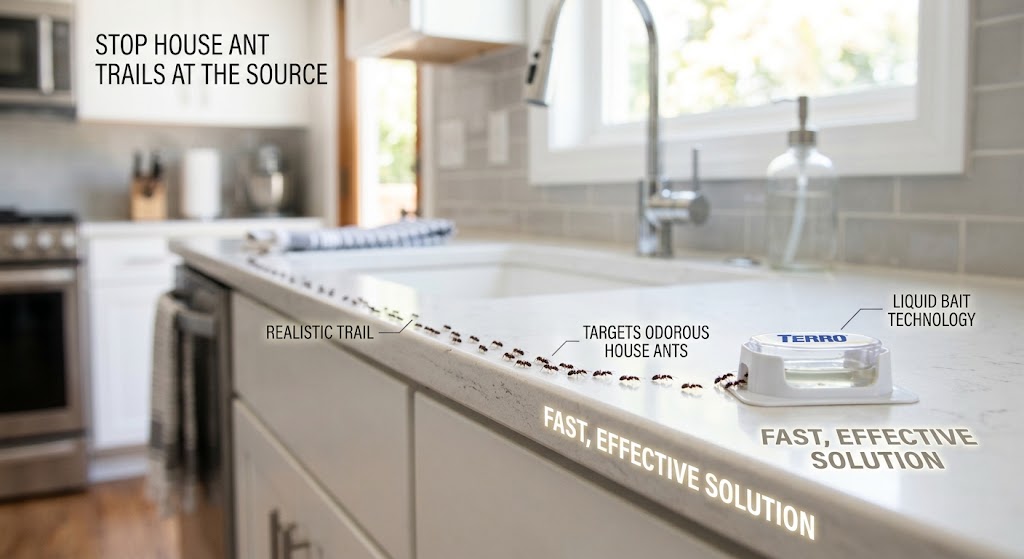
Odorous house ants can be frustrating because they often seem to disappear and then return a day or two later. You may wipe away an ant trail in the kitchen, only to find another line of ants along a countertop, window, wall, or doorway. The key is to look beyond the ants you can see.
The best bait for odorous house ants should be part of a broader strategy that includes finding active trails, reducing food and moisture sources, checking outdoor activity, and closing practical entry points. For indoor activity, a targeted liquid bait can be a useful starting point, while outdoor baiting and monitoring may be helpful when ants are active around the property.
In this guide, we compare practical products for odorous house ants and explain which bait and control method makes sense for different situations.
BugOffControl Recommended
The products featured in this guide were researched and selected by BugOffControl.com based on their intended pest-control use, product type, manufacturer information, and the role each option can play in an overall odorous house ant control strategy.
We do not recommend that every homeowner buy every product. Instead, the products are organized by purpose so you can choose the options that best match your particular ant problem.
Affiliate Disclosure: If you purchase through links on this page, BugOffControl.com may earn a commission at no additional cost to you. This helps support our pest-control guides and product research.
As an Amazon Associate I earn from qualifying purchases.
Quick Answer: What Is the Best Bait for Odorous House Ants?
For indoor odorous house ant activity, our featured bait option is TERRO Liquid Ant Killer Bait Stations T300B because it provides a convenient, targeted liquid bait format for active indoor trails.
For outdoor ant activity, TERRO Outdoor Liquid Ant Bait Stakes provide a ready-to-use outdoor baiting option.
However, bait is only one part of a successful control strategy. If ants keep returning, you may also need to monitor activity, remove food and moisture sources, address outdoor activity, and seal practical entry points.
Our Top Odorous House Ant Bait Picks
| Product | Best For | Indoor | Outdoor |
|---|---|---|---|
| TERRO Liquid Ant Killer Bait Stations T300B | Indoor ant baiting | ✓ | — |
| TERRO Outdoor Liquid Ant Bait Stakes | Outdoor ant baiting | — | ✓ |
| TERRO T3206SR Insect Traps | Monitoring activity | ✓ | — |
| TERRO Ant Killer Plus | Outdoor insect control | — | ✓ |
| Caulk & Sealant | Closing practical entry points | ✓ | ✓ |
| Sanitation | Removing food sources | ✓ | ✓ |
| Moisture Control | Reducing favorable conditions | ✓ | ✓ |
1. TERRO Liquid Ant Killer Bait Stations T300B — Best Indoor Bait 4.6 ☆
☆

Best for: Indoor odorous house ant trails
If you are specifically looking for the best bait for odorous house ants indoors, TERRO T300B is the main product to consider in this guide.
The liquid bait station provides ants with an accessible food source designed for indoor ant control. Instead of simply killing individual ants as they cross a countertop or floor, baiting gives you a more targeted way to address active foraging.
Why We Like It for Indoor Ant Activity
Odorous house ants commonly travel along established trails when they locate food or water.
A properly positioned bait station can give foraging ants an opportunity to encounter the bait.
The important thing is to use the product according to its current label and avoid treating bait stations as if they were ordinary contact sprays.
Pros
- Convenient liquid bait-station format
- Designed for indoor ant control
- Useful around active ant trails
- Provides a targeted feeding option
- Easy to incorporate into a broader control strategy
Cons
- Placement matters
- Does not correct the reason ants are entering
- Does not seal cracks or gaps
- Does not correct moisture problems
- May not be sufficient by itself for persistent activity
Best for: Homeowners dealing with recurring indoor ant trails who want a convenient liquid bait option.
Amazon: Check Latest Price & Availability on Amazon
2. TERRO Outdoor Liquid Ant Bait Stakes — Best Outdoor Bait 4.2 ☆

Best for: Outdoor odorous house ant activity
If ants are active around your foundation, patio, landscaping, walkway, or other exterior areas, indoor bait alone may not address the entire problem.
TERRO Outdoor Liquid Ant Bait Stakes provide a ready-to-use baiting option designed for outdoor ant activity.
Why Outdoor Bait Matters
Ants that repeatedly enter a house may also be active around the exterior.
Outdoor baiting gives you another way to address foraging activity around the property while you investigate possible food sources, nesting areas, moisture, and entry points.
Pros
- Ready-to-use format
- Designed for outdoor ant activity
- Convenient stake-style placement
- Can complement indoor baiting
- Useful when ants are active around the exterior
Cons
- Placement is important
- Outdoor conditions can affect bait stations
- Does not replace sanitation or exclusion
- May not solve every ant problem by itself
Best for: Homeowners seeing recurring ant activity around the outside of the home.
Amazon: Check Latest Price & Availability on Amazon
Which Bait Should You Choose?
The simplest way to choose is to start with where the ants are active.
Ants Mainly Inside?
Start with:
TERRO T300B + sanitation + inspection
Look for food sources, moisture, and entry points.
Ants Mainly Outside?
Consider:
TERRO Outdoor Liquid Ant Bait Stakes + outdoor inspection
Check foundations, landscaping, walkways, plants, garbage areas, and other locations where ants are active.
Ants Inside and Outside?
A broader approach may include:
Indoor bait + outdoor bait + monitoring + sanitation + moisture control + exclusion
You do not automatically need every product. Match the control method to the activity you actually observe.
How to Identify Odorous House Ants
Before choosing the best bait for odorous house ants, make sure you are dealing with the right type of ant.
Odorous house ants are small household ants that commonly travel in visible trails. When crushed, they can produce a distinctive odor often described as rotten or fermented.
They may become particularly noticeable after discovering an accessible food or water source.
Common Signs
Look for:
- Small ants traveling in organized trails
- Dark brown to black coloration
- Activity around kitchens
- Trails along counters and walls
- Ants around windows and doors
- Activity near sinks
- Ants entering through small gaps
- Recurring trails after cleaning
- Outdoor activity around foundations and landscaping
Appearance alone is not always enough to confirm an ant species.
If you are uncertain about identification, consider the ants’ appearance, behavior, size, and nesting habits before choosing a control strategy.
Where Do Odorous House Ants Hide?
Finding an ant trail is useful, but finding where the trail leads is even more important.
Odorous house ants can use small openings and protected areas around buildings and landscapes.
Indoor Areas to Inspect
Check:
- Kitchen counters
- Cabinets
- Under sinks
- Around appliances
- Behind appliances
- Window frames
- Door frames
- Baseboards
- Wall openings
- Plumbing penetrations
- Utility openings
- Food-storage areas
- Pet-food areas
- Bathrooms
- Laundry areas
- Cracks around floors and walls
Outdoor Areas to Inspect
Look around:
- Foundations
- Mulch
- Stones
- Plants
- Trees and shrubs
- Walkways
- Patios
- Exterior doors
- Windows
- Garbage areas
- Utility openings
- Protected cracks and edges
Why This Matters
If ants are repeatedly entering from outside, killing the ants inside may only provide temporary relief.
The objective is to determine where the activity begins, what is attracting the ants, and how they are gaining access to the building.
Signs You Have a Recurring Odorous House Ant Problem
One or two ants do not necessarily indicate a major infestation.
Repeated activity is more significant.
Watch for:
Repeated trails: Ants continually following the same route along walls, counters, windows, or floors.
Food activity: Ants repeatedly visiting crumbs, sugary spills, pet food, drinks, or other accessible food sources.
Moisture activity: Ants appearing around sinks, plumbing, condensation, or damp areas.
Recurring trails: Activity returning after the visible ants have been removed.
Entry-point activity: Ants repeatedly appearing around doors, windows, utility openings, or foundation areas.
Indoor and outdoor activity: Ants being observed around the home as well as inside it.
Why Do Odorous House Ants Enter Homes?
Ants generally enter buildings while searching for basic resources such as:
Food + water + shelter + access.
Common attractants include:
- Food crumbs
- Sugary spills
- Open food containers
- Pet food
- Garbage
- Moisture
- Leaking plumbing
- Condensation
- Damp areas
- Overripe fruit
- Outdoor food sources
- Vegetation near buildings
- Cracks and gaps
- Utility openings
This is why simply killing visible ants may not provide lasting results.
A stronger strategy combines targeted baiting with sanitation, moisture management, monitoring, and exclusion.
How We Chose the Best Bait for Odorous House Ants
We selected the featured products based on the specific role each option can play in an overall ant-control strategy.
The main focus is baiting, but odorous house ant problems are not always solved by bait alone.
For example:
- An indoor bait targets indoor feeding activity.
- An outdoor bait addresses appropriate exterior activity.
- A monitoring trap helps identify activity patterns.
- Sanitation removes food sources.
- Moisture control addresses water-related conditions.
- Caulk and sealant can reduce access through suitable openings.
The goal is simple:
Use the right product for the right job.
Best Bait and Control Options for Odorous House Ants
1. TERRO T300B Liquid Ant Killer Bait Stations
Best for: Indoor baiting
This is the primary bait recommendation in this guide for homeowners dealing with visible indoor ant trails.
The liquid bait station offers a convenient way to provide a targeted bait source where ants are actively foraging.
Best for: Indoor kitchens, living areas, and other locations where recurring ant trails are present.
Amazon: Check Latest Price & Availability on Amazon
2. TERRO Outdoor Liquid Ant Bait Stakes
Best for: Outdoor baiting
These ready-to-use bait stakes are intended for outdoor ant activity and can complement an indoor baiting strategy when ants are also active around the property.
Best for: Exterior areas where recurring ant activity is visible.
Amazon: Check Latest Price & Availability on Amazon
3. TERRO T3206SR Non-Toxic Insect Traps 4. 2 ☆

Best for: Monitoring
A monitoring product can help you determine where insect activity is concentrated.
Consider placing monitoring traps near:
- Kitchens
- Baseboards
- Windows
- Doors
- Under sinks
- Plumbing areas
- Appliances
- Food-storage areas
- Suspected entry points
Pros
- Non-toxic monitoring option
- Helps locate activity
- Useful for tracking changes
- Simple supporting tool
Cons
- Monitoring does not eliminate an established ant problem
- Requires checking
- Does not correct food or moisture sources
- Does not seal entry points
Amazon: Check Latest Price & Availability on Amazon
4. TERRO Ant Killer Plus Multi-Purpose Insect Control 4.4 ☆

Best for: Outdoor insect-control applications
For homes with recurring exterior insect activity, an outdoor insect-control product may provide another control option where its current label permits the intended use.
Before application, inspect the area for:
- Food debris
- Garbage
- Excess vegetation
- Moisture
- Plant-related sources
- Foundation cracks
- Entry points
Pros
- Designed for outdoor insect control
- Convenient shaker-bag format
- Can provide an additional outdoor control option
Cons
- Must be used according to the current label
- Does not replace baiting when baiting is appropriate
- Does not correct sanitation problems
- Does not seal structural openings
Amazon: Check Latest Price & Availability on Amazon
Supporting Odorous House Ant Control Methods
Bait is the main commercial focus of this guide, but these supporting steps can make a major difference when ants keep returning.
Caulk and Sealant

Best for: Suitable entry points
Once you identify where ants are entering, inspect around:
- Doors
- Windows
- Pipes
- Utility lines
- Foundation areas
- Frames
- Plumbing penetrations
- Other unwanted openings
Seal suitable gaps without blocking openings that are required for drainage, ventilation, safety, or normal building operation.
Sanitation
Best for: Reducing food sources
Helpful steps include:
- Clean crumbs promptly
- Wipe sugary spills
- Store food securely
- Keep countertops clean
- Clean beneath appliances
- Empty garbage regularly
- Keep pet-food areas clean
- Wash dishes promptly
- Remove food residue
The goal is not to make your home sterile. It is to remove easy food sources that encourage continued ant activity.
Moisture Control
Best for: Reducing water-related attractants
Check for:
- Leaking faucets
- Leaking pipes
- Condensation
- Damp cabinets
- Water beneath sinks
- Poor drainage
- Wet areas around appliances
- Standing water
- Damp outdoor areas
Correct leaks and unnecessary moisture whenever possible.
Odorous House Ant Control by Activity Level
Light Activity
You may have relatively minor activity when you see:
- A few ants around one food source
- Occasional ants near a window
- A short trail
- Activity limited to one area
- No obvious recurring trails
Start With:
Inspection + sanitation + monitoring + targeted bait
Find what is attracting the ants before adding more products.
Moderate Activity
Moderate activity may involve:
- Daily trails
- Ants in several rooms
- Activity returning after cleaning
- Ants around sinks
- Ants entering through windows or doors
- Indoor and outdoor activity
Consider:
Indoor bait + monitoring + sanitation + moisture control + exclusion
If ants are also active outside, an appropriate outdoor bait or treatment may be added according to its current label.
Heavy or Recurring Activity
More persistent activity may include:
- Multiple active trails
- Large numbers of ants
- Activity throughout the house
- Indoor and outdoor activity
- Repeated return after treatment
- Several apparent entry points
A Broader Strategy May Include:
Indoor bait + outdoor bait + monitoring + appropriate outdoor treatment + sanitation + moisture correction + exclusion
The objective is not to use the most products. It is to identify the source and give every control method a specific job.
Odorous House Ant Products Compared
| Product / Method | Main Purpose | Light | Moderate | Heavy / Recurring |
|---|---|---|---|---|
| TERRO T300B | Indoor liquid baiting | ✓ | ✓ | ✓ |
| TERRO Outdoor Liquid Bait Stakes | Outdoor baiting | — | ✓ | ✓ |
| TERRO T3206SR Traps | Monitoring activity | ✓ | ✓ | ✓ |
| TERRO Ant Killer Plus | Outdoor insect control | — | ✓ | ✓ |
| Sanitation | Remove food sources | ✓ | ✓ | ✓ |
| Moisture Control | Correct favorable conditions | ✓ | ✓ | ✓ |
| Caulk & Sealant | Reduce suitable entry points | ✓ | ✓ | ✓ |
Quick Takeaway
For an occasional trail, begin with inspection, sanitation, monitoring, and targeted baiting.
For regular indoor activity, focus on indoor bait while correcting food, moisture, and entry-point issues.
For recurring indoor and outdoor activity, consider a broader combination of indoor bait, outdoor bait or treatment, monitoring, sanitation, moisture control, and exclusion.
Why Bait Is Important for Odorous House Ants
One of the most common mistakes is focusing entirely on individual ants.
A visible trail represents the ants that are actively foraging.
When ants are searching for food, an appropriately selected bait can provide a targeted feeding opportunity.
That makes bait an important part of many odorous house ant control strategies.
However, more bait does not automatically mean better control.
The bait should be selected, positioned, and used according to its current product label.
At the same time, investigate why the ants are there in the first place.
How to Use Ant Bait More Effectively
1. Follow the Ant Trail
Watch where ants are traveling.
2. Find the Likely Entry Point
Look toward windows, doors, cracks, plumbing openings, and exterior areas.
3. Remove Competing Food Sources
Clean crumbs, spills, food residue, and other accessible attractants.
4. Check for Moisture
Look for leaks, condensation, damp cabinets, and standing water.
5. Place Appropriate Bait
Use the selected bait according to its current product label.
6. Avoid Unnecessary Disturbance
Allow the bait to function as intended rather than immediately treating every ant individually.
7. Monitor Activity
Use monitoring where appropriate to determine whether activity is changing.
8. Inspect Outdoors
Look around foundations, landscaping, walkways, doors, and windows.
9. Address Suitable Entry Points
Seal appropriate cracks and gaps once they have been identified.
10. Continue Monitoring
Look for a sustained reduction in activity rather than judging the result after a single day.
Common Odorous House Ant Control Mistakes
Killing Only the Ants You See
Visible ants may only be foragers.
Ignoring Entry Points
If ants can continue entering through the same opening, new activity may keep appearing.
Leaving Food Sources Available
Small amounts of food residue can encourage continued foraging.
Ignoring Outdoor Activity
Exterior activity can contribute to recurring indoor trails.
Using Too Many Products
More products do not automatically produce better results.
Each product should have a clear purpose.
Disturbing Bait Activity
Follow the product label and allow bait to be used as intended.
Ignoring Moisture
Leaks, condensation, and damp areas should not be overlooked.
Failing to Monitor
Without monitoring, it can be difficult to determine whether activity is actually declining.
Do You Need All of These Products?
No.
This is important.
For an occasional indoor trail, you may only need:
Inspection + sanitation + monitoring + targeted indoor bait
For regular indoor and outdoor activity, you may consider:
Indoor bait + outdoor bait + sanitation + moisture control + exclusion
For persistent activity, a broader approach may include:
Indoor bait + outdoor bait + monitoring + appropriate outdoor treatment + sanitation + moisture correction + exclusion
The correct combination depends on the property and where the ants are active.
What I Would Choose for Odorous House Ants
If I were organizing these options into a simple BugOffControl buying guide, I would give each product a specific role.
Best Indoor Bait
TERRO Liquid Ant Killer Bait Stations T300B
A convenient option for targeted indoor baiting.
Best Outdoor Bait
TERRO Outdoor Liquid Ant Bait Stakes
A ready-to-use option for outdoor ant activity.
Best Monitoring Product
TERRO T3206SR Non-Toxic Indoor Insect Traps
Useful for locating and tracking indoor activity.
Best Outdoor Treatment Option
TERRO Ant Killer Plus Multi-Purpose Insect Control
An additional outdoor control option where the current label permits the intended use.
Best Prevention
Useful for reducing access through suitable entry points.
Best Supporting Methods
Sanitation + moisture control
These basic steps can reduce conditions that encourage recurring activity.
Pesticide Safety
Always read the current product label before using any pesticide or insect-control product.
Follow the manufacturer’s directions for:
- Application
- Application sites
- Application rates
- Storage
- Disposal
- Protective equipment
- Environmental precautions
- Restrictions around children and pets
- Other label requirements
Do not assume that the directions for one product apply to another.
Use every product only according to its current label.
When Should You Call a Professional?
Consider professional pest-control assistance when:
- Ant activity is widespread
- Trails continue returning despite appropriate DIY efforts
- You cannot locate the source
- Ants are appearing throughout the property
- Activity appears to be inside inaccessible areas
- Moisture or structural problems are difficult to correct
- Outdoor activity is extensive
- You are uncertain about identification
- DIY control has not produced improvement
A professional can inspect areas that may be difficult to access and develop a control strategy based on the property.
Frequently Asked Questions
What is the best bait for odorous house ants?
For indoor activity, TERRO Liquid Ant Killer Bait Stations T300B are the featured indoor bait option in this guide. For outdoor activity, TERRO Outdoor Liquid Ant Bait Stakes provide an outdoor baiting option.
The best choice depends on where the ants are active, and every product should be used according to its current label.
What is the best indoor bait for odorous house ants?
TERRO T300B Liquid Ant Killer Bait Stations are our featured indoor bait choice for homeowners dealing with visible indoor ant trails.
What is the best outdoor bait for odorous house ants?
TERRO Outdoor Liquid Ant Bait Stakes are the featured outdoor bait option in this guide for recurring exterior ant activity.
Why do odorous house ants keep coming back?
Recurring activity may be associated with accessible food or water, outdoor activity, protected areas, or openings that allow ants to enter.
Finding and correcting these conditions is an important part of long-term control.
How do I get rid of odorous house ants in my kitchen?
Start by removing food sources and cleaning areas where ants are active. Check around sinks, cabinets, appliances, windows, and other potential entry points.
A targeted indoor bait can then be used according to its current product label.
Do odorous house ants come inside for food?
They can enter buildings while searching for accessible food and water.
Sugary spills, crumbs, pet food, garbage, and other food sources may encourage continued activity.
Where do odorous house ants hide?
They can use protected areas around buildings and landscapes. Potential locations include cracks, foundations, landscaping, wall areas, and other sheltered spaces.
The actual source varies by property.
Why are ants suddenly appearing in my house?
Ant activity can increase after ants discover an accessible food or water source or when environmental conditions change.
Check for food residue, moisture, outdoor activity, and possible entry points.
Should I use indoor and outdoor ant bait?
If ants are active both inside and outside, using appropriate indoor and outdoor bait products can be part of a broader control strategy.
You do not automatically need both. Match the products to where activity is occurring.
Should I spray odorous house ants?
A spray is not automatically the best first choice for every ant problem. When ants are actively foraging, an appropriate bait may provide a more targeted option. An outdoor insect-control product may also be considered where its current label permits the intended use.
How can I stop odorous house ants from entering my home?
Inspect around doors, windows, pipes, utility openings, foundations, and other suitable entry points. Once you identify an unwanted opening, appropriate caulk or sealant may help reduce access.
Does cleaning get rid of odorous house ants?
Cleaning can remove food residue and visible trails, but it may not eliminate recurring activity if ants continue entering from an outdoor or protected source.
Combine sanitation with inspection, baiting, monitoring, and exclusion as appropriate.
Does moisture attract odorous house ants?
Moisture can contribute to pest activity by providing access to water and favorable conditions. Check for leaking plumbing, condensation, standing water, and damp areas.
How do I know if my ant treatment is working?
Monitor activity over time.
Look for:
- Fewer visible ants
- Shorter trails
- Less frequent activity
- Reduced activity around previous hotspots
- Fewer ants entering through known locations
- Less activity around food and moisture sources
Do not judge the entire result based on one day.
Should I use every product in this guide?
No the goal is to choose the right product for the right job.
A minor ant problem may require only a few control measures, while recurring activity may require a broader strategy.
Final Verdict: Best Bait for Odorous House Ants
The best bait for odorous house ants depends on where the ants are active and how persistent the problem has become.
For indoor activity, TERRO Liquid Ant Killer Bait Stations T300B are the featured bait choice in this guide.
For outdoor activity, TERRO Outdoor Liquid Ant Bait Stakes provide an additional baiting option.
But bait should not be viewed as the entire solution.
If odorous house ants keep returning, look for the conditions supporting them:
Food + moisture + outdoor activity + entry points.
The BugOffControl Approach
1. Identify the ant.
Make sure you are dealing with odorous house ants before choosing a control strategy.
2. Find the trail.
Watch where the ants travel and identify their most active routes.
3. Find the attractant.
Check for food, water, moisture, garbage, pet food, and other accessible resources.
4. Use targeted indoor bait.
Consider TERRO T300B for appropriate indoor baiting.
5. Monitor activity.
Use TERRO T3206SR traps where appropriate to help locate and track activity.
6. Inspect outdoors.
Check foundations, landscaping, walkways, doors, windows, and other exterior areas.
7. Consider outdoor baiting.
TERRO Outdoor Liquid Ant Bait Stakes provide an outdoor baiting option where appropriate.
8. Consider outdoor treatment.
TERRO Ant Killer Plus may provide another outdoor control option where its current label permits the intended use.
9. Correct the conditions.
Improve sanitation, reduce unnecessary moisture, and remove attractants.
10. Seal practical entry points.
Close suitable cracks and gaps that allow ants to enter.
11. Keep monitoring.
Continue watching previously active areas to determine whether activity is actually declining.
The Bottom Line
For occasional odorous house ant activity, start with inspection, sanitation, monitoring, and targeted indoor baiting.
For regular indoor activity, focus on bait while correcting food, moisture, and entry-point problems.
For heavy or recurring activity, a broader strategy may include indoor bait, outdoor bait, monitoring, appropriate outdoor treatment, sanitation, moisture correction, and exclusion.
You do not need every product in this guide.
The better approach is to use the right bait or control method for the right job while addressing the conditions that allow odorous house ants to keep returning.
Check Latest Price & Availability on Amazon
Always verify the current Amazon listing and read the current manufacturer’s label before using any pest-control product.