How to Get Rid of Norway Rats (DIY Control Kit Guide)
Norway rats can turn a quiet home, garage, shed, garden, or backyard into a stressful place surprisingly quickly. They are strong rodents, excellent diggers, and highly adaptable animals that can take advantage of food, water, shelter, clutter, and small openings around a property. The good news is that you don’t have to depend on one trap or one bag of rat bait. A better DIY strategy is to match the control method to the level of rat activity. For a small problem, you may only need monitoring, trapping, sanitation, and exclusion. For a moderate problem, you may need traps plus properly secured bait stations.
For heavier activity, you may need a more organized control program combining bait stations, rodenticide, monitoring, sanitation, moisture reduction, and exclusion.
This guide walks you through the process step by step and shows where products such as Tomcat Bromethalin Bait Chunx, Catchmaster glue traps, tunnel-style rat traps, and Protecta LP bait stations can fit into a Norway rat control plan.
BugOffControl Recommended: Don’t think of rat control as simply “put out poison.” The goal is to control the rats already present, remove what attracts them, and prevent additional rats from entering.
Affiliate Disclosure
If you purchase through links on this page, BugOffControl.com may earn a commission at no additional cost to you. This helps support our pest-control guides and product research.
As an Amazon Associate I earn from qualifying purchases.
Quick Answer: How Do You Get Rid of Norway Rats?
A successful DIY Norway rat program usually involves several steps:
1. Identify the activity
↓
2. Remove food and garbage
↓
3. Reduce moisture and standing water
↓
4. Remove outdoor shelter and clutter
↓
5. Trap or bait according to the severity of the problem
↓
6. Seal entry points
↓
7. Continue monitoring
The most important thing to keep in mind is: Killing rats without fixing the conditions attracting them can result in another rat problem.
That’s why this guide combines control + sanitation + moisture management + exclusion.
Norway Rat Control at a Glance
Rat Activity Levels: Choose the Right Control Approach
| Rat Activity Level | What You May Notice | Recommended Approach | Main Goal |
|---|---|---|---|
| 🟢 Light Activity | A few droppings, occasional scratching sounds, or a single rat sighting may indicate early activity. | Inspect + clean up + seal entry points + monitor and trap. Remove food sources, inspect for entry points, set appropriate traps, and monitor for additional signs. | Stop a small rat problem before it grows. |
| 🟡 Moderate Activity | Multiple droppings, repeated sightings, gnaw marks, or ongoing nighttime activity can indicate a more established problem. | Traps + secured bait stations + sanitation + exclusion. Combine trapping with properly secured bait stations, thorough sanitation, and exclusion work. | Reduce an established rat population and prevent new activity. |
| 🔴 Heavy Activity | Frequent sightings, large amounts of droppings, strong signs of nesting, or continued activity despite control measures may indicate a significant infestation. | Multiple control methods + secured bait stations + sanitation + exclusion. Use a coordinated approach to address active rats, food sources, nesting areas, and entry points. | Bring significant rat activity under control and prevent continued entry. |
| 🏠 Prevention | Rat activity has been reduced, but potential food sources, entry points, garbage, or moisture problems may remain. | Seal entry points + manage food, garbage, and moisture + regular monitoring. Continue checking for new signs of activity. | Keep rats from returning and reduce the risk of future infestations. |
Always follow the pesticide and trap manufacturer’s instructions and applicable local requirements.
What Is a Norway Rat?
The Norway rat (Rattus norvegicus) is one of the most widespread rats associated with human environments.
It is also commonly called the brown rat, sewer rat, or brown Norway rat.
Norway rats generally have a heavier, stockier appearance than roof rats. They commonly have:
- Brownish, gray-brown, or dark fur
- A relatively blunt nose
- Small ears compared with the head
- A thick body
- A tail that is generally shorter than the body
- Large front teeth designed for gnawing
They are particularly good at digging and can establish burrows around foundations, gardens, sheds, garbage areas, and other protected locations.
Norway Rat Habitat: Where Do They Live?
Understanding the habitat of Norway rats can make finding the source of an infestation much easier.
Norway rats prefer areas where they can find food, water, shelter, and protection from predators.
Around homes, look closely at:
Outside
- Garbage areas
- Compost
- Gardens
- Vegetable beds
- Fruit trees
- Dense vegetation
- Wood piles
- Debris piles
- Sheds
- Crawl spaces
- Areas beneath decks
- Foundation edges
- Drainage areas
- Outdoor animal-feeding areas
Inside
- Basements
- Garages
- Storage rooms
- Kitchens
- Utility areas
- Crawl spaces
- Wall voids
- Areas behind appliances
- Food-storage areas
Norway rats may also live in burrows outdoors and enter structures when food, shelter, or favorable conditions are available.
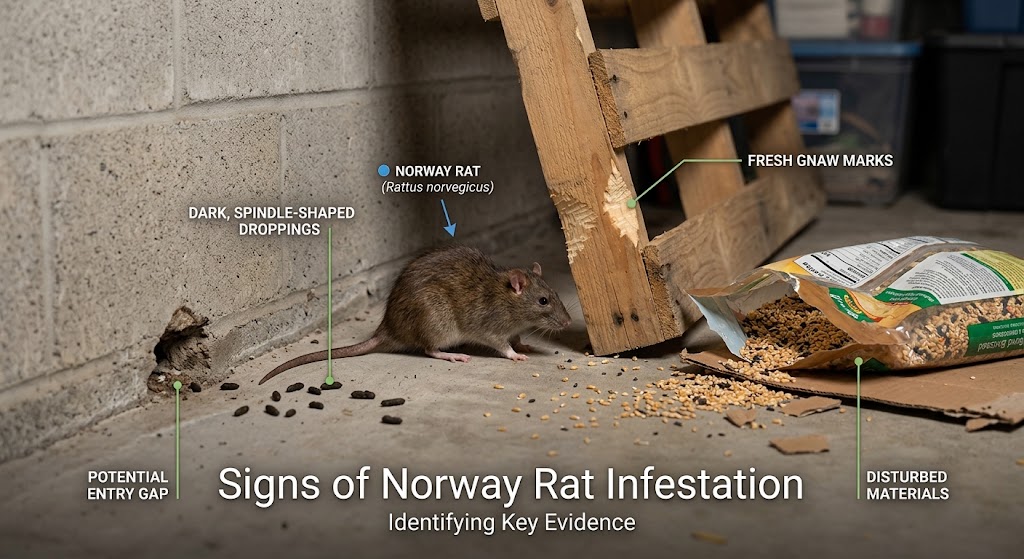
Signs of Norway Rats
You may not see the rat itself. Instead, look for evidence.
Droppings
Rat droppings are much larger than mouse droppings. Look behind appliances, along walls, in cabinets, garages, storage areas, and near food sources.
Gnaw Marks
Look for damage to:
- Food packaging
- Plastic
- Wood
- Electrical cables
- Doors
- Stored materials
- Pipes
Grease or Rub Marks
Repeated travel along walls and narrow routes can leave dark marks.
Burrows
Check around foundations, sheds, gardens, debris, and other protected areas.
Noises
Scratching, gnawing, or movement at night can indicate activity in walls, ceilings, storage areas, or other protected spaces.
Disturbed Garbage
Torn garbage bags and scattered food can be a major clue.
Why Norway Rats Are a Health Concern
Norway rats are more than a nuisance. Rodents can contaminate food, surfaces, and living areas with urine, feces, saliva, and other materials.
Depending on the circumstances, rats and rodent contamination can be associated with diseases and infections including leptospirosis and salmonellosis. Rodents can also be involved in the transmission of other pathogens and parasites.
Risk is particularly important when people come into contact with contaminated materials, rodent droppings, urine, nesting material, or contaminated food.
Protect Yourself During Cleanup
If you discover significant rodent contamination:
- Avoid sweeping or vacuuming dry droppings.
- Wear appropriate protective equipment.
- Follow appropriate rodent-cleanup procedures.
- Keep children and pets away from contaminated areas.
- Wash hands thoroughly after cleanup.
- Dispose of contaminated material appropriately.
If contamination is extensive, professional cleanup may be the safer option.
Build Your Norway Rat Control Kit
Instead of buying random rat products, build your kit around specific control jobs.
A practical DIY kit can include:
Control
- Rat bait
- Rat traps
- Glue boards where appropriate
Secure Baiting
- Tamper-resistant bait stations
Exclusion
- Hardware cloth
- Metal mesh
- Copper or stainless-steel mesh for suitable gaps
- Door sweeps
- Appropriate sealant
- Metal flashing where necessary
Sanitation
- Heavy-duty garbage containers
- Sealed food-storage containers
- Cleaning supplies
Monitoring
- Flashlight
- Inspection supplies
- Traps or monitoring devices
The important thing to remember is that each item has a purpose.
🟢 LIGHT NORWAY RAT ACTIVITY
When this approach makes sense
A light infestation might mean:
- You have seen one or two rats.
- You find occasional droppings.
- There is limited outdoor activity.
- You have identified a likely food source.
- There is no evidence of widespread indoor activity.
Don’t immediately jump to the strongest control method.
Start by making your property less attractive.
Step 1: Remove Food
Secure:
- Pet food
- Bird seed
- Animal feed
- Dry food
- Garbage
- Fallen fruit
- Food scraps
Use strong containers with secure lids. Don’t leave pet food outside overnight if it can be avoided. Clean spilled food quickly.
Step 2: Reduce Moisture
Look for:
- Leaking faucets
- Leaking pipes
- Standing water
- Poor drainage
- Outdoor water containers
- Leaking equipment
- Condensation
Fixing water problems removes another reason rats may remain nearby.
Step 3: Start Exclusion
Inspect the outside of the structure carefully.
Look around:
- Doors
- Garage doors
- Pipe penetrations
- Utility lines
- Vents
- Foundations
- Crawl spaces
- Wall penetrations
For durable repairs, metal mesh or hardware cloth can be more useful than relying on soft materials alone.
Step 4: Use Traps for Limited Activity
When rat activity is limited, trapping can be a useful first-line control method.
Enclosed Tunnel Rat Trap 4.2 
Best for:
Light-to-moderate activity where you want a contained trapping setup.
Pros:

- Enclosed design
- No exposed jaw
- Suitable for large mice and rats
- Can be used indoors or outdoors when appropriate
- More discreet than some exposed traps
Cons:
- Requires correct placement
- Must be checked regularly
- May not be enough by itself for a larger infestation
- Requires careful positioning where rat activity is confirmed
Amazon: Check the Enclosed Tunnel Rat Trap on Amazon
Catchmaster Max-Catch Glue Traps 4.3 ☆
Glue boards can be useful for monitoring or intercepting rodent activity in suitable protected locations.
The Catchmaster Max-Catch 36-pack gives you multiple traps for monitoring different areas.
Best for:
Monitoring and trapping in appropriate protected areas.
Pros:

- Ready to use
- No bait mixing
- Multiple traps in one package
- Useful for monitoring rodent activity
- Can be placed in protected travel routes
Cons:g
- Glue traps must be monitored frequently
- They can be affected by dust and environmental conditions
- They are not appropriate for every situation
- Trapped animals can experience prolonged distress if the traps are not checked properly
- They should be kept away from children, pets, and non-target animals
Amazon: Check Catchmaster Max-Catch Glue Traps on Amazon
Important: Use glue traps responsibly and check them frequently. Where local rules or animal-welfare requirements restrict their use, choose another appropriate control method.
🟡 MODERATE NORWAY RAT ACTIVITY
Consider moving to a more organized approach when:
- Rats are seen repeatedly.
- Droppings continue appearing.
- Rats are feeding around garbage or food.
- Traps alone are not solving the problem.
- There are several areas of activity.
- Outdoor activity is increasing.
This is where bait + secure bait stations + monitoring + sanitation + exclusion can become useful.
Protecta LP Rat Bait Stations 4.9
A bait station gives you a controlled location for presenting rodenticide while helping protect bait from accidental access.
The Protecta LP Rat Bait Station is a dedicated rat baiting station designed for rodenticide placement.
Best for:
Organized rat baiting around areas with identified rat activity.
Pros:

- Designed specifically for rodent baiting
- Multiple stations allow coverage of several activity areas
- Helps contain bait
- More organized than placing loose bait around a property
- Useful for exterior and other appropriate locations when used according to the label
Cons:
- Requires proper placement
- Must be inspected and maintained
- Must be used with compatible bait and according to applicable instructions
Amazon: Check Protecta LP Rat Bait Stations on Amazon
Safety first: Always follow the station manufacturer’s instructions and the rodenticide label. Keep baiting equipment away from children, pets, and non-target animals.
Tomcat Bromethalin Bait Chunx 4.5 ☆
For an established rat problem, a rodenticide may become part of the control program.
The Tomcat with Bromethalin Bait Chunx product comes in a 4.25-pound pail.
Bromethalin is a rodenticide active ingredient, so this is a product that needs particularly careful handling.
Best for:
Established rat activity where a properly labeled rodenticide is appropriate.
Pros:

- Designed for rodent control
- Chunx-style bait can be used with compatible bait stations
- Large package can provide multiple applications
- Useful as part of a structured baiting program
Cons:
- Toxic to rodents and potentially dangerous to pets and non-target animals
- Requires careful handling
- Must be placed in appropriate baiting equipment where required
- Requires strict compliance with the current product label
- Rodenticide should never be treated as a substitute for sanitation and exclusion
Amazon: Check Tomcat Bromethalin Bait Chunx on Amazon
Important
Don’t use more bait simply because you have more rats. Use the product only according to its current label, including approved placement, baiting equipment, application instructions, and precautions.
For homes with pets, children, wildlife, or other non-target animals, secure baiting is particularly important.
How Bait + Bait Stations Work Together
Think of these as two separate pieces of the same system:
Rat bait
= the control product
Bait station
= the controlled delivery system
Instead of scattering bait around the property, the bait is placed where rats are active and contained according to the product’s instructions.
This is a much more organized approach.
🔴 HEAVY NORWAY RAT ACTIVITY
Heavy activity may involve:
- Frequent rat sightings
- Numerous droppings
- Multiple active areas
- Significant gnawing
- Rats entering occupied rooms
- Active burrows
- Continued activity despite basic trapping
- Food and garbage being heavily disturbed
- Rats entering from several points
At this level, don’t think: What is the strongest rat poison? Think: How do I attack every part of the problem?
The Heavy-Activity Control Plan
1. Identify the Activity Areas
Find:
- Travel routes
- Dropping locations
- Feeding areas
- Burrows
- Entry points
- Nesting locations
2. Remove Food
Secure garbage, food, pet food, bird seed, and animal feed.
3. Remove Water
Repair leaks and standing-water problems.
4. Reduce Shelter
Remove clutter, debris, overgrown vegetation, and unnecessary hiding areas.
5. Use Appropriate Trapping
Deploy suitable traps in protected areas where activity is confirmed.
6. Use Secure Bait Stations When Appropriate
Place bait stations according to the product label and local requirements.
7. Inspect Regularly
Look for new:
- Droppings
- Gnaw marks
- Tracks
- Feeding activity
- Burrows
8. Close Entry Points
Once active rats have been addressed, complete the exclusion work so new rodents cannot simply move into the same space.
Products That Help Block or Deter Rats
A complete rat-control kit shouldn’t only contain products designed to kill rats.
Some of your most important products are the ones that help stop rats from getting in or make the property less attractive.
Hardware Cloth
Hardware cloth can be useful for protecting larger openings, vents, crawl-space openings, and other vulnerable areas.
Pros:
- Durable
- Chew-resistant when properly selected
- Useful for larger openings
- Good for long-term exclusion
Cons:
- Requires cutting and installation
- May need additional fasteners
- Must be installed correctly to prevent gaps
Metal or Copper Mesh
Metal mesh can be useful for filling suitable small openings around pipes and other structural penetrations when combined with an appropriate sealant or repair method.
Pros:
- More resistant to chewing than many soft materials
- Useful around irregular openings
- Helpful for small exclusion repairs
Cons:
- Not appropriate for every opening
- Needs to be installed securely
- Should not be the only solution for large openings
Door Sweeps
A damaged or poorly fitting exterior door can create a simple entry route. A suitable door sweep can help close the gap underneath. Best for: Exterior doors, garages, and utility entrances where appropriate.
Sealant and Repair Materials
Use appropriate sealants to close small gaps around:
- Pipes
- Utility lines
- Frames
- Foundation penetrations
- Other structural openings
Don’t Make This Common Mistake
Expanding foam alone should not be treated as a rat-proof barrier. Rats can chew through many soft materials. For vulnerable areas, combine appropriate sealant with a durable material such as metal mesh or hardware cloth.
Can Rat Repellents Keep Norway Rats Away?
Repellent products may be marketed for rodents, but don’t build your entire control plan around repellents.
If rats have easy access to:
- Food
- Water
- Shelter
- Garbage
- Warm nesting areas
a repellent alone is unlikely to solve the underlying problem. Exclusion and sanitation should remain the foundation of prevention.
The BugOffControl Norway Rat Control Kit
Here’s how I would organize the complete kit for readers.
Rat Control Methods by Infestation Level
Use this table to match each rat control job with the appropriate product or method. The colored lights make it easy to see which approaches are most suitable for light, moderate, or heavy rat activity.
| Control Job | Recommended Product / Method | Infestation Level |
|---|---|---|
| 🔎 Inspect for Activity | Flashlight + thorough visual inspection for droppings, gnaw marks, nesting material, entry points, and other signs of rat activity | 🟢 Light |
| 🍽️ Remove Food Sources | Store food in sealed containers and keep garbage securely covered | 🟢 Light |
| 💧 Reduce Water Sources | Repair plumbing leaks, improve drainage, and eliminate standing water where possible | 🟢 Light |
| 🪤 Monitor & Trap | Enclosed tunnel-style rat traps placed along active travel routes | 🟢 Light → 🟡 Moderate |
| 🪤 Monitor & Trap | Catchmaster glue boards where appropriate and permitted, placed in protected locations away from children and pets | 🟢 Light → 🟡 Moderate |
| 🧰 Secure Bait | Protecta LP bait stations for securely containing rodent bait in areas where baiting is appropriate | 🟡 Moderate → 🔴 Heavy |
| ☠️ Rodenticide Bait | Tomcat Bromethalin Bait Chunx, used only according to the product label and inside appropriate bait stations | 🟡 Moderate → 🔴 Heavy |
| 🧱 Seal Entry Points | Hardware cloth, metal mesh, and suitable sealants to close gaps and openings rats may use to enter | 🟢 All Levels |
| 🚪 Prevent Re-entry | Door sweeps and structural repairs to eliminate potential access points | 🟢 All Levels |
| 🧹 Improve Sanitation | Remove debris, clutter, spilled food, and other materials that can provide food or shelter | 🟢 All Levels |
| 💧 Control Moisture | Repair leaks, improve drainage, and eliminate standing water that can attract or support rodent activity | 🟢 All Levels |
🟢 Light: Focus on early detection, trapping, sanitation, and exclusion before the problem becomes established.
🟡 Moderate: Combine trapping, sanitation, exclusion, and properly secured bait stations to reduce ongoing activity.
🔴 Heavy: Consider a coordinated control approach using multiple appropriate methods. Persistent or extensive infestations may require assistance from a qualified pest-control professional.
Safety note: Always follow the product label when using rodenticides or traps. Keep rodenticide products inaccessible to children, pets, and non-target animals, and never use a product in a manner inconsistent with its label.
Norway Rat Control: What Should You Use First?
🟢 Light Activity
Start with:
Sanitation + food control + moisture control + exclusion + monitoring/trapping. Don’t automatically reach for rodenticide if the problem is small and manageable.
🟡 Moderate Activity
Consider:Traps + secure bait stations + appropriate rodenticide + sanitation + exclusion. This gives you several ways to address the infestation while removing the conditions that support it.
🔴 Heavy Activity
Use a comprehensive approach: Inspection + sanitation + moisture control + appropriate trapping + secure baiting + exclusion + ongoing monitoring If rats are entering occupied areas or the infestation is extensive, professional pest management may be appropriate.
Common Norway Rat Control Mistakes
Mistake #1:
Only Killing the Rats, You may remove the current rats while leaving the property attractive to the next group.
Better approach: Control + sanitation + exclusion.
Mistake #2: Leaving Garbage Accessible
An open garbage container can become a regular food source.
Better approach:
Ensure that the air where garbage is contained is properly sanitized at all times and make sure that all garbage containers is in good repair and has tightly fitted lids.
Mistake #3: Ignoring Outdoor Activity
Rats living around the yard, shed, garbage, or foundation can eventually find their way indoors.
Better approach:
Inspect the entire property.
Mistake #4: Using Too Much Bait
More bait isn’t automatically better.
Better approach:
Follow the current product label exactly.
Mistake #5: Using Soft Materials Alone
Rats can chew through many soft materials.
Better approach:
Use durable exclusion materials appropriate for the opening.
Mistake #6: Forgetting About Water
Food isn’t the only attraction.
Better approach:
Fix leaks and remove unnecessary water sources.
Norway Rat Control Checklist
Use this checklist during your inspection:
Food
☐ Secure garbage
☐ Store food properly
☐ Remove spilled food
☐ Secure pet food
☐ Check bird feeders
☐ Remove fallen fruit
Water
☐ Fix leaks
☐ Remove standing water
☐ Check outdoor water sources
☐ Improve drainage
Shelter
☐ Remove debris
☐ Reduce clutter
☐ Organize storage
☐ Manage dense vegetation
☐ Inspect sheds and garages
Control
☐ Identify active areas
☐ Set appropriate traps
☐ Monitor activity
☐ Use bait stations where appropriate
☐ Follow rodenticide labels
Exclusion
☐ Inspect foundation
☐ Check doors
☐ Install door sweeps where needed
☐ Check pipe penetrations
☐ Inspect vents
☐ Repair wall openings
☐ Install durable mesh where appropriate
More Rat Control Guides From BugOffControl
If you’re dealing with rats, don’t stop with this one guide. Continue learning with other BugOffControl rat-control resources:
- How to Get Rid of Rats
- Best Rat Baits
- How to Keep Rats Away From Your Home
- How to Get Rid of Rats out of your garden
Frequently Asked Questions About Norway Rats
1. What is the fastest way to get rid of Norway rats?
There isn’t one universal fastest method. The most useful approach is to identify where rats are active, remove food and water sources, use an appropriate control method, and prevent additional rats from entering.
2. What attracts Norway rats to a house?
Accessible food, garbage, animal feed, water, shelter, clutter, vegetation, and openings into buildings can all make a property attractive to rats.
3. Are Norway rats dangerous?
They can pose health and property risks. Rats can contaminate food and surfaces and may be associated with diseases such as leptospirosis and salmonellosis.
4. Are glue traps good for Norway rats?
They can be useful in suitable protected situations, particularly for monitoring or intercepting rodent movement, but they require frequent inspection and responsible use.
5. Is bromethalin bait effective against rats?
Bromethalin is an active ingredient used in some rodenticides. Products containing it must be used strictly according to their current label.
6. Should rat bait always be placed inside a bait station?
Follow the specific product label. Where a bait station is required or appropriate, use the correct station and placement method.
7. How do I stop Norway rats from coming back?
Focus heavily on exclusion, food control, sanitation, moisture reduction, and removal of outdoor shelter.
8. Can rats chew through expanding foam?
Rats can chew through many soft materials. Foam alone should therefore not be considered a reliable rat-proof barrier.
9. Where do Norway rats usually hide?
They may hide in burrows, crawl spaces, garages, sheds, wall voids, storage areas, debris piles, and other protected locations close to food and water.
10. How do I know if rats are gone?
Continue monitoring for new droppings, gnaw marks, tracks, disturbed food, and other evidence. A period without fresh signs is more useful than simply not seeing a rat.
Final Thoughts: Build a Rat Control System, Not Just a Rat Trap
Norway rat control becomes much easier to understand when you stop looking for one magic product.
- A trap has a job.
- A bait station has a job.
- Rat bait has a job.
- Sanitation has a job.
- Moisture control has a job.
- Exclusion has a job.
The strongest DIY strategy brings those jobs together.
Your basic formula is:
Find the activity
↓
Remove food
↓
Reduce water
↓
Remove shelter
↓
Trap or bait appropriately
↓
Seal entry points
↓
Keep monitoring
For a small problem, you may only need the first few steps and appropriate trapping.
For moderate activity, a combination of trapping and properly secured baiting may be appropriate.
For heavier infestations, a more comprehensive control program may be necessary—and professional help may be the safest option when the infestation is extensive or difficult to access.
BugOffControl Recommended: Don’t simply ask, “What kills Norway rats?” Ask, “Why are Norway rats here, where are they getting in, and what will stop them from coming back?” That change in thinking is what turns a collection of rat-control products into a complete DIY pest-management plan.