How to Get Rid of Lesser House Flies (Fannia canicularis): Complete Control Guide
Have you noticed small flies repeatedly hovering and making strange, jerky flights in the middle of a room? If they seem to circle around the same area instead of constantly landing on walls, food, or countertops, you may be looking at lesser house flies (Fannia canicularis).
These flies are smaller than common house flies and are especially noticeable because of their unusual hovering behavior. Although seeing a few adults can be annoying, the bigger question is where they are coming from. Lesser house fly control works best when you find and remove suitable breeding material, reduce the adults already present, and prevent more flies from entering the home.
In this complete guide, you’ll learn how to identify lesser house flies, distinguish them from other small flies, find potential breeding sources, reduce adult activity, choose useful control products, and prevent the problem from returning.
Quick Answer: How Do You Get Rid of Lesser House Flies?
The most effective approach is to find and remove the organic material supporting their development. Start by inspecting poultry manure, animal waste, compost, rotting vegetation, garbage areas, and other damp or decomposing organic material around the property.
After addressing the source, reduce adult flies with suitable traps or other appropriately labeled controls. Repair damaged screens, limit unnecessary door openings, improve outdoor sanitation, and continue monitoring the area.
The key is source control: traps and adult-fly treatments can reduce the flies you see, but they won’t eliminate the underlying problem if a suitable breeding source remains nearby.
Affiliate Disclosure
If you purchase through links on this page, BugOffControl.com may earn a commission at no additional cost to you. This helps support our pest-control guides and product research.
As an Amazon Associate I earn from qualifying purchases.
What Are Lesser House Flies?
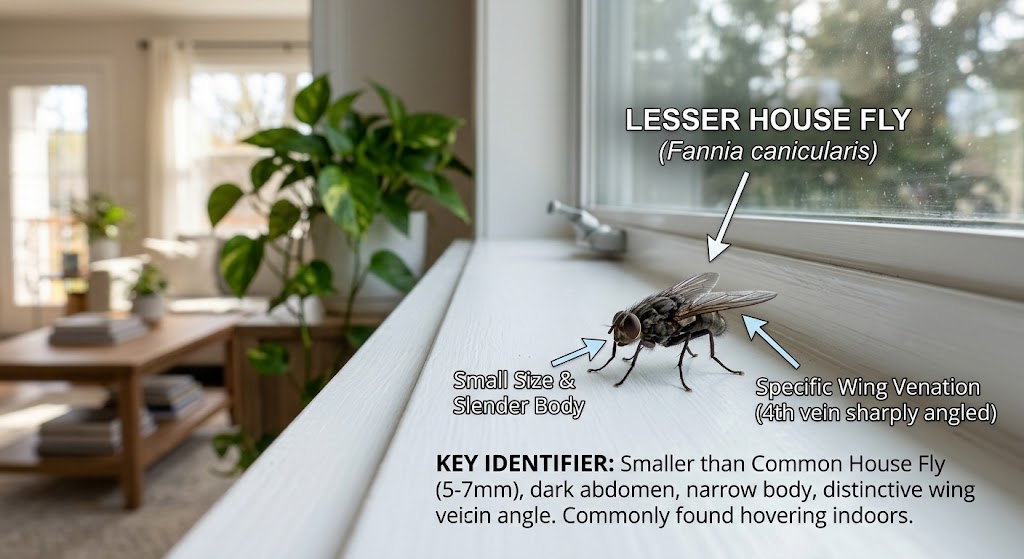
The lesser house fly, Fannia canicularis, is a small fly associated with the family Fanniidae. It is generally smaller and more slender than the common house fly and is particularly recognizable because of its distinctive flight behavior.
You may notice these flies:
- Hovering repeatedly in open areas.
- Making short, irregular or jerky flights.
- Circling around the middle of a room.
- Appearing around porches, garages, windows, or other sheltered areas.
- Becoming more noticeable when outdoor conditions favor fly activity.
Their unusual behavior is often the first clue that you are dealing with something other than an ordinary house fly.
How to Identify Lesser House Flies
Before choosing a treatment, make sure the insect matches the description of Fannia canicularis. Different fly species can require very different control strategies.
Size and Appearance
Lesser house flies are generally around 3.5–6 mm long. They are usually grayish and smaller than common house flies.
Because several small fly species can look similar, don’t rely on size alone. Behavior and location are also useful identification clues.
Their Characteristic Hovering Flight
The most noticeable clue is often their behavior. Male lesser house flies commonly make persistent hovering flights in open areas. You may see them repeatedly moving through the same section of a room rather than settling on surfaces.
If you keep seeing a small group of flies performing strange hovering patterns in the middle of a room, take a closer look before assuming they are fruit flies or common house flies.
Where They May Rest
Although they can spend considerable time flying, lesser house flies may eventually rest on vertical or hanging surfaces, particularly during quieter periods.
This behavior can make sticky monitoring devices useful in locations where the flies repeatedly gather or rest.
Lesser House Fly vs. Other Small Flies
Correct identification can save you time and money because different flies often require different control approaches.
Common Indoor Flies at a Glance
| Fly Type | Scientific Name | How to Recognize It | Commonly Found |
|---|---|---|---|
| Lesser House Fly | Fannia canicularis | Small gray fly with a slightly slender body; often flies in circles or zigzags around rooms | Homes, kitchens, porches, windows, and indoor areas |
| Common House Fly | Musca domestica | Gray body with four dark stripes on the thorax and a checkerboard abdomen | Kitchens, garbage areas, food waste, and homes |
| Fruit Fly | Drosophila species | Tiny tan-to-brown fly, often with reddish eyes; attracted to ripe or fermenting food | Kitchens, fruit bowls, trash, and recycling areas |
| Drain Fly | Family Psychodidae | Tiny, fuzzy, moth-like fly with broad wings | Sinks, drains, bathrooms, showers, and damp plumbing areas |
| Fungus Gnat | Various families | Tiny, delicate dark fly with long legs and slender wings | Houseplants, damp potting soil, greenhouses, and plant containers |
| Cluster Fly | Pollenia species | Larger sluggish fly with a dark gray body and golden hairs on the thorax | Windows, walls, attics, ceilings, and other sheltered areas |
Why Identification Matters
If the flies are actually drain flies, cleaning and removing drain buildup may be central to control. If they are fungus gnats, the focus may be moist potting soil.
Lesser house flies can require a different approach because the breeding source may be associated with outdoor organic material rather than a kitchen drain.
Where Do Lesser House Flies Come From?
Finding the source is one of the most important parts of controlling a recurring fly problem.
Lesser house fly larvae can develop in suitable decomposing organic material. Outdoor areas therefore deserve just as much attention as the inside of the house.
Potential sources to inspect include:
Poultry and Animal Manure
Chicken coops, livestock areas, and other places where manure accumulates can create favorable conditions for fly development.
If you live near poultry or livestock, inspect these areas carefully when fly activity increases.
Pet Waste
Dog waste left in yards can attract flies and contribute to fly activity. Regularly remove pet waste and keep the surrounding area as clean and dry as practical.
Compost
Poorly managed compost can contain decomposing organic material suitable for various flies. Keep compost properly maintained and avoid allowing unnecessary wet organic material to accumulate near the home.
Decaying Leaves and Grass
Wet grass clippings, rotting leaves, and other decomposing vegetation can create attractive conditions for flies. Remove excessive organic debris from areas immediately around the house when practical.
Garbage Areas
Inspect outdoor garbage containers, especially around the bottom, lid, and surrounding ground. Organic residue combined with moisture can create conditions that attract flies.
Hidden Animal Remains
An inaccessible dead rodent, bird, or other animal can occasionally cause persistent fly activity. If flies continue appearing despite good sanitation, investigate accessible attic, crawl-space, garage, or other areas where a hidden source could exist. Do not enter hazardous or inaccessible areas simply to investigate a fly problem. Professional assistance may be appropriate.
Understanding the Lesser House Fly Life Cycle
Understanding the life cycle explains why killing the adults you see may not immediately end the infestation.
Lesser house flies pass through four basic stages:
- Egg — Eggs are deposited in suitable breeding material.
- Larva — The developing maggot feeds within the organic material.
- Pupa — The insect undergoes transformation before becoming an adult.
- Adult — The mature fly emerges and can reproduce.
Temperature, moisture, food availability, and environmental conditions influence how quickly development occurs.
Why This Matters
You may eliminate many adult flies today and still see new ones later if immature stages remain in the breeding material. That is why source removal should be the foundation of control, with traps or adult treatments used as supporting measures.
How to Find the Lesser House Fly Breeding Source
If you can’t immediately identify where the flies are coming from, don’t randomly treat every area. Instead, inspect systematically.
Step 1: Identify Where Activity Is Highest
Start with the room or area where you see the most flies.
Check around:
- Windows
- Exterior doors
- Screened porches
- Garages
- Utility rooms
- Attics
- Roof spaces
- Animal housing
- Garbage storage
- Compost
- Outdoor sheds
A concentration near a door or window may indicate that the flies are entering from outside rather than breeding inside that room.
Step 2: Inspect Nearby Organic Material
Look for damp or decomposing material around the property.
Pay particular attention to:
- Poultry manure
- Livestock waste
- Pet waste
- Compost
- Rotting leaves
- Wet grass
- Organic garbage
- Other decomposing material
Don’t automatically assume the closest source is responsible. Several fly species can use similar materials, so identification still matters.
Step 3: Look for Hidden Sources
If outdoor areas appear clean, investigate accessible indoor locations.
Potential areas include:
- Attics
- Crawl spaces
- Garages
- Utility areas
- Areas behind or beneath appliances
- Forgotten garbage containers
- Accessible wall or ceiling areas
Be cautious around electrical equipment, insulation, contaminated waste, and confined spaces.
Step 4: Track the Activity
For several days, note:
- Where you see the flies.
- What time they are most active.
- Whether activity increases after certain weather conditions.
- Whether traps are catching fewer flies.
- Whether activity moves after sanitation work.
This simple observation can help you determine whether the population is declining or whether a source remains nearby.
Step-by-Step Lesser House Fly Control
Once you’ve identified the likely source, use a simple control sequence.
Step 1: Remove the Breeding Material
Remove accumulated manure, pet waste, rotting vegetation, garbage residue, or other suitable organic material where practical. Cleaning up the source is more important for long-term control than repeatedly killing individual adults.
Step 2: Reduce Moisture
Where possible, correct unnecessary moisture around organic material.
Check for:
- Leaking outdoor faucets
- Poor drainage
- Overflowing containers
- Wet waste areas
- Leaking hoses
- Water accumulating near garbage or animal areas
Keeping organic material drier can make the environment less favorable for fly development.
Step 3: Reduce Adult Flies
Once the source has been addressed, use appropriate monitoring or control methods to reduce the adults already present. Depending on the location, this may include sticky traps, indoor fly light traps, or appropriately labeled adult-fly treatments.
Step 4: Seal Entry Points
Inspect:
- Window screens
- Door screens
- Screen doors
- Door sweeps
- Gaps around windows
- Other obvious exterior openings
Repair damaged screens and reduce unnecessary openings.
Step 5: Monitor the Results
Continue checking the property after cleanup. A declining number of adult flies and fewer flies appearing on monitoring traps are useful signs that your control efforts are working.
Best Lesser House Fly Control Products
There is no single product that solves every lesser house fly problem. The best choice depends on whether you need to monitor adults, capture them indoors, prevent entry, or address a source.
| Product Type | Best For | Main Benefit | Limitation |
|---|---|---|---|
| Sticky Fly Traps | Indoor rooms, garages, enclosed porches | Captures adult flies without spraying | Requires replacement and careful placement |
| Indoor Fly Light Trap | Recurring indoor adult activity | Provides ongoing interception | Requires suitable placement and maintenance |
| Fly-Control Aerosol | Immediate reduction of exposed adults | Rapid adult knockdown when properly labeled | Does not remove breeding material |
| Screen Repair Materials | Windows and doors | Helps prevent new flies from entering | Does not control flies already inside |
| Sanitation Supplies | Outdoor breeding-source management | Helps remove conditions supporting flies | Requires regular maintenance |
1. Sticky Fly Traps 4.2 
Sticky traps can be useful when adult flies repeatedly pass through or rest in a particular area.
Pros

- Simple to use.
- No insecticide application required.
- Useful for monitoring activity.
- Can capture adults over time.
Cons
- Can be visually noticeable.
- Adhesive surfaces eventually need replacement.
- Poor placement can reduce usefulness.
- Does not eliminate the breeding source.
Best for: Monitoring and reducing adult flies in appropriate indoor or sheltered locations.
2. Indoor Fly Light Traps 4.2
Fly light traps are designed to attract flying insects toward a capture surface. Many indoor units use replaceable glue boards.
Pros

- Can provide continuous monitoring and capture.
- Suitable for enclosed indoor areas.
- No insecticide needs to be sprayed into the room when using a glue-board design.
- Captured insects remain contained.
Cons
- Powered units require electricity.
- Glue boards need periodic replacement.
- Placement affects performance.
- Competing light can affect attraction.
Best for: Indoor areas with recurring adult fly activity.
3. Appropriately Labeled Fly Aerosols 4.5 ☆
An appropriately labeled aerosol can provide quick knockdown of exposed adult flies.
Pros

- Rapid reduction of visible adults.
- Convenient for targeted situations.
- Can provide short-term relief.
Cons
- Does not remove eggs, larvae, or breeding material.
- Requires careful label compliance.
- Some products have restrictions around food, pets, people, and occupied areas.
Best for: Short-term adult control when the product label specifically permits the intended use.
What About Fly Baits?
Fly baits can be useful for certain fly problems, but don’t assume that a bait designed for common house flies will automatically be the right choice for lesser house flies.
If you are considering a product such as Maxforce Fly Spot Bait, check the current product label to confirm that the intended fly, location, and application method are permitted.
Always follow the current label rather than relying on an older product description or general fly-control advice.
Pros and Cons of Lesser House Fly Control
Advantages of a Source- First Approach –Addresses the underlying problem
- Can reduce future generations.
- Reduces dependence on repeated insecticide applications.
- Helps make the property less attractive to flies.
- Works alongside traps and exclusion measures.
Limitations
- The breeding source may be difficult to locate.
- Outdoor sources may be outside your property.
- Cleanup may require repeated effort.
- Adult flies may continue appearing temporarily after the source is removed.
- Misidentification can lead to ineffective treatment.
Why Do Lesser House Flies Keep Coming Back?
If you’ve cleaned the house and the flies continue appearing, don’t automatically assume the treatment failed. Several explanations are possible.
The Breeding Source Is Still Nearby
A chicken coop, compost pile, animal enclosure, garbage area, or other organic source may continue producing flies.
New Adults Are Still Emerging
Immature flies already present in a breeding site may continue developing after cleanup begins.
Flies Are Entering From Outdoors
Damaged screens, open doors, and other gaps can allow adults to enter.
The Pest Was Misidentified
If the flies are fuzzy, extremely tiny, attracted to fruit, or associated with plant soil, another species may be responsible.
There Is a Hidden Source
Persistent activity near one wall, ceiling, attic, crawl space, or utility area deserves further investigation.
Common Lesser House Fly Control Mistakes
Mistake 1: Spraying Without Finding the Source
An insecticide can kill exposed adults without removing the material supporting immature flies.
Mistake 2: Treating Every Small Fly the Same Way
Fruit flies, drain flies, fungus gnats, and lesser house flies have different habits and potential breeding sources.
Mistake 3: Ignoring the Yard
A clean kitchen does not rule out an outdoor source.
Mistake 4: Using Too Many Products
More products do not automatically mean better control. Choose appropriate products and follow their labels.
Mistake 5: Poor Trap Placement
A trap positioned away from fly activity may not perform as expected.
Mistake 6: Expecting Immediate Permanent Results
Removing adults is only one part of the process. Existing immature stages may continue developing.
How to Prevent Lesser House Flies
Once the population is under control, prevention becomes much easier.
Keep Animal Areas Clean
Remove manure and waste regularly from poultry and animal areas.
Manage Pet Waste
Pick up dog waste frequently and maintain clean outdoor areas.
Maintain Compost Properly
Keep compost managed rather than allowing wet organic material to accumulate unchecked.
Remove Rotting Vegetation
Clear excessive piles of wet leaves, grass clippings, and other decomposing vegetation near the home.
Keep Garbage Areas Clean
Wash and inspect garbage containers periodically and prevent organic residue from accumulating around them.
Repair Screens
Check window and door screens for tears and loose edges.
Reduce Unnecessary Door Openings
Keep exterior doors closed when practical, especially when fly activity is high outdoors.
Improve Drainage
Correct unnecessary standing water and moisture around organic waste areas.
Consider Air Movement
Fans can make some open doorways and sheltered areas less attractive to flying insects. They should be viewed as a supplementary measure rather than a standalone solution.
How to Know If Your Control Program Is Working
Don’t judge success solely by whether you see a few flies the day after treatment.
Look for a consistent downward trend:
- Fewer flies hovering indoors.
- Less activity near windows and doors.
- Fewer flies caught on monitoring traps.
- No new accumulation of suitable breeding material.
- Less activity around suspected outdoor sources.
Monitor the situation over several days rather than expecting an immediate permanent change.
Safety Tips for Lesser House Fly Control
Always make safety part of your pest-control plan.
- Read the entire product label before use.
- Use products only for the pests and locations permitted by the label.
- Follow directions concerning ventilation and re-entry.
- Keep insecticides and traps away from children and pets.
- Do not mix insecticides or household chemicals unless specifically directed by the label.
- Follow all food-contact and food-preparation restrictions.
- Wear the protective equipment specified on the label.
- Dispose of contaminated organic material appropriately.
- Use caution when investigating dead animals or contaminated waste.
- Get professional assistance when the source is inaccessible or hazardous.
When Should You Call a Pest-Control Professional?
Professional assistance may be worthwhile when:
- Fly numbers remain high despite sanitation.
- You cannot locate the breeding source.
- Flies appear to be emerging from inaccessible areas.
- A large poultry or livestock operation is involved.
- The suspected source involves hazardous waste.
- You need help confirming the fly species.
- The infestation continues despite correcting obvious conditions.
A qualified pest professional can help identify the insect, inspect potential sources, and develop a control program suited to the property.
Frequently Asked Questions About Lesser House Flies
1. What are lesser house flies?
Lesser house flies are small flies scientifically known as Fannia canicularis. They are generally smaller than common house flies and are especially recognizable by their characteristic hovering behavior.
2. How can I tell if I have lesser house flies?
Look for small, grayish flies that repeatedly hover or make erratic flights in open areas. Their behavior is one of the most useful clues, although physical identification is also important.
3. Where do lesser house flies breed?
Potential breeding material includes manure, animal waste, compost, decaying vegetation, and other suitable decomposing organic material. The exact source should be investigated rather than assumed.
4. Why are lesser house flies hovering in my room?
Male lesser house flies are known for persistent hovering flights in open spaces. Indoor activity may also indicate that adults are entering from an outdoor source nearby.
5. Are lesser house flies the same as common house flies?
No. They are different species. Lesser house flies are generally smaller and have distinctive hovering behavior that can help distinguish them from common house flies.
6. Will fly traps get rid of lesser house flies?
Traps can help reduce or monitor adult activity, but they should not be considered a substitute for finding and removing the breeding source.
7. Why do I still see flies after cleaning?
Existing immature stages may still be developing, or adults may be entering from another source. Continue monitoring and inspect nearby outdoor areas.
8. Can lesser house flies come from a chicken coop?
Poultry manure can provide suitable conditions for fly development, so chicken coops and other animal-housing areas should be inspected when fly activity is persistent.
9. How do I keep lesser house flies from entering my home?
Repair damaged screens, reduce unnecessary open-door time, seal obvious entry points, and reduce fly-producing conditions around the property.
10. When should I contact a pest professional?
Consider professional assistance when the population remains high, the breeding source cannot be located, the suspected source is inaccessible or hazardous, or you need help confirming the insect’s identity.
Lesser House Fly Control Checklist
Before considering the problem under control, ask yourself:
- Have I confirmed the flies resemble Fannia canicularis?
- Have I checked poultry and animal areas?
- Have I inspected pet-waste areas?
- Have I checked compost and decaying vegetation?
- Have I inspected garbage containers?
- Have I looked for hidden sources?
- Have I repaired damaged screens?
- Have I selected appropriate monitoring or control products?
- Have I followed all product-label instructions?
- Am I monitoring fly activity after making changes?
Final Thoughts
Getting rid of lesser house flies is not simply about killing the adults you see hovering around the room. The more reliable approach is to identify the fly, locate the conditions supporting it, remove the breeding material, reduce adult activity, and prevent new flies from entering.
Start outdoors as well as indoors, particularly if you have poultry, pets, compost, garbage, or other sources of decomposing organic material nearby. Use traps or appropriately labeled fly-control products as supporting tools rather than relying on them to solve the entire problem.
If the flies continue returning after sanitation, exclusion, and monitoring, take another look at the species and search for a hidden breeding source. When that source is inaccessible or difficult to identify, professional pest-control assistance can help determine the next step.