Best Northern House Mosquito Control Products (2026)
Few things are more frustrating than getting bitten by mosquitoes when you’re trying to relax in the evening or fall asleep at night. If small mosquitoes keep appearing around your bedroom, porch, garage, or yard, Northern house mosquitoes (Culex pipiens) may be part of the problem.
These mosquitoes are especially associated with homes, stagnant water, sheltered outdoor areas, and nighttime activity. They can breed in surprisingly small water sources, which means an overlooked gutter, bucket, plant saucer, or other container can keep producing new adults.
The good news is that you don’t have to spend every evening chasing individual mosquitoes.
A much better approach is to find the breeding source, stop the next generation, prevent mosquitoes from entering the home, reduce outdoor resting areas, and then use targeted adult-control products when necessary.
This complete guide explains how to identify, prevent and control Northern house mosquitoes both indoors and outdoors, including practical product options for light, moderate and severe mosquito problems.
Affiliate Disclosure
If you purchase through links on this page, BugOffControl.com may earn a commission at no additional cost to you. This helps support our pest-control guides and product research.
As an Amazon Associate I earn from qualifying purchases.
Northern House Mosquito Control Products at a Glance
If you’re looking for products before reading the full guide, this comparison gives you a quick starting point.
| Product | Best For | Primary Job | Where to Use It |
|---|---|---|---|
| Summit Chemical Mosquito Dunks | Light mosquito problems | Controls mosquito larvae before they become adults | Suitable standing-water sources where the label permits |
| Safer Brand Flying Insect Light Trap | Indoor mosquito activity | Attracts and captures flying insects | Bedrooms, hallways, and other suitable indoor areas |
| Wondercide Outdoor Pest Control Spray Concentrate | Moderate outdoor activity | Treats insects around outdoor areas and vegetation | Yards, vegetation, and appropriate exterior areas |
| LiBa 2800V Indoor Bug Zapper | Indoor or screened areas | Uses an electric grid to kill attracted flying insects | Garages, screened areas, and suitable indoor locations |
| Atticus Talak 7.9% Bifenthrin Concentrate | More persistent outdoor problems | Provides residual insecticide control when used according to the label | Appropriate exterior applications permitted by the product label |
| Flowtron BK-40D Electronic Insect Killer | Outdoor flying-insect activity | Attracts and kills flying insects | Suitable outdoor areas around the home |
🟢 Light Mosquito Problem
Start with:
Summit Chemical Mosquito Dunks + Safer Brand Flying Insect Light Trap
This combination addresses two different parts of the problem: mosquito larvae in appropriate standing water and adult flying insects that have already entered the home.
🟡 Moderate Mosquito Problem
Consider:
Wondercide Outdoor Pest Control Spray Concentrate + LiBa 2800V Indoor Bug Zapper
This approach combines outdoor treatment with indoor interception while you continue removing breeding sources.
🔴 Severe or Persistent Mosquito Problem
Consider:
Atticus Talak 7.9% Bifenthrin Insecticide Concentrate + Flowtron BK-40D
These are more intensive adult-control options. They should be used carefully and only according to the current product label. Large or persistent mosquito populations may warrant professional mosquito management instead of simply adding more products.
Important: Product formulations, labels, approved uses and application directions can change. Always read the current manufacturer label before using any pesticide or mosquito-control product. Never assume that a product is appropriate for every water source, plant, surface, person or animal.
Quick Answer: How Do You Get Rid of Northern House Mosquitoes?
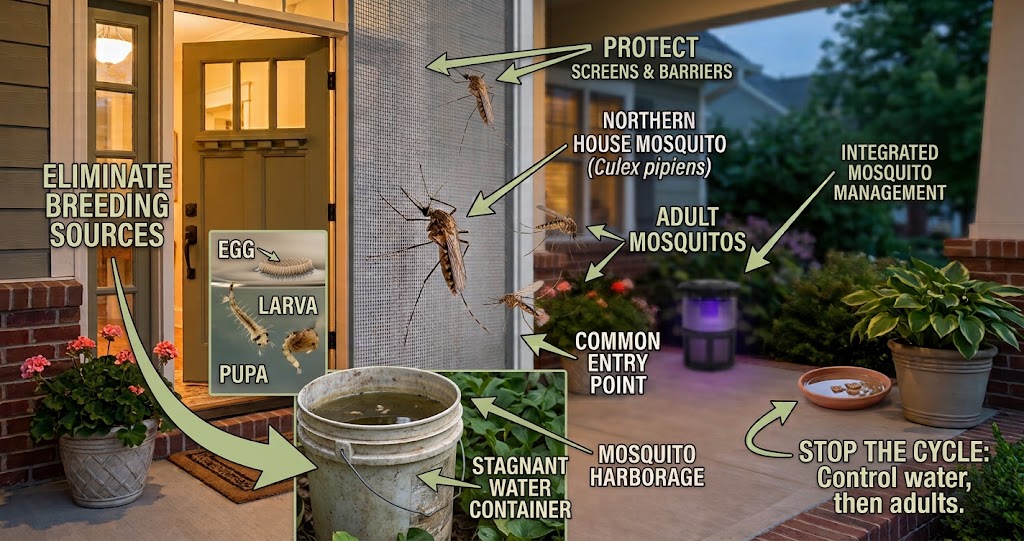
The most effective strategy is to attack the problem at several points in the mosquito life cycle.
Start with the source:
- Remove standing water around the property.
- Clean clogged gutters and improve drainage.
- Empty containers, plant saucers and toys that collect rainwater.
- Maintain birdbaths and other water features properly.
- Use Bti products in appropriate standing water when the label permits it.
- Repair window and door screens.
- Seal unnecessary gaps where mosquitoes can enter.
- Reduce dense vegetation and sheltered resting areas.
- Use targeted outdoor mosquito-control products when appropriate.
- Use indoor traps to capture mosquitoes that have already entered.
- Reinspect the property after rainfall.
- Consider professional mosquito control when populations remain high.
The key principle is: Stop the breeding source first, then deal with the adult mosquitoes.
An adult mosquito can be killed today, but if larvae are developing in a nearby water source, new mosquitoes may continue appearing.
What Is a Northern House Mosquito?
The Northern house mosquito, Culex pipiens, is a mosquito species associated particularly with temperate regions of the Northern Hemisphere. It is closely associated with human environments and can take advantage of artificial water-holding sites around homes. The species can be difficult for homeowners to identify with certainty because several Culex mosquitoes have similar general appearances. For that reason, don’t rely on color alone.
Instead, consider the combination of:
- Appearance
- Time of activity
- Location
- Breeding habitat
- Biting behavior
If exact species identification matters—for example, during a local mosquito-borne disease investigation—professional identification or local public-health resources may be appropriate.
Northern House Mosquito vs. Other Common Mosquitoes
Not every mosquito that bites you at night is necessarily Culex pipiens.
| Mosquito Group | Typical Activity | Common Breeding Situation | Useful Clue |
|---|---|---|---|
| Northern house mosquito (Culex pipiens) | Mainly evening/night | Stagnant water | Often associated with homes |
| Asian tiger mosquito (Aedes albopictus) | Often daytime as well as other periods | Small containers | Distinctive black-and-white pattern |
| Other Culex mosquitoes | Often evening/night | Various standing-water habitats | Can closely resemble other Culex species |
| Anopheles species | Often dusk/night | Various water habitats | Identification requires more than biting time |
This comparison is only a general guide. Mosquito identification can be difficult without close examination.
Why Are Northern House Mosquitoes Worse at Night?
Northern house mosquitoes are primarily crepuscular and nocturnal, meaning activity commonly increases around dusk and continues during the nighttime.
That makes them particularly noticeable when people are:
- Sitting outside after sunset
- Walking through the yard at night
- Relaxing on a porch
- Going to bed
- Sleeping with windows open
- Using an outdoor entertainment area
If your mosquito problem seems to appear suddenly around sunset, nighttime activity is an important clue.
Where Do Northern House Mosquitoes Hide During the Day?
Adult mosquitoes don’t spend every hour flying around looking for people. During daylight, they may rest in protected, shaded locations such as:
- Dense shrubs
- Tall grass
- Ivy
- Vegetation around buildings
- Areas beneath decks
- Shaded landscape edges
- Other cool, sheltered locations
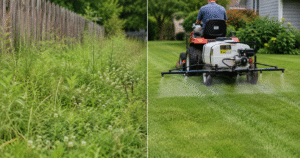
This is one reason simply treating open sunny areas may not address the entire problem. If you’re using a labeled outdoor mosquito-control product, pay attention to the specific resting surfaces and application sites permitted by its label.
Where Do Northern House Mosquitoes Breed?
This is arguably the most important question in the entire guide. Northern house mosquitoes can use stagnant or slow-moving water, particularly water containing organic material. Potential breeding locations around a property include:
- Clogged gutters
- Birdbaths
- Buckets
- Plant saucers
- Children’s toys
- Wheelbarrows
- Trash containers
- Rain barrels
- Drainage areas
- Outdoor equipment
- Unused containers
- Low areas that repeatedly collect water
The important lesson is that you don’t need a large pond to have a mosquito problem. A surprisingly small water source can become part of the mosquito life cycle.
Understanding the Northern House Mosquito Life Cycle
Understanding the life cycle makes mosquito control much easier to understand.
The basic sequence is:
Eggs → Larvae → Pupae → Adult
1. Eggs
Female mosquitoes lay eggs in or around suitable water habitats.
2. Larvae
Mosquito larvae develop in water.
This is the stage targeted by products such as Bti larvicides.
3. Pupae
The mosquito continues developing in water before emerging as an adult.
4. Adult
The adult mosquito leaves the water and becomes the flying, biting stage that people notice.
Why This Matters
If you only kill adults, you’re treating the final stage. If you remove or appropriately treat breeding water, you can interrupt the mosquito’s development before it becomes a flying adult. That’s why source reduction should be the foundation of your control program.
How to Find the Mosquito Breeding Source
If mosquitoes are repeatedly appearing around your home, don’t just walk around looking for mosquitoes.
Try this inspection sequence:
Step 1: Start Near the Problem Area
If mosquitoes are concentrated around a bedroom, porch or patio, inspect the exterior area closest to it.
Step 2: Look Up
Check:
- Gutters
- Downspouts
- Roof drainage
- Containers sitting on elevated surfaces
Step 3: Look Down
Inspect:
- Plant saucers
- Buckets
- Toys
- Low spots
- Drainage areas
Step 4: Check Shaded Locations
Mosquito breeding sites can be easy to miss, especially around:
- Shrubs and landscaping
- Under or around decks
- Outdoor equipment and containers
- Dense vegetation
- Gutters and drainage areas
- Other places where water can collect
Step 5: Inspect After Rain
Rain can create new temporary water sources. Make another inspection after significant rainfall rather than assuming yesterday’s inspection is still accurate.
Step 6: Expand the Search
Don’t assume the breeding source is directly beside the house. Mosquitoes can travel from surrounding areas, so persistent activity may involve a neighboring property, drainage area or other habitat outside your immediate yard.
Tier 1: Light Control — Prevention and Early Detection
Best For:
- One or two mosquitoes occasionally
- Occasional nighttime bites
- Preparing before mosquito season
- Properties without a major mosquito population
This is where you should begin whenever possible.
1. Remove Standing Water Every Week
Walk around your property regularly and empty water from:
- Buckets
- Flowerpot saucers
- Toys
- Wheelbarrows
- Containers
- Outdoor furniture
- Trash items
- Other objects that collect rain
Turn unused containers upside down or store them somewhere protected from rain.
2. Clean Your Gutters
Clogged gutters are easy to overlook. Leaves and debris can prevent water from draining and leave pockets of stagnant water where mosquitoes can reproduce. Inspect gutters regularly, particularly after periods of heavy rainfall. Also check downspouts to make sure water is moving away from the building.
3. Maintain Birdbaths
Birdbaths can be attractive to birds and attractive to mosquitoes for completely different reasons. If you keep a birdbath, empty and clean it regularly and refill it appropriately. For water that cannot reasonably be emptied, an appropriately labeled mosquito larvicide may be an option.
Summit Chemical Mosquito Dunks 4.5  ☆
☆
Best for: Appropriate standing-water sources where mosquito larvae may develop.
Mosquito Dunks contain Bacillus thuringiensis israelensis (Bti), a biological larvicide designed to control mosquito larvae in suitable water.
The advantage is that Bti addresses mosquitoes while they are still developing in water rather than waiting until they become flying adults.
Good Fit For

- Suitable water-holding containers
- Birdbaths or other permitted water sources
- Areas where water cannot conveniently be removed
Important Consideration
Don’t place a larvicide into every body of water you see. Use it only in water sources permitted by the current product label, and follow the directions for application, replacement and disposal.
4. Repair Window and Door Screens
A mosquito-control program can fail at the last step if mosquitoes have an easy way inside.
Inspect:
- Bedroom screens
- Window screens
- Screen doors
- Sliding doors
- Porch screens
- Garage screens
Repair holes and replace badly damaged screens.
Tier 2: Moderate Control — Active Abatement
Best For:
- Daily mosquito activity
- Regular nighttime bites
- Mosquitoes entering the home
- Noticeable activity around dusk
- Dense outdoor resting habitat
At this stage, source reduction remains essential, but you may need additional adult control.
Wondercide Outdoor Pest Control Spray Concentrate 4.2
Best for: Homeowners looking for a plant-oil-based outdoor pest-control spray for appropriate labeled applications.

Wondercide uses plant-derived active ingredients and is designed for use in suitable outdoor areas where pests are becoming a nuisance. It can be useful as part of an outdoor pest-management routine when applied according to the lable. The advantage is that it provides a spray-based approach for treating appropriate outdoor areas rather than relying only on traps or spot treatments.
Good Fit For
- Yards and other permitted outdoor areas
- Vegetation and outdoor surfaces where the current label allows application
- Situations where a plant-oil-based pest-control option is preferred
Important Consideration
A plant-based product should not automatically be considered harmless to every organism or suitable for every location. Follow the current label for dilution, application sites, precautions and re-entry requirements. Take particular care around pollinators, aquatic environments, edible plants, children and pets, and avoid applying the product where the label does not permit use.
5. Reduce Outdoor Mosquito Resting Habitat
You don’t need to remove every plant from your yard. Instead, concentrate on areas that have become excessively dense.
Consider trimming:
- Overgrown shrubs
- Tall grass
- Dense ivy
- Low branches
- Vegetation touching the home
This can reduce sheltered resting areas around the places where people spend time.
6. Consider Indoor Trapping
If mosquitoes are making it inside, an indoor trap can provide another layer of control.
Safer Brand Flying Insect Light Trap 4.2 ☆
Best for: Suitable indoor areas where flying insects are becoming a nuisance. The unit uses light to attract flying insects toward an adhesive trapping surface, helping capture adult insects without sprays or pesticides.
Potential locations include:

- Bedrooms
- Hallways
- Kitchens
- Living areas
- Other suitable indoor locations
The Safer Brand light trap provides supplemental control of flying adult insects, but it does not eliminate outdoor breeding sources or prevent new insects from entering the home.
Place the unit in a suitable indoor location and use it according to the manufacturer’s instructions.
7. Consider an Indoor Electric Insect Killer 4.4 ☆
LiBa 2800V Indoor Bug Zapper

Best for: Suitable indoor or screened areas where flying insects are entering. The device uses an electrical grid to kill insects that contact it.
Potential locations include:
- Garages
- Screened areas
- Utility areas
- Other suitable locations
Keep the device away from water and use it according to the manufacturer’s instructions.
8. Consider Spatial Repellents Outdoors
Spatial mosquito repellents can create a treated zone around an outdoor living area. Some products use active ingredients such as metofluthrin or allethrin. These products are intended to provide temporary relief in a defined area rather than eliminate an entire mosquito population. Always follow the current product instructions regarding placement, ventilation, people, pets, food and other safety considerations.
Tier 3: Severe Control — Major Infestation
Best For:
- Large numbers of mosquitoes every evening
- Persistent indoor activity
- Multiple breeding sources
- Large drainage or wetland areas nearby
- Problems that continue despite source reduction
- Situations involving local mosquito-borne disease activity
At this point, simply adding another consumer product may not solve the underlying problem. The focus should shift toward integrated mosquito management.
Atticus Talak 7.9% Bifenthrin Insecticide Concentrate 4.6 ☆
Best for: Appropriate labeled exterior applications requiring a concentrated residual insecticide. Bifenthrin is a pyrethroid insecticide used for insect control in various labeled applications. Concentrated product such as this requires considerably more care than a ready-to-use household spray.

Before applying it:
- Read the entire label.
- Follow the specified dilution.
- Use required protective equipment.
- Observe all re-entry instructions.
- Keep it away from prohibited water environments.
- Follow all restrictions concerning plants, people and animals.
Don’t Assume a Fixed Residual Period
Outdoor insecticide performance can vary considerably. Rainfall, sunlight, surface type, application technique and other environmental conditions can affect how long a treatment remains effective. Use the current product label, rather than relying on a generic number of weeks.
9. Advanced Larval Management
Large or difficult breeding habitats can require specialized treatment. Professional mosquito programs may use:
- Bti
- Insect growth regulators such as methoprene
- Other appropriately labeled larvicides
These treatments can target mosquitoes before they emerge as adults.
However, don’t improvise chemical treatments in:
- Natural waterways
- Wetlands
- Large drainage systems
- Wastewater areas
- Ponds
- Environmentally sensitive habitats
Such areas may require professional assessment and compliance with local regulations.
10. ULV Mosquito Fogging

Ultra-low-volume, or ULV, mosquito applications can rapidly reduce adult mosquitoes in appropriate circumstances. However, fogging has an important limitation: It primarily addresses adult mosquitoes. If larvae are continuing to develop in standing water, the population can rebuild. For significant infestations, professional mosquito management may be preferable to repeated DIY fogging.
11. Seal the Structure
For persistent indoor mosquito problems, inspect the building itself.
Check:
- Door thresholds
- Weather stripping
- Window frames
- Screen doors
- Crawl-space vents
- Utility penetrations
- Cable openings
- Pipe penetrations
- Garage doors
- Gaps around exterior fixtures
Mosquito control becomes much easier when the building isn’t providing an open invitation.
Flowtron BK-40D Electronic Insect Killer 4.4 ☆

Best for: Outdoor insect interception in an appropriate location. The Flowtron BK-40D is an outdoor electronic insect killer designed to attract and kill flying insects. Placement matters.
Putting an insect trap immediately beside the patio isn’t automatically the best strategy. Consider where flying insects are active and where the unit can be safely installed according to its instructions.
Some compatible attractants are marketed for increased attraction of particular biting insects. If you use one, make sure it is compatible with your exact unit and follow the manufacturer’s instructions.
Remember
An outdoor insect killer is an adult-insect interception tool. It doesn’t remove mosquito breeding sites.
Why Mosquito Control Sometimes Fails
You’ve removed the obvious bucket, treated the yard and repaired the screen—yet mosquitoes are still biting. What happened? Several possibilities exist.
You Missed a Breeding Site
Check again for:
- Gutters
- Plant saucers
- Containers
- Toys
- Drainage areas
- Hidden water beneath vegetation
Rain Created New Water
A clean property can develop new breeding sites after rainfall.
Mosquitoes Are Coming From Elsewhere
The source may be outside your immediate yard.
Adults Are Still Alive
Removing the breeding source doesn’t make every existing adult disappear instantly.
The Wrong Area Was Treated
Outdoor mosquitoes may be resting in dense vegetation rather than in open lawn.
Mosquitoes Are Entering the Home
Even a well-maintained yard won’t help much if damaged screens or open doors provide an easy entry route.
The Species May Be Different
Several mosquito species can cause similar complaints.
If behavior and habitat don’t match Culex pipiens, don’t automatically assume the identification is correct.
How Long Does It Take to Get Rid of Northern House Mosquitoes?
There isn’t one guaranteed timeline. Several factors affect how quickly mosquito activity decreases:
- Temperature
- Rainfall
- Number of breeding sites
- Mosquito life stage
- Nearby properties
- Treatment method
- Size of the property
- How quickly new breeding sites appear
Removing a water source stops that particular habitat from producing additional mosquitoes, but mosquitoes that have already developed may remain until they naturally die or are controlled.
That’s why monitoring and repeated inspection are more reliable than expecting one treatment to solve everything permanently.
What Happens After Heavy Rain?
Heavy rainfall can completely change mosquito conditions.
Rain may:
- Fill containers
- Overflow gutters
- Create puddles
- Fill drainage areas
- Produce new temporary breeding sites
After rainfall, walk the property again.
A five-minute inspection can sometimes reveal a breeding site that didn’t exist a few days earlier.
How to Get Rid of Northern House Mosquitoes in a Bedroom
If you’re being bitten at night, start with the bedroom—but don’t stop there.
Step 1: Check Screens
Look for even small tears or gaps.
Step 2: Check the Door
Inspect the bottom and sides for gaps.
Step 3: Inspect Outside the Bedroom
Look for nearby:
- Containers
- Gutters
- Vegetation
- Standing water
- Drainage problems
Step 4: Use Supplemental Indoor Control
An appropriate indoor trap can help capture adult mosquitoes that have already entered.
Step 5: Check the Rest of the Property
If mosquitoes continue appearing, expand the inspection. The source may be farther away than expected.
How to Stop Northern House Mosquitoes Around the Yard
1. Remove Water
Eliminate unnecessary standing water.
2. Manage Vegetation
Reduce excessive dense shelter around living areas.
3. Protect the House
Maintain screens, doors and structural seals.
4. Control Adults When Necessary
Use appropriate traps, repellents or labeled outdoor treatments as a supplement to source reduction. This layered approach is generally more useful than relying on one “miracle” mosquito product.
What NOT to Do When Controlling Mosquitoes
More treatment doesn’t necessarily mean better control. Avoid these common mistakes:
Don’t Pour Random Chemicals Into Water
Never add pesticides, bleach, fuel or other household chemicals to ponds, drains or natural water sources unless specifically permitted by the product label and applicable rules.
Don’t Overapply Pesticides
More pesticide does not automatically provide better mosquito control.
Don’t Ignore Standing Water
An adult mosquito spray can’t replace source reduction.
Don’t Spray Every Plant
Only treat plants and surfaces permitted by the product label.
Don’t Assume Plant-Based Means Risk-Free
Natural or plant-derived ingredients can still affect insects, aquatic organisms, pets or people.
Don’t Depend Only on Bug Zappers
They can be useful tools, but they don’t eliminate mosquito breeding sites.
Don’t Keep Fogging Without Finding the Source
Repeated adult control without source management can become a cycle.
Northern House Mosquito Control: A One-Week Reset Plan
Want a simple starting point? Use this seven-day approach.
Day 1 — Find the Water
Walk the entire property and remove unnecessary standing water.
Day 2 — Clean the Gutters
Inspect gutters and downspouts for retained water and debris.
Day 3 — Protect the House
Repair screens and seal obvious entry points.
Day 4 — Manage the Landscape
Trim excessively dense vegetation near patios, doors and windows.
Day 5 — Address Larvae
Where appropriate and permitted by the label, use a Bti product in standing water that cannot reasonably be removed.
Day 6 — Address Adults
Evaluate whether an indoor trap, outdoor treatment or other supplemental control is appropriate.
Day 7 — Reinspect
Walk the property again, especially after rain. Then repeat the inspection routine weekly during periods of mosquito activity.
Northern House Mosquito Health Risks
Most mosquito bites cause little more than temporary itching and irritation. However, mosquitoes can sometimes transmit disease-causing pathogens when they bite.
Northern house mosquitoes (Culex pipiens) and other closely related Culex mosquitoes can be involved in transmission cycles for viruses such as:
- West Nile virus
- St. Louis encephalitis virus
The presence of Culex mosquitoes does not mean that every mosquito carries a disease. The actual risk varies by location, season, mosquito populations, and whether disease-causing viruses are currently circulating in the area.
West Nile Virus
Many people infected with West Nile virus have no symptoms. When illness occurs, symptoms may include:
- Fever
- Headache
- Body aches
- Joint pain
- Vomiting
- Diarrhea
- Rash
A small proportion of infected people develop serious neurologic illness. Warning signs can include:
- High fever
- Severe headache
- Neck stiffness
- Confusion
- Muscle weakness
- Tremors
- Seizures
- Loss of consciousness
Serious or rapidly worsening symptoms require prompt medical attention.
St. Louis Encephalitis
St. Louis encephalitis virus is another mosquito-borne virus associated primarily with Culex mosquitoes. Many infections produce no symptoms, but some can develop into serious illness involving inflammation of the brain. Older adults are at greater risk of severe neurologic disease.
Potential warning signs include:
- Fever
- Severe headache
- Confusion
- Stiff neck
- Drowsiness
- Tremors
- Weakness
- Seizures
Seek medical attention for serious or rapidly worsening symptoms.
Best Northern House Mosquito Control Products by Problem Level
| Problem Level | What to Do First | Supplemental Product | Main Goal |
|---|---|---|---|
| 🟢 Occasional mosquitoes | Remove standing water and check common breeding spots | Summit Mosquito Dunks, where appropriate and label-permitted | Stop mosquito larvae before they become adults |
| 🟢 Occasional indoor mosquitoes | Repair screens and inspect doors and windows for entry points | Safer Flying Insect Light Trap | Reduce and capture adult mosquitoes indoors |
| 🟡 Regular outdoor activity | Remove standing water and manage dense vegetation | Wondercide Outdoor Pest Control Spray Concentrate | Reduce mosquito activity around outdoor living areas |
| 🟡 Regular indoor activity | Inspect screens, doors, windows, and other entry points | LiBa 2800V Indoor Bug Zapper | Reduce flying adult insects in suitable areas |
| 🔴 Heavy outdoor activity | Locate breeding habitats and eliminate or manage them | Labeled residual outdoor treatment or professional service | Reduce the adult mosquito population and address contributing sources |
| 🔴 Persistent mosquito problems | Conduct a thorough inspection for hidden breeding sites and entry points | Professional mosquito management | Address both the breeding source and ongoing adult activity |
Which Product Should You Choose?
Instead of asking, “What is the strongest mosquito product?” ask:
What part of the mosquito problem am I trying to control?
If larvae are the problem:
Look at an appropriate Bti larvicide such as Summit Mosquito Dunks.
If mosquitoes are getting indoors:
Look at screen repairs and indoor trapping.
If mosquitoes are resting around the yard:
Consider an appropriately labeled outdoor mosquito treatment.
If flying insects are concentrated in a suitable outdoor area:
An outdoor insect killer may provide supplemental interception.
If the infestation is extensive:
Don’t simply keep adding products. Find the breeding source or consider professional mosquito management.
When Should You Call a Professional?
Professional help may be appropriate when:
- Mosquito numbers remain high despite source reduction.
- Large breeding areas cannot be drained.
- The property borders wetlands or extensive drainage.
- Mosquitoes continue entering the house.
- The infestation affects a large property.
- You are unsure how to use a concentrated insecticide.
- Treatment involves environmentally sensitive water.
- Local mosquito-borne disease activity is a concern.
- Multiple properties appear to be contributing to the problem.
A professional can help identify breeding habitats that aren’t obvious during a normal homeowner inspection.
Weekly Northern House Mosquito Inspection Checklist
Use this checklist once a week during mosquito season and again after significant rainfall.
💧 Water
☐ Empty buckets
☐ Empty plant saucers
☐ Turn over unused containers
☐ Check children’s toys
☐ Inspect birdbaths
☐ Check rain barrels
☐ Clean gutters
☐ Inspect downspouts
☐ Check drainage areas
☐ Look for new puddles
🏠 Home
☐ Check window screens
☐ Check screen doors
☐ Inspect door seals
☐ Check crawl-space openings
☐ Inspect utility penetrations
🌿 Yard
☐ Trim excessive vegetation
☐ Check dense shrubs
☐ Inspect shaded areas
☐ Check beneath decks
☐ Look around outdoor equipment
🦟 Mosquito Activity
☐ Check activity around dusk
☐ Note where mosquitoes are concentrated
☐ Check bedrooms and entry points
☐ Look for mosquitoes resting indoors
☐ Reinspect after rainfall
What If You Still See Mosquitoes After Treatment?
Don’t automatically assume the treatment failed.
Ask these questions:
- Did I remove every breeding site?
- Did it rain afterward?
- Are mosquitoes coming from another property or nearby habitat?
- Are damaged screens allowing them inside?
- Are there shaded resting areas that weren’t addressed?
- Could I be dealing with another mosquito species?
- Are existing adult mosquitoes still present?
This troubleshooting approach can save you from repeatedly applying products without addressing the real source.
The Most Important Northern House Mosquito Control Lesson
Northern house mosquito control isn’t really about killing every mosquito you see. It’s about breaking the cycle. Think of the process like this:
Identify → Find water → Remove or treat larvae → Block entry → Reduce resting habitat → Control adults → Monitor → Repeat
That’s a much more practical strategy than spraying whenever you get bitten. If you can remove the breeding habitat, you reduce the number of mosquitoes being produced. If you repair screens, you make it harder for them to enter. If you reduce sheltered resting areas, you make your property less attractive as a daytime refuge. And if adult mosquitoes are still causing problems, targeted products can provide another layer of control.
Final Northern House Mosquito Control Plan
🟢 Light Infestation
Start with:
Standing-water removal + gutter maintenance + screen repairs + appropriate Bti use
🟡 Moderate Infestation
Add:
Landscape management + appropriate outdoor treatment + indoor trapping
🔴 Severe Infestation
Consider:
Detailed breeding-site investigation + advanced larval/adult management + professional mosquito control
The goal isn’t to use the most products. The goal is to use the right control method for the right stage of the mosquito problem.
Frequently Asked Questions
What is the fastest way to get rid of Northern house mosquitoes?
Removing standing-water breeding sites is one of the most important first steps. You can also use appropriate adult-control measures to reduce mosquitoes that are already present.
Where do Northern house mosquitoes lay eggs?
They commonly use stagnant or slow-moving water, including suitable artificial containers, clogged gutters and other water-holding habitats.
Do Northern house mosquitoes bite at night?
Yes. They are primarily active around dusk and during nighttime hours.
Where do Northern house mosquitoes hide during the day?
They can rest in shaded, protected locations such as dense vegetation, shrubs, tall grass and areas around structures.
Can Northern house mosquitoes get inside a house?
Yes. They can enter through open doors, damaged screens and other openings.
Why do I keep getting mosquitoes in my bedroom?
The mosquitoes may be entering from outdoors through screens, doors or other gaps. A nearby breeding source can also continually replenish the adult population.
Can mosquito dunks kill adult mosquitoes?
No. Bti mosquito dunks target mosquito larvae developing in suitable water. They do not function as an adult mosquito spray.
Will a bug zapper get rid of Northern house mosquitoes?
A bug zapper can kill flying insects that contact the device, but it shouldn’t be considered a complete mosquito-control program.
Can clogged gutters cause mosquitoes?
Yes. Gutters that retain stagnant water can provide suitable mosquito breeding habitat.
How often should I check my property for mosquito breeding sites?
A weekly inspection is a useful routine. Inspect again after significant rainfall because new water-holding sites can appear.
Does fogging eliminate mosquitoes permanently?
No. ULV fogging can provide rapid adult mosquito knockdown under appropriate conditions, but it doesn’t necessarily eliminate breeding sites.
Why are mosquitoes still around after I removed standing water?
Existing adult mosquitoes may still be present, mosquitoes may be entering from outside the property, or another breeding site may have been missed.
What attracts Northern house mosquitoes?
They are attracted to environmental cues associated with hosts and suitable resting and breeding conditions. Factors such as carbon dioxide, body odors, heat, moisture and the surrounding environment can influence mosquito activity.
Can Northern house mosquitoes transmit West Nile virus?
Culex mosquitoes, including Northern house mosquitoes and closely related species, can participate in West Nile virus transmission cycles. Local disease risk varies by location and time.
What should I do if I develop serious symptoms after a mosquito bite?
Most mosquito bites are harmless, but serious symptoms such as high fever, severe headache, confusion, neck stiffness, weakness or seizures require prompt medical attention.
Final Product Guide
🟢 Summit Chemical Mosquito Dunks
Best for: Appropriate standing-water larval control.
🟢 Safer Brand Flying Insect Light Trap
Best for: Supplemental indoor trapping.
🟡 Wondercide Outdoor Pest Control Spray Concentrate
Best for: Appropriate outdoor pest-control applications.
🟡 LiBa 2800V Indoor Bug Zapper
Best for: Suitable indoor, garage or screened areas.
🔴 Atticus Talak 7.9% Bifenthrin Insecticide Concentrate
Best for: Appropriate labeled exterior residual insecticide applications.
🔴 Flowtron BK-40D Electronic Insect Killer
Best for: Supplemental outdoor flying-insect interception.
Check Latest Price & Availability on Amazon
Tip: Start with the guide that matches the problem you’re seeing. If mosquitoes keep returning, focus on finding and eliminating the breeding source rather than relying only on adult-mosquito treatments.
Final Takeaway
The most effective way to approach a Northern house mosquito problem is to stop thinking only about the mosquitoes that are biting you.
Look for where the next generation is developing.
A bucket of stagnant water, clogged gutter, damaged screen or dense patch of vegetation may be contributing more to the problem than the mosquitoes you see flying around the house.
Start with the basics:
Remove water → interrupt larvae → protect the home → reduce resting habitat → control adults → monitor again.
With a consistent weekly inspection routine and the right products for the situation, you can make your property considerably less welcoming to Northern house mosquitoes.