Best Fire Ant Control Products (Complete Guide)
Fire ants can quickly turn a beautiful backyard into an uncomfortable place for your family and pets. Their painful stings, expanding colonies and persistent mounds can make lawns, gardens, patios and walkways difficult to enjoy. Fortunately, choosing the right fire ant control products and applying them correctly can help you regain control.
Whether you’re dealing with a few troublesome mounds or widespread activity throughout your yard, the right approach depends on understanding how fire ants behave and which treatments address your particular problem. In this guide, we’ll compare popular fire ant baits, mound treatments and alternative control methods, explain how to use them effectively, and share practical ways to help prevent new colonies from becoming established.
Quick Answer: What Is the Best Way to Control Fire Ants?
For widespread fire ant activity, a labeled granular bait such as Amdro or Advion can help target colonies through the ants’ natural food-gathering behavior. For individual mounds requiring quicker suppression, a suitable mound treatment may be more appropriate. For lasting management, combine appropriate treatments with regular monitoring and prevention, following each product’s label.
Best Fire Ant Control Products at a Glance
This comparison table puts the main treatment choices near the beginning of the guide, allowing you to compare their intended uses without having to read the entire article first.
Affiliate Disclosure
If you purchase through links on this page, BugOffControl.com may earn a commission at no additional cost to you. This helps support our pest-control guides and product research.
As an Amazon Associate I earn from qualifying purchases.
|
Product |
Best suited for |
Active ingredient |
Application |
|---|---|---|---|
|
Routine fire ant baiting |
Hydramethylnon (standard formulation) |
Broadcast or localized, as labeled |
|
|
Established infestations |
Indoxacarb |
Broadcast, as labeled |
|
|
Individual mounds |
Acephate |
Labeled dry mound treatment |
|
|
Labeled outdoor contact treatments |
Bifenthrin |
Diluted liquid, as labeled |
|
|
Spinosad-based baiting |
Spinosad |
Broadcast or localized, as labeled |
Formulations and registrations may vary by country and product version. Confirm the active ingredient, fire ant directions and permitted treatment sites on the exact package before purchasing.
Choosing between treatments
-
Several mounds: Consider an appropriately labeled broadcast bait.
-
An isolated problem mound: Consider a labeled individual mound treatment.
-
Recurring activity: Monitor the property and use a consistent, label-compliant control program.
-
Extensive infestations: Consider professional pest management.
1. Understanding Fire Ants and Why They Are Difficult to Control
The red imported fire ant (Solenopsis invicta) is an invasive species originally from South America. It became established in the United States during the 1930s, with early populations recorded around Mobile, Alabama. Since then, it has spread throughout much of the southern United States and into other regions with suitable climates.
Fire ants prefer warm, sunny, open areas, including lawns, pastures, parks and agricultural land. They construct loose soil mounds that can become noticeable after rain or changes in soil conditions.
How to recognize a fire ant infestation
Look for these common signs:
-
Loose soil mounds: Fire ant nests often produce irregular, dome-shaped mounds without an obvious opening at the top.
-
Aggressive defensive behavior: Workers may emerge rapidly when the nest is disturbed.
-
Painful stings: Their stings commonly produce burning pain, itching and small white pustules.
-
Visible foraging trails: Workers may travel between food sources and underground nesting areas.
-
New mounds: Additional mounds may appear as colonies grow, relocate or establish new nests.
Important: Not every mound in your lawn belongs to fire ants. Some native ants also construct soil mounds. Observe ants from a safe distance and avoid disturbing an unidentified colony before choosing a treatment.
Why fire ants are so persistent
Several characteristics make fire ant management challenging.
-
Large colonies: Mature colonies can contain thousands of workers and may have one or more queens.
-
Extensive underground nests: Workers and queens may occupy areas beyond the visible mound.
-
Colony relocation: Some disturbed colonies can relocate their nesting sites.
-
Rapid reproduction: Established queens can produce many eggs, allowing colonies to expand.
-
Favorable climates: In warm regions, fire ants may remain active for much of the year.
Fire ants can also present a health risk. Their stings can be painful, and people with allergies may experience serious reactions. Avoiding active colonies is particularly important in areas where children and pets play.
2. Fire Ant Baits vs. Contact Insecticides: Which Should You Choose?
Before buying a product, understand the difference between colony-targeting baits and contact insecticides. Both have useful applications, but they work differently.
Fire ant baits
-
Workers carry bait into the colony.
-
Slower results.
-
Suitable for multiple colonies.
-
Requires active foraging.
Contact treatments
-
Kill susceptible ants on contact.
-
Often faster visible results.
-
Suitable for specific treatment sites.
-
May not eliminate the queen.
|
Comparison |
Baits |
Contact treatments |
|---|---|---|
|
Primary purpose |
Reach ants within the colony |
Kill ants exposed to the treatment |
|
Speed |
Generally slower |
Often faster |
|
Queen control |
Possible if bait reaches the queen |
Not guaranteed |
|
Treatment area |
Individual mounds or larger areas |
Mounds or other labeled areas |
|
Main limitation |
Depends on bait acceptance and foraging |
May leave hidden colony members alive |
How fire ant baits work
Fire ant baits typically consist of an attractive food source coated or combined with an insecticide. Worker ants collect the material and transport it into the colony. Depending on the active ingredient, the bait can affect workers, developing ants and queens.
The main advantage is that bait can reach ants that would otherwise remain underground. However, it takes time for workers to collect and distribute enough bait for effective colony control.
How contact insecticides work
Contact treatments contain active ingredients that kill susceptible ants when they are exposed to them. Depending on the formulation and label, they may be used as mound treatments, granular turf applications or perimeter treatments.
They can reduce visible activity more quickly than baits, but they are not guaranteed to eliminate an entire underground colony. Some treatments may also interfere with bait collection if applied at the wrong time.
Practical takeaway: Use baits when your priority is reaching the colony. Consider contact treatments when a particular mound needs faster attention. If you use both, follow the directions and timing for each product.
3. Best Fire Ant Control Products: Detailed Reviews
The following products represent different approaches to fire ant management. Their suitability depends on the infestation, treatment location and exact formulation. The advantages and disadvantages below focus on their intended uses rather than promising guaranteed results.
For routine baiting
1. Amdro Fire Ant Bait 4.6  ☆
☆
Active ingredient: Hydramethylnon in the standard formulation
Best for: Homeowners managing multiple fire ant mounds.

Product overview
Amdro Fire Ant Bait is a granular bait designed to attract foraging fire ants. Workers collect the granules and carry them back to the colony, allowing the active ingredient to reach ants that are not visible above ground.
Depending on the particular package, it may be intended for broadcast or individual mound applications.
Pros
-
Targets ants through their natural food-gathering behavior.
-
Convenient granular application.
-
Suitable for treating multiple colonies when the label permits.
-
Does not require mixing a liquid concentrate.
Cons
-
Does not provide immediate results.
-
Requires suitable weather and active foraging.
-
Rain or irrigation may reduce bait attractiveness.
-
Additional treatments may be needed according to the label.
How to use: Apply at the labeled rate when ants are actively foraging and the conditions are suitable. Keep the granules dry as directed and avoid disturbing freshly baited mounds.
Check Latest Price & Availability on Amazon
Alternative colony-targeting bait
2. Advion Fire Ant Bait 4. 36☆

Active ingredient: Indoxacarb
Best for: Established fire ant colonies in permitted treatment areas.
Product overview
Advion Fire Ant Bait uses indoxacarb, an insecticide that is activated through metabolic processes in susceptible insects. Worker ants collect the bait and distribute it within the colony.
Its formulation provides an alternative to hydramethylnon-based baits, making it another option to consider when selecting a fire ant management program.
Pros
-
Uses a different active ingredient from standard Amdro bait.
-
Designed to reach colony members through foraging.
-
Suitable for labeled broadcast applications.
-
Provides an alternative for homeowners comparing bait formulations.
Cons
-
Does not kill every ant immediately.
-
Requires active foraging for successful bait collection.
-
Product availability and permitted uses vary.
How to use: Follow the specific package directions for application rates, coverage and retreatment. Do not apply it more frequently than the label allows.
Check Latest Price & Availability on Amazon
Individual mound treatment
3. Orthene Fire Ant Killer 4.7 ☆
Active ingredient: Acephate

Best for: Specific mounds where a dry treatment is permitted.
Product overview
Orthene Fire Ant Killer is a dry treatment intended for particular fire ant mound applications. Its active ingredient, acephate, affects the nervous system of susceptible insects.
Unlike a bait, it is not intended to rely on worker ants carrying a food source back to the queen. It is designed for direct application according to the product’s directions.
Pros
-
Dry formulation where available.
-
Does not require mixing a liquid concentrate.
-
Can provide relatively fast suppression of treated mounds.
-
Useful for certain isolated problem areas.
Cons
-
May not provide the same coverage as a broadcast bait.
-
May have a noticeable odor.
-
Requires careful handling and label-compliant protective equipment.
How to use: Apply only as directed for the specific formulation and permitted location. Avoid disturbing the mound unnecessarily and follow all restrictions for children and pets.
Check Latest Price & Availability on Amazon
Labeled liquid applications
4. Talstar P Professional Insecticide 4.7 ☆
Active ingredient: Bifenthrin

Best for: Specific outdoor contact treatments listed on the label.
Product overview
Talstar P is a concentrated liquid insecticide containing bifenthrin, a synthetic pyrethroid. It is used in several pest management applications, including certain labeled outdoor treatments.
Bifenthrin acts primarily through contact with susceptible insects and can provide residual activity on permitted surfaces.
Pros
-
Concentrated formula for labeled dilution.
-
Provides residual contact activity in permitted areas.
-
Can be used for certain outdoor pest management purposes.
-
Useful where liquid applications are specifically authorized.
Cons
-
Requires accurate measuring and dilution.
-
Not every formulation or application is suitable for fire ant mounds.
-
Can be hazardous to aquatic organisms and beneficial insects.
-
Residual activity does not guarantee colony elimination.
How to use: Check the exact label for fire ant directions, application sites, dilution rates and equipment. Do not use a general perimeter application as a substitute for a specifically approved mound treatment.
Check Latest Price & Availability on Amazon
Spinosad-based alternative
5. Come and Get It Fire Ant Killer 4.3 ☆
Active ingredient: Spinosad

Best for: Homeowners seeking a spinosad-based fire ant bait.
Product overview
Come and Get It Fire Ant Killer is a granular bait containing spinosad, an insecticidal substance produced by a soil bacterium. Worker ants collect the bait and carry it into the colony, where susceptible ants are affected.
Spinosad is derived from a natural source, but the finished pesticide still requires careful handling.
Pros
-
Uses a spinosad-based active ingredient.
-
Takes advantage of natural fire ant foraging behavior.
-
Convenient granular application.
-
Provides an alternative to conventional synthetic insecticides.
Cons
-
Can harm non-target insects, including bees exposed to it.
-
Must be used according to the specific permitted treatment sites.
-
Natural origin does not mean harmless to pets or wildlife.
How to use: Follow the label’s application rate, weather restrictions and precautions. Do not assume that a fire ant bait is suitable for vegetable gardens simply because it contains a naturally derived ingredient.
How to Choose the Right Fire Ant Treatment
The size of your property, the location of the mounds and the urgency of the problem all influence which treatment is appropriate. Rather than relying on a fixed mound count, assess how widely the ants are distributed and where they create a hazard.
Light infestation
A few isolated mounds
Consider a labeled individual mound bait or treatment. Monitor nearby areas to check whether the problem is limited to the visible nests.
Moderate infestation
Several mounds throughout the lawn
Consider a labeled broadcast bait that covers the affected area. Treat individual mounds separately only if necessary and permitted by the labels.
Heavy infestation
Numerous or recurring colonies
Consider a property-wide management program, regular monitoring and professional assistance if the infestation is extensive or persistent.
What to check before purchasing
-
Treatment area: Calculate the area you need to cover and compare it with the product’s stated coverage.
-
Speed of control: Decide whether your priority is colony suppression or quicker treatment of a particular mound.
-
Application equipment: Check whether you need a broadcast spreader, a measuring container or a suitable sprayer.
-
Sensitive locations: Consider pets, children, vegetable gardens, flowering plants, drains and water sources.
-
Retreatment requirements: Review the label’s permitted intervals and seasonal restrictions before buying a large quantity.
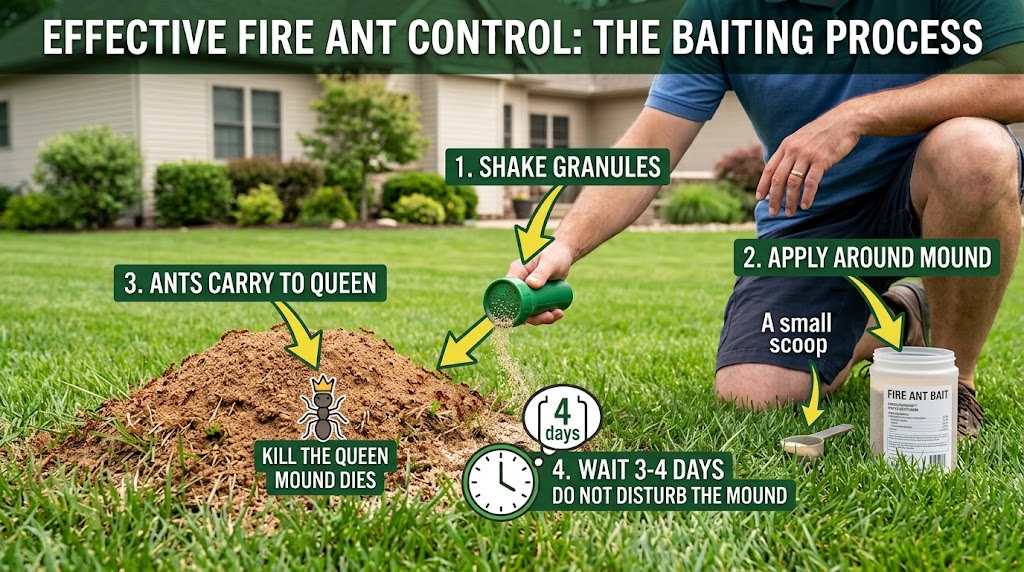
5. Step-by-Step: How to Apply Fire Ant Baits Correctly
Correct bait application is essential because the treatment depends on worker ants collecting the granules. Even a suitable product may produce disappointing results if the weather or application conditions are unsuitable.
-
Inspect the yard before treatment.
Locate visible mounds and observe foraging trails from a safe distance. Identify the areas that need treatment without stepping on or disturbing the nests.
-
Choose a suitable weather window
Baits generally work best when ants are actively foraging. Select a period that meets the product’s weather instructions, avoiding rain, heavy dew and irrigation when they could damage the bait.
-
Measure the area and the application rate
Calculate the area you need to treat and check the coverage printed on the package. Do not increase the rate to try to speed up the results.
-
Apply the bait as directed
Use a suitable spreader for broadcast applications or follow the instructions for localized mound applications. Keep the bait away from places where children, pets or wildlife might eat it.
-
Allow the workers to collect the bait
Do not immediately drench or spray freshly baited mounds. Allow sufficient time for foraging workers to collect the bait, observing any waiting period specified by the manufacturer.
-
Check the results
Reinspect treated areas at the interval recommended by the label. If activity continues, check the application conditions and product directions before deciding whether a follow-up treatment is needed.
Avoid a common mistake: Applying contact insecticide directly over freshly applied bait can kill or repel foraging ants before they collect it. Follow the timing instructions for both products if you intend to use them together.
The Two-Step Fire Ant Control Method
When fire ants are spread across a lawn and a few mounds are particularly troublesome, a two-step approach may be appropriate. It combines colony-targeting bait with selective treatment of problem mounds, without automatically requiring several different pesticides.
Start with a labeled broadcast bait.
Apply an appropriate fire ant bait across the affected lawn at the labeled rate. This allows foraging ants to collect bait from multiple colonies, including nests that may not have obvious mounds.
Assess individual problem mounds.
After the bait has had the required time to work, inspect areas near walkways, play areas and other high-traffic locations. If active mounds remain, consider an appropriate labeled mound treatment.
Monitor and adjust.
Reinspect the yard and check whether activity has decreased. Repeat treatment only when the product label permits it and monitoring indicates that further control is necessary.
This method is not necessary for every infestation. A few isolated mounds may need only one suitable treatment, while extensive or recurring infestations may require professional management. Avoid automatically combining multiple insecticides or applying additional products simply because the first treatment has not produced immediate results.
Nonchemical Ways to Reduce Fire Ant Activity
Pesticides are only one part of a fire ant management plan. Simple changes to your property can make it easier to detect new colonies and reduce opportunities for ants to find food and enter buildings.
Remove accessible food
Clean up fallen fruit, outdoor food scraps and spilled pet food. Keep garbage containers covered and clean to avoid attracting foraging ants.
Seal potential entry points
Repair damaged screens and seal gaps around doors and foundations. These measures help limit ant entry into the house, although they do not eliminate outdoor colonies.
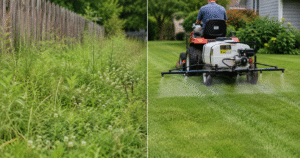
Maintain your lawn
Keep grass and vegetation manageable so you can spot new mounds and trails. Avoid placing children’s play equipment over known nests
Inspect the property regularly
Check sunny lawn edges, garden beds and other areas where mounds may appear. Early detection makes it easier to deal with isolated colonies before they become a widespread problem.
Avoid using gasoline, boiling water or household cleaning chemicals on fire ant mounds. These methods can cause injuries, damage plants or contaminate soil and may fail to reach the queen.
Fire Ant Control Safety: Protect Your Family, Pets and Garden
Fire ant products must be handled carefully, even when they are sold for residential use. Always read the complete label before application and follow its safety requirements.
|
Safety concern |
What to do |
|---|---|
|
Children |
Keep them away from treated areas for the period specified on the label. |
|
Pets |
Prevent access to bait granules and treated surfaces until the label permits re-entry. |
|
Vegetable gardens |
Use only products specifically labeled for the intended crop and application. |
|
Bees and beneficial insects |
Avoid exposing pollinators to insecticides, particularly on flowering plants. |
|
Ponds and drains |
Prevent pesticide runoff into water and follow all environmental restrictions. |
|
Protective equipment |
Wear the gloves, clothing and other protective equipment required by the label. |
Remember: Organic-derived does not mean harmless. Spinosad, for example, can be harmful to bees under certain exposure conditions. Bifenthrin and other insecticides can also pose substantial risks to aquatic organisms. Never assume that a product is safe simply because it is marketed for lawns or home gardens.
Fire ant stings can cause painful, itchy welts and, in some cases, serious allergic reactions. If someone develops difficulty breathing, facial swelling or other signs of anaphylaxis after being stung, seek emergency medical attention immediately.
Fire Ant Control: Quick Product Recommendation Table
This final comparison helps readers match their particular situation to a treatment method without repeating the detailed product reviews.
|
Your situation |
Treatment to consider |
Product example |
|---|---|---|
|
A few isolated mounds |
Localized bait or mound treatment |
|
|
Multiple mounds in a lawn |
Labeled broadcast bait |
|
|
A troublesome mound near a walkway |
Labeled individual mound treatment |
Orthene, where permitted |
|
Need a liquid treatment |
A specifically labeled liquid application |
Talstar P, where permitted |
|
Prefer a spinosad-based bait |
Labeled granular bait |
|
|
Recurring, widespread colonies |
Integrated management and monitoring |
Broadcast bait and professional assistance as needed |
These are examples of treatment categories, not guarantees of product performance. Always confirm current registration, application directions and availability.
Frequently Asked Questions About Fire Ant Control
1. What is the best product for killing fire ants?
The most appropriate product depends on your infestation. Amdro and Advion are examples of baits designed to target colonies, while appropriately labeled mound treatments can help suppress individual nests more quickly. Neither approach guarantees that every colony will be eliminated.
2. How long does fire ant bait take to work?
Results depend on the active ingredient, weather, ant activity and colony size. Some products begin reducing activity within days, while others take several weeks. Check the manufacturer’s expected treatment period before deciding whether additional treatment is needed.
3. Is fire ant bait better than liquid insecticide?
They have different purposes. Bait is designed to be carried into the colony by workers, whereas contact insecticides generally act on ants exposed to the treatment. A bait may be more appropriate for widespread colony control, while a suitable liquid treatment can address certain individual problem areas.
4. Can I use fire ant bait and mound killer together?
Some programs use both methods, but timing is important. Applying a contact insecticide too soon may prevent ants from collecting the bait. Follow the directions for both products and never combine them unless their labels permit it.
5. What is the best time of day to apply fire ant bait?
Apply bait when ants are actively foraging. In hot climates, activity may be higher during cooler morning and evening hours. Observe the ants and follow the weather and application instructions on the package.
6. Does boiling water kill fire ants?
Boiling water may kill ants it reaches, but it often fails to eliminate the deeper colony and queen. It can also cause serious burns and damage surrounding plants. A properly labeled fire ant treatment is generally a more controlled option.
7. Are organic fire ant baits safe for pets?
Not automatically. Naturally derived active ingredients, including spinosad, can still harm animals if improperly used or ingested. Keep pets away from treated areas as required by the label.
8. Why do fire ant mounds return after treatment?
Some treatments fail to reach the queen or all members of the colony. Other colonies may relocate or establish new mounds nearby. Regular monitoring and appropriate follow-up treatments can help address recurring activity.
9. Can I use fire ant bait in my vegetable garden?
Only if the particular product is labeled for that site and intended use. Check the package for crop restrictions, application rates and any required harvest intervals. Never assume that a bait is approved for edible gardens because it contains a naturally derived ingredient.
10. How can I prevent fire ants from returning?
Inspect your lawn regularly, remove accessible food sources, maintain your landscaping and monitor previously infested areas. Where fire ants remain a recurring problem, a properly timed, labeled bait program may help reduce new activity.
Related Ant Control Guides
For readers dealing with other ant problems, BugOffControl can connect this guide to relevant articles elsewhere on the site. Use the following related topics where the corresponding articles are published.
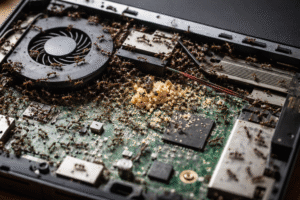
How to Get Rid of Ants in Your Laptop
Learn why ants may enter electronic devices and how to address the problem without damaging sensitive components.
How to Get Rid of Ants in Electronics
Explore practical precautions for managing ant activity around computers and other electronic equipment.
How to Identify Tiny Bugs in Your Kitchen
Learn how to distinguish small household pests and identify possible sources of an infestation.
Conclusion: Choose the Right Fire Ant Control Strategy
Getting control of fire ants starts with identifying the problem and choosing a treatment that matches your property. Baits such as Amdro and Advion offer ways to target colonies through foraging workers, while appropriate mound treatments can provide quicker suppression of specific problem areas. Spinosad-based baits offer another option for homeowners comparing active ingredients.
The key is to avoid relying on a single application or expecting immediate results from every product. Apply treatments according to their labels, allow sufficient time for them to work, and monitor your yard for further activity. Combine suitable treatments with routine inspection and sensible yard maintenance to help reduce the chances of recurring infestations.
BugOffControl’s Fire Ant Control Advice
Start with the treatment that addresses your actual problem rather than buying several pesticides unnecessarily. For multiple colonies, consider an appropriate bait. For individual mounds, choose a labeled localized treatment. If fire ants continue to spread or repeatedly return, consider professional assistance.