How to Get Rid of German Cockroaches in Your Refrigerator
Finding German cockroaches around your refrigerator can be frustrating, especially when you start wondering whether they are hiding inside the appliance.
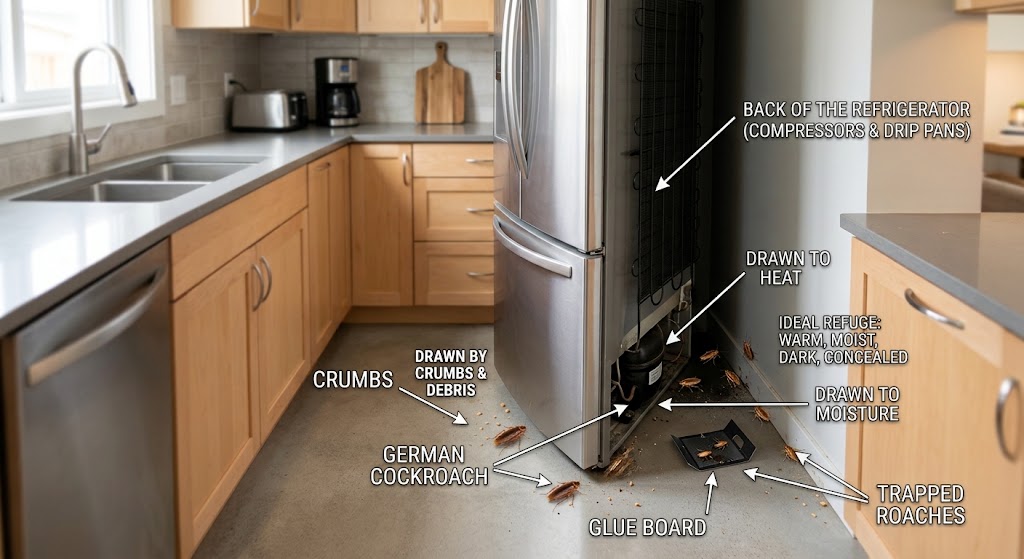
The good news is that seeing a German cockroach near your refrigerator does not automatically mean the entire appliance is infested. Refrigerators and the surrounding area can provide several things cockroaches look for: warmth, moisture, food particles, darkness, and protected hiding places.
The most effective approach is to look beyond the refrigerator itself.
You want to clean the area, remove food and moisture sources, find where the cockroaches are traveling, use appropriate control products, seal potential entry points, and monitor the results.
This guide walks you through each step, from finding the source of the problem to taking practical steps to get it under control.
Quick Answer: How to Get Rid of German Cockroaches Around a Refrigerator
Start by thoroughly cleaning underneath and around the refrigerator, removing crumbs and grease, correcting moisture problems, and checking nearby cabinets, walls, plumbing openings, and appliances.
Then use glue traps to monitor activity and an appropriate cockroach bait in areas where cockroaches are traveling or hiding. For more established activity, an insect growth regulator (IGR) may also be useful when the product label allows the intended application.
Avoid spraying insecticide randomly around the refrigerator or applying products inside food-storage areas unless the label specifically permits that use.
If you are seeing numerous cockroaches, repeated nymphs, activity in several rooms, or continuing activity despite treatment, the problem may extend beyond the refrigerator area and may require professional pest-control assistance.
Affiliate Disclosure
This article may contain affiliate links. If you purchase a product through one of these links, Bug Off Control may earn a commission at no additional cost to you.
As an Amazon Associate, Bug Off Control earns from qualifying purchases.
German Cockroach Products Worth Considering
The right product depends on where the cockroaches are hiding and how widespread the activity appears to be.
| Product | Type | Potential Use Around Refrigerator | Important Consideration |
|---|---|---|---|
| Advion Cockroach Gel Bait | Gel bait | Cracks, crevices and suitable hiding areas | Precise placement is important |
| Combat Max Roach Killing Bait Stations | Bait stations | Floor-level areas and cockroach travel routes | Enclosed format can be convenient |
| Gentrol Point Source IGR | IGR | Suitable areas near cockroach activity | Does not provide an instant adult kill |
| Harris Boric Acid Roach Powder | Insecticidal dust | Appropriate dry voids or areas permitted by the label | Avoid excessive application and moisture |
| TERRO Roach Bait Gel | Gel bait | Suitable cracks and crevices | Follow the product label carefully |
| Catchmaster Glue Boards | Monitoring trap | Under or near the refrigerator and travel routes | Helps monitor activity but does not eliminate an infestation alone |
Important: Product formulations, labels, application directions, and availability can change. Always read and follow the current product label before use.
A practical starting combination
For many refrigerator-area situations, a useful approach is:
Glue boards + appropriate cockroach bait + cleaning + moisture control
Glue boards can help show you where the cockroaches are traveling, while bait can target cockroaches in suitable areas.
For heavier or more established activity, an IGR or other control method may be considered as part of a broader integrated approach.
Check Latest Price & Availability on Amazon
Which Product Is Right for Your Situation?
Not sure what you actually need? Start with the problem you are seeing.
| What You’re Seeing | What to Consider |
|---|---|
| You’re not sure where cockroaches are traveling | Glue boards |
| Cockroaches are repeatedly around the refrigerator | Appropriate gel bait or enclosed bait stations |
| You are seeing small nymphs repeatedly | Bait + monitoring + consider an IGR |
| Activity is occurring throughout the kitchen | Multiple monitoring points + integrated control |
| Cockroaches are appearing in several rooms | Broader inspection and professional assistance may be appropriate |
| You suspect they are inside an appliance | Avoid dismantling the appliance and consider professional inspection |
The goal isn’t to cover the entire kitchen with pesticide. The goal is to find the activity, target it appropriately, and remove the conditions helping the cockroaches survive.
First, Determine How Serious the Problem Is
Before reaching for a product, take a few minutes to determine what you are actually dealing with. A single cockroach sighting and a kitchen full of repeated activity are two very different situations.
Light Activity
You may be dealing with relatively limited activity if you notice:
- One or two occasional cockroaches
- Little or no evidence of nymphs
- Few or no droppings
- No obvious egg cases
- Activity concentrated around one area
- Little activity on monitoring traps
What to do
Start with:
- Cleaning around the refrigerator
- Removing crumbs and food residue
- Correcting moisture problems
- Placing glue boards near likely travel routes
- Inspecting cracks and gaps
- Using appropriate bait where permitted
- Monitoring for changes
Early detection gives you a chance to address the problem before it becomes more widespread.
Moderate German Cockroach Activity
The situation deserves more attention when you start seeing:
- Cockroaches repeatedly
- Several cockroaches over a period of time
- Small nymphs
- Droppings around hiding areas
- Activity in cabinets or around sinks
- Cockroaches near multiple appliances
- Repeated catches on glue boards
- Possible egg cases
What to do
At this stage, go beyond cleaning the refrigerator area.
Inspect:
- Under and behind the refrigerator
- Around the stove
- Under the sink
- Around plumbing
- Inside cabinet corners
- Behind or beneath other appliances
- Along baseboards
- Around utility openings
- Areas where walls and floors meet
Use monitoring traps to determine where activity is concentrated, and place appropriate bait according to the label. An IGR may also be considered where appropriate and permitted by its label.
The objective is to reduce the population while addressing the conditions that allow it to continue.
Severe or Widespread German Cockroach Activity
A more established infestation may involve:
- Frequent sightings
- Numerous nymphs
- Cockroaches in multiple rooms
- Significant droppings
- Repeated egg-case findings
- Heavy activity on monitoring traps
- Daytime sightings
- Continued activity after treatment
- Cockroaches emerging from multiple hiding areas
At this point, don’t focus exclusively on the refrigerator. German cockroaches can move through kitchens, bathrooms, cabinets, wall voids, plumbing areas, and other warm, protected locations.
What to do
A more comprehensive approach may include:
- Thorough sanitation
- Moisture reduction
- Monitoring
- Proper bait placement
- Appropriate IGR use
- Targeted dust applications where permitted
- Sealing gaps and openings
- Inspection of nearby appliances
- Professional pest-control assistance
If you live in an apartment, condominium, or other multi-unit building, it can also be important to consider whether cockroach activity may be moving between connected units.
Why Are German Cockroaches Attracted to Refrigerators?
Your refrigerator isn’t necessarily the source of the infestation. However, the area around it can create favorable conditions.
1. Warmth
The mechanical components of a refrigerator can produce warmth.
Cockroaches generally prefer warm, protected environments, which can make areas around appliances attractive hiding locations.
2. Food Particles
Small crumbs and food residue can accumulate beneath or behind appliances without being obvious.
Even a relatively clean kitchen can have food particles in hard-to-reach places.
3. Moisture
Water from spills, condensation, plumbing problems, or nearby leaks can provide an important moisture source.
4. Darkness
Cockroaches are often active when the surrounding area is dark and quiet. The space beneath or behind an appliance provides shelter from normal household activity.
5. Protected Spaces
Small gaps around walls, cabinets, flooring, plumbing, and electrical or utility openings can provide hiding places. This is why simply spraying a cockroach when you see it may not address the larger problem.
Can German Cockroaches Live Behind or Under a Refrigerator?
Yes, the area behind or underneath a refrigerator can provide suitable shelter for German cockroaches. However, that doesn’t mean the cockroaches are necessarily living inside the refrigerator itself. Check areas such as:
- Under the refrigerator
- Behind the refrigerator
- Along the wall behind it
- Around the refrigerator’s base
- Nearby cabinet corners
- Floor-to-wall gaps
- Nearby plumbing
- Electrical or utility openings
- Under adjacent appliances
Use a flashlight to inspect these areas carefully. If the refrigerator needs to be moved, use caution and avoid damaging flooring, electrical connections, water lines, or the appliance.
Can German Cockroaches Get Inside the Refrigerator?
Cockroaches can sometimes enter protected areas of an appliance, but finding one near your refrigerator doesn’t automatically mean they are getting into the food compartment. Start by checking the door gasket for obvious damage, gaps, or poor sealing. Also:
- Keep the refrigerator interior clean.
- Clean spills promptly.
- Store food properly.
- Remove expired food.
- Check around the bottom and back of the appliance.
- Do not apply insecticide inside food-storage areas unless the product label specifically permits that use.
If you believe cockroaches are entering the internal mechanical or electrical portions of the appliance, do not dismantle those components yourself simply to search for insects. A qualified professional can determine whether the appliance itself needs inspection.
Where Do German Cockroaches Hide Around a Refrigerator?
German cockroaches are small enough to take advantage of surprisingly narrow spaces. Common areas to inspect include:
Behind the refrigerator
Look along the wall, floor, appliance edges, and nearby utility connections.
Under the refrigerator
Check for crumbs, grease, moisture, droppings, and cockroach activity.
Around baseboards
Small gaps between flooring, walls, and trim can provide protected routes.
Under the kitchen sink
Plumbing creates openings and moisture can make this area attractive.
Inside cabinet corners
Pay particular attention to dark corners and areas around plumbing.
Around other appliances
Dishwashers, stoves, microwaves, and other appliances may also provide warmth and shelter.
Around utility openings
Inspect areas where pipes, cables, or other services enter walls or cabinets.
Step-by-Step: How to Get Rid of German Cockroaches Around Your Refrigerator
Step 1: Clean Under and Around the Refrigerator
Start with the basics.
Remove:
- Crumbs
- Grease
- Food packaging
- Spilled food
- Pet-food residue
- Accumulated debris
If possible, carefully clean the floor and surrounding surfaces. Don’t forget the areas that are normally hidden.
Step 2: Remove Moisture Sources
Look for:
- Leaking pipes
- Condensation
- Water spills
- Damp cabinets
- Leaking appliance connections
- Standing water
- Plumbing problems
A persistent moisture problem can make pest control much more difficult. Fix leaks when possible and keep surrounding areas dry.
Step 3: Inspect With a Flashlight
A flashlight can reveal clues that are easy to miss during normal cleaning. Look for:
- Live cockroaches
- Nymphs
- Droppings
- Egg cases
- Shed skins
- Grease or food residue
- Gaps and cracks
- Possible travel routes
Don’t just look at the refrigerator. Inspect the surrounding kitchen as well.
Step 4: Use Glue Boards to Find Activity
Glue boards are particularly useful when you’re unsure where the cockroaches are traveling. Place them in suitable locations such as:
- Near the refrigerator
- Along walls
- Under cabinets
- Near the sink
- Behind or beside appliances
- Along suspected travel routes
Check them regularly. The pattern of catches can help you identify areas that deserve closer attention. Remember that glue boards are primarily monitoring tools. They aren’t a complete solution for an established infestation.
Step 5: Use Cockroach Bait Where Appropriate
Bait can be useful because cockroaches may encounter it while moving through their normal hiding and feeding areas. Depending on the product, bait may be available as:
- Gel
- Bait stations
- Other labeled bait formulations
Place bait according to the product’s directions and only in locations where the label permits its use.
An important mistake to avoid
Don’t spray insecticide directly over or around bait unless the product directions specifically allow it.
Repellent sprays or other chemicals can interfere with cockroach movement toward bait, depending on the products involved. The goal is to create a treatment area that works together rather than against itself.
Step 6: Consider an IGR for Established Activity
An insect growth regulator, or IGR, works differently from a conventional insecticide. Rather than simply targeting adult cockroaches, an IGR is designed to interfere with the normal development or reproduction of immature insects, depending on the active ingredient and product. This can make an IGR useful as part of a broader approach when cockroach activity is established. However, an IGR is not an instant adult cockroach killer. Always follow the current product label for placement, application, precautions, and permitted use areas.
Step 7: Seal Suitable Gaps
Once you’ve identified potential entry or hiding points, address them where practical. Pay attention to:
- Cracks around cabinets
- Gaps around pipes
- Wall openings
- Loose trim
- Baseboard gaps
- Openings around utility lines
Sealing gaps can reduce hiding opportunities and make future monitoring easier. Don’t seal areas until you’re confident you aren’t simply trapping an active pest problem inside an inaccessible space.
Step 8: Recheck the Area
Pest control shouldn’t end immediately after treatment. Continue monitoring. Look for:
- Fewer cockroaches
- Fewer nymphs
- Fewer glue-board catches
- Less activity around the refrigerator
- No new obvious droppings or egg cases
- Longer periods without sightings
These signs can help you determine whether activity is declining.
What If the Cockroach Bait Doesn’t Seem to Work?
Don’t immediately assume the product is ineffective. Several things can interfere with bait performance.
There may be competing food
If crumbs, grease, pet food, or other food sources are readily available, cockroaches have more feeding options.
The bait may be poorly positioned
Cockroaches are more likely to encounter bait when it is placed close to their normal hiding and travel areas.
The bait may have dried out
Some bait formulations are less useful once they are no longer in suitable condition.
The infestation may be larger than it appears
Seeing cockroaches around the refrigerator doesn’t necessarily mean the refrigerator is the main source.
The species may have been misidentified
Different cockroach species can require different approaches. Correct identification is an important first step.
What Not to Do Around Your Refrigerator
Some approaches can create more problems than they solve.
Don’t randomly spray every surface
More pesticide doesn’t automatically mean better control. Targeted treatment is generally preferable to indiscriminate spraying.
Don’t spray inside the refrigerator
Food-storage areas should not be treated with insecticide unless the product label specifically permits that application.
Don’t dismantle electrical components
Trying to take apart a refrigerator to find cockroaches can create electrical, mechanical, or appliance-safety hazards.
Don’t flood cracks with insecticide
Excessive application is unnecessary and can create exposure concerns.
Don’t rely only on foggers
Foggers may not reach the protected cracks and crevices where German cockroaches spend much of their time. They also don’t solve the underlying food, moisture, shelter, or entry-point issues.
Don’t ignore the rest of the kitchen
If cockroaches are established, treating only the refrigerator area may leave the main population untouched.
How to Prevent German Cockroaches Around Your Refrigerator
Once activity declines, prevention becomes much easier when you focus on the conditions that attracted or supported the cockroaches.
Keep the area under the refrigerator clean
Schedule occasional cleaning beneath and around the appliance.
Store food properly
Use sealed containers where appropriate and avoid leaving exposed food out overnight.
Empty garbage regularly
Food waste can provide another readily available food source.
Clean spills quickly
Even small spills can become attractive to pests.
Reduce unnecessary cardboard
Cockroaches can use clutter and cardboard as shelter, particularly in warm areas.
Fix plumbing and moisture problems
Don’t ignore small leaks.
Inspect used appliances
Secondhand appliances can potentially harbor pests. Inspect them carefully before bringing them indoors.
Monitor periodically
Glue boards can be useful even after the problem appears to be under control. They can provide an early warning if activity returns.
How to Identify a German Cockroach
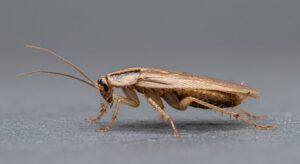
German cockroaches are relatively small compared with some other household cockroach species. Adults are typically:
- Light brown to tan
- Relatively small
- Equipped with wings
- Marked by two dark stripes behind the head
They are commonly associated with warm indoor environments such as kitchens and bathrooms.
What Do German Cockroach Nymphs Look Like?
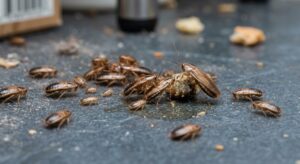
Nymphs are smaller and do not have the fully developed appearance of adults. They can be particularly important to notice because repeated nymph sightings may indicate that cockroaches are reproducing somewhere nearby. If you begin seeing numerous small cockroaches rather than an occasional adult, inspect the surrounding area more carefully.
What Do German Cockroach Droppings Look Like?
German cockroach droppings can appear as:
- Small dark specks
- Dark stains
- Pepper-like material
- Smears around hiding areas
Look around:
- Cabinet corners
- Appliance edges
- Wall-floor junctions
- Cracks
- Sheltered areas
- Areas where cockroaches have been observed
Droppings can help identify areas of activity, but they shouldn’t be used alone to determine the exact size of an infestation.
Can German Cockroaches Spread Around the House?
Yes. German cockroaches can move between suitable food, water, and shelter sources. They aren’t necessarily restricted to the refrigerator area. Depending on the circumstances, activity may extend into:
- Kitchens
- Bathrooms
- Cabinets
- Pantries
- Laundry areas
- Utility spaces
- Other warm areas
That’s why repeated activity in more than one location should be treated as a broader inspection issue rather than simply a refrigerator problem. For additional prevention ideas, see our [Guide to Keeping Cockroaches Out of Your Home].
Are German Cockroaches a Health Concern?
German cockroaches can contaminate food and food-contact surfaces as they move through areas where they feed and hide. Cockroach body parts, droppings, and shed material can also contribute to indoor allergens for some people. That doesn’t mean that seeing one cockroach automatically means someone will become sick.
However, an established infestation is a good reason to improve sanitation and address the pest problem rather than allowing activity to continue.
Can German Cockroaches Fly?
German cockroaches have wings, but they are generally much more associated with running and crawling than sustained flight.
If you see a small brown cockroach rapidly moving across a kitchen floor, cabinet, countertop, or appliance area, it may be a German cockroach, but proper identification is still important.
Does a Refrigerator Cause a German Cockroach Infestation?
Not by itself. A refrigerator can provide conditions that cockroaches may find useful, but the appliance isn’t necessarily the original source.
The larger problem may involve:
- Food sources
- Moisture
- Nearby cabinets
- Plumbing
- Wall openings
- Other appliances
- Stored materials
- An existing indoor population
Think of the refrigerator as one possible part of the environment, not automatically the source of the infestation.
Signs Your Cockroach Problem Is Improving
It can be difficult to tell whether treatment is working if you’re only watching for completely zero sightings.
Instead, look for a trend.
Positive signs can include:
- Fewer live cockroach sightings
- Fewer nymphs
- Fewer cockroaches caught on glue boards
- Less activity around the refrigerator
- Fewer fresh droppings
- No new obvious egg cases
- Longer periods between sightings
Monitoring is particularly useful because it gives you something more objective to compare over time. If activity remains high or begins spreading, reassess the situation rather than simply applying more product.
When Should You Call a Pest-Control Professional?
Professional assistance may be appropriate when:
- Cockroaches are appearing throughout the home
- You are seeing numerous nymphs
- Activity continues despite reasonable control efforts
- You find substantial evidence of an established infestation
- Cockroaches appear to be coming from inaccessible areas
- You suspect activity inside an appliance
- You live in a multi-unit building
- You cannot identify where the infestation is coming from
- You are uncomfortable handling pesticides
A professional can help identify hiding areas and develop a treatment plan based on the level and location of activity.
Frequently Asked Questions
1. Why do I keep finding German cockroaches around my refrigerator?
The area can provide warmth, moisture, food particles, darkness, and shelter. The refrigerator may simply be one part of a larger infestation.
2. Can German cockroaches live behind a refrigerator?
Yes. The space behind an appliance can provide shelter and access to food, moisture, and protected cracks.
3. How do I get rid of German cockroaches under my refrigerator?
Clean the area, remove food and moisture sources, use monitoring traps, apply appropriate bait according to its label, inspect surrounding hiding areas, and continue monitoring.
4. What is the best bait for German cockroaches?
There isn’t one product that is appropriate for every situation. Gel baits and enclosed bait stations can both be useful options when used according to their labels.
5. Can I put cockroach gel bait inside my refrigerator?
Do not place insecticide inside food-storage areas unless the product label specifically permits that use. Treat suitable surrounding areas according to the label instead.
6. Will cleaning under my refrigerator get rid of German cockroaches?
Cleaning can remove food debris and improve sanitation, but cleaning alone may not eliminate an established infestation.
7. Why am I seeing baby German cockroaches?
Small nymphs can indicate that German cockroaches are reproducing somewhere nearby. Repeated nymph sightings deserve closer inspection.
8. Can German cockroaches come through plumbing gaps?
Openings around plumbing can provide routes between protected areas. Inspect and seal suitable gaps where practical.
9. Should I use a fogger to get rid of German cockroaches?
Foggers aren’t a reliable substitute for targeted inspection, sanitation, monitoring, and appropriate treatment of cracks and hiding areas. Always follow pesticide labels and safety directions.
10. How long does it take to get rid of German cockroaches?
There isn’t one guaranteed timeline. Results depend on the size of the infestation, available food and moisture, hiding locations, treatment approach, and whether the source is addressed.
The Simple Strategy to Remember
If German cockroaches are appearing around your refrigerator, don’t focus only on killing the cockroach you can see. Focus on the environment supporting the activity.
Clean → Dry → Inspect → Monitor → Treat → Seal → Recheck
Start by removing food and moisture. Then use monitoring traps to understand where the cockroaches are traveling. Apply appropriate bait or other control products according to their labels, address hiding and entry points, and continue monitoring.
If you’re seeing repeated nymphs, widespread activity, or cockroaches throughout multiple rooms, treat the situation as a broader infestation rather than simply a refrigerator problem.
The earlier you identify the source and supporting conditions, the easier it is to develop a focused control strategy.
Conclusion
Finding German cockroaches around your refrigerator doesn’t necessarily mean the appliance itself is infested. In many cases, the area around the refrigerator simply provides a convenient combination of warmth, moisture, food residue, darkness, and hiding places.
The most effective approach is to look at the whole environment, not just the cockroach you happen to see. Start by cleaning beneath and around the refrigerator, removing accessible food sources, correcting moisture problems, and inspecting nearby cracks, cabinets, plumbing openings, and other appliances. Use glue boards to monitor activity, and consider appropriate cockroach bait or other labeled control products based on what you find.
If you continue seeing nymphs, repeated activity, droppings, or cockroaches in multiple areas of the home, the problem may be larger than the refrigerator area. At that point, a broader inspection and professional pest-control assistance may be appropriate.
The goal isn’t simply to kill the cockroaches you can see. It’s to reduce the conditions that support them, target their hiding and travel areas, and monitor whether activity is actually declining.
With a consistent approach of cleaning, moisture control, inspection, monitoring, targeted treatment, and follow-up, you can take a much more focused approach to getting German cockroaches away from your refrigerator and out of the surrounding kitchen.