
Best All-Natural Spider Repellent Sprays for Indoor Use (Complete Guide)

Finding a spider crawling across your bedroom wall or hanging from a web in your kitchen is rarely a welcome surprise. Although most household spiders are harmless and actually help control other insects, their presence can make certain areas of your home uncomfortable.
If you prefer to avoid conventional pesticides, you may be wondering whether natural spider repellent sprays can help. Products containing peppermint oil, cedarwood oil and other botanical ingredients offer alternatives worth exploring. However, not every natural spray works the same way, and some provide little evidence of lasting spider protection.
In this guide, we’ll compare popular natural spider repellent products, explain what their ingredients can and cannot do, and help you choose an option that suits your home. You’ll also learn how to apply products responsibly, protect pets and prevent spiders from repeatedly entering your living spaces.
Quick Answer: What Should You Look for in a Natural Spider Repellent?
If you’re shopping for a natural spider repellent, consider a peppermint-based product such as Mighty Mint or a cedarwood-based formulation such as Wondercide. STEM botanical sprays and scented repellent pouches offer other formats to investigate.
Before buying, check that the specific product is labeled for spiders and your intended indoor application. No botanical spray should be relied on as a permanent barrier. Sealing entry points and removing webs are essential parts of effective prevention.
Best Natural Spider Repellent Sprays: Quick Comparison
Choosing a spider repellent is easier when you understand what each product is intended to do. Some products are marketed primarily as repellents, while others are designed for direct insect treatment. Scented pouches provide yet another option.
Affiliate Disclosure
This page contains affiliate links. If you buy through my links, I may earn a small commission at no extra cost to you.
As an Amazon Associate, I earn from qualifying purchases.
|
Product |
Main Ingredient or Format |
Intended Use to Check |
Main Consideration |
|---|---|---|---|
|
Peppermint oil |
Labeled spider-repellent applications |
Strong mint fragrance |
|
|
Botanical oils, depending on formulation |
Indoor pest control and any specific spider claims |
Check the exact formulation |
|
|
Botanical insect-control formulation |
Contact treatment for pests listed on the label |
Not every formulation has the same spider claims |
|
|
Scented repellent pouches |
Small, suitable storage areas |
Limited coverage compared with sprays |
Product formulations and labels can change. The table describes product types, not independently verified performance results. Check the current manufacturer’s label before purchasing.
What to Know Before Buying a Natural Spider Repellent
Before spending money on a spider spray, it helps to understand what natural repellents can realistically accomplish.
Natural Does Not Always Mean Effective
Peppermint and cedarwood oils have strong fragrances and are commonly used in botanical pest-control products. However, the presence of an essential oil does not automatically establish that a product will repel spiders reliably in a typical home.
Some ingredients may discourage certain spiders under particular conditions, but performance can vary according to the species, formulation, treated surface and surrounding environment.
Look for a product that specifically identifies spiders on its label rather than assuming that a general-purpose botanical insect spray will work against them.
Repelling Spiders Is Different From Killing Them
A repellent is intended to discourage a pest from entering or remaining in a treated area. A contact insecticide is intended to kill susceptible pests when they receive a sufficient application.
These are different purposes. A product that kills insects on contact does not necessarily repel spiders after it dries. Likewise, a product marketed as a repellent should not automatically be expected to kill a spider.
Knowing the difference helps you choose a product that matches the problem you’re trying to solve.
Natural Sprays Do Not Guarantee Long-Term Protection
Essential oil fragrances can fade as the ingredients evaporate. Cleaning, sunlight, moisture and other environmental conditions can also affect how long a treatment remains on a surface.
Be cautious of claims that a botanical spray will protect your home for several weeks or months unless the specific product label supports that duration.
For ongoing prevention, physical exclusion and housekeeping are more dependable measures to incorporate into your routine.
Why Spiders Enter Homes
Understanding why spiders enter your home can help you choose the right control measures. In most cases, they are looking for food, shelter or a suitable place to establish themselves.
1. Insects Provide a Ready Food Supply
Spiders are predators. Depending on the species, they feed on flies, mosquitoes, moths, crickets and other small arthropods.
If your home has a regular supply of these insects, it may also provide attractive hunting opportunities for spiders. Controlling the underlying insect problem can therefore help reduce spider activity.
2. Clutter Provides Convenient Hiding Places
Closets, storage rooms, garages and seldom-used corners can offer excellent shelter for spiders. Cardboard boxes, piles of clothing and stored belongings create dark spaces where spiders may remain undisturbed.
Regularly cleaning and organizing these areas makes it easier to discover webs and spider activity before they become recurring problems.
3. Gaps Around Windows and Doors Allow Entry
Spiders can crawl through small openings around doors, windows, utility pipes and other structural gaps. Damaged screens and poorly fitted door sweeps can make entry even easier.
Inspecting and repairing these areas is particularly important if spiders keep appearing in the same rooms.
4. Outdoor Conditions Can Encourage Spider Activity
Dense vegetation, woodpiles and outdoor lighting that attracts flying insects can create favorable conditions near your home.
Keeping shrubs trimmed away from exterior walls, storing firewood away from the foundation and managing outdoor lighting can help reduce the number of insects and sheltered areas near potential entry points.
Detailed Reviews of Natural Spider Repellent Products
The following products provide different ways to approach botanical spider control. These are product overviews based on their intended formats and ingredients, not claims of personal testing or independently measured effectiveness.
1. Mighty Mint Spider Repellent 4.2 
Why Consider Mighty Mint?

Mighty Mint is a peppermint-oil-based spider repellent marketed to homeowners who prefer a botanical alternative. Its strong mint fragrance distinguishes it from cedarwood and other scented formulations.
A ready-to-use spray can be convenient when you want to treat particular areas without mixing ingredients yourself. However, you should first check the label to confirm which indoor surfaces and spider-control applications are permitted.
Potential advantages
-
Peppermint-based formulation.
-
Convenient spray-bottle application.
-
No need to prepare a homemade mixture.
-
An option for people who prefer mint fragrances.
Potential disadvantages
-
The strong fragrance may be unpleasant in confined rooms.
-
Essential oils may affect some finishes and surfaces.
-
Spider repellency is not guaranteed.
-
Particular care is necessary around pets, especially cats.
Best suited for: Homeowners interested in a peppermint-based product who have suitable, label-approved areas to treat.
Consider another approach if: You need permanent protection, have pets that may lick treated surfaces or are sensitive to strong fragrances.
2. Wondercide Indoor Pest Control 4.2
Why Consider Wondercide?
Wondercide offers botanical pest-control products, including cedarwood-based formulations. The brand may appeal to homeowners who prefer a woody fragrance instead of peppermint.
However, the specific ingredients and permitted uses depend on the product. Check the exact formulation and confirm that it is labeled for indoor spider control before purchasing it for that purpose.
Potential advantages
-
Botanical product options.
-
An alternative fragrance to peppermint.
-
Convenient spray format.
-
Useful for homeowners comparing different botanical formulations.
Potential disadvantages
-
Not every formulation is labeled for spiders.
-
Some formulations may leave residues on sensitive surfaces.
-
Essential oils can still pose risks to pets.
-
Long-lasting spider repellency should not be assumed.
Best suited for: Homeowners who prefer cedarwood-based products and have confirmed that the chosen formulation is appropriate for their intended application.
Consider another approach if: You need a product with a clearly labeled spider use that the particular formulation does not provide.
3. STEM Botanical Spray 4.3 ☆
Why Consider STEM?

STEM offers botanical insect-control products in convenient spray formats. These may appeal to homeowners who prefer a ready-made treatment over a homemade mixture.
The important distinction is whether the particular STEM product is designed for contact treatment or spider repellency. Check the exact formulation and labeled pests rather than assuming that all botanical STEM sprays serve the same purpose.
Potential advantages
-
Ready-to-use spray format.
-
Botanical formulations are available.
-
Convenient for targeted applications permitted by the label.
-
No need to mix essential oils at home.
Potential disadvantages
-
Contact activity is not the same as lasting repellency.
-
Spider coverage varies by formulation.
-
Strong fragrances may not suit every household.
Best suited for: Homeowners who want a ready-to-use botanical treatment for a pest specifically listed on the product label.
Consider another approach if: Your primary objective is a long-lasting spider barrier and the product is not labeled for that purpose.
4. Grandpa Gus’s Spider Repellent Pouches 4.0
Why Consider Grandpa Gus’s Pouches?

Not every household pest-control situation calls for a spray. Scented pouches provide an alternative for suitable storage areas where you would prefer not to apply liquids.
They may be convenient in certain closets or storage containers, provided the manufacturer permits those uses. Their main limitation is coverage: a small pouch cannot reasonably be expected to protect an entire room.
Potential advantages
-
No liquid application.
-
Convenient for suitable small spaces.
-
No need to spray nearby belongings.
-
Simple to place in approved locations.
Potential disadvantages
-
Limited coverage.
-
Scent strength can diminish over time.
-
Must be stored according to the label.
Best suited for: Homeowners looking for a non-spray format for suitable storage areas.
Consider another approach if: You have widespread spider activity or need to treat a large, open living space.
Which Natural Spider Repellent Should You Choose?
The right product depends on your circumstances. Instead of choosing solely by fragrance or marketing claims, consider the area you want to treat and the type of spider problem you have.
|
Your Situation |
Option to Consider |
Important Consideration |
|---|---|---|
|
You prefer peppermint |
Check the indoor-use directions |
|
|
You prefer a cedarwood fragrance |
Confirm the exact product covers spiders |
|
|
You want a botanical contact treatment |
Check the labeled pest and treatment method |
|
|
You do not want to spray |
Suitable only for limited areas |
|
|
Spiders repeatedly enter through gaps |
Physical exclusion |
Seal entry points rather than relying on fragrance |
|
You have pets that lick floors |
Nonchemical prevention |
Minimize exposure to essential oils |
A helpful buying tip
If you are unsure which product to purchase, begin by identifying where the spiders are appearing. A spider repeatedly found near a window may call for screen repairs and sealing, while recurring webs in a storage room may indicate a need for regular cleaning and monitoring. Choose a spray only when it addresses a specific, label-approved need.
How to Apply Natural Spider Repellent Sprays
Correct application helps you avoid unnecessary exposure and prevents damage to household surfaces. Follow the manufacturer’s directions rather than assuming all natural sprays should be applied in the same way.
Step 1: Remove existing webs
Vacuum visible webs and egg sacs where safe to do so. Pay particular attention to ceiling corners, window frames, closets and areas behind furniture.
Step 2: Check for entry points
Inspect door frames, window screens, gaps around plumbing and openings where utility lines enter. Repair damaged areas before considering additional treatment.
Step 3: Apply only where permitted
If the product is labeled for your intended use, apply it as directed. Avoid food, dishes, electrical equipment, bedding and any surface excluded by the manufacturer.
Step 4: Allow the area to dry
Observe the stated drying and re-entry instructions. Ventilate the area as directed, and keep children and pets away for the required period.
Step 5: Monitor the treated area
Check for new webs and recurring spider sightings. If activity continues, investigate the source instead of increasing the amount or frequency of spray.
Natural Spider Repellent Safety: What Pet Owners Should Know
Natural and plant-based ingredients are not automatically safe for pets or children. Essential oils can cause irritation or poisoning depending on the ingredient, concentration and type of exposure.
If you have cats, dogs, birds or young children, take particular care before using an essential oil product indoors.
-
Cats: Certain essential oils can be especially hazardous to cats. Prevent them from walking on wet treated surfaces or licking residues.
-
Dogs: Essential oils can also harm dogs if ingested or applied directly to their skin. Follow the specific product precautions.
-
Children: Store all sprays and pouches securely and keep children away during application and for the label’s specified period.
-
Sensitive household members: Strong fragrances can irritate some people, particularly those with respiratory sensitivities.
Never assume that a treated surface is safe simply because it feels dry. Follow the label’s re-entry instructions, and consult a veterinarian if you are uncertain whether a product is appropriate for your pet.
If a pet is exposed and develops drooling, vomiting, tremors, weakness or breathing difficulties, seek veterinary advice promptly.
For households where exposure is difficult to prevent, focus on sealing gaps, vacuuming webs, organizing storage and reducing insects rather than relying on essential oil sprays.
DIY Peppermint Spider Spray: Should You Make Your Own?
Making a peppermint spray at home may seem like an inexpensive alternative to commercial products. However, there are several reasons to be cautious.
Essential oils do not dissolve evenly in water. Shaking a mixture temporarily disperses the oil, but the ingredients can separate again. This means that different sprays from the same bottle may not contain consistent concentrations.
Homemade mixtures also lack standardized spider-control testing and label directions. They may stain furniture, irritate skin or create unnecessary risks for pets.
If you want to try a botanical spray, a properly labeled commercial product makes it easier to identify its intended uses and precautions. Avoid applying homemade essential oil mixtures to bedding, food-preparation areas, pet bedding or delicate surfaces.
For most households, improving exclusion and removing webs is a more dependable starting point than preparing an untested spray.
How to Prevent Spiders From Returning
Spraying alone rarely addresses every reason spiders enter a home. A practical prevention routine combines physical exclusion, housekeeping and targeted treatment where appropriate.
The Three-Layer Spider Prevention Plan
Keep spiders from entering.
-
Seal suitable gaps around windows and doors.
-
Install or repair door sweeps.
-
Repair damaged window screens.
-
Seal openings around pipes and utility lines.
Reduce hiding places and insect activity.
-
Remove webs and egg sacs.
-
Store belongings in lidded containers.
-
Reduce unnecessary clutter.
-
Address recurring insect problems.
-
Keep vegetation and firewood away from the house.
Use products only when needed.
-
Consider a labeled botanical product for appropriate applications.
-
Use suitable traps to monitor activity.
-
Follow all safety and application directions.
-
Reassess persistent spider problems.
Seal Gaps Around Doors and Windows
Inspect the exterior of your home, paying particular attention to gaps around window frames, door jambs and utility openings.
Use suitable caulk to seal small structural gaps and install door sweeps where necessary. Replace damaged screens and check that windows close properly.
These measures can reduce entry opportunities for spiders as well as many other household insects.
Remove Clutter and Regularly Clean Storage Areas
Spiders often occupy quiet, undisturbed places. Keeping closets, garages and storage rooms organized makes it easier to inspect them.
Consider replacing open cardboard storage with lidded plastic containers. Vacuum behind furniture and along baseboards, especially in rooms where you frequently discover webs.
Reduce Insects Around Your Home
Because spiders feed on other arthropods, addressing recurring insect activity can help reduce the food available to them.
Repair screens, keep food properly stored, address standing water where appropriate and manage outdoor lighting. Warmer or yellow-toned outdoor lights may attract fewer insects than some conventional lights, although the results depend on the insect species and lighting conditions.
Keep Landscaping Away From the House
Trim shrubs and climbing vegetation that touch exterior walls. Keep firewood and garden debris away from the foundation where practical.
These simple changes can reduce sheltered areas close to your home and make it easier to inspect the exterior for spider activity.
Monitor Spider Activity With Appropriate Traps
Glue traps can help identify areas where spiders are moving. Place them only in suitable locations, away from children, pets and non-target wildlife, and check them regularly.
Remember that traps are monitoring and capture tools, not a complete prevention strategy. If you discover potentially dangerous spiders or persistent infestations, seek help from a qualified pest-control professional.
Troubleshooting: Why Your Spider Repellent May Not Be Working
If you have already purchased a botanical spider spray but continue to see spiders, consider the following possibilities.
|
Problem |
Possible Reason |
What to Do |
|---|---|---|
|
Spiders keep appearing near windows |
Damaged screens or gaps |
Inspect and repair entry points |
|
New webs appear after cleaning |
Spiders remain in sheltered areas |
Inspect and vacuum recurring web locations |
|
Spiders return after spraying |
Fragrance may have faded or the product may not repel that species |
Follow the label and improve exclusion |
|
Several insects and spiders appear together |
An underlying insect problem may be attracting spiders |
Identify and address the insects |
|
Spiders appear in storage areas |
Clutter provides shelter |
Organize belongings and inspect regularly |
|
You notice spiders despite preventive measures |
New spiders may still be entering |
Monitor activity and reassess possible entry routes |
If you repeatedly find spiders in the same areas, try to identify the pattern. Knowing whether they are appearing near windows, drains, storage rooms or exterior doors can help you choose a more targeted solution.
Frequently Asked Questions About Natural Spider Repellent Sprays
1. What is the best natural spider repellent spray for indoor use?
Mighty Mint is an option for homeowners interested in peppermint-based spider repellents. Wondercide offers botanical alternatives, including cedarwood-based formulations. Compare their current labels, intended uses and safety precautions before choosing one. Neither should be considered a guaranteed solution.
2. Does peppermint oil really repel spiders?
Peppermint oil is widely used in products marketed as spider repellents. Its strong fragrance may discourage some spiders under certain conditions, but reliable, long-lasting effectiveness in homes has not been established. It is best used as a supplementary measure rather than your primary prevention method.
3. How often should I spray my home for spiders?
Follow the reapplication instructions on your chosen product’s label. There is no universal schedule for natural spider sprays because formulations, application methods and environmental conditions differ. Applying more frequently than directed can increase exposure without improving results.
4. Are natural spider repellent sprays safe for cats and dogs?
Not necessarily. Some essential oils can be toxic to cats and dogs, particularly if ingested or applied directly to their skin. Read the label carefully and follow all precautions. If your pets frequently lick floors or rub against baseboards, consider prioritizing nonchemical prevention.
5. Can natural spider sprays be used on mattresses and furniture?
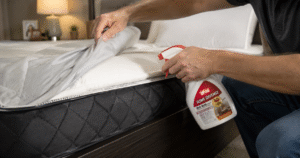
Only when the product label explicitly permits those applications. Essential oils can stain fabrics and damage certain finishes. Avoid spraying mattresses, pillows, bedding and other frequently contacted surfaces unless the manufacturer specifically allows it.
6. Do botanical spider sprays kill spiders on contact?
Some botanical insect-control sprays are designed to kill susceptible pests on direct contact, while others are marketed as repellents. Check the specific product label to determine whether it is intended to kill spiders, repel them or control other insects.
7. Can I make a homemade peppermint spider repellent?
You can prepare homemade essential oil mixtures, but their effectiveness is uncertain. Oils do not dissolve evenly in water, making their concentration inconsistent. Homemade mixtures also lack standardized application and safety directions. A properly labeled product is generally easier to use according to its intended purpose.
8. Why do spiders keep coming back after I spray?
Spiders may continue entering through gaps around windows and doors, or they may already be hiding in undisturbed areas. A spray may also lose its fragrance or have limited effectiveness against the particular species. Removing webs, sealing entry points and controlling insects can help address these underlying problems.
9. What is the most effective way to keep spiders out of my home naturally?
Start by sealing entry points, repairing window screens, removing webs and reducing clutter. Also address insects that provide food for spiders. These measures address common causes of spider activity without requiring frequent applications of essential oils.
10. Can natural spider repellents keep every type of spider away?
No. Spider species differ in their behavior, preferred habitats and responses to environmental conditions. A product that may discourage one species may have little effect on another. Identifying the spider and addressing the conditions attracting it are important parts of a suitable control plan.
Conclusion: Choosing a Natural Spider Repellent That Suits Your Home
Choosing a natural spider repellent starts with understanding what you want the product to accomplish. Peppermint-based sprays, cedarwood formulations and other botanical products offer different options, but their effectiveness and permitted uses vary.
Mighty Mint may appeal to homeowners who prefer peppermint, while Wondercide offers botanical alternatives with different formulations. STEM provides another spray format to investigate, and scented pouches may be convenient for suitable small storage areas.
Before purchasing, compare the product labels, check the intended spider-control applications and consider the safety requirements for your household. If you have pets or young children, take particular care with essential oils and avoid unnecessary exposure.
Most importantly, don’t rely on sprays alone. Sealing gaps, repairing screens, removing webs, reducing clutter and controlling insects can help address the reasons spiders enter your home in the first place.
With a combination of sensible prevention and carefully selected products, you can make your home less attractive to spiders while avoiding unnecessary treatments.