How to Get Rid of Cockroaches in Outlets, Clocks & Power Strips
Why Are German Cockroaches Hiding Around Your Electronics?
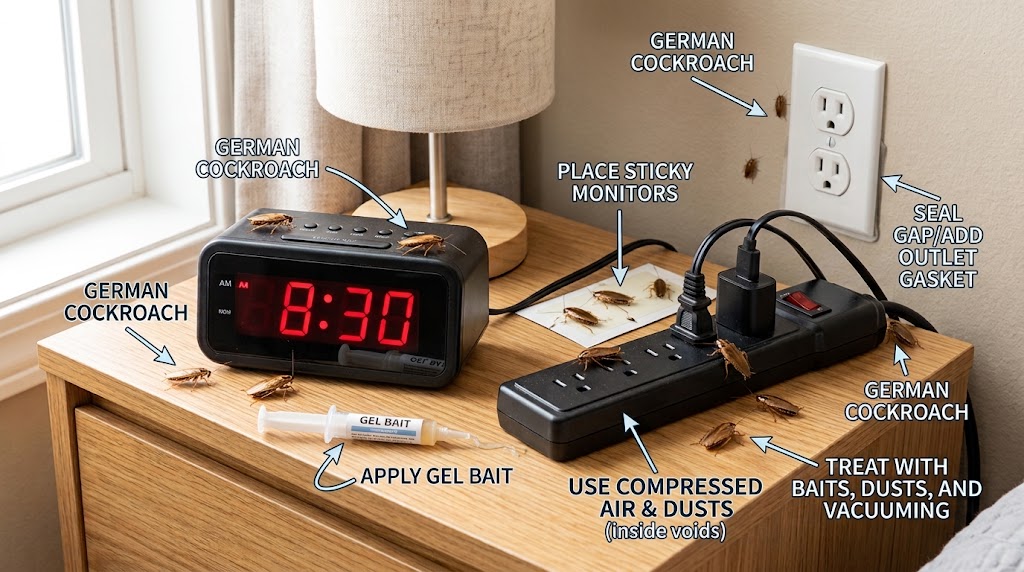
Imagine checking your digital alarm clock before bed when a small, light-brown cockroach suddenly darts behind it. You move the clock to investigate, only to spot another insect near the wall outlet. The following night, you notice movement around your phone base or the power strip beneath your desk.
If this sounds familiar, you may be wondering how German cockroaches found their way into places that seem to have nothing to eat.
The answer is that German cockroaches do not need food inside an electronic device to use it as a hiding place. Small openings, sheltered interiors, darkness, and warmth from some operating components can make clocks, phone bases, and other household equipment attractive places to investigate. Dust, crumbs, moisture, and clutter nearby can make the surrounding area even more appealing.
The bigger worry goes beyond the unpleasant surprise of spotting a cockroach nearby. Cockroaches hiding around electrical equipment can be difficult to reach, may contaminate internal components, and can continue appearing even after you clean the visible surfaces. Spraying insecticide into a device or applying loose powder inside an electrical outlet can create additional problems rather than solve the infestation. Fortunately, there are safer ways to tackle the problem.
In this complete guide, you will learn how to control German cockroaches around digital clocks, landline phone bases, wall outlets, and power strips; which pest control products may help; how to identify where the insects are coming from; and when to seek professional assistance.
Whether you have spotted one cockroach beside your bedside table or are repeatedly finding them around your home office, the key is to control the cockroaches around the equipment, monitor identify where the cockroaches are hiding and address the problem safely without putting yourself or your electrical equipment at risk.
Affiliate disclosure: Bug Off Control may earn a commission from qualifying purchases made through affiliate links, at no additional cost to you. Product information and recommendations are provided for informational purposes. Always check current product labels and manufacturer instructions before purchasing or using any treatment.
Top Products for Managing German Cockroaches Around Electronics
Use the right combination of cockroach baits, monitoring traps, and preventive measures to manage German cockroaches around electronics without damaging your devices or creating unnecessary electrical hazards.
| Product | Main Purpose | Where to Use It | Best For |
|---|---|---|---|
| Advion Cockroach Gel Bait | Attracts cockroaches to feed on the bait. | Small, label-approved application sites away from electrical components and device openings. | Targeted cockroach control |
| Combat Max Roach Bait Stations | Provides contained cockroach bait in a ready-to-use station. | Protected locations near desks, entertainment centers, and furniture, following label directions. | Convenient, contained bait placement |
| Catchmaster Insect Glue Boards | Captures crawling insects and helps reveal where cockroaches are active. | Along baseboards, beside desks, and near furniture where cockroaches travel. | Monitoring cockroach activity |
| Gentrol Point Source IGR | Helps disrupt cockroach development and reproduction. | Locations permitted by the product label, positioned according to its directions. | Supporting longer-term population control |
| Boric Acid Roach Powder | Kills cockroaches that contact or ingest the dust. | Only suitable, dry, label-approved treatment areas where the powder will not spread into electronics or become accessible to children or pets. | Targeted treatment in appropriate locations |
| Caulk for Suitable Gaps | Seals suitable cracks and gaps that cockroaches may use for shelter or access. | Appropriate non-electrical gaps around baseboards, furniture, and other building surfaces. | Reducing hiding places and entry routes |
Important safety tip: Never place gel bait, boric acid powder, or other insecticides inside electrical outlets, power strips, clocks, or electronic devices unless the product label explicitly permits that use. Keep bait stations and glue boards away from children and pets, and do not block ventilation openings or interfere with electrical equipment.
For the best results, combine appropriate bait placement with monitoring, good sanitation, moisture control, and sealing suitable gaps. Follow each product’s label for permitted locations, application methods, and precautions.
1. Why German Cockroaches Are Attracted to Small Electronics
German cockroaches (Blattella germanica) are small, fast-moving insects that prefer sheltered locations close to food and moisture. They commonly infest kitchens and bathrooms, but they can spread into bedrooms, offices, and entertainment areas. Small electronic devices may provide several useful hiding conditions.
Warmth from operating components
Some powered devices generate heat while operating. Although warmth alone does not prove that an item is infested, it can make certain sheltered spaces attractive to cockroaches.
Dark, protected spaces
The narrow gaps beneath a clock, the rear of a phone base, and the spaces behind furniture offer protection from light and everyday disturbance.
Small openings and narrow crevices
German cockroaches can squeeze into surprisingly small spaces. Gaps around equipment housings, cable openings, and nearby furniture can provide access to protected hiding places.
Nearby food and moisture
A bedside clock does not need to contain food for cockroaches to gather nearby. Crumbs on a desk, an uncovered drink, a leaking pipe, or food residue in another room may support the infestation.
An established infestation elsewhere
If cockroaches are appearing around several electronic devices, the source may be a nearby kitchen, bathroom, utility area, or wall cavity rather than the equipment itself.
Important: Spotting a cockroach near your electronics doesn’t necessarily mean it has made a home inside the device. Inspect the surrounding area and use monitoring traps to help determine where activity is concentrated.
2. How to Control German Cockroaches Around Digital Clocks
Digital alarm clocks, bedside displays, and small electronic clocks often sit undisturbed for long periods. If cockroaches can reach openings in the housing, they may use the interior as a hiding place.
Step 1: Disconnect a suspected infested clock
If you believe cockroaches are inside the clock, unplug it before moving it, provided the plug and equipment appear safe to handle. For battery-operated devices, remove the batteries if the manufacturer’s instructions permit. Do not open a powered device or insert tools into its casing.
Step 2: Inspect the nightstand and nearby wall
Move the clock to a clean, safe location and inspect:
- The back and underside of the nightstand.
- The gap between the furniture and the wall.
- The baseboard and floor beneath the clock.
- Nearby charging cables and cable openings.
- Any crumbs, paper clutter, or other debris.
Look for live insects, droppings, shed skins, and egg cases.
Step 3: Clean the exterior carefully
Clean the clock’s exterior according to the manufacturer’s instructions. Keep liquids away from vents, buttons, charging ports, and electrical connections. Do not spray insecticide into the display, ventilation openings, or battery compartment.
Step 4: Monitor the surrounding area
Place a Catch master glue board on the floor along the nearby baseboard or beside the nightstand. Keep it away from children, pets, and areas where people could step on it. Check the trap regularly. Repeated catches near the clock may indicate a travel route or hiding place that needs further investigation.
Step 5: Treat nearby cockroach hiding places
If activity continues, use an appropriate cockroach bait in a nearby location permitted by its label. Keep it away from the clock, its cables, and surfaces where people prepare food.
If cockroaches are emerging from inside the clock, keep the device disconnected and contact a qualified repair professional or replace the equipment if necessary.
Do not attempt to force cockroaches out by heating, freezing, spraying, or sealing an operating clock inside a plastic bag. These improvised methods can damage electronics and do not provide a dependable treatment.
3. How to Control German Cockroaches Around Landline Phone Bases
Landline phone bases and cordless handset cradles may remain plugged in throughout the day and night. Their housings can contain small openings and sheltered spaces that provide hiding places for cockroaches. The problem may also extend beyond the phone. Cluttered desks, wall gaps, and nearby food or moisture can sustain activity around the equipment.
Follow these steps
1. Disconnect the equipment safely.
Unplug the power adapter before cleaning or moving the phone base. Follow the manufacturer’s instructions when disconnecting telephone cables. If the equipment shows signs of electrical damage, do not handle it unnecessarily.
2. Inspect the desk and cable area.
Check the rear of the desk, the underside of the phone base, and the places where cables pass through furniture. Look for cockroach droppings, shed skins, and other signs of activity.
3. Remove nearby attractants.
Clear away food wrappers, crumbs, paper clutter, and unnecessary cardboard. Wipe suitable hard surfaces without allowing liquid to enter the phone or its connections.
4. Set monitoring traps nearby.
Place glue boards along the wall or behind the desk, where they can remain undisturbed. Avoid placing them directly on the phone base or where adhesive could contact cables.
5. Use targeted bait where permitted.
A suitable cockroach bait may be placed in an approved crack or crevice near the hiding area. Do not put gel bait inside the phone, its cradle, or a charging connection.
What if cockroaches are inside the phone base?
Keep the device disconnected and arrange an inspection by the manufacturer or a qualified electronics repair professional. Cockroach contamination can sometimes interfere with electrical connections or components.
Spraying alcohol or insecticide into the housing, using a hair dryer, or attempting to flush the insects out may cause damage. If the phone develops unusual faults, visible contamination, or a burning smell, do not reconnect it until its safety has been assessed.
4. How to Control German Cockroaches Around Wall Outlets
Wall outlets require special care because the spaces around electrical boxes may connect to wall cavities or provide access through gaps around cables and fittings.
German cockroaches can sometimes move through these structural openings. In apartment buildings, activity may also be associated with shared utility spaces or neighboring units. However, an outlet is not necessarily a nest, and cockroaches do not need to travel through electrical wiring itself to reach a room.
Step 1: Check for activity around the outlet
Look at the surrounding wall, baseboard, and nearby furniture. Note whether cockroaches appear only occasionally or repeatedly emerge from the same opening. Do not remove the faceplate to investigate.
Step 2: Place a monitoring trap nearby
A glue board along the nearby baseboard can help reveal whether cockroaches are traveling along that wall. Keep the trap away from the outlet itself, electrical cables, children, pets, and foot traffic.
Step 3: Treat the wider cockroach problem
If you suspect an infestation, inspect the kitchen, bathroom, and other areas where food and moisture are available. Use an appropriate bait in nearby, label-approved locations that are separate from electrical components. Do not apply gel bait or loose powder inside the outlet box.
Step 4: Have suspected entry points assessed
If cockroaches repeatedly appear to emerge from an outlet, contact a qualified pest management professional. An electrician should assess any electrical defect or opening around the fitting that requires repair. Do not inject boric acid into the wall outlet, remove the cover to apply pesticide, or seal the fitting with ordinary caulk without an appropriate assessment.
When is an outlet an electrical safety concern?
Seek qualified electrical assistance if you notice:
- A burning smell or unusual heat.
- Buzzing, sparks, or scorch marks.
- A loose or damaged outlet.
- Repeated electrical interruptions or visible contamination.
If there is smoke, sparking, or an immediate fire hazard, keep away and seek emergency assistance as appropriate.
5. How to Control German Cockroaches Around Power Strips and Surge Protectors
Power strips are frequently placed behind desks, under beds, and beneath entertainment centers. Unfortunately, these locations can also accumulate dust, crumbs, and clutter.
Cockroaches may hide behind the power strip or, if openings allow access, inside its casing. Because power strips contain electrical components, suspected internal infestations require a cautious approach.
Step 1: Disconnect the power strip if safe
If the plug and equipment appear safe to handle, disconnect the power strip from the wall before moving it. If there are signs of electrical damage, unusual heat, or sparking, keep away and obtain qualified assistance.
Step 2: Inspect the surrounding area
Check beneath the desk, behind nearby furniture, and along the baseboard. Look for droppings, shed skins, and cockroach activity around cables and other hiding places.
Step 3: Clean the floor and furniture
Remove crumbs, dust, hair, food wrappers, and unnecessary cardboard. Clean exterior surfaces according to the manufacturer’s instructions, keeping moisture away from electrical equipment.
Step 4: Place traps along travel routes
Position glue boards on the floor beside the desk or along the baseboard near the power strip. Do not place them where they could interfere with cables or create a trip hazard.
Step 5: Improve the surrounding setup
Keep the area uncluttered and the floor free of food debris. If the manufacturer’s instructions permit, secure the power strip in an accessible position away from floor debris. Do not obstruct ventilation openings or place an operating power strip inside an enclosed container that could trap heat.
Step 6: Replace equipment that may be contaminated
If cockroaches are emerging from inside the power strip, or you suspect internal contamination or damage, stop using it and arrange appropriate inspection or replacement.
Do not open the casing, spray insecticide into the vents, or reconnect the device to test whether it still works.
6. The Hidden Risk: Cockroaches and Electronic Damage
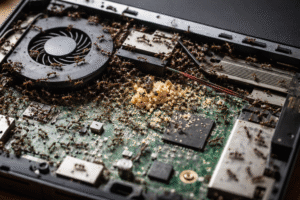
German cockroaches can cause more than an unpleasant surprise. Their presence inside electrical equipment may contribute to contamination and equipment failure. Potential problems include:
- Contamination: Droppings, shed skins, and dead insects can accumulate inside equipment.
- Electrical malfunction: Insects or debris may interfere with components and, under some circumstances, contribute to electrical faults.
- Component damage: Internal contamination may affect connections and other sensitive parts.
- Recurring activity: Cockroaches may return if the surrounding infestation remains uncontrolled.
Not every sighting leads to damage, and a cockroach near a device does not automatically mean its internal components are affected. Nevertheless, repeated activity inside an electronic item deserves attention. If you suspect internal contamination, disconnect the equipment when safe and consult a qualified repair professional or the manufacturer.
7. Choose the Right Treatment Based on the Level of Activity
The following plan helps you decide what to do next. These levels are practical guidelines, not a scientific measure of infestation size.
🟢 Light activity: Occasional sightings
What you notice: One or two cockroaches near a clock, phone base, or power strip, with no confirmed evidence of insects inside the device.
What to do:
- Clean the surrounding furniture and floor.
- Remove food debris, open food containers, and unnecessary clutter.
- Place glue boards along nearby walls and furniture edges.
- Inspect nearby kitchens, bathrooms, and other potential sources.
- Check the traps regularly to see whether activity continues.
Do not assume the problem is solved simply because you no longer see cockroaches during the day.
🟡 Moderate activity: Repeated sightings
What you notice: Cockroaches appear several times a week, traps catch multiple insects, or droppings and shed skins are present.
What to do:
- Inspect the entire room and adjacent areas.
- Use a suitable gel bait or contained bait station according to its label.
- Consider an appropriate insect growth regulator, if permitted by its label.
- Continue monitoring with glue boards.
- Eliminate accessible food and moisture sources.
- In a shared building, notify the property manager if activity may involve adjoining units.
Baits and insect growth regulators serve different purposes. Baits target feeding cockroaches, while growth regulators interfere with development or reproduction. Neither replaces sanitation and monitoring.
🔴 Heavy activity: Multiple sightings or suspected internal infestation
What you notice: Numerous cockroaches, repeated daytime sightings, activity in several rooms, or insects emerging from electrical equipment.
What to do:
- Stop using suspect equipment and disconnect it when safe.
- Avoid applying pesticides inside devices or electrical boxes.
- Arrange appropriate inspection or replacement of contaminated equipment.
- Seek professional cockroach control throughout the affected areas.
- Investigate structural entry points and possible neighboring-unit sources.
- Continue monitoring after treatment to assess whether activity declines.
When German cockroaches are established in several locations, treating only the bedroom or office may leave the main infestation untouched.
8. Six Products That Can Support Cockroach Control Around Electronics
These products have different purposes. Choose based on the location of the cockroach activity, the product label, and the safety of the surrounding area rather than assuming that one product will solve every infestation.
1. Advion Cockroach Gel Bait 4.6  ☆
☆
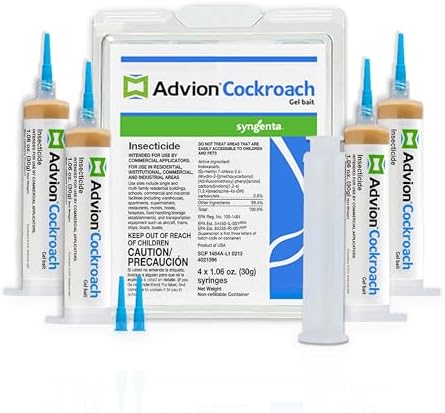
Best for: Targeted baiting in permitted locations.
Advion gel bait is designed to attract feeding cockroaches. It may be useful in suitable cracks and crevices near hiding places, provided the label permits that use.
Keep it away from exposed electrical components, food-contact surfaces, and places where children or pets could encounter it. Do not apply it inside electronics.
Check Latest Price & Availability on Amazon
2. Combat Max Roach Killing Bait Stations 4.3 ☆

Best for: Convenient, contained bait placement.
Bait stations provide cockroach bait in a contained format. Place them only in suitable locations specified by the label, where children and pets cannot access them.
Do not put bait stations inside a bag with an electronic device. This is not a reliable or established method for extracting cockroaches from equipment.
Check Latest Price & Availability on Amazon
3. Catchmaster Insect Glue Boards 4.4 ☆

Best for: Monitoring and capturing crawling cockroaches.
Glue boards help identify where cockroaches are moving and whether their numbers appear to be declining.
Place them along baseboards, behind furniture, or near suspected travel routes. They capture insects that contact the adhesive but do not eliminate an established infestation by themselves.
Check Latest Price & Availability on Amazon
4. Gentrol Point Source Insect Growth Regulator 4.5 ☆
Best for: Supporting longer-te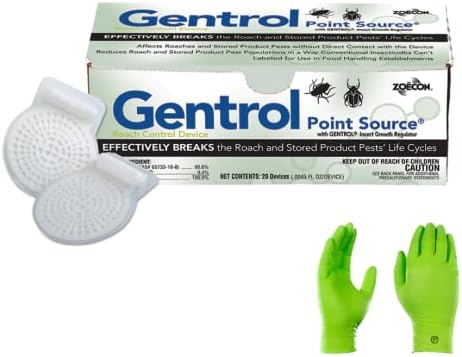 rm population management.
An insect growth regulator interferes with cockroach development and reproduction. It is not an instant-kill product, and its effectiveness depends on appropriate use and placement.
Follow the product label and do not assume its release mechanism will safely or reliably treat insects inside electronic equipment.
Check Latest Price & Availability on Amazon
5. Boric Acid Roach Powder 4.3 ☆

Best for: Suitable dry treatment sites allowed by the label.
Boric acid products can kill cockroaches that encounter an effective application. Loose dust, however, can present exposure risks if inhaled or spread onto accessible surfaces.
Never inject boric acid into an electrical outlet, switch box, power strip, clock, or phone base. Use only permitted application sites and methods.
Check Latest Price & Availability on Amazon
6. Caulk for Suitable Non-Electrical Gaps 4.3 ☆

Best for: Reducing access through appropriate cracks.
Caulk may help close suitable gaps around baseboards and other non-electrical areas after the purpose of the opening has been assessed.
Do not block ventilation openings, cover a damaged electrical fitting, or seal a suspected electrical defect without appropriate professional assessment.
Check Latest Price & Availability on Amazon
9. Essential Safety Rules for Cockroach Control Around Electronics
A successful treatment should protect your home and equipment without introducing unnecessary risks.
- Never spray liquid insecticides into electronic equipment. Liquids and aerosols can damage components and create electrical hazards.
- Never inject loose powder or gel bait into outlet boxes. Use pesticides only in locations permitted by their labels.
- Never remove an outlet faceplate to apply pesticide. Leave electrical work to a qualified professional.
- Avoid using foggers as a substitute for targeted treatment. Foggers may leave residues and may not reach hidden cockroaches.
- Do not freeze electronic devices to kill cockroaches. Condensation during temperature changes can damage internal components.
- Do not dismantle powered equipment. Disconnect suspect devices when safe and seek appropriate inspection.
- Follow every pesticide label. Observe its placement instructions, precautions, and restrictions.
- Protect children and pets. Keep traps and pesticides inaccessible, and store products securely.
- Do not reconnect suspect equipment simply because it looks clean. Internal damage may not be visible.
The safest approach is to treat the cockroaches in their surrounding environment while leaving electrical components free from improvised pesticide applications.
10. Frequently Asked Questions
1. Why do German cockroaches hide inside digital clocks?
Digital clocks may offer dark, sheltered spaces and warmth from operating components. Cockroaches may also hide behind the clock rather than inside it. Inspect nearby furniture, floor edges, and wall gaps to locate their travel routes.
2. Can German cockroaches live inside landline phone bases?
Yes, they may shelter inside a phone base if openings provide access. If you suspect an internal infestation, disconnect the device and arrange appropriate inspection instead of spraying into the casing.
3. How do cockroaches get into wall outlets?
Cockroaches may enter through gaps around electrical boxes, cable openings, or connected wall cavities. Repeated sightings around an outlet warrant monitoring and, when necessary, assessment by a qualified pest management professional and electrician.
4. Should I spray insecticide into a power strip?
No. Spraying into a power strip can damage components and create electrical hazards. Disconnect suspect equipment when safe, avoid opening its casing, and address the surrounding cockroach infestation.
5. Will glue boards eliminate a German cockroach infestation?
Glue boards are useful for capturing individual insects and monitoring activity. However, they rarely eliminate an established infestation alone. Combine monitoring with sanitation, suitable baiting, and a broader control plan.
6. Can I use gel bait near an electrical outlet?
You may be able to use gel bait in a nearby, label-approved location if it can be kept away from electrical components and accessible surfaces. Never apply it inside an outlet or electrical box.
7. Is boric acid safe to put inside a wall outlet?
No. Do not inject or dust boric acid into an electrical outlet box. Use only label-approved application sites away from electrical components, or contact a qualified professional.
8. What should I do if cockroaches come out of my power strip?
If you can do so safely, disconnect the power strip and stop using it. Do not spray or dismantle it. Arrange appropriate inspection or replacement, and treat the surrounding cockroach infestation using label-approved methods.
9. Why do cockroaches keep returning after I clean my bedroom?
Cleaning removes food debris and other attractants, but it may not eliminate hidden insects or their access routes. Check nearby kitchens, bathrooms, furniture, and structural gaps. In shared buildings, cockroaches may also be entering from adjoining areas.
10. When should I call a pest control professional?
Seek professional help when sightings are frequent, several rooms are affected, traps continue catching cockroaches, or insects appear to be emerging from electrical equipment. A professional can assess the infestation and recommend a coordinated treatment plan.
Related Guides: Protect Other Areas of Your Home
German cockroaches rarely limit themselves to one device when suitable hiding places are available elsewhere. Explore these related Bug Off Control guides to learn how to protect other household equipment.
- The Complete Guide to Pests in Home Electronics — Learn why insects enter electronic equipment and how to reduce the conditions that attract them.
- How to Protect Routers, Modems, Computers, and Laptops from German Cockroaches — Discover prevention and control measures for computers and network equipment.
- German Cockroach Control Around TVs, Cable Boxes, and Speakers — Learn how to manage cockroach activity around entertainment systems.
- How to Get German Cockroaches Out of a Microwave — Understand the safety concerns associated with suspected cockroach activity inside kitchen appliances.
- How to Get German Cockroaches Out of a Gaming Console — Find out what to do when insects may be hiding inside a console.
Conclusion: Keep German Cockroaches Away from Your Electronics
Finding German cockroaches around your digital clock, landline phone base, wall outlet, or power strip can be frustrating. The good news is that you do not need to risk damaging your equipment by spraying insecticide into it or applying loose powders around electrical connections.
Start by inspecting the surrounding area, removing crumbs and clutter, and placing glue boards along likely cockroach travel routes. If activity continues, use suitable cockroach bait in label-approved locations and investigate other areas of your home that may be supporting the infestation.
If insects are entering an electronic device, disconnect it when safe and arrange appropriate inspection or replacement. If they repeatedly appear around outlets or multiple devices, seek professional help to investigate the wider infestation and any potential electrical concerns.
Most importantly, remember that lasting cockroach control means addressing the hiding places, food sources, moisture, and entry routes around your equipment—not putting pesticides inside the equipment itself.
With careful monitoring, targeted treatment, and sensible prevention, you can reduce German cockroach activity, protect your household electronics, and make your home less inviting to these persistent pests.