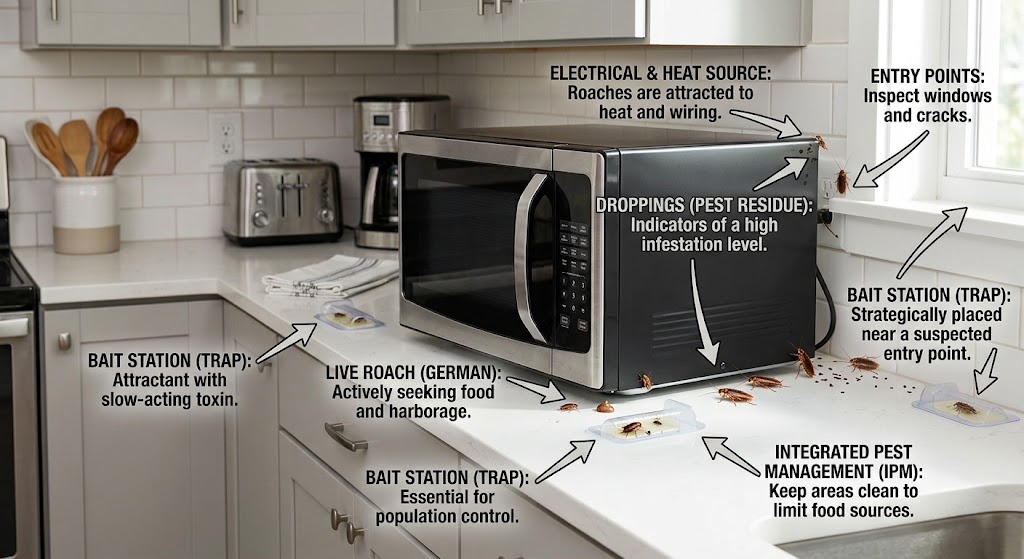
How to Get Rid of German Cockroaches in a Microwave
Finding German cockroaches around your microwave can be a frustrating surprise. You may wipe down the counters, clean up after meals, and still notice a small roach disappearing behind the appliance when the kitchen gets quiet.
The good news is that you don’t need to spray the inside of your microwave to deal with the problem. German cockroaches are attracted to warm, dark, protected spaces, and the area around a microwave can provide several of those conditions. Food crumbs, grease, moisture, and small gaps around appliances can make the kitchen even more appealing.
The important part is knowing where to treat and where not to treat.You should never spray insecticide into the microwave’s cooking cavity, electrical components, control panel, or ventilation openings. Instead, clean the appliance and surrounding area, remove food sources, use appropriately labeled cockroach bait around the microwave, and monitor activity with glue traps.
This guide explains how to get rid of German cockroaches in and around a microwave, whether you have noticed one or two roaches or you’re dealing with a larger kitchen infestation.
Quick Answer: How Do You Get Rid of German Cockroaches in a Microwave?
To control German cockroaches around a microwave:
- Unplug the microwave before moving or cleaning around it.
- Remove food crumbs, grease, and other attractants.
- Clean the microwave and the countertop underneath and around it.
- Vacuum accessible exterior areas and nearby cracks.
- Place appropriately labeled German cockroach gel bait around the microwave, not inside the cooking chamber or electrical housing.
- Use glue boards to monitor activity.
- Inspect nearby cabinets, the sink, refrigerator, dishwasher, stove, and other appliances.
- Reduce moisture and eliminate food sources.
- Increase the treatment area if you continue finding roaches.
- Consider professional pest control if the infestation is widespread or persistent.
The goal is not to spray the microwave. The goal is to control the cockroaches using the areas surrounding the appliance.
Affiliate Disclosure
This article may contain affiliate links. If you purchase a product through one of these links, Bug Off Control may earn a commission at no additional cost to you.
As an Amazon Associate, Bug Off Control earns from qualifying purchases.
German Cockroach Microwave Control Kit
Before choosing products, determine how much activity you’re seeing.
German Cockroach Infestation Levels
Moderate Infestation🟡Repeated sightings, small nymphs, droppings, or regular nighttime activity. Expand baiting and monitoring beyond the microwave and inspect surrounding appliances, cabinets, plumbing areas, and other potential hiding places.
These levels are practical guidelines rather than exact population counts. A few sightings can still indicate that more cockroaches are hiding nearby.
German Cockroach Infestation Levels
Use these practical levels to help determine how broadly you should approach German cockroach control around your microwave and throughout the kitchen.
| Infestation Level | Color | Signs You May Notice | Recommended Approach |
|---|---|---|---|
| Light Infestation | 🟢 | An occasional German cockroach or isolated sightings around the microwave. | Thoroughly clean the area, remove food sources, place appropriately labeled cockroach bait, use monitoring traps, and inspect nearby areas for additional activity. |
| Moderate Infestation | 🟡 | Repeated sightings, small nymphs, droppings, or regular nighttime activity. | Expand baiting and monitoring beyond the microwave. Inspect nearby appliances, cabinets, plumbing areas, and other potential hiding places throughout the kitchen. |
| Severe Infestation | 🔴 | Numerous cockroaches, daytime sightings, many nymphs, or activity across multiple kitchen areas. | Address the infestation throughout the kitchen, strengthen monitoring and control measures, and consider professional pest-control assistance if activity continues. |
Important: These levels are practical guidelines, not exact population measurements. Even a small number of German cockroaches can indicate that others may be hiding nearby.
German Cockroach Infestation Levels
Use these practical levels to help determine how broadly you should approach German cockroach control around your microwave and throughout the kitchen.
Important: These levels are practical guidelines, not exact population measurements. Even a small number of German cockroaches can indicate that others may be hiding nearby.
What You Need to Control German Cockroaches Around a Microwave
You don’t need a huge collection of products to get started.
Basic Control Supplies
- German cockroach gel bait
- Glue boards or sticky monitors
- Vacuum with a crevice attachment
- Kitchen cleaner or degreaser
- Hot, soapy water
- Disposable gloves
- Bait cards or another suitable bait-placement method
- Sealed food-storage containers
- An appropriately labeled insect growth regulator, when useful
Optional Products for Larger Infestations
Depending on the situation, you may also use:
- Additional cockroach bait placements
- Additional monitoring traps
- An appropriately labeled insecticidal dust for suitable cracks and crevices
- An IGR used according to its label
Always read the pesticide label before use. A product should only be used in locations and amounts permitted by its label.
Why German Cockroaches Hide Around Microwaves
German cockroaches are not necessarily interested in the microwave because it is a microwave. They’re interested in what the appliance and its surroundings can provide. The area around a microwave can offer:
- Warmth
- Darkness
- Protection
- Small gaps
- Food particles
- Grease
- Moisture nearby
- Easy access to the rest of the kitchen
Cockroaches may hide around appliance components and other protected areas where they are difficult to reach directly. That is why trying to spray into the appliance isn’t a good solution.
Important: Don’t Spray Inside the Microwave
This is one of the most important parts of controlling cockroaches around a microwave.
Do not spray insecticide into:
- The cooking cavity
- Electrical components
- The control panel
- Internal ventilation openings
- Air openings
- Food-contact surfaces
Liquid insecticide can damage the appliance and may leave unwanted chemical residue. The source material specifically warns against spraying liquid insecticide inside the microwave and recommends using bait outside the appliance instead.
If you believe cockroaches have established themselves deep inside the appliance, don’t remove the casing yourself. Microwaves contain components that can create serious electrical hazards.
Step 1: Unplug and Clean the Microwave
Before moving or cleaning around a countertop microwave, disconnect it from the electrical outlet.
Remove the:
- Glass turntable
- Roller ring
- Food debris
- Grease buildup
- Other removable parts that can be safely cleaned
Wash removable parts with hot, soapy water and clean the cooking chamber according to the manufacturer’s instructions. Then clean the exterior. Pay particular attention to grease and food residue because these can provide attractants for cockroaches.
Step 2: Clean Under and Behind the Microwave
This step is easy to overlook. If you have a countertop microwave, carefully move it after unplugging it and clean the surface underneath. Look for:
- Crumbs
- Grease
- Food particles
- Droppings
- Dead insects
- Egg cases
- Moisture
- Gaps
Clean the wall and countertop behind the microwave as well. Once everything is clean, the area becomes much easier to monitor.
Step 3: Vacuum Accessible Areas
Use a vacuum with a narrow crevice attachment to remove loose debris from accessible areas around the appliance. Concentrate on:
- Underneath the microwave
- Behind the microwave
- Around the countertop
- Along wall and cabinet gaps
- Around accessible exterior ventilation areas
The source recommends vacuuming accessible exterior vents and surrounding areas to remove debris, dead roaches, and accessible egg cases.
Do not insert a vacuum attachment into electrical openings or take the microwave apart.
Step 4: Place German Cockroach Gel Bait Around the Microwave
Now you can begin targeting the cockroaches themselves. A properly labeled cockroach gel bait can be placed around the microwave, where roaches are likely to travel. One practical method described in the source is placing small bait placements on index cards or small pieces of cardboard and positioning them beneath, behind, or beside the appliance.
Good Bait Locations May Include:
- Behind the microwave
- Under the microwave
- Beside the microwave
- Near nearby cabinet gaps
- Along suitable cracks and crevices
- Near areas where roach activity has been observed
Keep bait away from food-contact surfaces and always follow the product label.
Why Small Bait Placements Matter
You don’t need to cover the area with bait. Small, properly positioned placements are generally more appropriate than large amounts scattered everywhere. The goal is to put the bait where cockroaches are likely to encounter it.
Step 5: Add Glue Boards
Glue boards serve two important purposes:
- They can capture some wandering cockroaches.
- They help you determine whether activity is increasing or decreasing.
Place monitors around the microwave rather than inside it.
Good locations may include:
- Behind the microwave
- Beside the microwave
- Under the front edge
- Near nearby cabinets
- Along suspected travel routes
Check them regularly.
If one area repeatedly catches roaches while another remains empty, you’ve gained useful information about where activity is concentrated.
🟢 Light German Cockroach Infestation Kit
A 🟢 light infestation may involve an occasional German cockroach around the microwave with little or no evidence of widespread kitchen activity.
🟢 Light Kit
Start with:
- Cockroach gel bait
- 2–4 glue boards
- Vacuum
- Kitchen cleaner or degreaser
- Bait cards or another label-approved bait placement method
- Sealed food-storage containers
Light Infestation Treatment
1. Clean the microwave thoroughly.
Remove food and grease.
2. Clean underneath and behind it.
Remove crumbs and debris.
3. Place bait around the appliance.
Keep pesticide outside the microwave.
4. Add glue boards.
Monitor the microwave and nearby kitchen areas.
5. Check for additional activity.
Look under the sink, around cabinets, behind the refrigerator, and around other appliances.
6. Keep monitoring.
Don’t assume the problem is gone simply because you haven’t seen a roach for a day or two.
🟡 Moderate German Cockroach Infestation Kit
A 🟡 moderate infestation may involve repeated sightings, nymphs, droppings, or regular nighttime activity.
At this point, treating only the microwave is usually not enough.
🟡 Moderate Kit
Consider using:
- Multiple cockroach gel-bait placements
- Several glue boards
- Vacuum
- Kitchen degreaser
- Moisture-control measures
- An appropriately labeled IGR if appropriate
- Additional bait placements around nearby kitchen harborage areas
Moderate Infestation Treatment
1. Treat the Microwave Area
Clean and bait around the appliance.
2. Expand Monitoring
Add glue boards around:
- The refrigerator
- Sink cabinet
- Dishwasher
- Stove
- Kitchen cabinets
3. Inspect Hiding Places
Look carefully at:
- Cabinet corners
- Hinges
- Plumbing openings
- Wall gaps
- Appliance spaces
- Baseboards
4. Reduce Moisture
Repair leaking pipes and faucets.
Dry wet areas when possible.
5. Remove Food Sources
Keep food sealed and clean crumbs and spills promptly.
6. Continue Monitoring
If traps continue catching roaches, don’t simply add more and more bait to the microwave. Expand your inspection and treatment area.
🔴 Severe German Cockroach Infestation Kit
A 🔴 severe infestation may involve numerous cockroaches, daytime sightings, large numbers of nymphs, or activity across several areas of the kitchen.
At this point, the microwave should be considered one part of a larger infestation.
🔴 Severe Kit
You may need:
- Multiple appropriately labeled gel-bait placements
- Multiple glue boards
- Thorough sanitation
- Vacuuming
- Moisture control
- Treatment of suitable cracks and crevices
- An appropriately labeled IGR
- Professional pest-control assistance when necessary
Severe Infestation Treatment
Inspect the entire kitchen. Pay particular attention to:
- Refrigerator
- Stove
- Dishwasher
- Microwave
- Sink cabinet
- Kitchen cabinets
- Pantry
- Plumbing penetrations
- Baseboards
- Wall gaps
- Other warm appliances
The source material recommends expanding treatment to surrounding kitchen areas because German cockroaches may move between appliances and other protected locations.
What If Cockroaches Are Coming Out of the Microwave at Night?
Don’t panic—and don’t reach for the spray can.
Nighttime activity can make cockroaches much easier to detect because they are often more active when the kitchen is quiet.
Instead:
- Keep the microwave unplugged if you need to move or clean around it.
- Clean food and grease from the surrounding area.
- Place glue boards nearby.
- Use appropriately labeled bait outside the appliance.
- Inspect nearby cabinets and appliances.
- Monitor activity over time.
If you continue seeing substantial activity, expand the treatment beyond the microwave.
What If You Have a Countertop Microwave?
Countertop microwaves are relatively easy to inspect because you can usually access the area underneath and behind the appliance.
After unplugging it:
- Move the microwave carefully.
- Clean the countertop underneath.
- Clean behind the appliance.
- Inspect accessible exterior areas.
- Place monitoring traps nearby.
- Position bait around the appliance according to its label.
- Inspect surrounding cabinets and appliances.
Don’t place pesticide inside the microwave itself.
What If You Have an Over-the-Range Microwave?
Over-the-range microwaves require a slightly different approach because they are mounted above the stove and may be exposed to cooking grease and steam.
Inspect the surrounding:
- Cabinets
- Wall gaps
- Vent area
- Stove area
- Grease-filter area
- Nearby plumbing and appliance spaces
If the unit has removable grease filters, clean them according to the manufacturer’s instructions. Do not spray insecticide into the ventilation system, electrical components, or other internal areas. Instead, concentrate your control efforts on suitable surrounding areas where cockroaches travel and hide.
Should You Run the Microwave Empty to Kill Cockroaches?
No. Running a microwave empty is not a dependable cockroach-control method. Cockroaches hiding in protected areas of the appliance may not be exposed in the way you expect. The source material specifically notes that running the microwave empty will not reliably kill roaches hiding in protected electronics areas. Cleaning, monitoring, baiting, and treating the surrounding kitchen are better parts of a control strategy.
Can You Put Roach Bait Inside a Microwave?
It’s better to keep pesticide products out of the cooking cavity and electrical components. Instead, place an appropriately labeled cockroach bait around the microwave, such as under, behind, or beside the appliance where permitted by the product label This lets you target roaches as they travel without putting pesticide where food is prepared or heated.
Can Diatomaceous Earth Be Used Around a Microwave?
Some pest-control approaches use dust products around appliances and in suitable cracks and crevices. However, dust should not be blown into the microwave’s electrical housing, cooking cavity, or ventilation openings. If using a dust product, make sure it is labeled for the intended pest and application site, and follow all label directions.
The source material describes dust treatment for suitable surrounding cracks and crevices while emphasizing keeping it away from microwave air-intake areas.
Should You Use an Insect Growth Regulator?
An insect growth regulator, or IGR, can be part of a broader German cockroach management program. IGRs work differently from conventional cockroach baits by interfering with cockroach development and reproduction. However, the specific product label determines where and how the product can be used.
Do not assume an IGR should be placed inside a microwave or its electrical housing.
Use it only in areas and according to directions specified on the product label.
Don’t Treat the Microwave and Ignore the Kitchen
This is one of the biggest mistakes you can make. If German cockroaches are living around the microwave, they may also be hiding elsewhere. Inspect:
Refrigerator
Check underneath, behind, and around accessible areas.
Kitchen Sink
Look for leaks, moisture, and gaps around pipes.
Cabinets
Inspect corners, hinges, cracks, and dark spaces.
Dishwasher
Look for moisture and food residue around the surrounding area.
Stove
Check underneath and around the appliance for grease and food debris.
Pantry
Look for open food packages, crumbs, and hidden activity. The goal is to make the entire kitchen less attractive—not simply to make one appliance less attractive.
How to Prevent German Cockroaches From Returning
Once activity begins to decline, prevention becomes important.
Keep Food Sealed
Store food in containers with tight-fitting lids.
Clean Crumbs Quickly
Even small crumbs can become food for pests.
Control Grease
Clean cooking surfaces and areas around appliances regularly.
Fix Leaks
Don’t ignore small plumbing leaks.
Keep the Area Dry
Reduce standing water and unnecessary moisture.
Reduce Clutter
Avoid giving cockroaches additional dark hiding places.
Monitor Regularly
Glue boards can help you detect renewed activity before it becomes obvious.
Signs Your German Cockroach Problem May Be Getting Worse
Watch for:
- Increasing numbers of roaches
- More frequent nighttime sightings
- Small nymphs
- Droppings
- Egg cases
- Roaches appearing during daylight
- Activity in multiple kitchen areas
- Increasing numbers of roaches on monitoring traps
Daytime sightings can be particularly useful as a warning that the infestation may be more established. If activity is spreading, expand the inspection instead of continuing to focus only on the microwave.
Common Mistakes to Avoid
❌ Spraying Insecticide Inside the Microwave
This can damage the appliance and create unwanted chemical contamination.
❌ Spraying Into Vents
Don’t use the vents as an entry point for liquid insecticide.
❌ Taking the Microwave Apart
Microwave components can create serious electrical hazards.
❌ Putting Pesticide on Food-Contact Surfaces
Keep pesticides away from areas where food is prepared or heated.
❌ Using Excessive Amounts of Bait
More bait does not automatically mean better control. Follow the product label.
❌ Treating Only the Microwave
The surrounding kitchen may contain additional cockroach hiding places.
❌ Ignoring Moisture
Water can help sustain cockroach activity even when food is well controlled.
❌ Relying Only on Glue Traps
Glue boards are valuable monitoring tools, but a larger infestation may require a broader control strategy.
How Long Does It Take to Get Rid of German Cockroaches Around a Microwave?
There isn’t one exact timeline.
A small number of wandering cockroaches may be easier to manage than an established population spread throughout the kitchen. Instead of expecting an immediate result, monitor the situation. Check your glue boards regularly and look for changes in:
- Number of roaches
- Size of roaches
- Location of activity
- Frequency of sightings
A gradual reduction in activity is more useful than judging the treatment by one night’s observations.
When Should You Call a Pest-Control Professional?
Professional help may be appropriate when:
- Roaches are appearing throughout the kitchen
- You are seeing them during the day
- There are many nymphs
- Activity continues despite consistent control efforts
- Roaches are present in several rooms
- The infestation has continued for an extended period
- You are uncomfortable treating the problem yourself
A professional can inspect areas that are difficult to reach and develop a treatment plan for a larger infestation.
Frequently Asked Questions About German Cockroaches in Microwaves
1. Can German cockroaches live inside a microwave?
German cockroaches can hide in protected areas around appliances, including areas associated with the appliance’s electronics and vents. However, you should not attempt to spray inside those areas. Treat and monitor the surrounding spaces instead.
2. How do I get German cockroaches out of my microwave?
Clean the microwave and surrounding area, remove food and grease, vacuum accessible exterior areas, place appropriately labeled cockroach bait around the appliance, and use glue boards to monitor activity.
3. Can I spray Raid inside my microwave?
No. Do not spray household insecticide into the microwave’s cooking chamber, vents, control panel, or electrical housing.
4. Will running my microwave empty kill cockroaches?
No. Running an empty microwave isn’t a reliable method for controlling cockroaches hiding in protected areas.
5. Where should I put roach bait near my microwave?
Depending on the product label, bait may be placed under, behind, or beside the microwave in areas where cockroaches travel. Keep it away from food-contact surfaces. Also keep baits out of the reach of children and pets
6. Should I put glue traps inside my microwave?
No. Place glue boards outside the appliance to monitor cockroach activity around it.
7. Why am I seeing baby cockroaches near my microwave?
Small nymphs can indicate that a breeding population is nearby. Inspect the microwave area as well as cabinets, appliances, plumbing areas, and other protected kitchen locations.
8. What should I do if cockroaches are coming out of my microwave?
Don’t spray into the appliance. Clean the surrounding area, place monitoring traps, use appropriately labeled bait outside the appliance, and inspect the rest of the kitchen.
9. Do I need to treat other appliances?
If German cockroach activity continues, inspect other appliances and nearby areas. Refrigerators, stoves, dishwashers, cabinets, and sink areas can provide additional hiding places.
10. When should I hire a professional?
Consider professional treatment if the infestation is widespread, daytime activity is occurring, numerous nymphs are present, or the problem continues despite a consistent control program.
Final Thoughts
German cockroaches around a microwave can make an otherwise clean kitchen feel uncomfortable, but the solution isn’t to spray the appliance. The safer and more practical approach is to control the environment around the microwave
Start by removing food and grease, cleaning underneath and behind the appliance, vacuuming accessible areas, and using glue boards to discover where activity is occurring. Then use an appropriately labeled cockroach bait around the appliance and expand the treatment when signs point to a larger infestation.
Think of the three levels this way:
🟢 Light: Clean, bait, and monitor.
🟡 Moderate: Expand baiting and monitoring into the surrounding kitchen.
🔴 Severe: Treat the problem as a wider kitchen infestation and consider professional pest-control assistance.
Most importantly, don’t put insecticide inside the microwave. Keep pesticides away from the cooking cavity, food-contact surfaces, electrical components, and ventilation openings.
With the right combination of sanitation, monitoring, baiting, moisture control, and attention to the surrounding kitchen, you can take a much more targeted approach to German cockroach control without putting your microwave at unnecessary risk.