How to Get Rid of German Cockroaches in a Coffee Maker
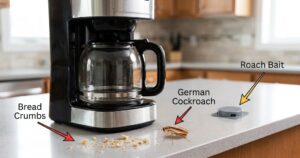
Found a German cockroach crawling around your coffee maker? You’re definitely not alone—and before you decide your coffee maker has to go in the trash, take a breath.
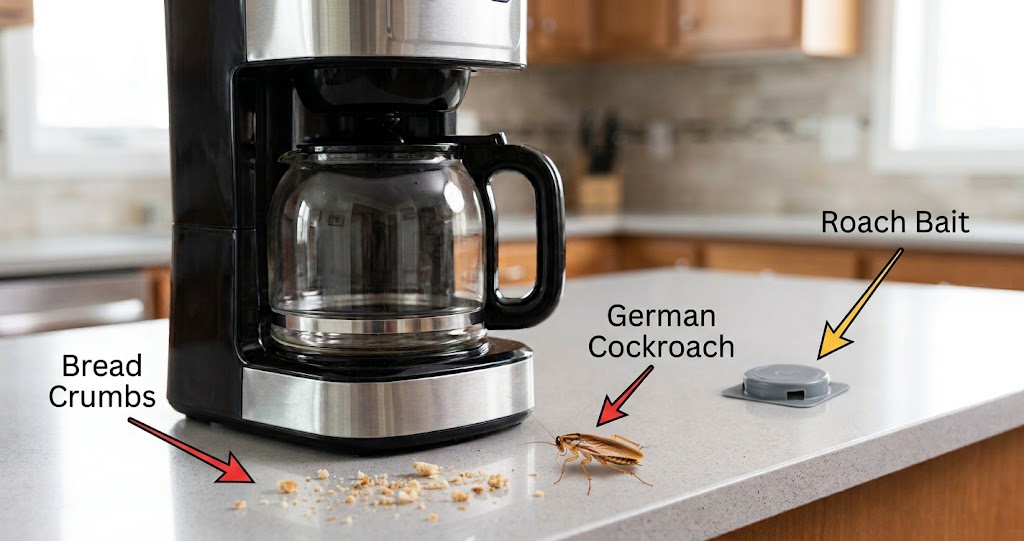
German cockroaches are attracted to places that provide warmth, moisture, food residue and dark hiding spaces, which can make a busy coffee station surprisingly appealing. Used coffee grounds, spilled creamer, sugar, water droplets and the warm areas around an appliance can all contribute to the problem.
The important thing is to deal with the coffee maker and the surrounding kitchen at the same time.
Simply cleaning the machine may not solve the problem if cockroaches are hiding behind the refrigerator, under the sink, inside cabinets or around another appliance nearby.
This guide will show you how to safely deal with German cockroaches around a coffee maker, what you should never spray inside the appliance, which products can help around the coffee station, how to determine the infestation level, and how to keep the roaches from coming back.
Important safety note: Never spray household insecticide, roach killer, fogger, dust or other pesticide inside a coffee maker or onto surfaces that contact coffee or drinking water. Always follow the coffee maker manufacturer’s cleaning instructions and the pesticide label.
Quick Answer: What Should You Do if You Find Roaches in Your Coffee Maker?
If you find German cockroaches in or around your coffee maker:
- Stop using the machine temporarily.
- Unplug it and allow it to cool.
- Empty water, coffee grounds, pods and other removable contents.
- Inspect the coffee maker and surrounding area with a flashlight.
- Clean removable components according to the manufacturer’s instructions.
- Vacuum accessible debris and cockroach evidence.
- Clean and dry the surrounding coffee station.
- Place cockroach monitors around—not inside—the appliance.
- Use appropriately labeled cockroach bait in suitable protected locations nearby.
- Inspect the rest of the kitchen for the source of the infestation.
- Continue monitoring for several weeks.
Never put roach spray, gel bait, insecticide dust or fogging chemicals inside the coffee maker.
Best Products for German Cockroaches Around a Coffee Maker
You don’t need to cover your kitchen in pesticides to deal with German cockroaches. The right products have specific jobs.
Affiliate Disclosure
This article may contain affiliate links. If you purchase a product through one of these links, Bug Off Control may earn a commission at no additional cost to you.
As an Amazon Associate, Bug Off Control earns from qualifying purchases.
Recommended Products for German Cockroach Control Around a Coffee Maker
| Product | Primary Purpose | Recommended Placement | Best For |
|---|---|---|---|
| Cockroach Gel Bait | Attracts cockroaches to a targeted food-based bait | Suitable protected cracks and crevices near activity | Active infestations |
| Roach Monitoring Traps | Detects and captures cockroaches for monitoring | Behind or beside the coffee station | Detecting activity |
| Enclosed Bait Stations | Contains roach bait inside a protected housing | Suitable areas near walls or appliances | Contained bait placement |
| Vacuum With Crevice Tool | Removes accessible roaches, droppings and debris | Around the appliance and surrounding counter | Immediate cleanup |
| Kitchen Cleaning Supplies | Removes food residue, spills and other attractants | Coffee station and surrounding surfaces | Prevention and sanitation |
Important: Keep all pesticides and bait out of the coffee maker itself and away from food- and water-contact surfaces. Always follow the product label directions.
A Very Important Rule
These products belong around the infestation—not inside your coffee maker.
Never put gel bait, insecticide dust or bait stations inside:
- The water reservoir
- The filter basket
- The pod compartment
- The brewing system
- Internal electrical components
- Any surface that contacts coffee or drinking water
Always check the product label before applying a pesticide.
Why Do German Cockroaches Like Coffee Makers?
Your coffee maker isn’t necessarily attracting roaches because it makes coffee. It’s attracting them because it can provide several things they need.
Warmth
The appliance and surrounding area can become warm during and after brewing.
Moisture
Water reservoirs, drip trays and spills can provide accessible moisture.
Food Residue
Coffee grounds, sugar, cream and other kitchen residues can provide food.
Darkness
The underside and back of appliances provide sheltered areas where cockroaches can hide.
Small Hiding Spaces
German cockroaches are remarkably good at squeezing into narrow cracks and protected areas. So if you’ve seen one roach disappear underneath your coffee maker, don’t assume that’s the only place it’s hiding.
Step 1: Stop Using the Coffee Maker Temporarily
If you actually saw a German cockroach enter the coffee maker, stop using it until you’ve had a chance to inspect and clean it.
Unplug the machine and allow it to cool completely.
Remove anything you can safely remove, including:
- Water
- Coffee grounds
- Used pods
- Filters
- Drip-tray contents
- Other removable components
Don’t reach inside electrical openings. And resist the temptation to immediately spray the appliance.
Step 2: Inspect the Coffee Maker at Night
German cockroaches are generally more active when the kitchen is quiet and dark. Turn off the kitchen lights and give the area some time. Then use a flashlight to inspect the coffee station.
Look around:
- The bottom of the coffee maker
- Behind the machine
- Underneath the machine
- The water reservoir
- Drip tray
- Pod compartment
- Filter area
- Power cord area
- Countertop underneath the machine
- Nearby cabinets
Look for:
- Live cockroaches
- Small nymphs
- Shed skins
- Dark droppings
- Egg cases
- Dead roaches
- Repeated activity
Pay Attention to Nymphs
Small German cockroaches are especially important to notice. If you’re seeing nymphs as well as adults, there’s a stronger reason to suspect that the infestation is established nearby rather than being a single wandering cockroach.
Step 3: Inspect Behind and Around the Coffee Maker
This is one of the most important steps. The coffee maker may simply be where you’ve noticed the cockroaches. Carefully inspect the area behind and around it.
Check:
- Behind the appliance
- Under the counter
- Along the backsplash
- Inside nearby cabinets
- Under the sink
- Around plumbing
- Behind the refrigerator
- Around the stove
- Behind other countertop appliances
If you find roaches in several locations, you’re dealing with a kitchen infestation, not just a coffee-maker problem.
Step 4: Clean the Removable Parts
Follow the coffee maker manufacturer’s cleaning instructions. Depending on the model, removable parts may include:
- Water reservoir
- Drip tray
- Filter basket
- Pod holder
- Removable lids
- Other washable components
Wash them using the method recommended by the manufacturer. Allow everything to dry thoroughly before putting the machine back together.
What About the Internal Brewing System?
- This is where you need to be particularly careful.
- Don’t randomly disassemble the appliance.
- Don’t spray pesticide into internal passages.
- Don’t spray through ventilation openings.
- Don’t pour insecticide into the water reservoir.
If you believe cockroaches have entered inaccessible internal components, check the manufacturer’s instructions or have the machine evaluated by a qualified appliance professional.
Step 5: Vacuum Accessible Areas
A vacuum with a crevice attachment can help remove accessible:
- Cockroaches
- Dead insects
- Droppings
- Shed skins
- Food debris
- Loose material
Concentrate on the outside of the appliance and surrounding surfaces. Do not force the vacuum into electrical openings. Afterward, empty or clean the vacuum according to the manufacturer’s instructions.
Step 6: Make the Coffee Station Less Attractive
Once you’ve cleaned the machine, don’t immediately return it to a wet or messy counter.
Wipe down the area and remove:
- Coffee spills
- Sugar
- Cream residue
- Crumbs
- Used coffee grounds
- Standing water
Pay particular attention to the area underneath and behind the appliance. A clean coffee station is easier to monitor and gives cockroaches fewer reasons to hang around.
Step 7: Keep the Coffee Station Dry
Moisture management is an important part of cockroach control. After using your coffee maker:
- Empty the drip tray when necessary.
- Remove used coffee grounds.
- Clean spills.
- Wipe wet surfaces.
- Don’t leave unnecessary standing water around the appliance.
- Follow the manufacturer’s instructions for storing or emptying the reservoir.
You don’t have to eliminate every drop of water from your kitchen. The goal is to remove avoidable moisture sources.
Step 8: Never Spray Roach Killer Inside the Coffee Maker
This is worth repeating because it’s one of the biggest mistakes you can make.
Do not spray insecticide into your coffee maker.
That includes:
- Aerosol roach sprays
- Foggers
- Insecticide dust
- Homemade pesticide mixtures
- Products not labeled for use on food-contact surfaces
The spray may not even reach the hiding cockroaches. Instead, it can leave unwanted pesticide residue inside an appliance used to prepare something you’re going to drink.
Treat the surrounding cockroach population—not the inside of the coffee maker with pesticide.
Step 9: Place Cockroach Monitoring Traps
Monitoring traps are extremely useful because they tell you whether the problem is still active. Place them in appropriate locations around the coffee station, such as:
- Behind the coffee maker
- Beside the appliance
- Along nearby walls
- Under suitable cabinet areas
- Near the sink
- Near the refrigerator
Keep monitoring traps away from children and pets when required by the product instructions.
Why Monitoring Matters
A trap can tell you things that a quick visual inspection can’t.
For example:
- No activity: The area may be improving.
- Occasional adults: There may still be a low-level infestation nearby.
- Adults plus nymphs: Continued breeding activity is more concerning.
- Increasing trap catches: The infestation may be expanding or the main source has not been addressed.
Step 10: Use Roach Bait Around the Infestation
If cockroaches are active around the coffee station, a properly labeled cockroach bait can be an important part of control. Use bait only in locations allowed by the label.
Potential locations can include suitable:
- Cracks
- Crevices
- Protected areas
- Cabinet voids
- Areas behind appliances
Keep Bait Away From Your Coffee Maker
Never put bait:
- Inside the coffee maker
- Inside the water reservoir
- In the filter basket
- In the pod compartment
- On the coffee preparation surface
- Anywhere it can contact drinking water
Also avoid placing bait where it will constantly become wet or contaminated with cleaning products.
Step 11: Don’t Overdo the Pesticide
Seeing cockroaches can make you want to spray everything. More pesticide isn’t necessarily better. A better strategy is to combine:
Cleaning + moisture reduction + monitoring + targeted baiting + habitat reduction.
Follow every pesticide label carefully. If you have a significant infestation, professional pest management may be the better option.
German Cockroach Infestation Levels
Not every cockroach sighting means you have the same level of infestation.
🟢 Light Activity
You may see:
- An occasional adult
- One or two nighttime sightings
- Little evidence around the coffee station
- No obvious nymph activity
What to do:
Clean the coffee station, remove food and moisture sources, inspect nearby areas and begin monitoring.
🟡 Moderate Activity
You may notice:
- Repeated sightings
- Small nymphs
- Droppings
- Several roaches around the coffee station
- Activity in nearby cabinets or appliances
What to do:
Expand your inspection throughout the kitchen. Use monitoring traps and appropriately labeled bait in suitable areas while improving sanitation and moisture control.
🔴 Heavy Activity
You may notice:
- Numerous cockroaches
- Frequent sightings
- Many nymphs
- Egg cases
- Activity in several areas
- Roaches emerging from multiple hiding places
Daytime sightings can occur when populations are large or hiding places are disturbed, although a single daytime sighting doesn’t automatically mean a severe infestation.
What to do: Treat the situation as a whole-kitchen infestation. Consider professional pest control, especially if activity continues despite your control efforts.
What If You Find German Cockroach Egg Cases?
German cockroach egg cases are called oothecae. Finding one is important because eliminating the adults you can see doesn’t necessarily mean the infestation is finished. Inspect nearby hiding places and continue monitoring. Don’t assume that spraying a visible roach or cleaning the coffee maker once will solve the problem. The goal is to interrupt the infestation over time by combining sanitation, monitoring and appropriate control methods.
Should You Freeze a Cockroach-Infested Coffee Maker?
You may find online advice recommending that you place a coffee maker in a freezer for several days. I wouldn’t recommend this as a general DIY treatment. Coffee makers contain electronic components, seals, plastics and other materials that may not be designed for extreme temperatures.
Moving a very cold appliance into a warm environment can also create condensation. Unless the manufacturer specifically provides instructions supporting this type of treatment, it’s better to avoid experimenting with extreme temperatures. If cockroaches appear to be established inside inaccessible internal components, contact the manufacturer or an appliance professional.
Should You Put the Coffee Maker in Direct Sunlight?
This is another popular DIY suggestion that deserves caution. Putting an appliance inside a sealed plastic bag in direct sunlight can create uncontrolled temperatures.
It may damage:
- Plastic components
- Electronics
- Seals
- Wiring
- Adhesives
It also isn’t a dependable way to confirm that every cockroach or egg case has been eliminated. Don’t rely on extreme heat as your primary cockroach-control method.
Step 12: Clean the Rest of the Kitchen
This is where your control efforts can really start making a difference.
Clean:
- Countertops
- Cabinet edges
- Floors
- Drawers
- Behind appliances
- Under appliances
- Around the refrigerator
- Around the stove
- Around the sink
Don’t forget the places you rarely look. German cockroaches are excellent at exploiting small food sources that humans overlook.
Step 13: Check for Water and Plumbing Problems
Inspect for:
- Leaking faucets
- Dripping pipes
- Damp cabinets
- Plumbing leaks
- Condensation
- Wet sponges
- Standing water
- Refrigerator leaks
If you discover a leak, fix it. A hidden plumbing leak can keep an infestation going even when the countertop looks perfectly clean.
Step 14: Remove Unnecessary Hiding Places
Reduce clutter around the kitchen. Pay special attention to:
- Cardboard
- Paper bags
- Food packaging
- Stacks of paper
- Cluttered cabinets
- Unused containers
A less cluttered kitchen is easier to inspect and monitor.
Step 15: Seal Suitable Gaps
Inspect areas around:
- Pipes
- Cabinets
- Backsplashes
- Countertop gaps
- Wall penetrations
Seal suitable cracks and openings where practical.
However, never block required appliance ventilation, electrical access or other safety features.
Step 16: Keep Monitoring After the Cleanup
This is the step people often skip. Don’t decide the infestation is gone simply because you haven’t seen a cockroach for a day or two. Continue checking your monitoring traps.
Watch for:
- New adults
- Nymphs
- Droppings
- Egg cases
- Increasing trap catches
- Activity in other kitchen areas
A steady decline in activity is a much better sign than one quiet night.
When Should You Replace the Coffee Maker?
You don’t automatically need a new coffee maker because you saw a cockroach nearby. However, replacement or professional evaluation may make sense when:
- Cockroaches repeatedly emerge from inaccessible internal areas.
- The appliance cannot be properly cleaned.
- There is contamination that cannot be removed.
- The appliance is damaged.
- The manufacturer doesn’t provide a safe cleaning procedure.
- A qualified technician recommends replacement.
If you replace the machine, don’t forget the kitchen infestation. Otherwise, German cockroaches can simply move into the new appliance.
7 Things You Should Never Do
❌ 1. Don’t Spray Inside the Coffee Maker
Keep pesticides away from drinking-water and food-contact components.
❌ 2. Don’t Put Gel Bait Inside the Machine
Bait belongs in appropriate areas around the infestation—not inside your coffee maker.
❌ 3. Don’t Pour Insecticide Into the Reservoir
Your coffee maker is not a pesticide application site.
❌ 4. Don’t Use a Fogger as Your First Response
Fogging isn’t a substitute for targeted cockroach management.
❌ 5. Don’t Ignore the Rest of the Kitchen
The coffee maker may only be one small part of the infestation.
❌ 6. Don’t Leave Food and Water Available
Crumbs, spills and moisture make the kitchen more attractive.
❌ 7. Don’t Stop Monitoring Too Soon
Cockroach control requires follow-up.
How to Keep German Cockroaches Out of Your Coffee Maker
Once you’ve dealt with the immediate problem, prevention becomes much easier.
Keep the Machine Clean
Remove coffee grounds and clean spills promptly.
Keep the Area Dry
Don’t allow unnecessary water to remain around the appliance.
Store Food Properly
Keep sugar, coffee additives and other food products in suitable sealed containers.
Clean Under Appliances
Don’t only clean what you can see.
Inspect Regularly
Occasionally check behind and underneath the coffee maker.
Keep Monitoring Traps Nearby
They can provide an early warning before a small problem becomes a larger one.
Deal With Leaks
Fix plumbing and moisture problems promptly.
Reduce Clutter
Fewer hiding places make inspection easier.
Frequently Asked Questions
1. Can German cockroaches live inside a coffee maker?
They can hide in or around appliances when suitable spaces, warmth and moisture are available. However, finding a roach around a coffee maker doesn’t automatically prove that the appliance contains an established infestation.
2. Should I throw away my coffee maker after seeing a roach?
Not necessarily. Inspect and clean the appliance according to the manufacturer’s instructions and determine whether the activity is actually coming from inside it. If the appliance is heavily infested internally and cannot be safely cleaned, replacement may be worth considering.
3. Can I spray Raid inside my coffee maker?
No. Don’t spray household insecticide inside an appliance used to prepare beverages unless the product specifically permits that use. Keep pesticides away from food-contact and drinking-water components.
4. Can I put my coffee maker in the freezer to kill German cockroaches?
Freezing isn’t a universally safe DIY treatment for coffee makers. Extreme temperatures can damage the appliance, and condensation can become an issue when it warms up. Follow the manufacturer’s cleaning and maintenance instructions instead.
5. Can sunlight kill cockroaches inside a coffee maker?
Direct sunlight is not a controlled or dependable treatment for an appliance. Extreme heat can also damage electronic and plastic components.
6. Why do I keep seeing cockroaches around my coffee maker after cleaning it?
The source may be somewhere else in the kitchen. Check cabinets, plumbing areas, the sink, refrigerator, stove and other appliances.
7. Can I put cockroach gel bait inside the coffee maker?
No. Keep pesticide bait away from the water reservoir, brewing system, filter basket, pod compartment and other food-contact areas.
8. Does cleaning the coffee maker get rid of German cockroaches?
Cleaning helps remove food residue and reduce attractive conditions, but it won’t necessarily eliminate an established infestation elsewhere in the kitchen.
9. How do I know if the infestation is getting better?
Use monitoring traps and watch the number and type of cockroaches you find. Fewer catches and sightings over time are encouraging. Continued nymph activity or increasing trap catches means more control may be necessary.
10. When should I call a pest-control professional?
Consider professional help if you’re seeing numerous cockroaches, nymphs, repeated activity in multiple areas, daytime activity that is becoming frequent, or continued infestation despite your control efforts.
Conclusion: Don’t Let Cockroaches Ruin Your Coffee
Finding a German cockroach around your coffee maker can be unsettling, but you don’t have to panic or immediately throw the appliance away.
Start by unplugging and inspecting the machine, cleaning its removable parts according to the manufacturer’s instructions, removing food and moisture sources, and keeping pesticides out of the coffee maker itself.
Then turn your attention to the area around the appliance. Use monitoring traps to discover where cockroaches are traveling, use appropriately labeled bait in suitable protected locations, clean the surrounding kitchen, reduce moisture and inspect other appliances and hiding places.
Most importantly, remember that the coffee maker may be a symptom rather than the source. If you’re finding adults, nymphs or droppings throughout the kitchen, tackle the wider infestation instead of focusing only on the appliance.
With consistent cleaning, monitoring and targeted control, you can make your coffee station a much less inviting place for German cockroaches—and get back to enjoying your morning coffee without unwanted company.
Clean the machine. Target the infestation. Keep monitoring.
That combination gives you a much better chance of keeping German cockroaches out of your coffee maker for good.