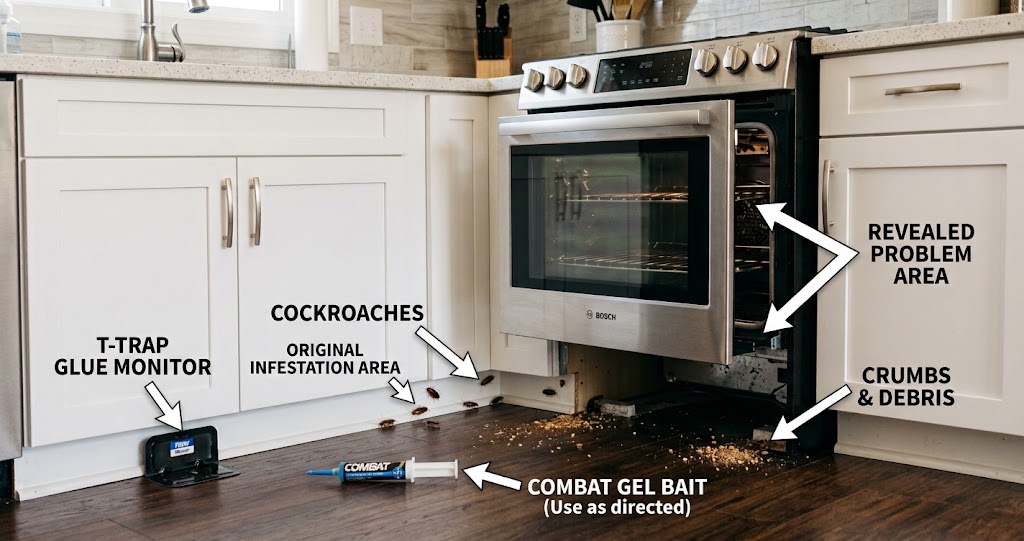
How to Get German Cockroaches Out of an Oven Safely

Finding a German cockroach crawling across your kitchen is bad enough. Discovering one around your oven—or worse, seeing one disappear into the appliance—can make you wonder whether the entire oven is infested. Don’t panic.
German cockroaches are attracted to kitchens because they can find several things they need in one place: food particles, grease, moisture, warmth, darkness, and small protected spaces. An oven and the areas surrounding it can provide several of these conditions. However, the solution is not to spray insecticide inside the oven.
Instead, the safest approach is to remove accessible food debris, clean the appliance according to the manufacturer’s instructions, monitor cockroach activity around the oven, and treat the surrounding infestation with appropriately labeled products.
This complete guide explains how to get German cockroaches out of an oven, what to do if you find them inside, how to clean the appliance safely, where to place monitoring traps and cockroach bait, and how to prevent German cockroaches from returning.
Important safety rule: Never spray aerosol insecticide or apply cockroach bait, boric acid, or another pesticide inside the oven’s cooking cavity, on heating elements, inside electrical components, around gas components, or on food-contact surfaces unless the current product label specifically permits that exact application.
Quick Answer: How Do You Get German Cockroaches Out of an Oven?
If you suspect German cockroaches are hiding in or around your oven, follow these steps:
- Turn the oven off and allow it to cool completely.
- Stop using the appliance temporarily if you have reason to believe cockroaches are inside inaccessible areas.
- Follow the manufacturer’s instructions for cleaning the oven.
- Remove accessible crumbs, grease, and food residue.
- Clean the floor and surrounding areas beneath and beside the appliance when safely accessible.
- Place cockroach monitoring traps around—not inside—the oven.
- Use appropriately labeled cockroach bait in suitable protected areas around the infestation.
- Inspect nearby appliances, cabinets, plumbing areas, and other potential hiding places.
- Do not spray pesticide into vents, heating elements, electrical compartments, gas components, or the cooking cavity.
- If cockroach activity is heavy or continues despite treatment, consider professional pest control.
The most important point
Don’t treat the oven as the entire infestation. German cockroaches often move between appliances and hiding places. If you see them around the oven, check the refrigerator, dishwasher, microwave, sink cabinet, kitchen cabinets, and plumbing areas too.
Best Products for German Cockroach Control Around an Oven
You don’t need to put pesticide inside an oven to control German cockroaches. Different products have different jobs, and choosing the right product for the right location is more important than simply using more pesticide.
Product Safety Comes First
Keep pesticides away from:
- The oven’s cooking cavity
- Heating elements
- Food-contact surfaces
- Electrical terminals
- Electrical control compartments
- Gas burners and gas connections
- Igniters
- Locations where the product label prohibits application
Always read the current product label before using any pesticide. Amazon Associate Disclosure: As an Amazon Associate, Bug Off Control earns from qualifying purchases. Product information is researched from manufacturer information, product specifications, and available customer feedback. Prices and availability may change.
Recommended Products
| Product | Main Purpose | Where It Belongs | Best For |
|---|---|---|---|
| Advion Cockroach Gel Bait | Targeted cockroach bait | Appropriate protected cracks and crevices around the infestation, according to the current label | Active infestations |
| Gentrol Point Source IGR | Helps interfere with cockroach development | Appropriate locations permitted by the current label | Ongoing infestations |
| Catchmaster Glue Boards | Monitoring and trapping | Beside, behind, or underneath the oven where safely accessible | Detection and monitoring |
| Harris Boric Acid Roach Powder | Boric-acid-based cockroach control | Only in dry, inaccessible locations where the label permits application | Targeted control |
| Cleaning Supplies | Removes crumbs, grease, and food residue | Accessible appliance and surrounding kitchen surfaces | Sanitation and prevention |
How to Choose the Right Product
You don’t necessarily need every product listed above.
- Glue boards are primarily useful for monitoring where cockroaches are traveling.
- Gel bait can provide targeted control when used in appropriate label-approved locations.
- IGR products can complement an integrated cockroach management program.
- Boric acid products may provide another control option when used exactly according to the product label.
- And don’t overlook basic cleaning. Removing grease, crumbs, and food residue reduces competing food sources around the appliance.
Match the Product to the Problem
Light activity:
Start with cleaning and monitoring.
Moderate activity:
Add targeted baiting and continue monitoring.
Heavy activity:
Treat the wider kitchen and consider professional pest control.
Important: These products are intended for appropriate treatment and monitoring locations around the oven—not inside the cooking cavity or internal appliance components.
Check Latest Price & Availability on Amazon
Why Do German Cockroaches Get Into Ovens?
A kitchen oven can be an attractive area for German cockroaches because it is surrounded by many of the conditions they prefer.
1. Warmth
German cockroaches favor warm environments. Areas around appliances that produce or retain heat can provide favorable hiding conditions.
2. Food and grease
Small crumbs, grease deposits, food particles, and spills can provide accessible food sources. Even a kitchen that appears clean can have tiny amounts of food residue underneath or behind appliances.
3. Darkness
German cockroaches generally prefer protected, dark locations rather than exposed areas. The spaces around appliance frames, cabinetry, drawers, and wall openings can provide shelter.
4. Narrow hiding spaces
Cockroaches are remarkably good at using small gaps.
They may hide around:
- Appliance frames
- Cabinet gaps
- Drawer areas
- Wall openings
- Plumbing penetrations
- Baseboards
5. Nearby moisture
The oven doesn’t necessarily need to provide the water source. A leaking faucet, damp cabinet, dishwasher connection, or plumbing leak nearby may provide moisture.
6. Nearby food sources
The kitchen itself can provide abundant food. Bread crumbs, cereal, sugar, pet food, grease, and food waste can all contribute to an environment that attracts cockroaches.
Could the Oven Be Only One Part of the Infestation?
Absolutely. This is one of the most important things to understand. If you find German cockroaches around your oven, don’t automatically assume the oven is their primary home. They may also be hiding:
- Behind the refrigerator
- Under the kitchen sink
- Behind the dishwasher
- Inside cabinet gaps
- Around plumbing
- Near the microwave
- Around the coffee maker
- Near the toaster
- Behind baseboards
- Inside wall voids
The oven may simply be where you happened to notice them.
Are German Cockroaches Around an Oven a Health Concern?
Cockroaches can contaminate surfaces as they move through kitchens and other areas. Their bodies, droppings, saliva, and shed material can contribute to contamination and may also contribute to indoor allergens that can bother sensitive individuals.
That makes repeated cockroach activity around a food-preparation appliance something worth taking seriously. However, don’t assume that every oven where a cockroach has been seen automatically needs to be thrown away.
Consider:
- How much activity you’ve observed
- Whether cockroaches are repeatedly entering the appliance
- Whether accessible areas can be safely cleaned
- Whether there is evidence of contamination
- Whether the appliance has inaccessible internal areas where cockroaches may be hiding
If you cannot safely determine the extent of an internal infestation, professional inspection may be appropriate.
German Cockroach Infestation Levels Around an Oven
Not every situation requires the same response. Use these three levels as a practical guide.
🟢 Light Infestation — Clean & Monitor
Typical signs
- One occasional sighting
- No repeated activity
- No obvious nymphs
- Little or no visible droppings
- No evidence of an established population
Your goal
Remove food sources, clean the area, and determine whether activity continues.
🟡 Moderate Infestation — Monitor & Target
Typical signs
- Repeated nighttime sightings
- Several cockroaches appearing over time
- Small nymphs
- Droppings around the kitchen
- Activity around multiple appliances
Your goal
Locate the activity and combine sanitation, monitoring, and targeted control.
🔴 Heavy Infestation — Treat the Wider Kitchen
Typical signs
- Numerous cockroaches
- Daytime sightings
- Many nymphs
- Egg cases
- Heavy droppings
- Activity around multiple appliances
- Cockroaches appearing in several rooms
Your goal- Stop treating the oven as an isolated problem and address the larger infestation.
🟢 Light Infestation: The Green System
If you’ve seen one German cockroach around your oven but haven’t found other evidence of infestation, start with the basics.
Step 1: Turn the Oven Off
If the oven has been operating, turn it off and allow it to cool completely. Never begin cleaning while the appliance is hot.
Step 2: Remove Accessible Food Debris
Follow the manufacturer’s cleaning instructions.
Remove accessible:
- Crumbs
- Grease
- Food particles
- Spills
- Baking debris
Step 3: Clean Around the Oven
Clean the surrounding floor, countertop, cabinets, and other accessible surfaces. Pay special attention to areas where crumbs and grease may accumulate.
Step 4: Place a Monitoring Trap
Place a glue board beside or near the oven where it won’t interfere with normal appliance operation. The purpose is not simply to catch a cockroach. It is to answer an important question: Are cockroaches still traveling through this area?
🟡 Moderate Infestation: The Yellow System
Repeated sightings mean you should look beyond the oven. If you’re seeing German cockroaches regularly—or you’re finding nymphs—there may be an established population nearby.
1. Increase Monitoring
Place monitoring boards in strategic locations.
Consider areas such as:
- Beside the oven
- Behind the oven when safely accessible
- Under the sink
- Behind the refrigerator
- Near cabinet corners
- Around plumbing openings
- Near the dishwasher
Check them regularly. The locations with the highest activity can help identify where additional attention is needed.
2. Use Targeted Cockroach Bait
A product such as Advion Cockroach Gel Bait may be useful when used according to its current label. Apply it only in suitable protected locations.
Never put gel bait:
- Inside the oven cavity
- On heating elements
- On oven racks
- On food-contact surfaces
- Inside electrical components
- Around gas components unless specifically permitted by the label
The goal is to intercept cockroaches outside the appliance.
3. Reduce Competing Food
Clean crumbs and grease regularly. Store food in sealed containers. Don’t leave food scraps or dirty dishes sitting out overnight when avoidable.
4. Look for Water
Inspect:
- Under the sink
- Around faucets
- Dishwasher connections
- Refrigerator water lines
- Plumbing openings
- Damp cabinets
Reducing accessible moisture can make the kitchen less favorable to German cockroaches.
🔴 Heavy Infestation: The Red System
A heavy infestation requires a much broader strategy. If German cockroaches are appearing during daylight, you’re finding many nymphs, or several appliances are affected, don’t concentrate all your efforts on the oven.
1. Monitor the Entire Kitchen
Check:
- Oven
- Refrigerator
- Dishwasher
- Microwave
- Coffee maker
- Toaster
- Cabinets
- Pantry
- Sink area
2. Use Targeted Control
Use appropriately labeled cockroach control products in suitable protected locations around the infestation. Avoid contaminating food-preparation areas or appliance components.
3. Consider an IGR
An insect growth regulator can complement a broader cockroach control program by interfering with normal cockroach development. A product such as Gentrol Point Source IGR should only be used according to its current label.
4. Inspect Other Appliances
German cockroaches may move between appliances. If you find activity around the oven, inspect nearby appliances rather than assuming the oven is the only problem.
5. Consider Professional Pest Control
Professional assistance is particularly worthwhile when:
- Daytime activity is occurring
- Numerous nymphs are present
- Multiple rooms are affected
- Several appliances have activity
- The infestation keeps returning
- DIY control isn’t reducing activity
What Should You Do If You See a Cockroach Inside Your Oven?
This is where safety becomes especially important. Do not reach for an aerosol pesticide and spray through the oven door, vents, or openings.
Instead:
1. Turn the Oven Off
Allow it to cool completely.
2. Stop Using It Temporarily if Necessary
If you believe cockroaches are entering inaccessible internal areas, consider stopping use until you’ve determined the safest next step.
3. Follow the Manufacturer’s Instructions
Use only cleaning procedures recommended for your particular oven.
4. Don’t Dismantle the Appliance
Ovens may contain:
- Electrical wiring
- Heating elements
- Insulation
- Gas components
- Igniters
- Control boards
Attempting to dismantle these components without appropriate knowledge can create serious safety risks.
5. Monitor Outside the Oven
Use glue boards around the appliance.
6. Treat the Surrounding Infestation
Use appropriately labeled products in suitable areas outside the appliance.
7. Consider Professional Inspection
If cockroaches repeatedly emerge from inaccessible parts of the oven, professional assistance is the safest option.
How to Clean an Oven After Cockroach Activity
Cleaning should remove food residue without damaging the appliance.
Step 1: Turn Off and Cool the Oven
Never begin cleaning while it is hot.
Step 2: Follow the Manual
Use the manufacturer’s recommended cleaning method.
Step 3: Remove Removable Parts
Remove racks, trays, or drawers only as instructed.
Step 4: Remove Food Debris
Clean accessible crumbs and food residue.
Step 5: Clean the Exterior
Clean accessible surfaces while keeping liquids away from electrical controls and openings.
Step 6: Clean Around the Appliance
Remove crumbs and debris from accessible areas underneath and beside the oven. Don’t move a heavy appliance alone doing so could cause injury or damage.
Step 7: Allow Everything to Dry
Follow the manufacturer’s instructions before returning the appliance to normal operation.
What If German Cockroaches Are Inside the Cooking Cavity?
Seeing a cockroach inside the actual cooking compartment can be particularly concerning. The safest approach is simple:
Do not turn the cooking cavity into a pesticide treatment zone.
Never casually spray insecticide onto:
- Heating elements
- Oven racks
- Burners
- Interior walls
- Food-contact surfaces
- Other cooking components
Instead:
- Turn the oven off.
- Allow it to cool.
- Follow the manufacturer’s cleaning instructions.
- Remove accessible food debris.
- Monitor the surrounding area.
- Address the larger cockroach infestation.
- Seek professional advice if cockroaches repeatedly enter inaccessible areas.
What About the Oven’s Bottom Drawer?
Some ovens have a lower storage or warming drawer that can collect crumbs and grease.
If yours does:
- Allow the oven to cool.
- Remove the drawer according to the manufacturer’s instructions.
- Empty food debris.
- Clean the drawer appropriately.
- Allow it to dry completely.
- Clean the accessible area around the drawer.
- Monitor for cockroach activity.
Don’t automatically apply pesticide inside the drawer.
Whether a pesticide can legally and safely be applied to a particular location depends on the product’s current label.
Gas Oven vs. Electric Oven vs. Wall Oven
The appliance configuration can affect how safely you can inspect and address cockroach activity.
Gas Ovens
Gas ovens contain components such as burners, valves, igniters, and gas connections. Do not apply pesticide around these components unless the product label specifically permits that application. Instead, focus on accessible areas around the appliance and nearby cockroach travel routes. If you suspect cockroaches are inside the gas or control compartment, professional inspection is recommended.
Electric Ovens
Electric ovens may contain wiring, heating elements, controls, insulation, and other electrical components. Do not spray liquid pesticide into electrical compartments or rear panels.
Focus on:
- Surrounding floors
- Accessible cracks and crevices
- Nearby cabinets
- Monitoring locations
- Other areas where cockroaches are traveling
Built-In Wall Ovens
Wall ovens can be more difficult to inspect because much of the appliance may be enclosed within cabinetry. Cockroaches may potentially use gaps around cabinetry and wall openings as travel routes. Do not dismantle the appliance simply to look for cockroaches. Instead, monitor accessible surrounding areas and address nearby cracks, gaps, and other potential entry points where appropriate.
10 Things You Should Never Do
1. Never spray insecticide inside the oven
The cooking cavity isn’t a general-purpose pesticide treatment area.
2. Never spray through vents or openings
Pesticide can reach electrical or other components that were not designed to receive it.
3. Never put gel bait inside the cooking cavity
Use bait only in locations permitted by the current label.
4. Never pour water into the appliance
Water and electrical components can create a dangerous situation.
5. Never use metal objects to probe inside the appliance
You could damage components or create an electrical hazard.
6. Never apply pesticide around gas components unless the label specifically allows it
Gas appliances require additional caution.
7. Never assume turning the oven on will solve the infestation
Using heat as a cockroach-control method is unreliable and does not address the wider infestation.
8. Never use household cleaners as a substitute for cockroach control
Cleaning removes food residue, but it does not eliminate an established cockroach population.
9. Never treat only the oven
Cockroaches can simply relocate to another appliance or hiding place.
10. Never ignore repeated nymph sightings
Small German cockroach nymphs can indicate that a breeding population is nearby.
Where Should You Look If Cockroaches Are Coming From Your Oven?
If cockroach activity continues, inspect the rest of the kitchen.
Refrigerator
Check accessible areas underneath and behind it.
Kitchen Sink
Look around plumbing, cabinet corners, and moisture sources.
Cabinets
Inspect corners, hinges, gaps, and plumbing penetrations.
Dishwasher
Check the surrounding cabinet and plumbing area.
Microwave
Inspect around the exterior and nearby countertop.
Coffee Maker
Check around the base and surrounding counter.
Toaster
Look for crumbs and activity around and underneath the appliance.
Baseboards
Inspect gaps where floors and walls meet.
Why Cleaning the Oven Alone Usually Isn’t Enough
Imagine you clean your oven until it looks spotless. But underneath the sink there’s a slow leak. Behind the refrigerator there are food crumbs. Inside a cabinet there are gaps and spilled food. Behind the dishwasher there’s warmth and moisture. The cockroaches still have everything they need. That’s why successful German cockroach control requires more than cleaning one appliance. Think of the strategy as:
Sanitation + Monitoring + Targeted Treatment + Moisture Control + Prevention
The goal isn’t simply to make the oven cockroach-free. The goal is to make the entire kitchen less attractive to German cockroaches.
How to Monitor German Cockroaches Around Your Oven
Monitoring is one of the easiest ways to determine whether your control efforts are working. Place glue boards in safe locations near:
- The oven
- The refrigerator
- The sink
- Kitchen cabinets
- The dishwasher
- Other areas showing activity
Check them regularly.
If catches decrease:
That’s a positive sign that activity may be declining.
If catches remain high:
The infestation may still be active.
If catches increase:
Look for another hiding or breeding area. Monitoring turns random sightings into useful information.
How to Prevent German Cockroaches From Returning to Your Oven
Once activity decreases, prevention becomes your next priority.
Keep the oven area clean
Remove food residue and grease regularly.
Clean beneath appliances
Hidden crumbs can become an overlooked food source.
Store food properly
Keep cereal, bread, flour, sugar, pet food, and other food products sealed whenever practical.
Fix plumbing leaks
Don’t give cockroaches easy access to water.
Reduce clutter
Limit unnecessary cardboard, paper, and other clutter in the kitchen.
Seal appropriate gaps
Where practical, seal cracks and gaps around baseboards, cabinetry, and plumbing penetrations.
Continue monitoring
A monitoring board can provide an early warning if cockroach activity starts increasing again.
Could German Cockroaches Be Coming From Another Apartment?
If you live in an apartment, condominium, duplex, or other attached housing, the source may not be entirely inside your unit.
German cockroaches can potentially move through:
- Plumbing openings
- Utility penetrations
- Wall voids
- Cabinet gaps
- Structural openings
If your kitchen is clean but activity continues, contact your property manager or a pest professional. Treating only one unit may not solve a problem involving connected spaces.
How Do You Know If Your Cockroach Treatment Is Working?
Don’t judge your results by whether you happen to see one cockroach today. Look at the trend over time.
Signs you’re making progress
- Fewer nighttime sightings
- Fewer nymphs
- Fewer monitoring-board catches
- Less fresh droppings
- Less activity around appliances
Signs the infestation may still be active
- New nymphs continue appearing
- Monitoring boards continue catching numerous roaches
- Daytime sightings continue
- Activity spreads to other areas
- Cockroach numbers don’t appear to be declining
The goal is consistent reduction in activity, not simply one or two days without a sighting.
Frequently Asked Questions
1. Can German cockroaches live inside an oven?
They can hide in protected areas associated with appliances, especially where warmth, food residue, darkness, and shelter are available. However, an oven may be only one part of a larger infestation.
2. How do I get German cockroaches out of my oven?
Turn the oven off, allow it to cool, clean accessible areas according to the manufacturer’s instructions, remove food residue, monitor around the appliance, and address the broader infestation using appropriately labeled pest-control products.
3. Can I spray Raid inside my oven?
No. Do not spray aerosol insecticide into the cooking cavity, heating components, electrical compartments, vents, or other areas unless the product label specifically permits that use.
4. Can I put Advion gel bait inside my oven?
No. Keep gel bait out of the cooking cavity and food-contact areas. Apply it only in locations permitted by the current product label.
5. Should I throw away an oven with cockroaches inside?
Not automatically. Consider the severity of the infestation, whether the appliance can be safely cleaned, and whether cockroaches are entering inaccessible internal areas. Professional inspection may help determine the safest option.
6. Will turning the oven on kill German cockroaches?
You should not rely on operating the oven as a cockroach-control method. It does not address cockroaches hiding elsewhere and may create unnecessary safety concerns.
7. Why do German cockroaches keep coming back to my oven?
The oven may be near the actual source of the infestation. Check the refrigerator, sink, dishwasher, cabinets, plumbing areas, and other kitchen appliances.
8. Are glue traps good for German cockroaches?
Yes. Glue boards can help detect activity, identify travel routes, and monitor whether cockroach numbers are increasing or decreasing.
9. Why am I seeing tiny cockroaches around my oven?
Small German cockroaches are nymphs. Repeated sightings can indicate that a breeding population is nearby.
10. Can cockroaches contaminate an oven?
Cockroaches can contaminate surfaces through droppings, saliva, body material, and microorganisms carried on their bodies. Clean accessible areas according to the manufacturer’s instructions and address the infestation.
11. Can I put boric acid inside my oven?
No. Do not place boric acid or another pesticide inside the cooking cavity unless the current product label specifically permits that exact use.
12. When should I call a pest professional?
Consider professional help when you see numerous cockroaches, repeated daytime activity, many nymphs, activity in several rooms or appliances, or continued activity despite sanitation and targeted control.
Related German Cockroach Guides
If German cockroaches are appearing around your kitchen appliances, these related guides can help you tackle the problem from several angles:
- How to Get Rid of German Cockroaches in Your Refrigerator
- How to Get German Cockroaches Out of a Microwave
- How to Get German Cockroaches Out of a Coffee Maker
- How to Get German Cockroaches Out of a Toaster
Conclusion: Keep German Cockroaches Out of Your Oven
A German cockroach around your oven can be disturbing, but spraying the appliance with insecticide is not the answer.
The safer and more effective approach is to clean the accessible areas, remove food and grease, monitor cockroach activity, treat appropriate areas around the infestation, and address the rest of the kitchen.
Remember the three levels:
🟢 Green — Clean & Monitor
Use this approach when you have an isolated sighting and little evidence of an established infestation.
🟡 Yellow — Monitor & Target
Use it when sightings become regular or nymphs begin appearing.
🔴 Red — Treat the Wider Infestation
Use a broader integrated approach when activity is heavy, widespread, or persistent. Most importantly, remember this: The oven may be where you see the cockroach, but it may not be where the infestation begins.
Check behind the refrigerator. Inspect beneath the sink look around cabinets and plumbing. Monitor other appliances remove food residue fix moisture problems. And continue monitoring after treatment.
With consistent sanitation, smart monitoring, targeted pest control, and prevention, you can make your kitchen a much less welcoming environment for German cockroaches.
Check Latest Price & Availability on Amazon for products that fit your situation. Always read and follow the current pesticide label and your oven manufacturer’s instructions before use.