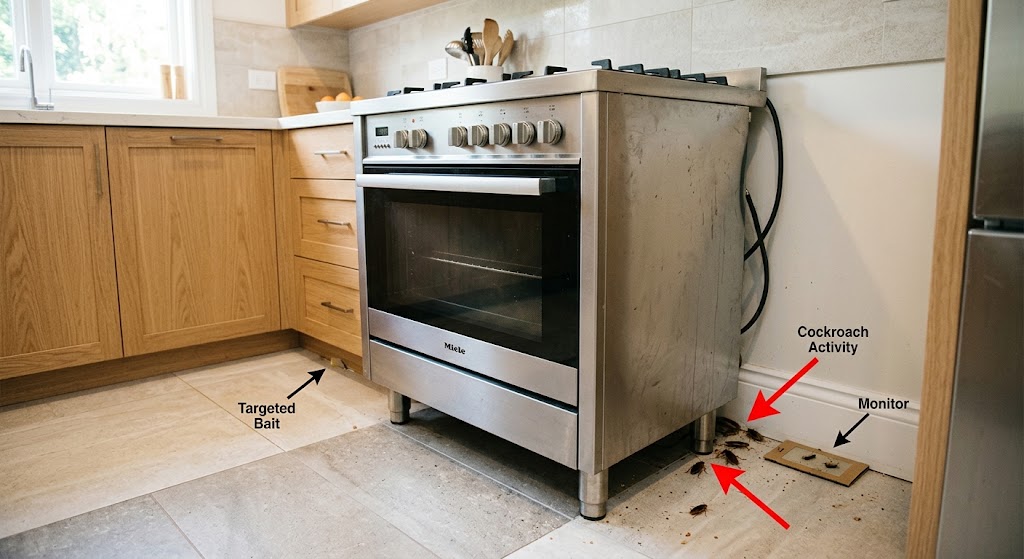
How to Get German Cockroaches Out of a Stove Safely

Seeing a German cockroach disappear beneath your stove is bad enough. Finding one crawling across the stovetop while you’re preparing dinner is even worse.
Unfortunately, stoves and the areas surrounding them can provide German cockroaches with several things they love: warmth, darkness, food crumbs, grease, moisture, and protected hiding places. Once cockroaches discover a reliable food source in the kitchen, they can spread to cabinets, refrigerators, dishwashers, countertops, and other appliances.
But there’s an important point to understand before reaching for an insecticide: a stove is not an ordinary pest-control area. It contains heating elements, electrical components, gas connections, and surfaces used around food. The safest approach is therefore to control cockroaches around the stove and in appropriate, accessible areas, rather than casually spraying inside the appliance.
This guide walks you through how to identify the problem, clean and inspect the stove area, use monitoring traps and appropriate cockroach baits, reduce food and moisture sources, and prevent German cockroaches from coming back.
Important safety note: Never apply a pesticide inside an oven cavity, onto burners, heating elements, electrical components, or food-contact surfaces unless the specific product label explicitly permits that application. Always read and follow the product label.
Quick Answer: How Do You Get German Cockroaches Out of a Stove?
The safest approach is to clean and inspect the stove and surrounding area, remove accessible food and grease, vacuum visible cockroaches and debris, place monitoring traps around the appliance, and use an appropriately labeled cockroach bait in permitted areas around the infestation.
Don’t spray insecticide into the oven, onto burners, or into electrical components. If cockroaches continue appearing after treatment around the stove, inspect nearby cabinets, plumbing, walls, and other appliances because the main harborage may be somewhere else.
For a small problem, early intervention may be enough. A persistent or widespread infestation may require a more comprehensive treatment program or professional pest-control assistance.
Affiliate Disclosure
This article may contain affiliate links. If you purchase a product through one of these links, Bug Off Control may earn a commission at no additional cost to you.
As an Amazon Associate, Bug Off Control earns from qualifying purchases.
Best Products for German Cockroach Control Around a Stove
If you’re ready to start controlling the problem, these are the main product categories worth considering.
| Product | Main Purpose | Where It Belongs | Best For |
|---|---|---|---|
| Advion Cockroach Gel Bait | Targeted cockroach bait | Label-approved cracks and crevices around activity | Active infestations |
| Alpine Cockroach Gel Bait | Alternative cockroach bait | Label-approved areas near cockroach activity | Bait rotation or alternative baiting |
| Gentrol Point Source IGR | Disrupts cockroach development | Appropriate areas according to the product label | Persistent infestations |
| Catchmaster Glue Traps | Monitoring and trapping | Behind, beside, or underneath the stove where appropriate | Finding activity and measuring progress |
| Boric Acid Roach Products | Cockroach control | Only in locations specifically permitted by the label | Protected areas away from food and contact |
Which Products Do You Actually Need?
You don’t necessarily need every product on this list. For many homeowners, a practical starting point is:
1. Monitoring traps + 2. an appropriate cockroach bait
If the infestation is established and nymphs continue appearing, an appropriately labeled IGR may be useful as part of a broader control strategy.
Boric-acid products can also have a place in cockroach management, but they must be used according to their specific label and kept away from children, pets, food, cookware, and food-preparation areas.
The goal isn’t to use the most products. It’s to use the right products in the right locations.
Why German Cockroaches Like Stoves
German cockroaches don’t necessarily choose a stove because they like cooking. They are attracted to the conditions that often surround kitchen appliances.
A stove area can provide:
- Warmth
- Darkness
- Food crumbs
- Cooking grease
- Moisture nearby
- Small cracks and gaps
- Protection from household activity
- Easy access to cabinets and other kitchen areas
Even tiny food particles can become a food source. A few crumbs underneath an appliance may not seem important to you, but repeated access to food can help support cockroach activity. That’s why simply killing the cockroach you see on the stovetop doesn’t solve the underlying problem.
Are German Cockroaches Actually Living Inside the Stove?
They can potentially enter accessible gaps and protected spaces associated with an appliance, but don’t automatically assume the entire infestation is inside the stove.
Cockroaches seen around a stove may actually be hiding:
- Behind the appliance
- Beneath the appliance
- Around the lower drawer
- Along cabinet edges
- Under nearby cabinets
- Behind the refrigerator
- Around plumbing
- Around utility openings
- Inside wall or cabinet voids
- Around other kitchen appliances
This distinction matters. If you only treat the stove, you may leave the real source of the infestation untouched. Think of the stove as one part of the kitchen’s cockroach environment rather than automatically treating the appliance itself as the nest.
Before You Start: Stove Safety Comes First
Before moving or cleaning around your stove, make sure the appliance is safe to work around.
Electric stove
Follow the manufacturer’s instructions for disconnecting power if this is necessary and can be done safely.
Gas stove
Do not disconnect, loosen, or manipulate a gas connection unless you are qualified to do so. If the appliance is hardwired or difficult to disconnect, don’t force it.
Also:
- Make sure the appliance is cool.
- Keep water away from electrical components.
- Don’t remove components you are not qualified to service.
- Don’t interfere with gas fittings.
- Don’t spray pesticides into appliance openings.
If accessing a suspected hiding area requires dismantling the appliance, leave that work to a qualified appliance technician or pest-control professional.
How to Get German Cockroaches Out of a Stove: Step-by-Step
Step 1: Remove Food and Grease From Around the Stove
Start with the simplest part of the problem: food. Clean accessible areas around the appliance, including:
- The floor beneath the stove
- The sides of the appliance
- The area behind the stove
- Accessible areas around the lower drawer
- Nearby cabinet edges
- Countertops around the cooking area
Remove crumbs, food particles, and grease buildup. Use an appropriate kitchen cleaner for suitable surfaces, but don’t allow liquid to enter electrical components, switches, burners, vents, or other areas where it could damage the appliance.
Why This Matters
German cockroaches are opportunistic feeders. If food remains available every night, they have less reason to interact with your control program.
Step 2: Inspect the Stove Area
Once the area is clean, inspect it carefully.
Look for:
- Live cockroaches
- Tiny nymphs
- Dark specks or droppings
- Shed skins
- Egg cases
- Grease buildup
- Food debris
- Moisture
- Cracks
- Gaps
- Cockroach odor or activity
Pay particular attention to areas where the stove meets the floor, wall, or cabinets. If you find numerous small nymphs, don’t assume you have only a few stray cockroaches. Nymphs can indicate an established breeding population somewhere nearby.
Step 3: Vacuum Accessible Cockroaches and Debris
A vacuum can help remove visible cockroaches, droppings, shed skins, crumbs, and debris from accessible areas. Use the hose around:
- The floor behind the stove
- Accessible gaps
- Cabinet edges
- The underside of accessible areas
- Other visible areas showing activity
Don’t force the vacuum into electrical or mechanical components. Afterward, empty the vacuum canister or dispose of the vacuum bag appropriately so captured insects don’t escape back into the home.
Vacuuming isn’t a complete treatment by itself, but it is an excellent way to reduce accessible debris and visible activity while you address the underlying infestation.
Step 4: Place Glue Traps to Find Their Travel Routes
One of the smartest things you can do is monitor before guessing where to treat. Place appropriately sized glue traps in safe locations:
- Behind the stove
- Beside the stove
- Underneath the stove where appropriate
- Near nearby cabinets
- Along suspected cockroach travel routes
Follow the trap manufacturer’s instructions and keep traps inaccessible to children and pets. Check them regularly.
What the Traps Tell You
If one trap catches significantly more cockroaches than another, that can help identify where activity is concentrated. You can also compare trap captures over time. For example: Many catches → active area, Fewer catches → activity may be declining, No catches over repeated checks → encouraging sign, but continue monitoring Monitoring turns your treatment from guesswork into a more informed process.
Step 5: Use Cockroach Gel Bait Correctly
Gel bait can be an important tool for German cockroach control. However, where you put it is just as important as what bait you buy. Use gel bait only in locations permitted by the product label. Suitable applications may include certain protected cracks and crevices around an infestation, depending on the label.
Never casually put gel bait:
- Inside the oven cavity
- On burners
- On heating elements
- On food-contact surfaces
- On cookware
- Inside electrical components
- On areas exposed to extreme heat
- Anywhere prohibited by the product label
The objective is to put bait where cockroaches can encounter it without creating a food-safety or appliance-safety problem.
Don’t Overapply Bait
More bait doesn’t automatically mean better control. Follow the manufacturer’s directions for placement and quantity. Small, strategically positioned placements in appropriate areas can be more sensible than covering an entire kitchen with pesticide.
Step 6: Consider an IGR for Persistent Activity
An insect growth regulator, commonly called an IGR, works differently from a conventional insecticide. Rather than simply trying to kill cockroaches immediately, an IGR interferes with normal insect development and can help disrupt reproduction and maturation.
This can be useful when German cockroach nymphs continue appearing. However, an IGR should be treated as part of a larger control program—not as a magic solution.
Use it only according to its product label and never place it inside the oven or on food-preparation surfaces unless the label specifically allows that application.
Step 7: Eliminate Moisture
Food isn’t the only resource German cockroaches need. Moisture can help keep an infestation going. Inspect the area around the stove and nearby kitchen for:
- Leaking plumbing
- Damp cabinets
- Water around the sink
- Condensation
- Leaking appliances
- Wet cleaning cloths
- Standing water
- Plumbing leaks behind cabinets
- Repair leaks where possible.
- Dry damp areas promptly.
- Don’t overlook the area beneath the sink simply because the cockroaches were first noticed around the stove.
Step 8: Inspect Nearby Appliances
If cockroaches are using the stove area, nearby appliances deserve attention too. Inspect around:
- Refrigerator
- Dishwasher
- Microwave
- Toaster
- Coffee maker
- Other countertop appliances
Warm appliances with food residue or protected gaps can provide additional harborage If you find evidence around several appliances, you’re probably dealing with a kitchen-wide infestation rather than a stove-only problem.
Step 9: Check Cabinets and Plumbing Areas
Kitchen cabinets are another common place to investigate.
Look beneath:
- The sink
- Countertop edges
- Cabinet corners
- Plumbing penetrations
- Areas around dishwasher connections
- Gaps where cabinets meet walls
Look for the same evidence:
- Droppings
- Nymphs
- Egg cases
- Live cockroaches
- Shed skins
Treating the visible stove area while ignoring an active cabinet infestation can allow cockroaches to continue returning.
Step 10: Seal Suitable Gaps
After identifying likely travel routes and addressing active areas, seal appropriate gaps that could allow cockroaches to move through the kitchen.
Potential areas include:
- Gaps around pipes
- Cracks along baseboards
- Openings around utility lines
- Cabinet-to-wall gaps
- Gaps around suitable structural penetrations
Use an appropriate sealant for the specific surface. However, don’t blindly seal every suspected hiding place before addressing the infestation. You don’t want to simply push cockroaches into another part of the kitchen.
Step 11: Continue Monitoring
This is the step many homeowners skip. After cleaning and treatment, continue checking your monitoring traps.
Look for:
- Fewer adult cockroaches
- Fewer nymphs
- Fewer droppings
- Less nighttime activity
- Declining trap captures
The objective isn’t simply to have one cockroach-free night. You’re looking for a consistent decline in activity.
🟢 Light German Cockroach Infestation
A light infestation may involve an occasional sighting, limited droppings, or a small number of cockroaches without obvious widespread activity.
Signs may include:
- One or two occasional sightings
- Limited droppings
- Little or no nymph activity
- Activity concentrated around one area
What to do
- Clean the stove and surrounding area.
- Remove grease and food debris.
- Place monitoring traps.
- Identify where cockroaches are traveling.
- Use appropriate bait in label-approved locations.
- Eliminate moisture sources.
- Inspect nearby cabinets and appliances.
- Continue monitoring.
Early intervention is your advantage.
A small problem is much easier to manage before the population expands.
🟡 Moderate German Cockroach Infestation
A moderate infestation may involve repeated sightings, multiple nymphs, droppings, or regular nighttime activity.
Signs may include:
- Frequent nighttime sightings
- Multiple nymphs
- Repeated trap captures
- Droppings around several areas
- Activity around more than one appliance
What to do
Expand your inspection beyond the stove.
Check:
- Cabinets
- Under the sink
- Refrigerator
- Dishwasher
- Plumbing areas
- Baseboards
- Other appliances
- Wall and cabinet gaps
Use monitoring traps to identify the most active areas. A combination of sanitation, targeted baiting, monitoring, moisture reduction, and an appropriately labeled IGR when warranted can provide a more complete approach than repeatedly spraying visible cockroaches.
🔴 Severe German Cockroach Infestation
A severe infestation may involve frequent sightings, large numbers of nymphs, heavy droppings, multiple egg cases, or cockroach activity throughout the kitchen.
Warning signs include:
- Cockroaches appearing during the day
- Numerous nymphs
- Heavy droppings
- Activity in multiple rooms
- Cockroaches coming from several appliances
- Persistent activity despite treatment
At this stage, treating only the stove is unlikely to solve the problem.
What to do
- Inspect the entire kitchen.
- Check surrounding appliances.
- Inspect cabinets and plumbing areas.
- Increase monitoring.
- Use appropriate baiting strategies.
- Eliminate food and moisture sources.
- Seal suitable entry points.
- Consider professional pest-control assistance.
If you live in an apartment, condominium, or other attached housing, neighboring units may also need to be considered because cockroaches can move through shared structural spaces.
⚠️ What NOT to Do Around a Stove
Don’t Spray Insecticide Inside the Oven
Avoid spraying pesticides into:
- The oven cavity
- Burners
- Heating elements
- Electrical components
- Food-contact surfaces
Unless the specific product label explicitly permits the application, don’t do it.
Don’t Use a Bug Bomb as Your Main Solution
Total-release foggers are generally a poor strategy for German cockroach infestations. The pesticide may not reach the protected cracks and voids where cockroaches are hiding.
Fogging can also expose people and pets to unnecessary pesticide residues and may cause cockroaches to move into other hiding places. Targeted control is usually a better approach.
Don’t Spray Directly Over Bait
Some insecticide sprays can interfere with baiting by contaminating the bait or making the treated area less attractive to cockroaches. If you’re using bait, follow the product directions and avoid combining products in ways that the labels don’t support.
Don’t Put Large Piles of Boric Acid Around the Kitchen, boric acid products can be useful when used correctly, but more powder does not necessarily produce better control. Use only product labeled for the intended pest and location. Keep them away from food, utensils, children, and pets.
What If You Have Pets or Small Children?
A kitchen requires extra care when children or pets are present.
Follow these precautions:
- Keep pesticides inaccessible to children and pets.
- Use enclosed bait stations where appropriate and where the label permits.
- Never leave loose pesticide products where a child or pet can reach them.
- Keep pesticides away from pet food and water bowls.
- Keep treated areas away from food and cookware.
- Store pesticides in their original containers.
- Follow all label precautions.
- Don’t place pesticides inside areas where a pet could lick or disturb them.
If you aren’t sure whether a particular product is appropriate for your household, read the label carefully or ask a qualified pest-control professional.
When children or pets are present, accessibility matters just as much as effectiveness.
How to Keep German Cockroaches From Coming Back
Getting the current population down is only half the job. The next goal is making your kitchen less attractive to new cockroaches.
Keep the Stove Area Clean
Wipe away food spills and cooking residue regularly. Don’t allow grease and crumbs to accumulate beneath or behind the appliance.
Store Food Properly
Keep dry foods in sealed containers. Don’t leave open packages sitting on counters overnight.
Take Out Garbage Regularly
Food waste can provide an easy meal for cockroaches. Use a covered trash container where practical and clean up spills around it.
Reduce Moisture
Repair leaking plumbing. Don’t leave standing water around sinks or appliances. Allow damp areas to dry.
Clean Under Appliances
Periodically clean accessible areas underneath and behind appliances. This is particularly important because these areas are easy to overlook.
Inspect Cardboard and Grocery Items
German cockroaches can sometimes hitchhike in boxes, bags, used appliances, and other items brought into the home. Inspect questionable items before bringing them into the kitchen.
Continue Monitoring
Even after sightings stop, monitoring traps can provide an early warning if cockroaches begin returning.
How Long Does It Take to Get German Cockroaches Out of a Stove?
There isn’t one guaranteed timeline. The answer depends on:
- The size of the infestation
- How long it has been established
- Availability of food
- Availability of moisture
- Number of hiding places
- Whether nearby rooms are affected
- Whether the source of the infestation has been addressed
You may see fewer cockroaches relatively quickly after making conditions less favorable and implementing appropriate control measures.
However, an established German cockroach population can take longer to bring under control. Don’t judge success by what happens during one night. Instead, monitor the trend over time.
What If Cockroaches Keep Coming Back After Treating the Stove?
This is an important clue. If you clean and treat around the stove but continue finding German cockroaches, the source may be elsewhere.
Inspect:
- Refrigerator
- Dishwasher
- Microwave
- Toaster
- Coffee maker
- Cabinets
- Under the sink
- Plumbing areas
- Baseboards
- Wall voids
- Adjacent rooms
If activity is widespread, stop thinking of it as a stove problem. You’re dealing with a broader German cockroach infestation that happens to include the stove area.
When Should You Call a Pest-Control Professional?
Professional assistance is worth considering when:
- Cockroaches are appearing throughout the kitchen.
- You are seeing numerous nymphs.
- Cockroaches are active during the daytime.
- Droppings are widespread.
- Multiple appliances show activity.
- Your control efforts aren’t reducing activity.
- You cannot safely access suspected harborage areas.
- The infestation has spread to multiple rooms.
- You live in attached housing where neighboring units may be involved.
A professional can help identify hidden harborage areas and develop a treatment program appropriate for the structure.
Frequently Asked Questions
1. Can German cockroaches live inside a stove?
German cockroaches can enter accessible gaps and protected areas associated with appliances. However, the stove may only be one part of a larger infestation. Always inspect the surrounding kitchen rather than assuming every cockroach is living inside the appliance.
2. Can I spray cockroach killer inside my stove?
Don’t spray insecticide inside an oven cavity, onto heating elements, burners, electrical components, or food-contact surfaces unless the product label specifically permits that application. Always follow the label.
3. What is the best way to get German cockroaches away from a stove?
Start by cleaning food and grease from accessible areas, vacuuming visible activity, placing monitoring traps, and using an appropriate cockroach bait in label-approved locations around the infestation. Also address moisture and nearby hiding places.
4. Will cleaning my stove get rid of German cockroaches?
Cleaning can remove food, grease, and debris that support cockroach activity, but cleaning alone may not eliminate an established infestation. Additional monitoring and targeted control may be necessary.
5. Should I use a bug bomb around my stove?
Bug bombs are generally not a good primary solution for German cockroaches. They may fail to reach hidden harborage areas and can drive cockroaches deeper into inaccessible spaces.
6. Where should I put cockroach traps around a stove?
Monitoring traps can be placed behind, beside, or underneath the stove where they can safely remain undisturbed. Follow the manufacturer’s instructions and keep traps away from children and pets.
7. Can German cockroaches come back after treatment?
Yes. Cockroaches can return if food, moisture, hiding places, or entry routes remain available. Continued sanitation and monitoring can help detect renewed activity early.
8. Why am I seeing baby German cockroaches around my stove?
Small nymphs can indicate that German cockroaches are reproducing nearby. Inspect surrounding cabinets, appliances, plumbing areas, and other protected spaces instead of focusing exclusively on the stove.
9. Are gel baits safe to use around a stove?
Gel bait can be useful when used according to its label, but it should not be casually placed on burners, heating elements, food-contact surfaces, or other prohibited areas. Use only label-approved placements.
10. When is a German cockroach infestation serious?
Frequent sightings, numerous nymphs, heavy droppings, daytime activity, or cockroaches appearing in several areas of the home can indicate a substantial infestation. Broader treatment or professional assistance may then be appropriate.
Related German Cockroach Guides
If German cockroaches have moved beyond your stove, these related guides can help you tackle other common hiding places:
- How to Get German Cockroaches Out of a Toaster
- How to Get German Cockroaches Out of a Microwave
- How to Get German Cockroaches Out of a Coffee Maker
- How to Get Rid of German Cockroaches in Your Refrigerator
Final Thoughts
German cockroaches around a stove are frustrating, but spraying the appliance with insecticide isn’t the answer.
The safer and more effective strategy is to look at the whole area: remove food and grease, eliminate moisture, inspect nearby hiding places, use monitoring traps to discover where activity is concentrated, and apply appropriate cockroach-control products only where their labels allow.
Remember that the stove may simply be one convenient stop for cockroaches traveling through your kitchen. If activity continues after you’ve addressed the stove area, expand your inspection to cabinets, plumbing, refrigerators, dishwashers, walls, and other appliances.
With consistent cleaning, targeted control, and continued monitoring, you can make your kitchen considerably less attractive to German cockroaches—and catch new activity before it becomes a much larger problem.