Controlling German Cockroaches in Kitchen Cabinets: A Complete Guide
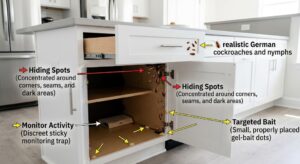
Seeing a German cockroach disappear into a kitchen cabinet can make you want to empty the entire kitchen. And if you spot one tiny nymph hiding behind a hinge or inside a drawer, you may start wondering just how many more are hiding where you can’t see them.
The good news is that controlling German cockroaches in kitchen cabinets is possible. The trick is to stop treating the problem as simply a matter of killing the roaches you can see.
German cockroaches are excellent at hiding in narrow cracks, cabinet seams, plumbing openings, appliance spaces, and other protected areas. Your kitchen also gives them easy access to food, moisture, and warmth.
That means successful control requires a combination of finding where they are hiding, removing what attracts them, monitoring their activity, using targeted bait, and preventing them from moving back into protected spaces.
This complete guide will show you how to tackle German cockroaches in kitchen cabinets step by step, how to choose the right products, what mistakes to avoid, and what to do when the infestation is more serious than it first appears.
Quick Answer: How Do You Control German Cockroaches in Kitchen Cabinets?
One of the smartest ways to tackle German cockroaches is to use an integrated pest management (IPM) approach. Instead of depending on one product or treatment, IPM combines several practical methods—such as cleaning, reducing moisture, monitoring activity, using targeted bait, and sealing hiding spots—to attack the problem from different angles.
- Empty and thoroughly clean the affected cabinets.
- Remove crumbs, grease, food residue, and unnecessary clutter.
- Reduce moisture around sinks, plumbing, and appliances.
- Place sticky traps to discover where cockroaches are traveling.
- Apply an appropriate cockroach gel bait to protected, label-approved locations.
- Consider an IGR for established infestations with ongoing nymph activity.
- Inspect the refrigerator, stove, dishwasher, microwave, and nearby cabinets.
- Seal suitable cracks and openings around cabinets and plumbing.
- Avoid repellent sprays and foggers that can interfere with baiting.
- Continue monitoring after activity begins to decline.
The goal isn’t simply to kill the cockroaches you see. It is to reduce the conditions that allow the infestation to survive and reproduce.
Quick Product Comparison
| Product | Main Purpose | Where It Belongs | Best For |
|---|---|---|---|
| Advion Cockroach Gel Bait | Targeted cockroach bait | Protected, label-approved cracks and crevices | Active infestations |
| Combat Max Roach Killing Gel | Gel bait | Suitable protected areas near cockroach activity | Targeted baiting |
| TERRO Cockroach Gel Bait | Cockroach bait | Protected locations where activity is found | Homeowners wanting a ready-to-use gel |
| Gentrol Point Source IGR | Disrupts cockroach development | Appropriate areas according to label | Established infestations |
| Combat Max Roach Killing Bait Stations | Enclosed bait | Cabinet corners and other suitable locations | Contained bait placement |
| Harris Boric Acid Roach Powder | Insecticidal dust | Appropriate dry, inaccessible voids | Hard-to-reach areas |
Bug Off Control Product-Selection Tip
You don’t necessarily need to buy every product on this list. For a smaller cabinet infestation, monitoring traps plus a properly labeled gel bait may be a sensible starting point. For an established infestation with continuing nymph activity, an IGR may complement the baiting program.
An insecticidal dust can have a place in some situations, but it should never be scattered across food-storage or food-preparation areas.
Always read the current product label before use. Application directions, permitted locations, precautions, and replacement schedules can vary between products.
Why German Cockroaches Are So Difficult to Control in Kitchen Cabinets
German cockroaches are particularly well adapted to living indoors. Kitchen cabinets give them several advantages at once:
- Darkness during the day
- Narrow hiding places
- Food particles
- Grease residue
- Water and humidity
- Warmth from nearby appliances
- Protection from household activity
A cabinet can look completely clean from the outside while still containing cracks and voids where cockroaches remain hidden. This is why spraying the few roaches you see on a countertop may provide only temporary relief.
The visible cockroach is often only a small part of the problem.
How to Identify German Cockroaches
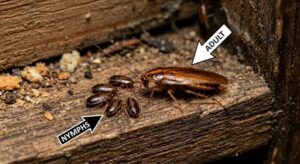
Adult German cockroaches are generally light brown or tan and have two dark, roughly parallel stripes behind the head. Young German cockroaches, called nymphs, are smaller and do not look exactly like adults. They are often darker, with a lighter marking running down the middle of the body.
Other signs can be just as important as seeing a live roach.
Look for:
- Small black or brown droppings
- Pepper-like specks in corners
- Shed skins
- Egg cases
- Tiny nymphs
- Dead cockroaches
- A recurring musty odor with heavier activity
- Cockroaches appearing after dark
- Roaches hiding around cabinet hinges or drawer tracks
If you repeatedly find nymphs, don’t assume you are dealing with an isolated visitor. Nymph activity suggests that reproduction is occurring somewhere nearby or that an established population is present.
Where German Cockroaches Hide in Kitchen Cabinets
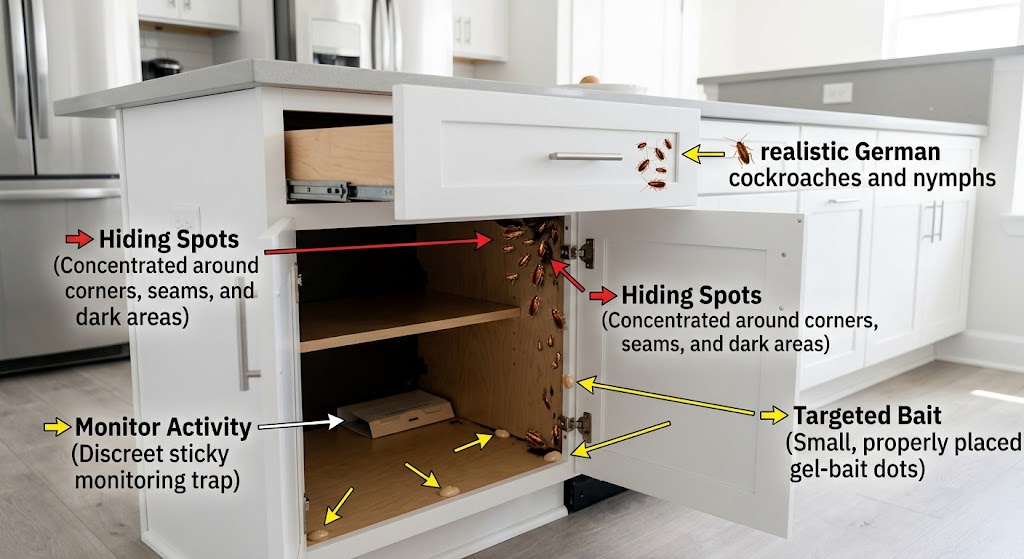
Don’t just inspect the middle of the shelves. German cockroaches prefer tight, protected spaces, so spend more time looking at the edges and hidden areas.
Cabinet Hinges
Check around hinges and the small spaces where cabinet doors meet the cabinet frame.
Drawer Tracks
Remove drawers where practical and inspect the tracks, corners, and space behind the drawer.
Cabinet Seams
Look closely where panels meet and where cabinet boxes meet walls.
Under the Sink
This area deserves special attention because plumbing provides both moisture and potential pathways into wall spaces.
Cabinet Toe-Kicks
The recessed area beneath lower cabinets can become a protected travel route.
Plumbing Openings
Inspect gaps around water supply lines and drainpipes.
Behind Appliances
Check around and behind the refrigerator, stove, dishwasher, and other appliances.
Areas Near Food Storage
Pantries and cabinets containing cereal, flour, pet food, snacks, and other dry goods deserve careful inspection.
German Cockroach Infestation Levels
Knowing how much activity you’re dealing with helps determine how aggressively you need to respond.
🟢 Light Infestation
Typical signs include:
- One or two nighttime sightings
- Little visible evidence of activity
- Few or no nymphs
- Activity concentrated around one area
Recommended Approach
Start with:
- Thorough cleaning
- Moisture reduction
- Sticky monitoring traps
- Targeted baiting
- Basic exclusion
Then monitor rather than immediately escalating to multiple pesticides.
🟡 Moderate Infestation
You may notice:
- Repeated nighttime activity
- Several cockroaches
- Nymphs
- Droppings in multiple locations
- Activity in several cabinets
- Activity around appliances or plumbing
Recommended Approach
Expand your inspection and treatment area.
Use:
- Sanitation
- Moisture control
- Monitoring traps
- Properly placed bait
- Enclosed bait stations where appropriate
- An IGR when suitable
- Exclusion and sealing
The important thing at this stage is to avoid treating only the cabinet where you happen to see the most roaches.
🔴 Severe Infestation
Warning signs can include:
- Numerous cockroaches
- Frequent daytime sightings
- Large numbers of nymphs
- Heavy droppings
- Egg cases
- Activity throughout the kitchen
- Cockroaches spreading into other rooms
Daytime sightings can occur for several reasons, but frequent daytime activity can be associated with a substantial infestation.
Recommended Approach
A severe infestation calls for a much broader inspection.
Check:
- All kitchen cabinets
- Appliances
- Plumbing areas
- Wall gaps
- Toe-kicks
- Nearby bathrooms
- Pantry areas
- Adjacent rooms
At this point, professional pest management may be appropriate, particularly if activity continues despite careful DIY treatment.
Step 1: Empty the Kitchen Cabinets
Before applying any pest-control product, remove the contents of the affected cabinet. Take out:
- Food
- Plates
- Cups
- Pots
- Pans
- Small appliances
- Paper products
- Unnecessary packaging
Inspect food packages for signs of cockroach activity. Anything contaminated should be handled appropriately rather than simply returned to the cabinet.
Step 2: Clean the Cabinets Thoroughly
Vacuum loose crumbs, droppings, shed skins, and other debris from accessible areas. Then clean the cabinet surfaces. Concentrate on:
- Corners
- Shelf edges
- Cabinet seams
- Drawer tracks
- Hinges
- Areas beneath stored items
- Greasy surfaces
Cleaning isn’t a complete cockroach treatment, but it removes some of the food and debris that help support an infestation.
Don’t Forget the Areas Around the Cabinets
Clean nearby:
- Countertops
- Floors
- Backsplashes
- Areas beneath appliances
- Stove sides
- Refrigerator sides
- Trash areas
German cockroaches don’t recognize your cabinet as a separate world. They may move between cabinets, appliances, countertops, and wall spaces.
Step 3: Store Food Properly
Open food packages can make a kitchen much more attractive to cockroaches. Whenever practical, transfer dry foods into tightly sealed containers.
Pay particular attention to:
- Flour
- Cereal
- Sugar
- Rice
- Pasta
- Crackers
- Pet food
- Snacks
Don’t forget pet food. If food is left accessible overnight, it can become another reason for cockroaches to remain active.
Step 4: Eliminate Easy Water Sources
A clean kitchen can still support cockroaches if water is readily available. Inspect:
- Faucet connections
- Sink plumbing
- Drainpipes
- Cabinet floors
- Dishwasher connections
- Refrigerator water lines
- Damp sponges
- Areas around appliances
Repair leaks when possible. Before bedtime, wipe down the sink and surrounding surfaces and avoid leaving unnecessary standing water. Reducing moisture won’t eliminate an infestation by itself, but it can make the environment less favorable.
Step 5: Use Sticky Traps to Find the Hot Spots
This is one of the most useful steps because it tells you where the cockroaches are actually active. Place monitoring traps near:
- Cabinet corners
- Under the sink
- Behind the refrigerator
- Beside the stove
- Near the dishwasher
- Along cabinet toe-kicks
- Near suspected travel routes
Place traps along edges and corners rather than randomly in the center of a room. Check them regularly. If one trap catches substantially more cockroaches than another, you’ve gained valuable information about where to concentrate your control efforts.
Step 6: Apply Cockroach Gel Bait Strategically
Gel bait can be highly useful against German cockroaches when applied correctly. The biggest mistake is thinking that more bait means better control. It doesn’t. Follow the product label for placement amount and frequency. Use small placements in appropriate protected areas where cockroaches are likely to encounter the bait. Potential locations can include suitable:
- Cracks
- Crevices
- Cabinet corners
- Seams
- Areas near hinges
- Spaces beneath sinks
- Other identified travel routes
The exact permitted application site depends on the product label.
Keep Bait Away From Food
Never apply pesticide where it could contaminate food, dishes, utensils, or food-contact surfaces. If a cabinet contains exposed food or dishes, remove those items before treatment and follow the product label carefully.
Step 7: Give the Bait Time to Work
One reason homeowners become frustrated is that they expect every cockroach to disappear immediately. Targeted baiting is not necessarily an instant solution. You may continue seeing some activity while the treatment is taking effect. Instead of judging success by one day’s sightings, look for an overall trend:
- Are you seeing fewer roaches?
- Are fewer nymphs appearing?
- Are monitoring traps catching fewer insects?
- Is nighttime activity declining?
Those changes are more useful indicators than whether you happened to see one cockroach tonight.
Step 8: Consider an IGR for Established Infestations
An insect growth regulator, or IGR, works differently from a conventional insecticide. Products containing (S)-hydroprene, for example, are designed to interfere with insect development. An IGR does not function simply as a quick-kill product. It can complement a baiting program by helping disrupt the cockroach life cycle.
An IGR May Be Particularly Useful When:
- Nymphs are common
- The infestation has been established
- Activity repeatedly returns
- Several areas are affected
- You want to address reproduction as part of the control strategy
Use an IGR only according to its current label, including instructions about placement, coverage, food, and replacement.
Step 9: Use Enclosed Bait Stations When Appropriate
Enclosed bait stations offer another way to provide cockroach bait while keeping the bait contained within a housing. Depending on the product label, suitable locations may include:
- Cabinet corners
- Under sinks
- Behind appliances
- Near trash areas
- Along cockroach travel routes
Bait stations are a convenient option when you prefer not to leave exposed gel bait in the open. Just remember that location matters. A station placed close to where cockroaches are active or regularly travel is likely to be more useful than one placed too far away from their usual hiding and movement areas.
Step 10: Use Boric Acid Carefully
Boric acid products can be useful in certain cockroach-control programs, but they should be treated as a targeted tool, not something to spread throughout the kitchen.
Where the product label permits dust application, a light application in an appropriate inaccessible and dry void is preferable to creating a large visible pile. Cockroaches can avoid heavy deposits.
Never Put Boric Acid on Food-Contact Areas
Do not scatter insecticidal dust across:
- Shelves used for exposed food
- Countertops
- Plates
- Utensils
- Food containers
- Food-preparation surfaces
Keep pesticide products inaccessible to children and pets and follow all label directions.
Step 11: Don’t Forget the Appliances
If cockroaches continue appearing in your cabinets, look beyond the cabinets. Inspect around:
Refrigerator
Check the floor and wall area around the refrigerator and other accessible exterior spaces.
Stove
Look around the sides, back, and nearby cabinetry.
Dishwasher
Inspect surrounding gaps and plumbing areas.
Microwave
Check appropriate exterior areas rather than opening or treating electrical components.
Coffee Makers and Small Appliances
If activity is associated with warm small appliances, inspect the surrounding area and follow appropriate appliance and pesticide safety precautions.
Important Safety Rule
Never spray insecticide into an electrical appliance or electronic component unless the product label specifically permits that application.
Do not put gel bait or insecticidal dust inside appliances simply because you suspect roaches are hiding there.
Step 12: Seal Cabinet and Plumbing Gaps
Once you’ve identified potential hiding and movement routes, seal appropriate openings.
Look for gaps:
- Around pipes
- Around plumbing penetrations
- Between cabinet boxes
- Where cabinets meet walls
- Around toe-kicks
- Around countertops
- Along obvious wall openings
Small cracks can often be sealed with an appropriate caulk. Larger openings may require a more suitable repair material. Sealing isn’t a replacement for baiting, but it can reduce hiding opportunities and make it harder for cockroaches to move through the structure.
Step 13: Reduce Clutter Around the Kitchen
German cockroaches prefer protected spaces. Reduce unnecessary:
- Cardboard boxes
- Paper bags
- Food packaging
- Stacks of newspapers
- Clutter beneath sinks
- Items stored against walls
This makes inspection easier and removes potential hiding places.
Step 14: Avoid Common DIY Mistakes
Mistake #1: Spraying Every Roach You See
It feels satisfying, but killing visible insects doesn’t necessarily address the hidden population.
Mistake #2: Using Huge Amounts of Gel
More bait isn’t automatically more effective. Follow the product label.
Mistake #3: Spraying Around Bait
Some sprays can repel cockroaches away from bait and interfere with the control strategy.
Mistake #4: Using Foggers as the Main Treatment
Foggers may not penetrate the narrow cracks and protected harborages where German cockroaches spend much of their time.
Mistake #5: Treating Only One Cabinet
If the population is established, it may be moving through several cabinets, appliances, and wall spaces.
Mistake #6: Ignoring Nymphs
Small nymphs are an important clue that you may be dealing with an active breeding population.
Mistake #7: Forgetting Moisture
Leaks under the sink or around appliances can continue supporting cockroach activity even after cleaning.
Mistake #8: Applying Pesticides to Food-Contact Surfaces
This creates an unnecessary contamination risk. Always follow the product label and keep pesticides away from food and food-preparation areas.
How Long Does German Cockroach Control Take?
There is no single timetable that works for every infestation. A small infestation may respond relatively quickly, while an established population can require continued monitoring and repeated treatment according to product directions. Don’t assume the problem has failed simply because you see a cockroach a few days after treatment. Instead, track the trend.
Signs Your Strategy Is Working
Look for:
- Fewer live cockroaches
- Fewer nymphs
- Fewer trap catches
- Less nighttime activity
- Fewer new droppings
- Reduced activity around previously busy cabinets
If activity isn’t declining, don’t simply keep adding more pesticide.
Reinspect the strategy.
The problem may be coming from an untreated appliance, wall void, plumbing area, neighboring room, or another source.
A Simple 4-Week Kitchen Cabinet Control Plan
Week 1: Find and Remove the Problem
- Empty affected cabinets
- Clean thoroughly
- Remove food debris
- Fix moisture problems
- Install monitoring traps
- Identify activity hotspots
- Apply appropriate bait according to the label
Week 2: Monitor
Check traps and inspect cabinets again. Look for changes in:
- Roach numbers
- Nymph activity
- Droppings
- Locations of activity
Refresh bait only according to product directions.
Week 3: Reassess
If activity is clearly declining, remain consistent. If activity is still high, inspect:
- Appliances
- Plumbing
- Adjacent cabinets
- Toe-kicks
- Wall openings
- Nearby rooms
Consider whether an IGR is appropriate.
Week 4: Maintain
Continue monitoring. Clean regularly, keep food sealed, reduce moisture, and maintain exclusion work. Don’t stop monitoring simply because you haven’t seen a cockroach for several days.
How to Prevent German Cockroaches From Returning
Once activity is under control, prevention becomes much easier.
Keep Food Sealed
Use tightly closed containers for dry foods.
Clean Food Residue
Don’t allow crumbs and grease to build up around cabinets and appliances.
Keep the Sink Area Dry
Reduce standing water and repair leaks.
Reduce Cardboard
Especially avoid unnecessary cardboard storage in or near the kitchen.
Inspect Incoming Items
Check grocery bags, packages, used appliances, and other items that enter the home.
Maintain Cabinet Seals
Repair new cracks and openings when you find them.
Keep Monitoring
A few strategically placed sticky traps can give you an early warning if activity begins again.
When Should You Call a Pest Professional?
DIY control can work for many situations, but some infestations are difficult to manage without professional equipment and experience. Consider professional help when:
- Roaches remain numerous despite consistent treatment
- Daytime activity continues
- Multiple rooms are affected
- Nymphs remain abundant
- Cockroaches are emerging from inaccessible areas
- You suspect wall voids or shared building spaces are involved
- The infestation repeatedly returns
- You are uncomfortable handling pesticides
This is especially important in apartments, condos, and other multi-unit buildings because cockroaches can move between connected spaces. A professional can inspect the structure and identify harborage areas that may be difficult for a homeowner to access.
Frequently Asked Questions
1. What is the best way to control German cockroaches in kitchen cabinets?
Use a combination of sanitation, moisture reduction, monitoring traps, targeted baiting, exclusion, and—when appropriate—an IGR. No single product is guaranteed to solve every infestation.
2. Why are German cockroaches hiding inside my kitchen cabinets?
Cabinets provide darkness and protection while placing cockroaches close to food, moisture, and warmth. Cracks, hinges, seams, and plumbing openings can provide particularly good hiding places.
3. Should I spray German cockroaches inside kitchen cabinets?
Avoid indiscriminate spraying. Some repellent insecticides can interfere with baiting, and pesticides should not be applied to food, dishes, or food-contact surfaces unless the label specifically allows it.
4. Where should I put cockroach gel bait in kitchen cabinets?
Use it only in locations permitted by the product label. Suitable protected cracks, crevices, corners, and other areas close to cockroach activity may be appropriate depending on the specific product.
5. Why am I still seeing roaches after putting down bait?
Bait does not necessarily cause an instant disappearance. Continue monitoring for an overall decline. If activity remains high, investigate hidden harborages and untreated areas rather than simply applying more bait.
6. What does it mean if I see baby German cockroaches?
Nymphs are an important sign of an active infestation and may indicate that reproduction is occurring nearby. Inspect surrounding cabinets, appliances, plumbing areas, and other protected spaces.
7. Are cockroach bait stations better than gel bait?
Neither is automatically better. Gel bait provides flexible placement in suitable protected areas, while enclosed stations keep bait contained. Choose based on the infestation, placement options, household needs, and product label.
8. Can German cockroaches live behind kitchen cabinets?
Yes. Gaps behind cabinets and between cabinet components can provide protected hiding places. Plumbing openings and appliance spaces can also connect these areas.
9. Should I use an IGR with cockroach bait?
An IGR can complement baiting in established infestations, particularly when nymph activity is present. It works differently from bait, so the two approaches can address different parts of the infestation.
10. What should I do if German cockroaches keep coming back?
Inspect beyond the original cabinet. Check appliances, plumbing, wall openings, adjacent cabinets, moisture sources, and nearby rooms. If the infestation continues despite consistent control efforts, consider professional pest management.
Related German Cockroach Guides
If you’re dealing with German cockroaches in kitchen cabinets, you may also want to investigate other common kitchen hiding places:
- How to Get German Cockroaches Out of a Refrigerator
- How to Get German Cockroaches Out of a Microwave
- How to Get German Cockroaches Out of a Coffee Maker
- How to Get German Cockroaches Out of a Toaster
- German Cockroach Infestation in Stove
- How to Get German Cockroaches Out of an Oven
- How to Get Rid of German Cockroaches in the Kitchen
These related guides can also help you determine whether the activity you’re seeing inside a cabinet is actually coming from a nearby appliance or another part of the kitchen.
Conclusion: Take Control of German Cockroaches in Your Cabinets
German cockroaches in kitchen cabinets can be frustrating, but you don’t have to attack the problem blindly.
Start by finding the activity, cleaning away food residue, reducing moisture, and using monitoring traps to identify the busiest areas. Then concentrate your baiting efforts where cockroaches are actually traveling and hiding.
For established infestations, an IGR may provide another useful layer of control by disrupting development. Appropriate exclusion work can help reduce hiding and movement routes, while continued monitoring helps you catch any remaining activity. Most importantly, resist the temptation to spray everything you see.
A successful German cockroach strategy is less about using the most pesticide and more about using the right control methods in the right places.
With patience, careful monitoring, good sanitation, and targeted treatment, you can make your kitchen cabinets a much less welcoming place for German cockroaches—and keep them that way.
Bug Off Control Recommended: Start with monitoring + sanitation + targeted baiting + moisture control, then expand your strategy if the evidence shows the infestation is larger than the cabinet itself.