How to Get Rid of German Cockroaches in a Car
Finding a German cockroach crawling under your car seat is bad enough. Finding another one on the dashboard a few nights later is when you start wondering just how many are hiding out of sight.
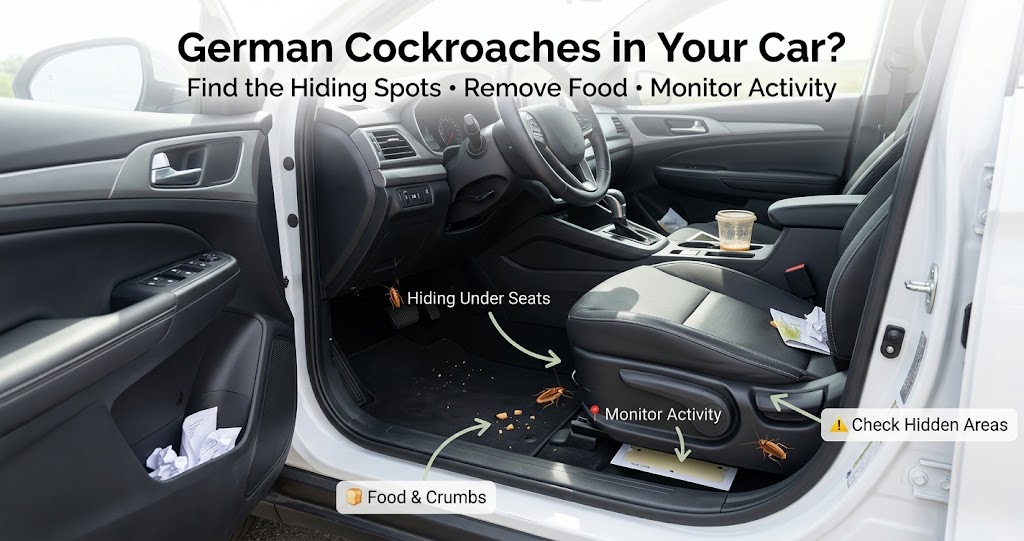
Unfortunately, a vehicle can provide German cockroaches with more shelter than you might expect. Crumbs under the seats, spilled drinks, clutter, dark crevices, seat rails, storage compartments, and protected areas around the dashboard can all give them places to hide.
The good news is that a cockroach problem in your vehicle can be brought under control.
The trick is not to simply spray every roach you see. A better approach is to remove food and clutter, vacuum thoroughly, identify where the insects are traveling, use appropriately labeled control products, and continue monitoring after treatment.
This guide explains how German cockroaches get into cars, where they hide, how to identify an infestation, which control methods can help, what mistakes to avoid, and how to keep them from coming back.
Quick Answer: How Do You Get Rid of German Cockroaches in a Car?
The most practical approach is a combination of: Remove clutter and food → deep clean → vacuum → monitor → use targeted control where permitted → continue inspecting.
Start by removing food, trash, cardboard, bags, and unnecessary belongings from the vehicle. Vacuum seats, carpets, seat rails, floorboards, the trunk, and other accessible hiding areas.
Next, use sticky monitoring traps in safe, hidden locations to determine where cockroaches are most active.
If activity continues, a cockroach gel bait or appropriately labeled enclosed bait station may help target cockroaches in areas where they hide and travel. An insect growth regulator (IGR) may also be useful in some established infestations when the specific product label permits the intended application.
Avoid using household foggers or bug bombs inside a vehicle unless the product’s current label specifically allows that use. A pesticide intended for a house is not automatically approved for an automobile.
The goal is not simply to kill the cockroaches you can see. The goal is to eliminate the conditions that allow them to survive and reproduce.
Amazon Associate Disclosure
As an Amazon Associate, Bug Off Control earns from qualifying purchases. Product information is provided for informational purposes, and product availability, prices, ratings, and specifications can change. Always read and follow the current manufacturer’s label and safety instructions before using any pest-control product.
Best Products for German Cockroaches in a Car
| Product Type | Best Use | Why It Can Help | Important Consideration |
|---|---|---|---|
| Advion Cockroach Gel Bait | Targeted baiting | Provides a food-based bait for cockroaches | Use only where the current label permits |
| Gentrol Point Source IGR | Reproduction/development control | Helps interfere with normal development of immature cockroaches | Verify the current label and approved application site |
| Combat Max Roach Bait Stations | Enclosed baiting | Keeps bait contained inside a station | Station must be positioned safely and according to its label |
| Harris Boric Acid Roach Powder | Appropriate cracks and voids | Provides insecticidal dust control when properly applied | Avoid airborne dust and exposed deposits |
| Catchmaster Glue Traps | Monitoring | Helps reveal where cockroaches are traveling | Place where they cannot interfere with vehicle operation |
| Diatomaceous Earth | Supplemental control | Can damage an insect’s protective outer layer | Avoid creating airborne dust and use an appropriate labeled product |
Bug Off Control Recommended
For most vehicle infestations, I would think in terms of a control system rather than a single product: Thorough cleaning + vacuuming + monitoring traps + targeted bait An appropriately labeled IGR may be added when an established infestation includes immature cockroaches.
Product labels and approved uses can change, and formulations can differ between locations. Always read the current product label before using an insecticide in or around a vehicle.
How German Cockroaches Get Into Cars
German cockroaches usually don’t have to crawl across a parking lot and climb into your vehicle. More often, they arrive as unwanted passengers. A cockroach can potentially be transported inside a bag, box, package, piece of luggage, or another item that is brought into the vehicle.
Cardboard Boxes and Packages
Cardboard can provide dark, protected hiding places for cockroaches. Packages, grocery boxes, deliveries, and storage containers can potentially transport insects from an infested location. If you don’t need cardboard inside your vehicle, remove it rather than allowing boxes to sit in the trunk for weeks.
Backpacks, Gym Bags and Work Bags
Bags that have been sitting on floors or in storage areas can potentially pick up cockroaches. Once the bag enters your vehicle, a hidden insect may eventually emerge.
Grocery Bags and Shopping Items
Reusable grocery bags, paper bags, food packaging, and other shopping items can provide opportunities for cockroaches to hitchhike. This is especially important when groceries are transported from a location with an existing infestation.
Infested Homes or Apartments
If your vehicle is repeatedly parked at or used around an infested property, belongings can potentially transport cockroaches into the vehicle. This can make the problem seem as though it is “coming back” even after the car has been thoroughly cleaned.
Passengers and Personal Belongings
A person does not have to carry a visible cockroach for one to enter your vehicle. Backpacks, purses, luggage, boxes, clothing, and other belongings can provide hiding places.
Where Do German Cockroaches Hide in Cars?
German cockroaches prefer protected areas where they can remain close to food, moisture, warmth, and shelter.
Inspect areas such as:
- Under the front seats
- Around seat rails
- Beneath floor mats
- Along carpet edges
- Inside center-console compartments
- Around cup holders
- Inside door storage pockets
- Around the glove compartment
- Beneath accessible trim
- Around the trunk
- Beneath trunk liners
- Around the spare-tire compartment
- Near food-storage areas
- Around accessible cracks and crevices
- Protected areas around the dashboard
- Areas surrounding HVAC components
Don’t assume that you will see cockroaches during the day. German cockroaches are primarily nocturnal, so a nighttime inspection can sometimes reveal activity that isn’t obvious during daylight hours.
Signs of German Cockroaches in a Vehicle
Seeing one cockroach doesn’t automatically prove that your entire vehicle is infested. However, repeated sightings or evidence of reproduction should be taken seriously. Look for the following signs.
Live Cockroaches
Adults and small nymphs are signs of active cockroach activity. If you’re seeing tiny nymphs, the problem deserves particular attention because they indicate that immature cockroaches are present.
Droppings
Small dark spots or specks can occur in protected areas where cockroaches spend time.
Shed Skins
Cockroach nymphs shed their outer skins as they grow. Finding multiple shed skins in a protected area can indicate repeated activity.
Egg Cases
German cockroach egg cases are called oothecae. Finding an ootheca in your vehicle is an important warning sign because it indicates that reproduction may be occurring.
Unpleasant Odor
Larger infestations can sometimes produce a stale or unpleasant odor as insects, droppings, and other debris accumulate.
Repeated Nighttime Activity
If you repeatedly see cockroaches after dark, especially in several areas of the vehicle, don’t assume each sighting represents a separate insect. There may be a hidden harborage nearby.
Can German Cockroaches Live in a Car?
Yes. A vehicle can provide shelter and, under favorable conditions, enough food and moisture for German cockroaches to survive. The risk becomes greater when food crumbs, sugary drinks, trash, cardboard, bags, and clutter remain inside the vehicle.
However, a car is also a changing environment. Temperature, humidity, food availability, cleaning, and vehicle use can all affect whether cockroaches can continue to survive. That is why removing food and shelter is such an important part of control.
Can German Cockroaches Reproduce in a Car?
Yes, it is possible if conditions are favorable. Finding an adult cockroach is one thing. Finding nymphs or egg cases is more concerning because it suggests the insects are not simply passing through.
A vehicle with accessible food, moisture, warmth, and protected hiding places can potentially support an ongoing population. If you are seeing numerous nymphs, repeated activity, or egg cases, treat the problem as more than an occasional hitchhiker. This is also when monitoring becomes especially valuable. You want to know whether activity is actually declining after treatment.
Why You Should Not Use a Bug Bomb or Fogger Inside Your Car
A common reaction to seeing cockroaches is to reach for a fogger or bug bomb. That is usually not the approach you want to take with a vehicle.
Fogging can:
- Leave pesticide residues on surfaces
- Create unnecessary exposure
- Reach surfaces that people regularly touch
- Potentially affect vehicle materials
- Fail to reach every hidden harborage
- Push insects deeper into protected spaces
- Create fire or explosion hazards with certain products
Most importantly, a product approved for use inside a home is not automatically approved for use inside a vehicle. Never assume that a fogger is safe simply because it is labeled for cockroach control. Only use a pesticide inside a vehicle when the current product label specifically permits that application.
Step 1: Remove Everything From the Vehicle
Before you begin treatment, empty the vehicle as much as practical.
Remove:
- Food
- Drink containers
- Wrappers
- Cardboard
- Paper bags
- Clothing
- Backpacks
- Toys
- Loose papers
- Trash
- Unnecessary trunk contents
Pay particular attention to objects that have been sitting beneath seats or inside the trunk. If you discover a heavily infested bag or box, don’t simply carry it into your home. That can potentially turn a vehicle problem into a household problem.
Step 2: Deep Clean the Interior
Cleaning removes many of the things that make a vehicle attractive to cockroaches. Wipe hard surfaces to remove food residue and spills. Pay special attention to:
- Cup holders
- Center-console compartments
- Door pockets
- Storage compartments
- Areas where food is regularly eaten
- Places where drinks have spilled
A single crumb isn’t likely to create an infestation by itself. The problem is the ongoing supply of food and residue that can support cockroaches over time.
Step 3: Vacuum the Vehicle Thoroughly
A thorough vacuuming is one of the most useful nonchemical steps you can take. Use a crevice attachment if available.
Concentrate on:
- Seat seams
- Under seats
- Seat rails
- Floorboard edges
- Carpet seams
- Around the center console
- Beneath floor mats
- Trunk carpeting
- Spare-tire compartments
- Accessible cracks and crevices
Vacuuming can physically remove cockroaches, nymphs, shed skins, droppings, crumbs, and other debris. Afterward, empty and handle the vacuum contents appropriately so insects cannot simply escape and return to the vehicle.
Step 4: Use Glue Traps to Find the Hot Spots
Monitoring traps are useful because they can tell you where the cockroaches are actually traveling. Place traps in safe, hidden locations where they won’t interfere with driving or normal vehicle operation. Potential monitoring locations include:
- Under seats
- Along floor edges
- Inside the trunk
- Near the spare-tire compartment
- Near suspected hiding areas
Check them regularly. If most catches occur beneath one seat, for example, that gives you a useful clue about where to concentrate your inspection. Monitoring is especially valuable because a vehicle can contain hidden spaces that aren’t easy to inspect visually.
Step 5: Apply Cockroach Gel Bait Carefully
Gel bait can provide targeted control without coating the vehicle with insecticide. If the product’s current label permits the intended use, apply small placements only in suitable protected locations. Do not place insecticide where occupants will regularly touch it or where it could interfere with driving.
Avoid applying bait to:
- Steering wheels
- Gear selectors
- Pedals
- Door handles
- Seats
- Touchscreens
- Dashboard controls
- Other frequently touched surfaces
Never place bait where it could become a driving hazard.
Why Small Bait Placements Matter
More bait does not necessarily mean better control. German cockroaches can consume relatively small amounts of bait, so excessive application can create unnecessary mess and increase the opportunity for accidental contact. Follow the specific product label rather than assuming that a larger amount will work faster.
Step 6: Consider an IGR for an Established Infestation
An insect growth regulator, or IGR, works differently from many conventional cockroach insecticides. Instead of simply targeting exposed cockroaches, an IGR interferes with normal insect development. Products such as Gentrol Point Source are designed to release an IGR over time.
An IGR may be useful as part of an integrated cockroach-control program when immature cockroaches are present. However, do not assume that every IGR product can be used in every vehicle or location. Check the current product label for the exact formulation, application site, placement instructions, and restrictions.
Step 7: Consider Enclosed Bait Stations
Some people prefer enclosed bait stations because the bait remains inside a housing. They can be convenient where an enclosed format is appropriate.
If using one, make sure it:
- Is permitted for the intended application
- Remains secure
- Cannot slide beneath pedals
- Does not interfere with the driver
- Does not obstruct seats or controls
- Cannot become a projectile during sudden braking
An enclosed station is not automatically better than gel bait. The right choice depends on the infestation, the location, and what the product label permits.
Step 8: Be Careful With Boric Acid and Other Dusts
Insecticidal dusts can be useful when applied correctly. But more is not better. A heavy pile of powder is not what you want. Where the label permits dust application, a light application into an appropriate crack or void is generally more sensible than leaving visible piles. Avoid creating airborne dust, particularly inside the confined space of a vehicle. Do not apply loose insecticidal dust to surfaces where occupants sit, touch, or regularly track it around the cabin.
Step 9: Don’t Depend on Essential Oils to Eliminate the Infestation
Peppermint, lemongrass, and other essential oils are often promoted online as natural cockroach solutions. Some substances may have repellent effects under certain conditions, but that does not make them a dependable way to eliminate an established German cockroach population. Don’t let scented products replace the fundamentals: Cleaning + vacuuming + monitoring + appropriate targeted control. Those steps should remain the foundation of your approach.
Step 10: Find and Correct the Source
This is one of the most important steps. If cockroaches continue appearing after the vehicle has been cleaned and treated, ask yourself: Where are the new cockroaches coming from? Consider whether the vehicle is repeatedly exposed to:
- An infested home
- An apartment building
- A workplace
- A restaurant or food-service environment
- Storage areas
- Infested luggage
- Grocery bags
- Cardboard boxes
- Backpacks
- Other vehicles
You could successfully reduce the existing population while continuing to introduce new cockroaches through belongings. Source control is therefore just as important as treating the vehicle itself.
What About Extreme Heat or Cold?
Extreme temperatures can affect cockroach survival, but simply leaving a vehicle outside in hot or cold weather is not a reliable treatment method. A vehicle can become extremely hot in direct sunlight, but temperatures can vary significantly between the cabin and hidden areas. Cold weather presents a similar problem.
You cannot assume that the temperature outside has been maintained long enough, or reached the necessary temperature throughout every hiding place, to eliminate all cockroaches and egg cases.
Don’t rely on weather as your primary treatment.
If cockroaches have moved into inaccessible areas such as dashboard components, HVAC spaces, or interior trim, professional pest management or appropriate vehicle disassembly may be necessary.
What About Diatomaceous Earth?
Diatomaceous earth can affect insects by damaging the protective outer layer that helps them retain moisture. However, it must be used carefully. If you choose to use it, select a product intended for pest control and follow its label. Avoid creating airborne dust, especially inside a confined vehicle.
And remember: Natural does not automatically mean harmless to breathe.
For many vehicle infestations, monitoring and targeted baiting can provide a cleaner and more practical approach when those uses are permitted by the product label.
German Cockroach Control in a Car: Light, Moderate and Heavy Infestations
Not every vehicle infestation requires the same level of response.
🟢 Light Activity
Signs may include:
- One or two sightings
- No obvious droppings
- No nymphs
- No egg cases
- Few or no trap catches
Recommended approach
Clean → vacuum → monitor → inspect
If activity disappears, continue checking periodically.
🟡 Moderate Activity
Signs may include:
- Repeated sightings
- Several trap catches
- Small nymphs
- Droppings
- Activity in multiple areas
Recommended approach
Deep clean → vacuum → locate hot spots → targeted baiting where permitted → consider an appropriately labeled IGR → continue monitoring. The important thing at this stage is to determine whether activity is actually declining.
🔴 Heavy Activity
Signs may include:
- Numerous cockroaches
- Many nymphs
- Egg cases
- Frequent daytime sightings
- Activity throughout the cabin
- Cockroaches emerging from dashboard or HVAC areas
Recommended approach
A heavy infestation may require professional pest management, particularly when cockroaches have moved into inaccessible vehicle components. repeatedly spraying visible insects is unlikely to address the hidden population.
How Long Does It Take to Get Rid of German Cockroaches in a Car?
Don’t expect an established infestation to disappear overnight. Cleaning and targeted control may reduce visible activity relatively quickly, but hidden cockroaches and developing nymphs can remain. That’s why monitoring matters. Instead of asking:
“I haven’t seen a cockroach today. Am I done?”
Ask:
“Are trap catches declining, and am I continuing to find evidence of activity?” A longer period of monitoring provides a much better indication of whether control is working.
How to Keep German Cockroaches From Coming Back
Once you’ve reduced the infestation, prevention becomes your next priority.
Keep Food Out of the Vehicle
Avoid leaving meals, snacks, sugary drinks, and food wrappers inside overnight.
Empty Trash Regularly
Don’t allow cups, wrappers, containers, or food packaging to accumulate.
Remove Cardboard
Avoid using the trunk as long-term storage for cardboard boxes.
Inspect Bags
Check backpacks, grocery bags, luggage, and work equipment before bringing them into the vehicle.
Clean Spills Quickly
Sweet drinks and food residue should be cleaned rather than allowed to accumulate.
Continue Monitoring
Keep monitoring traps in appropriate hidden locations when practical and check them periodically.
Pay Attention to Parking Locations
If sightings repeatedly increase after parking near dumpsters, heavily infested buildings, or other high-risk locations, consider whether those environments are contributing to the problem.
Common Mistakes That Make Vehicle Cockroach Problems Worse
Spraying Every Cockroach You See
Killing a visible cockroach doesn’t necessarily eliminate the hidden population.
Using Too Much Insecticide
More pesticide does not automatically mean better control.
Ignoring Food Sources
Food residue, spills, and trash can continue supporting cockroaches.
Treating Without Monitoring
Without traps or regular inspections, it can be difficult to determine whether the population is actually declining.
Forgetting the Trunk
The trunk and spare-tire compartment can provide dark, protected areas.
Moving Infested Items Into Your Home
A contaminated bag or box can potentially transfer cockroaches from the vehicle into your house.
Using a Household Product Without Checking the Label
A pesticide designed for household use is not automatically approved for automotive applications.
Assuming One Treatment Is Enough
German cockroaches can hide extremely well. If you stop checking immediately after the first treatment, you may miss continuing activity.
When Should You Call a Professional?
Professional help becomes especially worthwhile when:
- You see cockroaches during the daytime
- There are numerous nymphs
- Egg cases are present
- Activity continues after thorough cleaning and appropriate treatment
- Cockroaches appear to be coming from the dashboard
- Activity seems concentrated around inaccessible HVAC components
- You cannot safely reach the suspected harborage
- The vehicle is being repeatedly reinfested
A professional can help identify hidden harborages and determine whether additional access or treatment is necessary. For severe infestations, professional pest management may be more effective than repeatedly applying consumer sprays.
Frequently Asked Questions
1. Can German cockroaches live in a car?
Yes. A vehicle can provide protected hiding areas and, when food and moisture are available, conditions that allow German cockroaches to survive.
2. How did German cockroaches get into my car?
They can potentially arrive inside bags, boxes, luggage, groceries, clothing, backpacks, or other belongings. Repeated exposure to an infested location can also contribute to the problem.
3. Where do German cockroaches hide in cars?
Common hiding areas include under seats, around seat rails, inside storage compartments, beneath carpets, around the trunk, and in protected areas around the dashboard and other interior components.
4. Should I use a roach bomb inside my car?
A fogger or bug bomb is generally not a good DIY solution for treating a vehicle. It can create unnecessary pesticide exposure and may not effectively reach hidden cockroach harborages. Never use one unless its current label specifically permits the intended application.
5. What is the best product for German cockroaches in a vehicle?
There isn’t one universal “best” product for every vehicle. Targeted cockroach gel bait can be useful where its label permits the application, while monitoring traps help identify activity. An appropriately labeled IGR may provide another tool when immature cockroaches are present.
6. Will cleaning my car get rid of German cockroaches?
Cleaning and vacuuming can remove food, debris, insects, and some hiding material, but an established infestation may require additional control measures.
7. Can cockroaches live in my car’s air-conditioning system?
Cockroaches can potentially occupy protected areas around HVAC components, but seeing one near an air vent does not automatically prove that the entire HVAC system is infested.
If cockroaches repeatedly emerge from vents, professional inspection may be appropriate.
8. Will leaving my car in the sun kill German cockroaches?
Not reliably. A vehicle can become extremely hot, but temperatures can vary throughout the cabin and hidden spaces. Don’t rely on sunlight alone to eliminate an infestation.
9. Can German cockroaches get from my car into my house?
Yes. Cockroaches can potentially be transferred when infested bags, boxes, luggage, clothing, or other belongings are moved from the vehicle into your home.
10. How do I know when the cockroaches are gone?
Continued monitoring is the best way to judge progress. You want to see activity decline and traps remain empty over time. Continue inspecting rather than relying on a single day without a sighting.
11. Can German cockroaches reproduce inside a car?
Yes, if conditions are favorable. Finding nymphs or egg cases is a stronger warning sign than finding a single adult because it suggests reproduction may be occurring.
12. How can I keep German cockroaches from returning to my car?
Keep food and trash out of the vehicle, clean spills promptly, remove unnecessary cardboard and clutter, inspect bags and packages, and periodically monitor areas where cockroaches have previously been found.
Related German Cockroach Guides
If you’re dealing with German cockroaches in your vehicle, they may also be hiding in other warm, protected areas around your home. Continue learning with these related Bug Off Control guides:
- How to Get Rid of German Cockroaches in Your Refrigerator
- How to Get German Cockroaches Out of a Microwave
- How to Get German Cockroaches Out of a Coffee Maker
- How to Get German Cockroaches Out of a Toaster
- German Cockroach Infestation in a Stove
- How to Get Rid of German Cockroaches in an Oven
These guides can help if the vehicle is not the only place where you’ve noticed German cockroach activity.
Final Thoughts
German cockroaches in a vehicle are frustrating, but seeing one does not mean you are stuck with them forever. The biggest mistake is concentrating only on the cockroaches you can see. Instead, think about the entire problem: Where did they come from? Where are they hiding? What are they eating? Where are they traveling? And are they reproducing?
Start by removing food, trash, clutter, and unnecessary cardboard. Then vacuum thoroughly and use monitoring traps to identify the areas receiving the most activity.
If cockroaches continue to appear, targeted baiting and other appropriate control methods may help when the product label permits their use. Continue monitoring rather than assuming the problem is over after one treatment.
Remember that a vehicle is a confined space containing electronics, upholstery, plastics, controls, and surfaces that people regularly touch. That’s why targeted control is a much better strategy than simply filling the cabin with insecticide.
If the infestation is light, start with cleaning, vacuuming, and monitoring. If you begin finding nymphs, egg cases, or repeated activity, take the problem more seriously and use a systematic control approach.
And if cockroaches continue appearing from inaccessible areas such as the dashboard or HVAC system, don’t keep spraying blindly. That’s when professional pest-control assistance may save you time, money, and frustration.
The goal isn’t just to kill the roaches you see. The goal is to remove the conditions that allowed them to establish themselves in your vehicle—and keep them from coming back.